
In today’s dynamic commercial real estate market, securing optimal financing isn’t just about finding capital—it’s about strategically structuring that capital to maximize returns while managing risk. The capital stack represents more than a funding mechanism; it’s a strategic tool that can significantly impact your project’s success. As market conditions evolve and lending criteria tighten, understanding how to navigate these complexities becomes increasingly valuable for investors, developers, and property owners alike.
Deconstructing the Commercial Real Estate Capital Stack
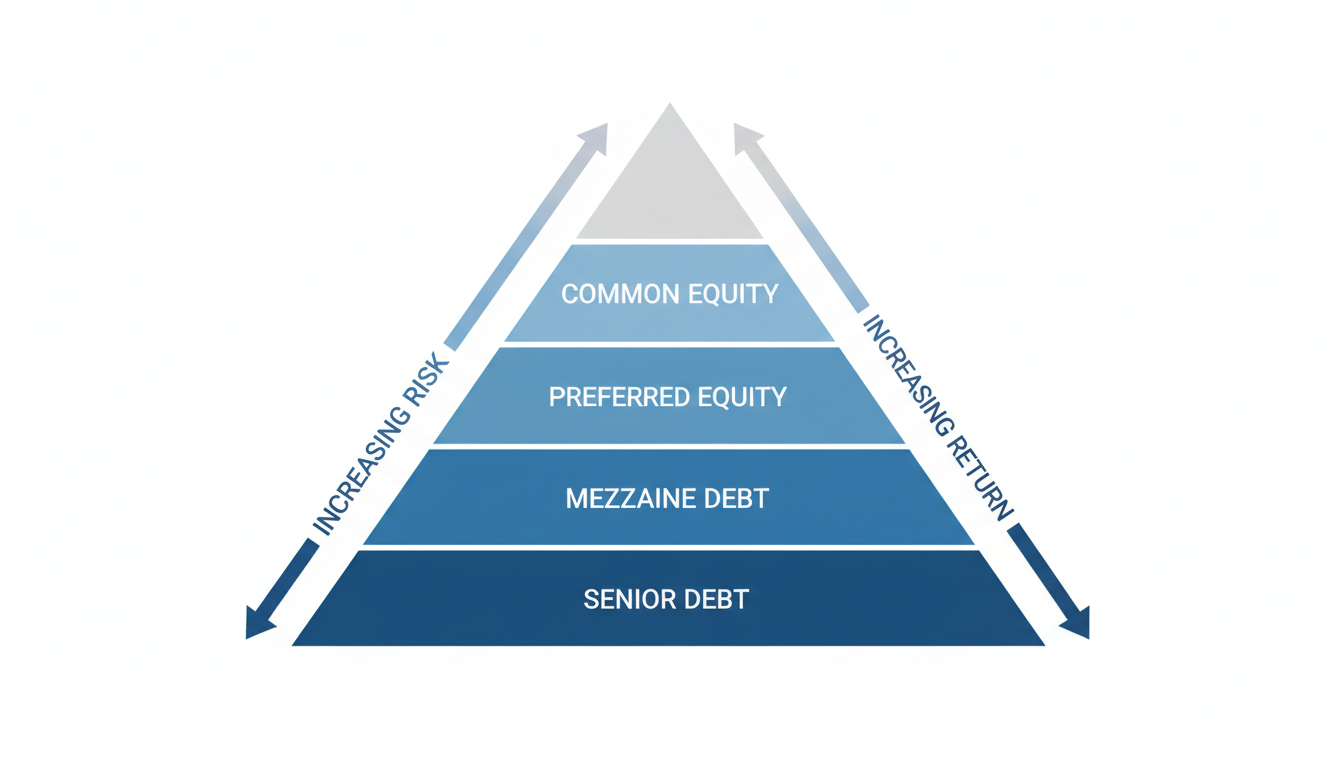
The capital stack represents the layered structure of all capital invested in a commercial real estate project. Each layer carries different rights, priorities, and risk-return profiles. Understanding these components is essential for making informed financing decisions.
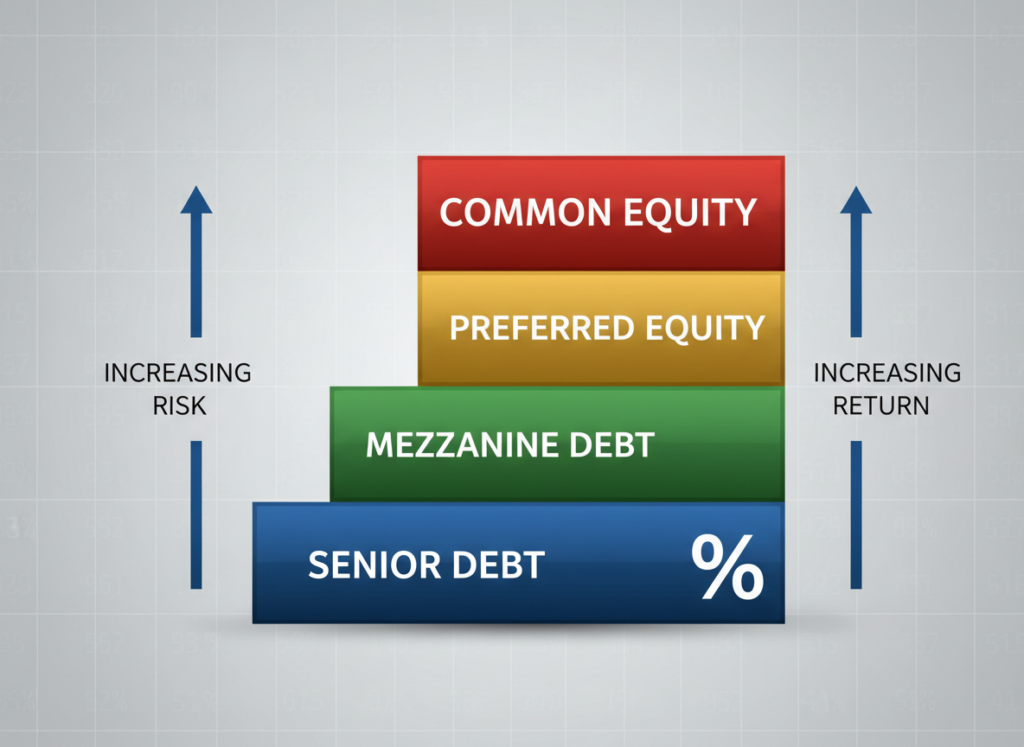
The commercial real estate capital stack: risk and return increase as you move up the structure
Senior Debt
The foundation of most capital stacks, senior debt typically represents 50-75% of the total project cost. It holds the first position in the payment hierarchy and has the lowest risk profile.
- First lien position on the property
- Lowest interest rates (typically 4-7%)
- Provided by banks, credit unions, CMBS lenders
- Foreclosure rights if borrower defaults
Mezzanine Debt
Sitting between senior debt and equity, mezzanine financing bridges the gap when senior debt isn’t sufficient but you want to limit equity dilution. It typically represents 10-20% of the capital stack.
- Subordinate to senior debt
- Higher interest rates (8-12%)
- Often includes equity participation
- Secured by ownership interests rather than the property
Equity Components
The equity portion of the capital stack includes preferred equity (middle risk) and common equity (highest risk). Together, these typically represent 15-30% of project funding.
- Preferred Equity: Priority distributions, fixed returns (12-15%)
- Common Equity: Residual cash flow after all other obligations
- Highest potential returns (15%+ IRR)
- Last to receive payment, first to absorb losses
Strategic Considerations for Commercial Real Estate Borrowers
Structuring your capital stack requires balancing multiple factors including cost of capital, control, flexibility, and risk tolerance. The right structure aligns with both your investment strategy and current market conditions.

Alignment of Interests Across the Capital Stack
One of the most overlooked aspects of capital stack structuring is how it aligns (or misaligns) the interests of various capital providers. Each layer has different objectives and risk tolerances:
Aligned Interests
- Clear waterfall distributions with defined triggers
- Transparent reporting and governance
- Shared upside potential through promote structures
- Complementary expertise between debt and equity partners
Potential Conflicts
- Lenders prioritize asset preservation over growth
- Equity investors may favor higher-risk strategies
- Competing rights during distress scenarios
- Differing time horizons and exit strategies
Leverage and Risk Considerations
The amount of debt you use relative to equity significantly impacts both potential returns and risk exposure. Finding the optimal balance requires careful analysis of your project’s specific characteristics.
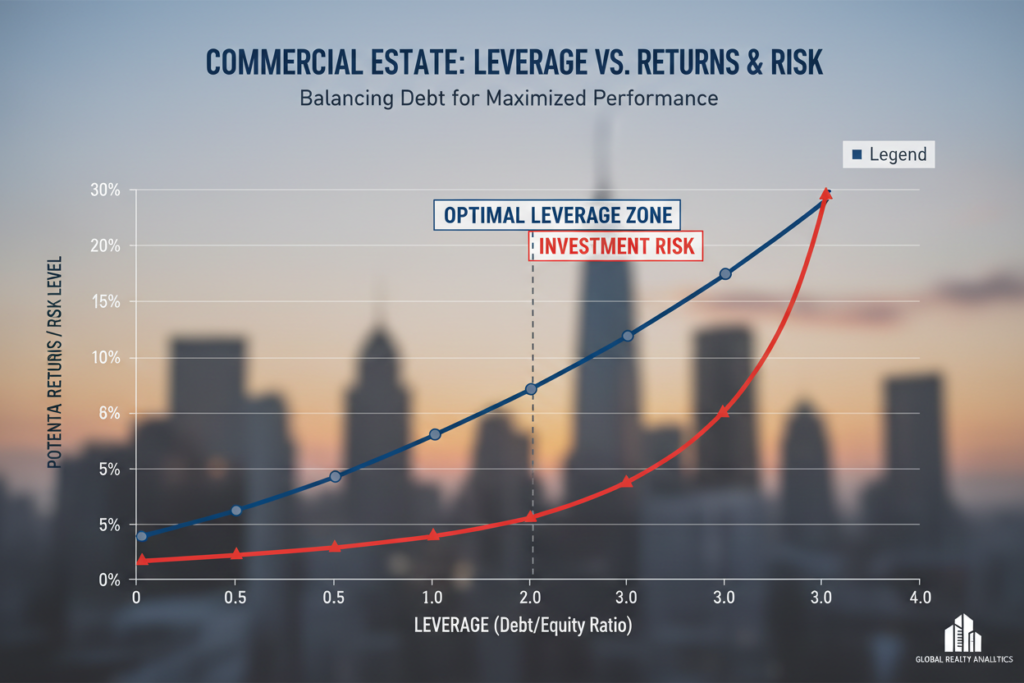
The leverage-return relationship: Higher leverage can amplify returns but also increases risk
| Leverage Level | Potential Benefits | Associated Risks | Typical Scenarios |
| Conservative (50-60% LTV) | Lower debt service, greater staying power | Lower potential returns, equity dilution | Core assets, stabilized properties |
| Moderate (65-75% LTV) | Balanced risk-return profile | Moderate financial stress in downturns | Core-plus, light value-add |
| Aggressive (75-85%+ LTV) | Higher potential equity returns | Higher default risk, less flexibility | Heavy value-add, development |
Aligning Capital Structure with Investment Strategy
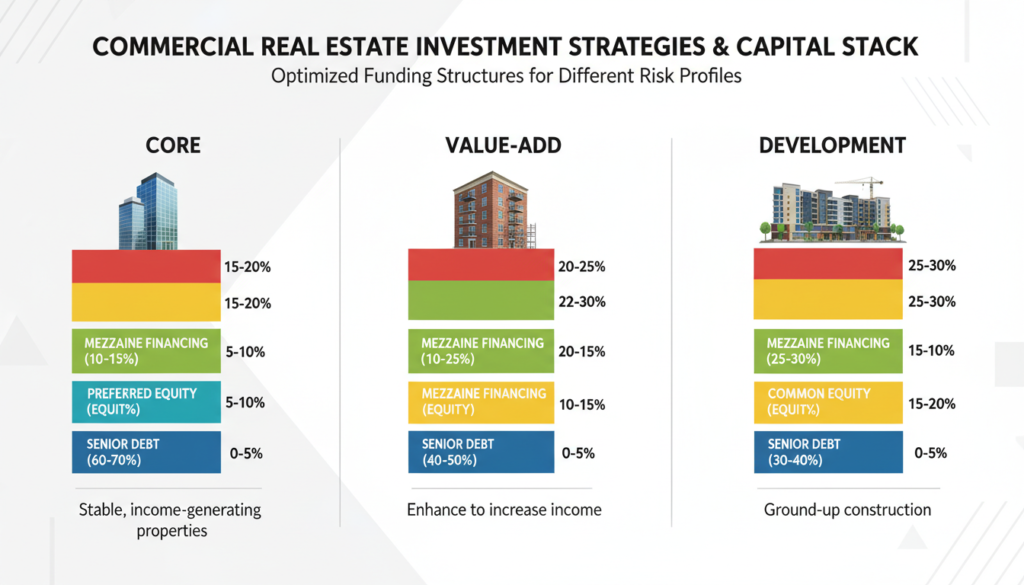
Different investment strategies require different capital structures. The optimal capital stack for a stabilized office building differs significantly from that of a ground-up multifamily development or a value-add retail center.
Core/Core-Plus Strategy
For stabilized assets with predictable cash flows, a more conservative capital structure typically works best.
- Higher proportion of senior debt (65-75% LTV)
- Focus on fixed-rate, longer-term financing
- Minimal or no mezzanine debt
- Larger sponsor equity contribution
- Emphasis on steady cash flow over appreciation
Value-Add Strategy
Properties requiring renovation, repositioning, or lease-up benefit from a more flexible capital structure.
- Moderate senior debt (60-70% LTV)
- Strategic use of mezzanine or preferred equity (10-15%)
- Reserves for capital improvements
- Potential for bridge financing during transition
- Balance between current income and future appreciation
Development/Opportunistic
Ground-up development or major repositioning requires a capital structure that accommodates higher risk and limited initial cash flow.
- Construction loan (55-65% of cost)
- Mezzanine or preferred equity (15-25%)
- Higher common equity requirement
- Phased funding tied to milestones
- Focus on total return rather than current yield
Need Expert Guidance on Your Capital Stack?
Our team specializes in structuring optimal financing solutions for commercial real estate projects. Let’s discuss your specific needs and explore options that align with your investment strategy.
Capital Stack Scenario Analysis: A Practical Example
To illustrate how different capital structures impact returns and risk, let’s examine a hypothetical 200-unit value-add multifamily acquisition in a growing secondary market. We’ll compare two potential capital stack approaches.
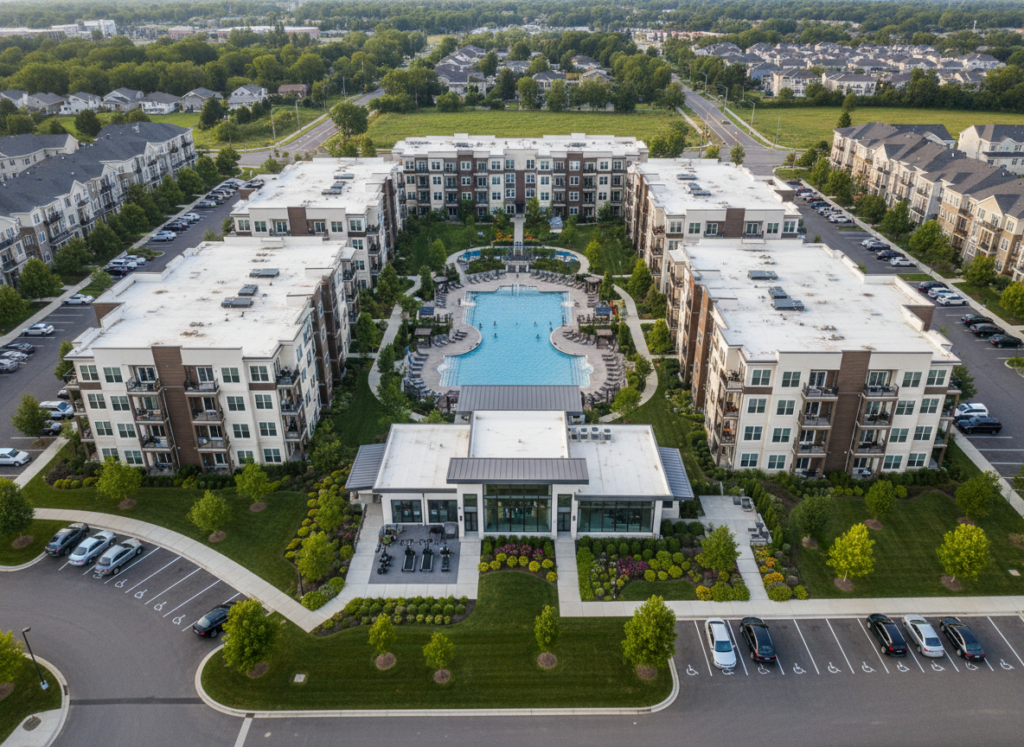
Hypothetical 200-unit value-add multifamily property
Scenario A: Conservative Approach
Purchase Price: $40 million ($200,000/unit)
Renovation Budget: $2 million ($10,000/unit)
Capital Stack Structure:
- Senior Debt: $28M (65% LTV, 4.5%, 10-year term)
- Preferred Equity: $4M (9.5% preferred return)
- Common Equity: $10M (sponsor + limited partners)
Projected Returns:
- Cash-on-Cash: 6-7% during renovation, 8-9% stabilized
- IRR: 14-16% over 5-year hold
- Equity Multiple: 1.9x – 2.1x
Risk Profile: Lower leverage provides greater cushion against market fluctuations and execution challenges. Better positioned to weather economic downturns.
Scenario B: Aggressive Approach
Purchase Price: $40 million ($200,000/unit)
Renovation Budget: $2 million ($10,000/unit)
Capital Stack Structure:
- Senior Debt: $30M (70% LTV, 4.75%, 10-year term)
- Mezzanine Debt: $6M (10% interest)
- Common Equity: $6M (sponsor + limited partners)
Projected Returns:
- Cash-on-Cash: 4-5% during renovation, 10-12% stabilized
- IRR: 18-20% over 5-year hold
- Equity Multiple: 2.3x – 2.5x
Risk Profile: Higher leverage amplifies returns but increases vulnerability to execution delays, market shifts, or leasing challenges. Less financial flexibility if problems arise.
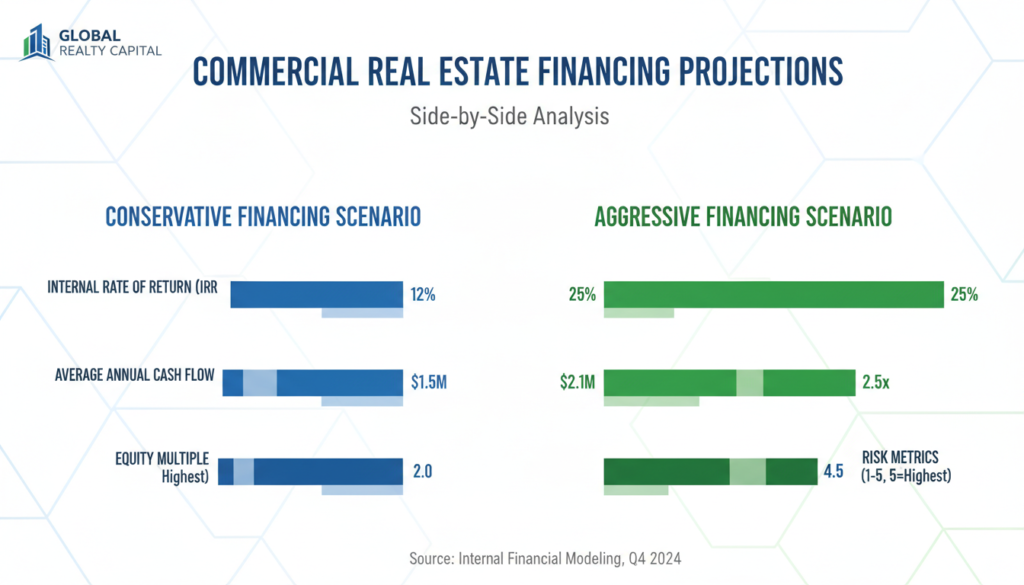
Comparative analysis of returns and risk profiles between financing scenarios
Key Takeaways from the Scenario Analysis
This case study illustrates several important principles about capital stack structuring:
- Risk-Return Tradeoff: The aggressive approach offers potentially higher returns but with significantly increased risk and reduced financial flexibility.
- Cash Flow Timing: Higher leverage typically reduces early cash flow but can enhance long-term returns if execution goes as planned.
- Sponsor Profile Alignment: The conservative approach suits investors prioritizing preservation of capital and steady returns, while the aggressive approach aligns with those seeking maximum appreciation.
- Market Cycle Considerations: Capital structure should reflect your view on where we are in the market cycle—more conservative structures provide better protection in late-cycle investments.
The Value of Expert Capital Advisory in Commercial Real Estate Financing
Structuring the optimal capital stack is not a one-size-fits-all process. It requires deep market knowledge, extensive lender relationships, and sophisticated financial modeling capabilities. An experienced capital advisor brings several critical advantages:

Market Intelligence
Capital markets evolve constantly, with new lending sources emerging while others retreat. A dedicated advisor maintains real-time knowledge of:
- Current pricing and terms across lender types
- Emerging alternative financing sources
- Shifting underwriting standards
- Competitive landscape for similar projects
- Regulatory changes affecting capital markets
Strategic Modeling
Beyond basic debt service calculations, sophisticated capital advisors provide:
- Scenario analysis under multiple market conditions
- Sensitivity testing for key variables
- Waterfall distribution modeling
- Tax efficiency considerations
- Refinancing and recapitalization strategies
Execution Excellence
Securing optimal financing requires more than identifying options—it demands flawless execution:
- Competitive lender selection process
- Comprehensive application packages
- Proactive issue identification and resolution
- Term sheet negotiation expertise
- Closing coordination across multiple parties
Optimizing Your Commercial Real Estate Financing Strategy
The capital stack is more than a financing mechanism—it’s a strategic tool that can significantly impact your project’s success. In today’s complex market environment, the difference between an optimized capital structure and a suboptimal one can mean millions in additional returns or unnecessary risk exposure.
At Thorne CRE, we specialize in helping investors, developers, and property owners navigate these complexities. Our approach combines deep market knowledge, extensive lender relationships, and sophisticated financial modeling to create capital solutions tailored to your specific project and investment objectives.

Ready to Optimize Your Project’s Capital Stack?
Schedule a confidential consultation with our commercial real estate financing experts. We’ll analyze your specific project needs and develop a customized capital strategy to maximize returns while managing risk.