
In the competitive world of commercial real estate, securing the right financing isn’t just about getting a loan—it’s about creating a strategic advantage. The difference between optimal and suboptimal financing can significantly impact your project’s profitability, timeline, and long-term success. As market conditions evolve and lender requirements shift, navigating the commercial real estate financing landscape requires both expertise and strategic foresight.
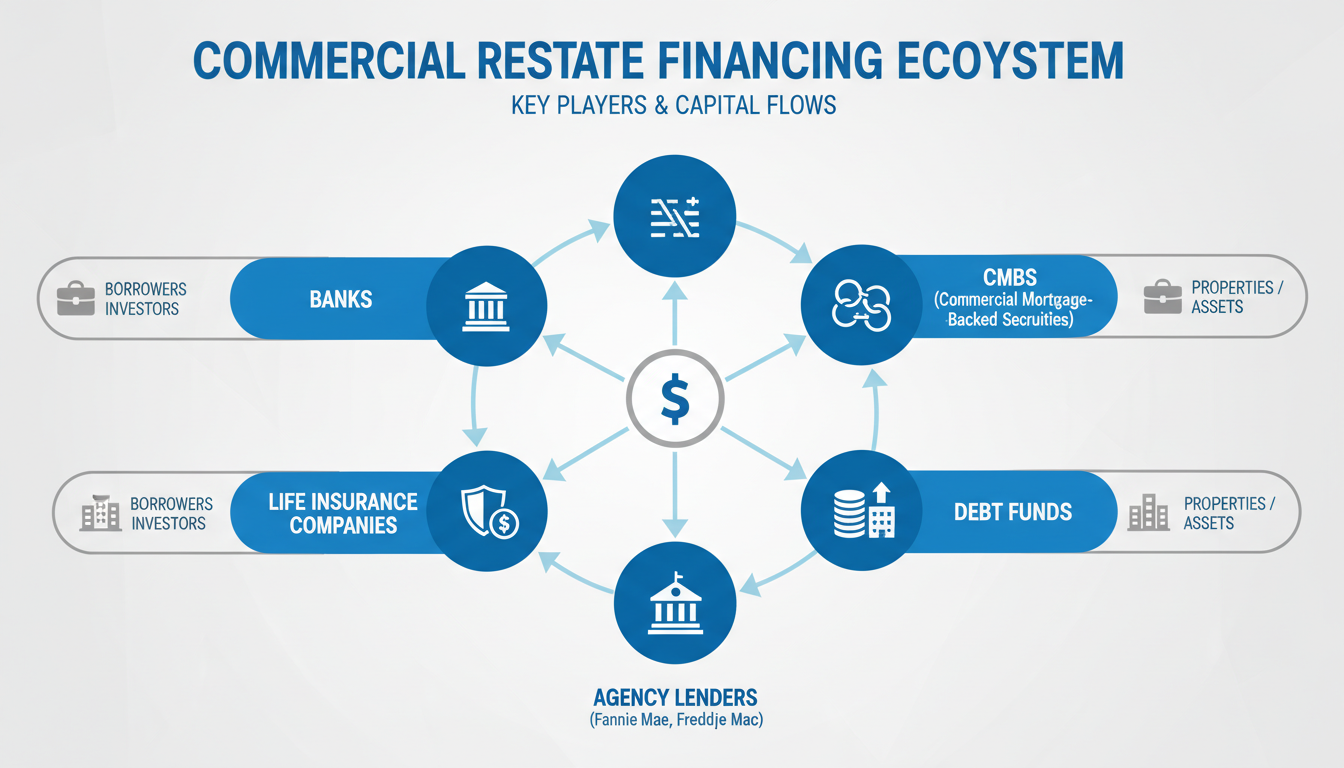
Today’s commercial real estate financing ecosystem features diverse lender types with varying appetites for different asset classes and risk profiles.
The Modern Commercial Real Estate Financing Ecosystem
Today’s commercial real estate financing market presents both challenges and opportunities. With the Federal Reserve’s monetary policy shifts, lenders have adjusted their risk appetites and pricing models. Understanding this ecosystem is the first step toward securing optimal financing.
Key Players in Commercial Real Estate Lending
Traditional Lenders
- Commercial banks and credit unions
- Life insurance companies
- CMBS (Commercial Mortgage-Backed Securities) lenders
Alternative Financing Sources
- Private debt funds
- Agency lenders (Fannie Mae/Freddie Mac)
- SBA loan programs
- Hard money and bridge lenders
Each lender type has distinct preferences regarding asset classes, loan sizes, leverage points, and borrower profiles. The key to successful financing is matching your specific project needs with the right capital source—a process that requires market knowledge and established relationships.
The 6 Core Commercial Real Estate Loan Types
Commercial real estate financing comes in various forms, each designed for specific property types, business stages, and investment strategies. Understanding these options is crucial for structuring the optimal capital stack for your project.
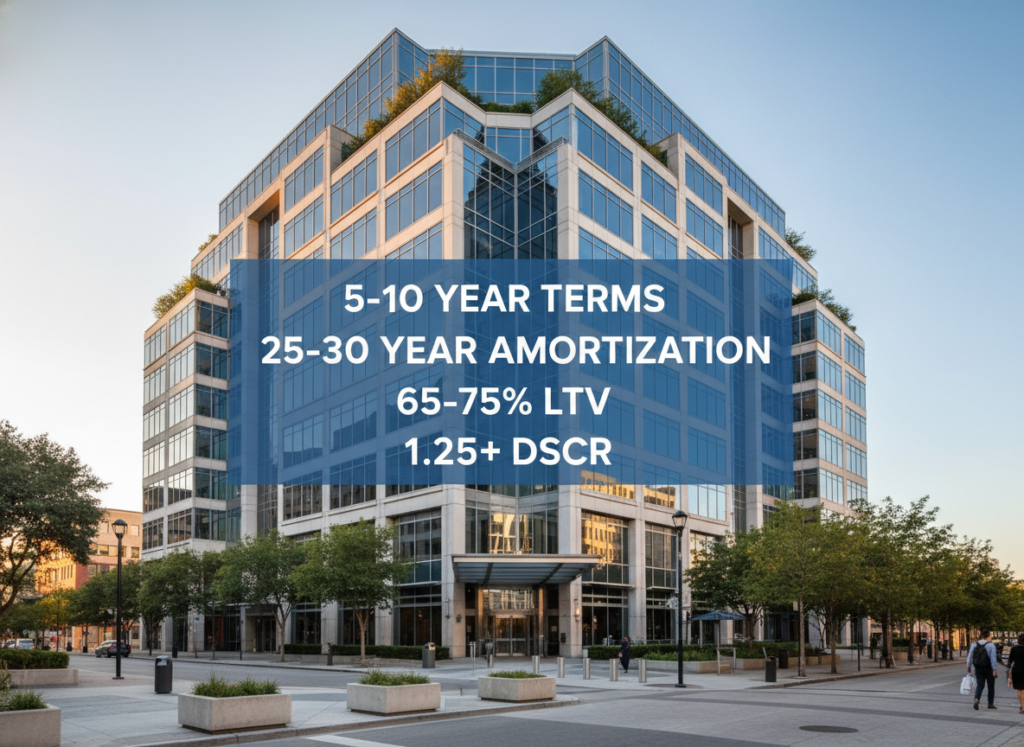
Permanent loans offer stable, long-term financing for stabilized commercial properties with predictable cash flows.
1. Permanent Loans: The Foundation of Stabilized Asset Financing
Permanent loans are the commercial real estate industry’s workhorse, providing long-term financing for stabilized properties with established cash flows. These loans typically feature:
| Feature | Typical Range | Key Considerations |
| Term Length | 5-10 years | Longer terms available from life companies |
| Amortization | 25-30 years | Creates balloon payment at maturity |
| Loan-to-Value (LTV) | 65-75% | Higher for multifamily, lower for specialized assets |
| Debt Service Coverage Ratio | 1.25x-1.35x | Lower DSCR = higher leverage but stricter requirements |
Permanent loans are ideal for investors seeking predictable financing costs and lower interest rates. However, they typically include prepayment penalties or yield maintenance provisions that can make early exits costly.
Need Help Determining the Right Permanent Loan Structure?
Our team can analyze your property’s financials and help you secure the optimal permanent financing solution with the most competitive terms available in today’s market.
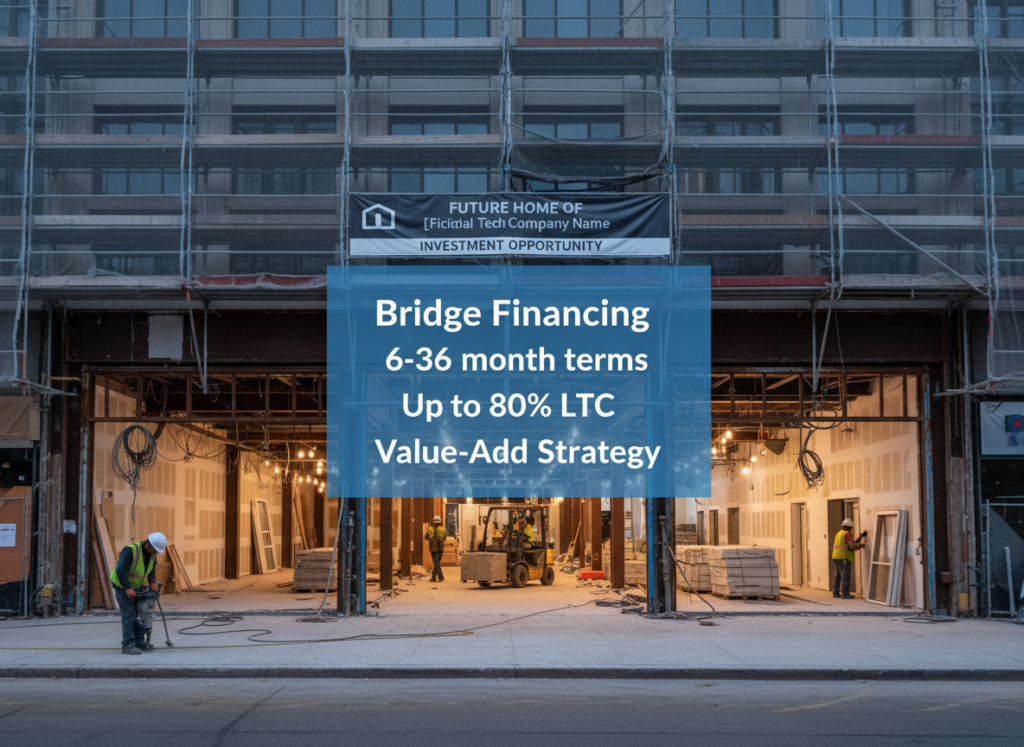
Bridge loans provide crucial financing during property transition periods, supporting value-add strategies and repositioning efforts.
2. Bridge Loans: Financing for Transitional Properties
Bridge loans serve as temporary financing solutions for properties in transition—whether undergoing renovation, lease-up, or repositioning. These short-term loans bridge the gap until a property can qualify for permanent financing.
Bridge Loan Advantages
- Higher leverage (up to 80% LTC/LTV)
- Flexible prepayment options
- Interest reserves to cover carrying costs
- Ability to finance properties with vacancy or repositioning plans
Bridge Loan Considerations
- Higher interest rates (typically 200-400 bps above permanent financing)
- Shorter terms (6-36 months)
- Exit strategy required
- Higher origination and closing costs
Bridge loans are particularly valuable in competitive markets where the ability to close quickly can secure deals that might otherwise be lost. They’re also essential for value-add strategies where immediate permanent financing isn’t feasible due to property condition or occupancy.
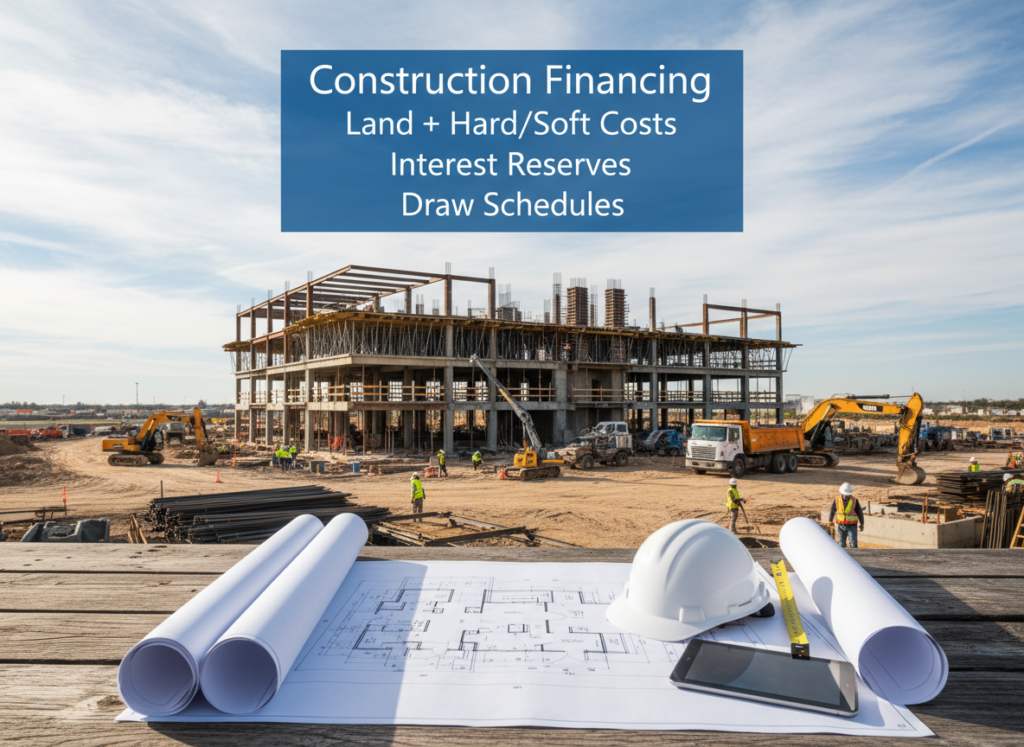
Construction loans finance both ground-up development and major renovation projects through structured draw schedules.
3. Construction Loans: Financing Development from Ground Up
Construction loans finance the development of new commercial properties or major renovations of existing structures. These specialized loans fund both the acquisition of land and the construction process through a series of draws as the project progresses.
Key Construction Loan Components:
- Loan-to-Cost (LTC) Ratio: Typically 65-80% of total project costs
- Interest Reserves: Funds set aside to cover interest payments during construction
- Draw Schedule: Predetermined milestones for fund disbursement
- Conversion Options: Some loans offer conversion to permanent financing upon completion
- Contingency Reserves: Typically 5-10% of hard costs to cover unexpected expenses
The success of construction financing often hinges on the strength of your general contractor, the comprehensiveness of your construction budget, and the clarity of your exit strategy. Lenders will scrutinize all three elements closely during underwriting.
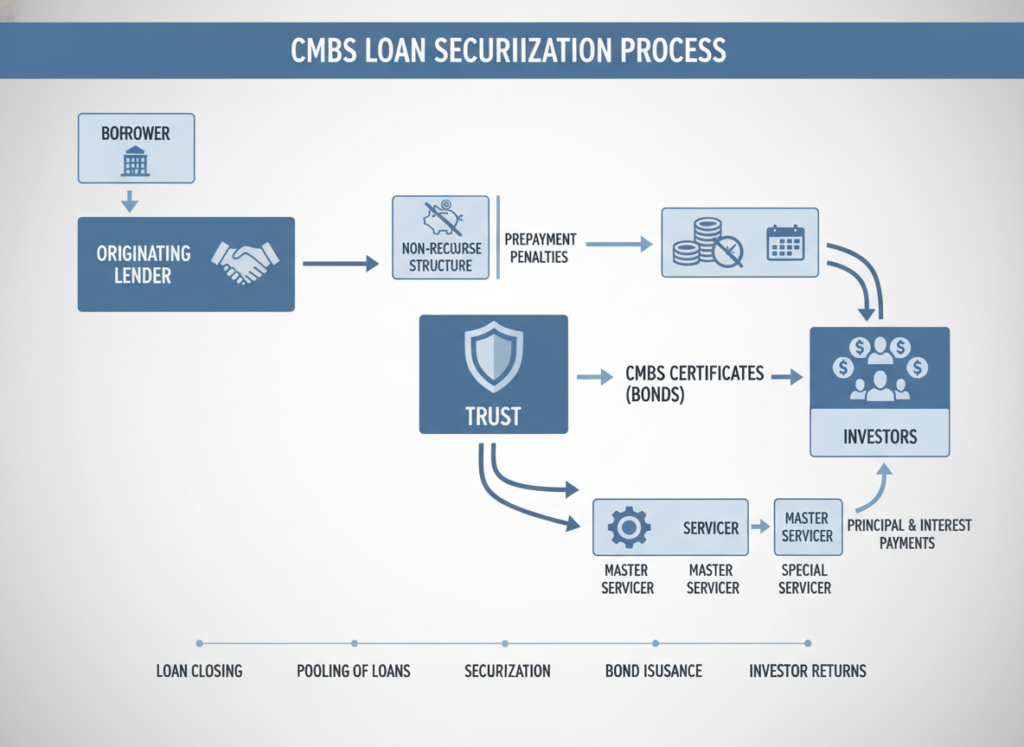
CMBS loans offer non-recourse financing with competitive terms but include complex prepayment structures.
4. CMBS Loans: Securitized Financing for Stabilized Assets
Commercial Mortgage-Backed Securities (CMBS) loans provide non-recourse financing for stabilized commercial properties. These loans are originated by conduit lenders and then pooled, securitized, and sold to investors in the secondary market.
CMBS loans offer some of the most competitive terms for stabilized assets, particularly for borrowers seeking higher leverage without personal guarantees. However, their rigid structures require careful consideration of your long-term strategy.
CMBS Loan Characteristics:
- Non-recourse financing (limited “bad boy” carveouts)
- Higher leverage options (up to 75% LTV)
- Fixed-rate terms of 5, 7, or 10 years
- Complex prepayment penalties (defeasance or yield maintenance)
- Less flexibility for property modifications during the loan term
CMBS loans are particularly well-suited for stabilized retail, office, industrial, and hospitality properties. However, they’re less ideal for properties requiring operational flexibility due to their rigid servicing structures and modification limitations.
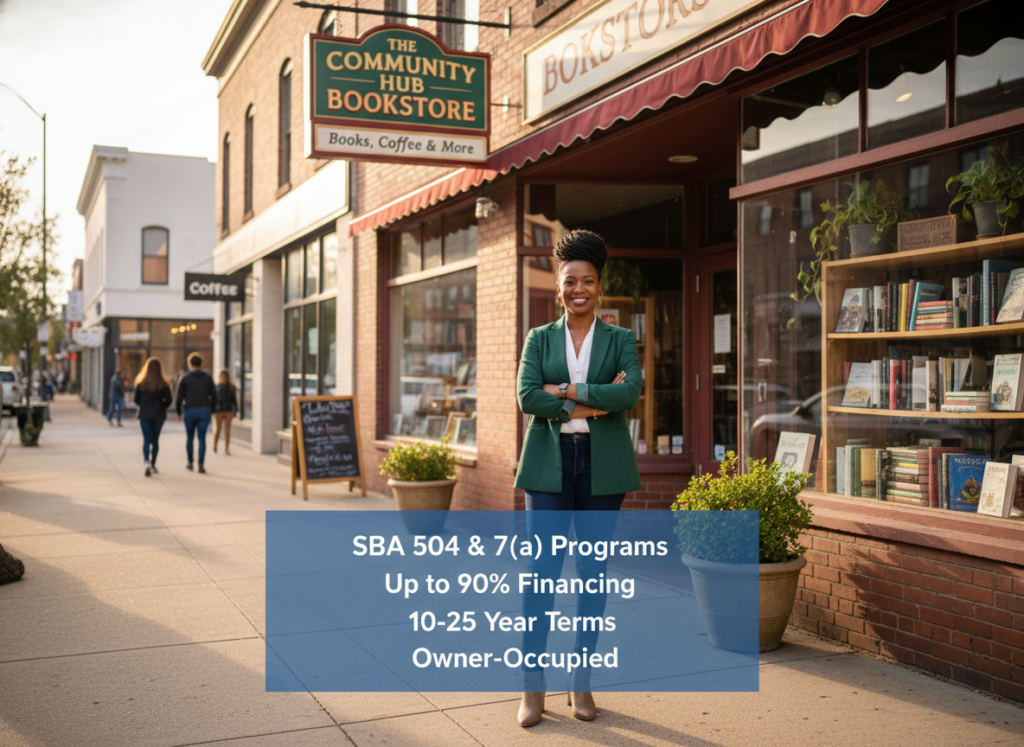
SBA loan programs offer favorable terms for small business owners purchasing their own commercial real estate.
5. SBA 7(a) & 504 Loans: Owner-Occupied Commercial Real Estate Solutions
The Small Business Administration offers two primary loan programs for small business owners seeking to purchase, construct, or refinance owner-occupied commercial real estate: the 7(a) and 504 loan programs.
SBA 7(a) Loans
- Up to $5 million loan amount
- Up to 90% financing
- 25-year real estate terms
- Can finance working capital alongside real estate
- Fully amortizing with no balloon payments
SBA 504 Loans
- Up to $5.5 million SBA portion
- As little as 10% down payment
- 10, 20, or 25-year fixed-rate terms
- Below-market fixed interest rates
- Specifically for fixed assets (real estate, equipment)
SBA loans are ideal for business owners who occupy at least 51% of the property they’re financing. They offer some of the most favorable terms available, including lower down payments, longer amortization periods, and competitive interest rates.
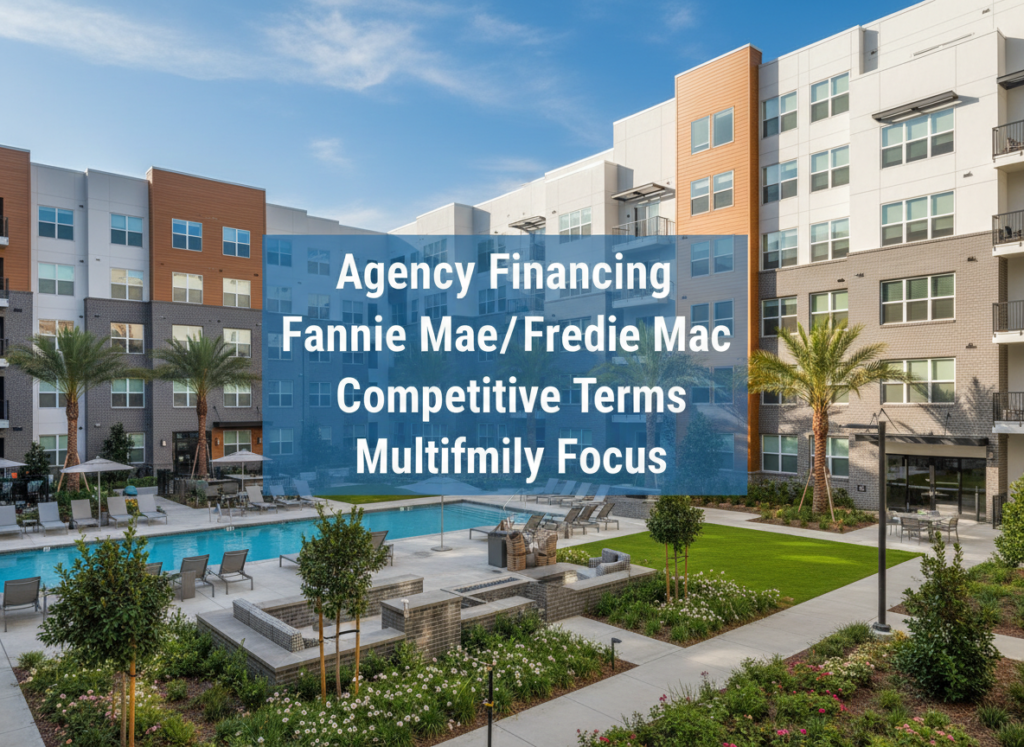
Agency financing through Fannie Mae and Freddie Mac provides reliable capital for multifamily properties.
6. Agency Loans: Specialized Multifamily Financing
For multifamily investors, agency financing through Fannie Mae and Freddie Mac offers some of the most competitive terms in the market. These government-sponsored enterprises provide liquidity to the multifamily sector through various loan programs.
Agency Loan Features:
- Competitive interest rates (often the lowest available for multifamily)
- High leverage options (up to 80% LTV)
- Non-recourse financing
- Fixed and floating rate options
- Terms from 5 to 30 years
- Specialized programs for affordable housing, green initiatives, and small loans
Agency loans are exclusively for multifamily properties with five or more units. They offer exceptional stability and reliability, particularly during market disruptions when other capital sources may retreat.
Unsure Which Loan Type Best Fits Your Project?
Our financing advisors can analyze your specific property and investment strategy to recommend the optimal loan structure and introduce you to the most competitive lenders in the market.
Critical Metrics in Commercial Real Estate Financing
Understanding the key metrics lenders use to evaluate commercial real estate loans is essential for structuring your financing request effectively and maximizing your leverage while maintaining favorable terms.
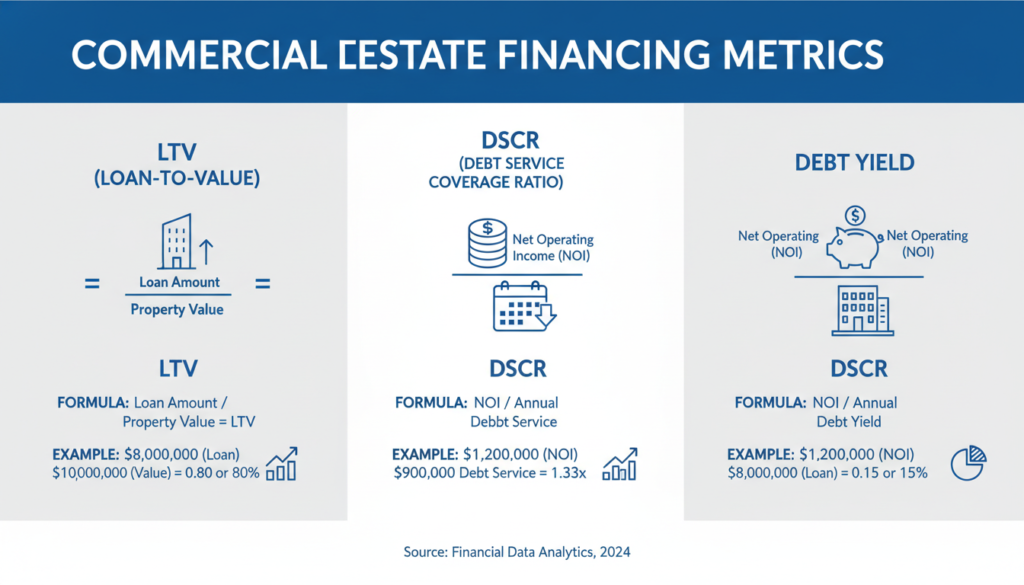
Lenders evaluate commercial real estate loans using multiple metrics to assess risk and determine appropriate leverage levels.
Loan-to-Value Ratio (LTV)
The loan-to-value ratio represents the loan amount as a percentage of the property’s appraised value. It’s a primary measure of leverage and risk in commercial real estate financing.
LTV Formula: Loan Amount ÷ Property Value = LTV%
Example: $7.5 million loan on a $10 million property = 75% LTV
Maximum LTV ratios vary by property type, with multifamily typically allowing the highest leverage (up to 80%), followed by industrial and retail (70-75%), and office and hospitality (65-70%).
Debt Service Coverage Ratio (DSCR)
The debt service coverage ratio measures a property’s ability to cover its debt obligations with its net operating income. It’s a critical metric for assessing cash flow risk.
DSCR Formula: Net Operating Income ÷ Annual Debt Service = DSCR
Example: $500,000 NOI ÷ $400,000 annual debt service = 1.25x DSCR
Most commercial lenders require a minimum DSCR of 1.20x to 1.25x, with higher requirements for specialized or higher-risk property types. A higher DSCR indicates stronger cash flow relative to debt obligations, reducing lender risk.
Debt Yield
Debt yield has become increasingly important in commercial real estate underwriting, particularly since the 2008 financial crisis. It measures the return on the loan amount irrespective of interest rates or amortization.
Debt Yield Formula: Net Operating Income ÷ Loan Amount = Debt Yield%
Example: $500,000 NOI ÷ $7.5 million loan = 6.67% debt yield
Most commercial lenders today require minimum debt yields of 7-9%, depending on property type and market conditions. Unlike DSCR, debt yield isn’t affected by interest rate fluctuations, making it a more stable risk metric over time.
The Thorne CRE Financing Process
Securing optimal commercial real estate financing requires a structured, strategic approach. At Thorne CRE, we’ve developed a comprehensive process that maximizes leverage while securing the most favorable terms available in the market.
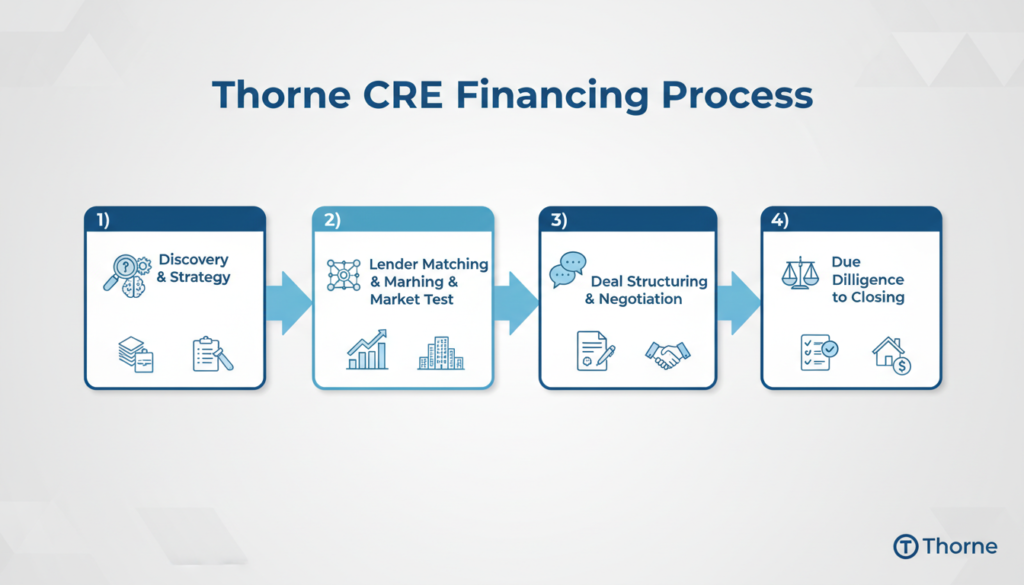
Our structured approach ensures optimal financing outcomes through strategic lender matching and expert negotiation.
1. Discovery & Strategy Development
Our process begins with a comprehensive analysis of your property, investment strategy, and financing objectives. This initial phase establishes the foundation for all subsequent steps.
Key Components:
- Property and market analysis
- Financial statement review and pro forma validation
- Borrower qualification assessment
- Capital structure optimization
- Preliminary term sheet modeling
This thorough discovery process allows us to identify potential challenges early and develop strategies to address them before approaching lenders.
2. Lender Matching & Market Test
With a clear strategy in place, we leverage our extensive lender network to identify the optimal capital sources for your specific project. Our approach goes beyond simply “shopping rates” to find true strategic alignment.
Our Lender Network Includes:
- National, regional, and local banks
- Life insurance companies
- CMBS conduit lenders
- Agency lenders (Fannie/Freddie)
- Debt funds and private lenders
- SBA lenders
- Credit unions
- Hard money lenders
- Mezzanine and preferred equity sources
By simultaneously presenting your deal to multiple qualified lenders, we create competitive tension that drives more favorable terms while identifying the most responsive and reliable capital partners.
3. Deal Structuring & Negotiation
Once initial proposals are received, we leverage our market knowledge and negotiation expertise to secure the most favorable terms possible. This phase often reveals significant opportunities for improvement beyond the initial term sheets.
Negotiation Focus Areas:
- Interest rate and spread reduction
- Fee minimization and restructuring
- Covenant and guarantee limitations
- Prepayment flexibility enhancement
- Reserve requirement optimization
- Future funding provisions
Our detailed knowledge of lender policies and approval processes allows us to negotiate effectively, often securing concessions that borrowers approaching lenders directly would miss.
4. Due Diligence to Closing
The final phase of our process focuses on efficiently navigating the due diligence and closing process to ensure on-time execution with minimal surprises.
Our Closing Management Includes:
- Due diligence requirement coordination
- Third-party report management
- Document review and negotiation
- Closing timeline management
- Post-closing follow-up
Throughout this phase, your dedicated Thorne CRE advisor serves as your advocate, managing communication between all parties and proactively addressing potential obstacles before they impact your timeline.
Ready to Experience a Smarter Financing Process?
Our team of commercial real estate financing experts is ready to help you secure the optimal capital structure for your next project. Schedule a consultation today to discuss your specific needs.
Commercial Real Estate Financing Success Stories
Our strategic approach to commercial real estate financing has helped clients across various property types and investment strategies secure optimal capital structures. Here are a few recent examples:
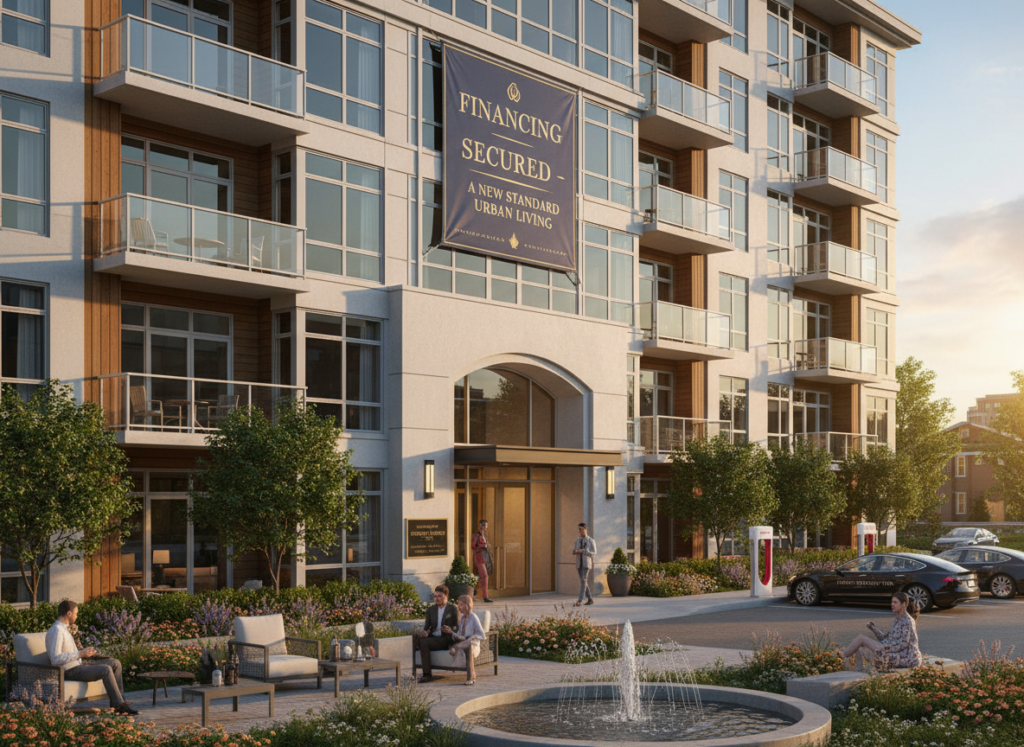
Value-add multifamily acquisition with bridge-to-permanent financing strategy.
Value-Add Multifamily Acquisition
The Challenge:
Client needed to acquire a 120-unit apartment complex with 78% occupancy and execute a comprehensive renovation program before stabilization.
The Solution:
Structured a bridge loan with a future funding component for capital improvements, followed by a Freddie Mac permanent takeout upon stabilization.
The Result:
- 80% loan-to-cost bridge financing
- Interest-only period during renovation
- Seamless transition to permanent financing
- No additional equity required at stabilization
Mixed-Use Development
The Challenge:
Developer needed construction financing for a ground-up mixed-use project with retail, office, and residential components in an emerging submarket.
The Solution:
Secured a construction loan from a regional bank with relationship-based pricing, followed by a CMBS permanent takeout with favorable prepayment terms.
The Result:
- 75% loan-to-cost construction financing
- Competitive pricing with minimal recourse
- Flexible prepayment structure
- Extended interest-only period
Owner-Occupied Medical Office
The Challenge:
Medical practice needed to acquire their office building with minimal cash outlay while maintaining financial flexibility for practice growth.
The Solution:
Structured an SBA 504 loan that minimized the down payment while securing long-term, fixed-rate financing with favorable terms.
The Result:
- 90% financing (10% down payment)
- 25-year fixed-rate term
- Below-market interest rate
- No balloon payment
These case studies demonstrate our ability to navigate complex financing challenges across different property types and investment strategies. By understanding each client’s unique objectives and leveraging our extensive lender relationships, we consistently deliver financing solutions that enhance returns and mitigate risks.
Strategic Commercial Real Estate Financing: Your Competitive Edge
In today’s dynamic commercial real estate market, the right financing strategy can be the difference between a good deal and a great one. Beyond simply securing capital, optimal financing structures enhance returns, mitigate risks, and provide the flexibility needed to execute your business plan successfully.
At Thorne CRE, we combine deep market knowledge, extensive lender relationships, and a rigorous analytical approach to deliver financing solutions tailored to your specific needs. Our process goes beyond traditional loan brokerage to provide true capital advisory services that align with your long-term investment objectives.

Our advisory approach focuses on developing comprehensive financing strategies aligned with your investment objectives.
Whether you’re acquiring, developing, or refinancing commercial real estate, our team is ready to help you navigate the financing landscape and secure the optimal capital structure for your next project.
Ready to Secure Optimal Financing for Your Next Project?
Schedule a complimentary financing strategy session with our team of commercial real estate capital advisors. We’ll analyze your specific needs and outline a customized approach to help you achieve your financing objectives.
Connect With Our Commercial Real Estate Financing Team
Take the first step toward securing optimal financing for your next commercial real estate project. Complete the form below, and one of our experienced capital advisors will contact you within one business day to discuss your specific needs.