
Did you know the Small Business Administration (SBA) guarantees over $30 billion in loans every year? This helps small businesses get affordable financing for commercial real estate projects.
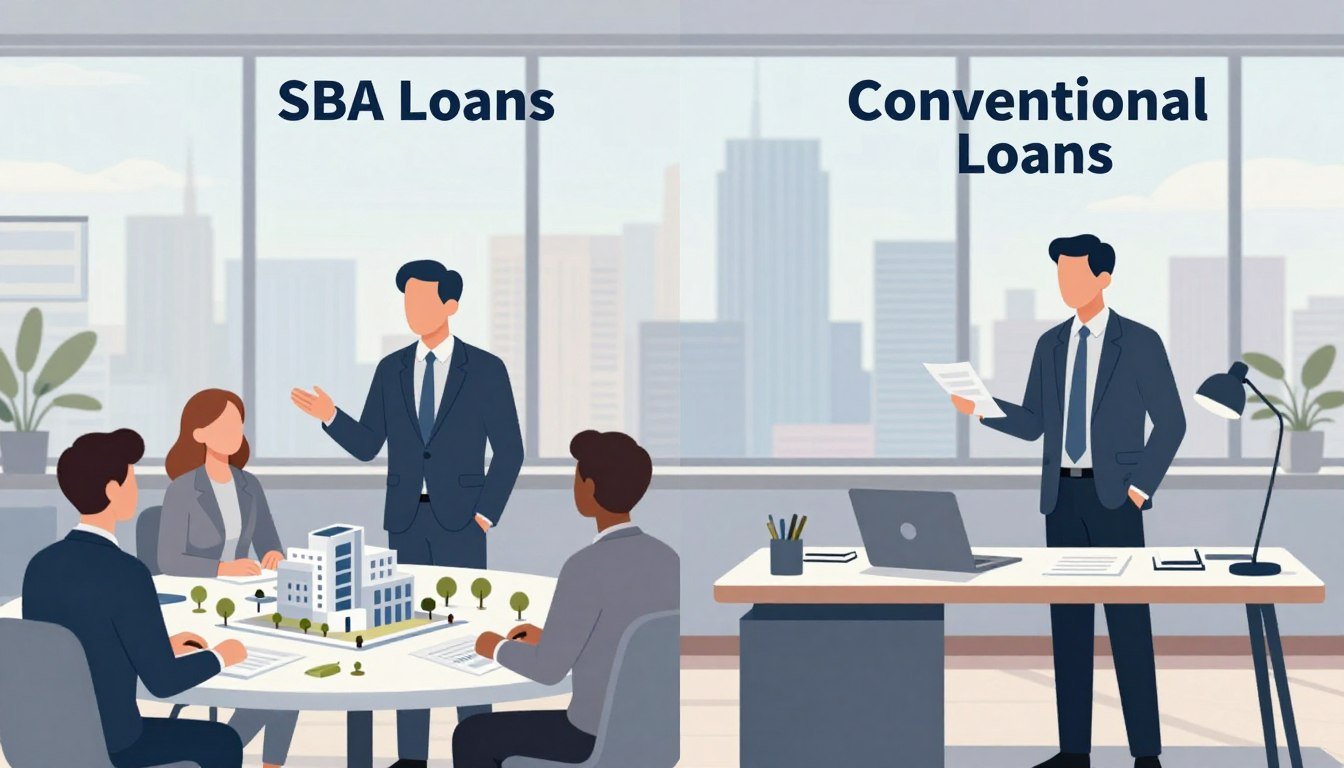
Small business owners need to know the difference between SBA loans and conventional loans when buying or refinancing commercial properties.
Both options have their good and bad sides. SBA loans have easier credit score rules and attractive interest rates. But, conventional loans offer more freedom in property type and use.
Key Takeaways
- Understanding the differences between SBA loans and conventional loans is crucial for small business owners.
- SBA loans offer more lenient credit score requirements and attractive interest rates.
- Conventional loans provide more flexibility in terms of property type and usage.
- Owner-occupied CRE financing options can help businesses achieve their goals.
- Choosing the right financing option depends on the business’s specific needs.
Understanding Owner-User Commercial Real Estate Financing
For businesses that use commercial properties, knowing about owner-user financing is key. This type of financing is for properties used for business, like office buildings or warehouses.
What Qualifies as Owner-Occupied CRE
A property must be used for business to qualify as owner-occupied CRE. This includes many types of properties, such as:
- Office buildings
- Retail spaces
- Warehouses
- Manufacturing facilities
The business must use a big part of the property. The exact percentage needed can change based on the lender and loan program.
The Importance of Choosing the Right Financing Option
Choosing the right financing is crucial for success. There are two main options for owner-occupied CRE: SBA loans and conventional loans. Each has its own benefits and drawbacks.
| Financing Option | Key Features |
|---|---|
| SBA Loans | Government-backed, favorable terms, longer repayment periods |
| Conventional Loans | Non-government-backed, potentially shorter repayment terms, stricter requirements |
It’s important to understand these differences. This helps make a choice that fits the business’s financial needs and goals.
The Fundamentals of SBA Loans for Commercial Real Estate
Learning about SBA loans is key for businesses wanting to buy or fix up commercial properties. The Small Business Administration (SBA) helps by backing a part of the loan for commercial real estate. This makes it simpler for businesses to get the money they need.
Overview of SBA’s Role in Commercial Financing
The SBA is very important for getting loans for commercial real estate for small businesses. It works with lenders to offer a guarantee on part of the loan. This lowers the risk for lenders and lets them give better deals to borrowers. It’s a big help for small businesses and helps the economy grow.
How SBA Loan Guarantees Work
SBA loan guarantees help by making lending to small businesses less risky. When a lender gives an SBA loan, the SBA covers a big part of it, usually 50% to 85%. This lets lenders offer better deals, like lower down payments and longer to pay back. It makes it easier for small businesses to get the financing they need.
General Eligibility Requirements
To get an SBA loan, businesses must meet some basic rules. They need to be small, have good credit, and be able to pay back the loan. The business must also use the loan for a real business need, like buying or fixing up commercial property.
Knowing these basics helps businesses understand how to get SBA loans for their commercial real estate needs. Whether it’s through the 504 or 7(a) programs, SBA loans have good terms that help businesses reach their goals.
SBA 504 Loan Program Explained
Commercial real estate financing just got easier with the SBA 504 loan program. It offers favorable terms for business owners.
The SBA 504 loan program helps businesses buy fixed assets like commercial real estate and equipment. It provides long-term, fixed-rate financing. This is great for small businesses wanting to grow or move.
Structure and Purpose of 504 Loans
The 504 loan program works with a Certified Development Company (CDC), a lender, and the borrower. The CDC gives up to 40% of the loan. The lender covers up to 50%. The borrower must put down at least 10%.
This setup lets businesses save money while still getting the funds they need for growth.
CDC Involvement and Loan Components
A CDC is a non-profit certified by the SBA to help with 504 loans. They play a key role by providing a big part of the loan and helping with the process.
The 504 loan has two parts: a loan from a conventional lender and a CDC loan guaranteed by the SBA.
Eligible Property Types and Uses
The SBA 504 loan program covers many uses. This includes buying or renovating commercial real estate and getting equipment.
| Eligible Property Types | Examples |
|---|---|
| Office Buildings | Professional offices, medical offices |
| Retail Centers | Shopping centers, restaurants |
| Industrial Facilities | Manufacturing plants, warehouses |
Understanding the SBA 504 loan program helps businesses make smart financing choices. It guides them in choosing the best option for their growth.
SBA 7(a) Loan Program for Real Estate Acquisition
The SBA 7(a) loan program helps businesses grow by buying real estate. It gives the funds needed for commercial property and other business needs.
Key Features of 7(a) Loans for CRE
The SBA 7(a) loan program is flexible and has good terms. Key features include loans up to $5 million, low interest rates, and up to 25 years to pay back for real estate. These loans can be used for buying property, refinancing, or expanding your business.
The SBA 7(a) loan program is appealing because of its flexibility. But, it’s important to know its limitations and how it compares to other options, like the SBA 504 loan program.
Flexibility and Limitations
The SBA 7(a) loan program is more flexible than the 504 program. But, it might have stricter rules for loan amounts. It also might not offer the same government guarantee as the 504 program for some amounts. Businesses need to consider these when choosing between the two.
When 7(a) Makes More Sense Than 504
The SBA 7(a) loan program is best for businesses needing financing for various purposes. It’s also good for those who don’t qualify for the 504 program or want a shorter repayment term. Knowing your business’s specific needs is key in deciding between the 7(a) and 504 loan programs.
Conventional Commercial Real Estate Loans Explained
Conventional commercial real estate loans are flexible and can be customized for your business. They are not backed by the government, giving lenders more freedom. This means they can structure loans differently and assess risks in their own way.

Types of Conventional CRE Financing
There are many types of conventional commercial real estate loans. Each one meets different business needs. The main types are:
- Fixed-rate loans
- Adjustable-rate loans
- Bridge loans
- Mezzanine financing
Each type has its own benefits. They fit different business plans and financial situations.
Bank vs. Non-Bank Lender Options
Conventional CRE loans are available from both banks and non-bank lenders. Banks often have better rates but are more picky about who they lend to. Non-bank lenders might offer more flexible terms but at a higher cost.
| Lender Type | Interest Rates | Qualification Criteria | Flexibility |
|---|---|---|---|
| Banks | Competitive | Strict | Low |
| Non-Bank Lenders | Higher | Lenient | High |
Portfolio Loans vs. Secondary Market Loans
Conventional CRE loans can be portfolio loans or secondary market loans. Portfolio loans are kept by the lender and offer more flexibility. Secondary market loans are sold to investors, which can lead to better rates because the risk is shared.
Knowing the differences between these loan types is key. It helps businesses make smart choices about their commercial real estate financing.
Owner-User Financing: Key Differences Between SBA and Conventional
Choosing between SBA and conventional loans for business properties is a big decision. Business owners need to know the pros and cons of each. This helps them pick the best option for their finances and goals.
Fundamental Structural Differences
SBA and conventional loans are set up differently. SBA loans offer better terms like lower down payments and longer payback times. Conventional loans, from private lenders, might be stricter.
SBA loans have government backing, making them safer for lenders. This means better deals for borrowers. Conventional loans depend on the lender’s view of the borrower and property value.
Government Backing vs. Pure Commercial Lending
Government backing is a big difference between SBA and conventional loans. SBA loans are backed by the Small Business Administration, making them safer for lenders. This leads to better terms for borrowers. Conventional loans, without this guarantee, are riskier and may have less favorable terms.
Risk Assessment Approaches
Lenders look at risk differently for SBA and conventional loans. SBA loans are safer for lenders, thanks to government backing. This means they can be more lenient with borrowers’ credit. Conventional loans, without this backing, focus more on the borrower’s financial history and property value.
Knowing these differences is key for business owners. They can then choose the right financing for their needs. By looking at the structure, government backing, and risk assessment, owners can support their business goals.
Down Payment Requirements: SBA vs. Conventional
Financing owner-occupied commercial real estate involves a key factor: the down payment. The down payment is crucial in the loan application process. It affects a business’s cash flow and its ability to operate.
SBA Down Payment Advantages
SBA loans offer favorable down payment terms. For example, the SBA 504 loan program asks for a down payment of 10% to 20% of the total project cost. This is good for businesses that want to save money for other needs or growth.
Conventional Loan Equity Requirements
On the other hand, conventional loans require much higher down payments. They can ask for 30% to 40% of the property’s price. This can be tough for a business’s finances, limiting its ability to invest elsewhere.
Impact on Cash Flow and Business Operations
The down payment difference between SBA and conventional loans affects a business’s finances and operations. SBA loans need less upfront money, giving businesses more flexibility. This is key for businesses wanting to grow or expand.
Interest Rates and Fee Structures Compared
Financing owner-occupied commercial real estate requires knowing about interest rates and fees. SBA and conventional loans differ, affecting the total cost of financing.
SBA loans often have better interest rates because of the government guarantee. But, their fee structures can be more complicated.
SBA Rate Calculations and Caps
SBA loans have set interest rates and caps to protect borrowers. The SBA sets a maximum interest rate for its loans, based on the loan type and term. For example, SBA 504 loans have fixed rates, offering stability.
Conventional Loan Pricing Factors
Conventional loans’ rates depend on the market and the borrower’s credit. Lenders look at the loan-to-value ratio and the borrower’s financial history. This leads to a wide range of interest rates, based on the borrower’s risk.
Understanding Total Cost of Financing
Business owners need to look at the total financing cost, including interest and fees. SBA loans have origination, guarantee, and servicing fees. Conventional loans have origination, appraisal, and closing costs. Knowing these costs helps compare options and choose the best one.
In summary, SBA and conventional loans have their pros and cons. Understanding their interest rates and fees is key to making a smart financing choice.
Loan Terms and Amortization Differences
Loan terms and amortization periods differ a lot between SBA and conventional loans. This affects the cost of financing for commercial properties. It’s key for businesses to know these differences to make smart choices about financing.
SBA’s Long-Term Financing Advantage
SBA loans offer longer repayment terms than conventional loans. For example, SBA 504 loans can last up to 20 or 25 years. This can lower monthly payments, helping businesses keep more cash.
Example of SBA Loan Terms:
| Loan Type | Maximum Term | Typical Collateral |
|---|---|---|
| SBA 504 | 20 or 25 years | Commercial Property |
| SBA 7(a) | Up to 25 years | Various Business Assets |
Conventional Loan Term Limitations
Conventional loans usually have shorter terms, from 5 to 15 years. They might have better interest rates, but the shorter terms mean higher monthly payments. This can be tough for a business’s cash flow.
“Conventional loans can be a good fit for businesses with strong cash flow, but the shorter terms may not be suitable for all businesses.” – Financial Expert
Balloon Payments and Refinancing Considerations
Some conventional loans have balloon payments, where a big payment is due at the end. Businesses need to plan for these or find ways to pay them off. SBA loans don’t have balloon payments, making financing more predictable.
When picking between SBA and conventional loans, businesses should think about their finances, cash flow, and future plans. Knowing the loan term and amortization differences helps choose the best financing for commercial real estate.
Occupancy Requirements and Property Usage Restrictions
Choosing between SBA and conventional loans for commercial real estate depends on several factors. These include occupancy requirements and property usage restrictions. It’s important for business owners to understand these to make the right financing choice.
SBA Occupancy Thresholds
SBA loans have specific rules about how much of the property must be used by the owner. For example, the SBA 504 loan program requires at least 51% of the property to be used by the owner. This rule helps ensure the loan is for owner-occupied commercial real estate, matching the SBA’s goals.
Conventional Loan Space Utilization Rules
Conventional loans, by contrast, might have less strict rules. Some conventional lenders don’t have specific occupancy requirements. Instead, they focus on the borrower’s credit and the property’s value. But, the rules can differ a lot between lenders.
Planning for Future Space Needs
Business owners need to think about their future space needs when deciding between SBA and conventional loans. A table comparing SBA and conventional loans can help show the main differences.
| Loan Type | Occupancy Requirement | Flexibility in Property Usage |
|---|---|---|
| SBA Loans | At least 51% owner-occupied | Limited flexibility due to SBA regulations |
| Conventional Loans | Varies by lender; often less stringent | More flexible, subject to lender approval |
When planning for the future, business owners should think about how their loan choice affects their ability to grow. 
In summary, knowing the rules for SBA and conventional loans is key for business owners. By understanding these rules, owners can make choices that fit their business goals and plans for growth.
Application Process and Timeline Comparison
Getting financing for commercial real estate is a journey. It involves knowing the differences between SBA and conventional loans. Each has its own steps and timeframes, affecting how fast you can get your loan.
SBA Loan Application Steps
The SBA loan process is detailed:
- Pre-qualification: First check if you qualify.
- Application submission: Share your financial details and business plans.
- SBA approval: The SBA takes time to review your application.
- Closing: You finalize the loan and get the money.
Conventional Loan Process
The conventional loan process is simpler:
- Pre-approval: A quick check based on your credit and finances.
- Application and underwriting: They review your financials and the property.
- Approval and closing: You agree on the loan terms and get the money.
Realistic Timeframes for Closing
The time to close a loan varies a lot. SBA loans take longer because of the SBA’s review.
| Loan Type | Average Processing Time | Typical Closing Timeframe |
|---|---|---|
| SBA Loan | 60-90 days | 90-120 days |
| Conventional Loan | 30-60 days | 45-90 days |
Knowing these timelines is key for planning your financing. SBA loans have good terms but take longer. Conventional loans are quicker but need stricter qualifications.
Documentation and Underwriting Differences
Financing owner-occupied commercial real estate requires knowing the documentation and underwriting differences between SBA and conventional loans. These differences affect the loan application process and the financing cost.
SBA-Specific Documentation Requirements
SBA loans need a lot of documents. This includes a detailed business plan, financial projections, and personal financial statements for all key owners. The SBA follows strict guidelines, making the application process more complex.
Conventional Loan Paperwork
Conventional loans ask for less detailed paperwork. Lenders might want financial statements, tax returns, and a business plan. But, the exact needs can change between lenders.
Underwriting Focus Areas for Each Option
The SBA loan underwriting checks the business’s credit, the business plan’s viability, and the collateral. Conventional loans also look at creditworthiness but might focus more on the loan-to-value ratio and cash flow.
Financial experts say, “The underwriting process for SBA loans is more rigorous due to the government guarantee.” This strict process makes the loan safer for both the lender and the borrower.
In summary, SBA and conventional loans have different documentation and underwriting needs. Knowing these differences is crucial for effectively navigating the financing process.
Pros and Cons: Honest Assessment of Both Options
SBA and conventional loans are two financing options for commercial real estate. Each has its own benefits and drawbacks. Business owners need to think carefully about these to pick the best option for their goals.
SBA Loan Advantages and Disadvantages
SBA loans have good terms, lower down payments, and competitive rates. But, they also have strict rules and long application times. These loans are best for businesses needing long-term financing and willing to deal with the SBA’s process.
Conventional Loan Strengths and Weaknesses
Conventional loans are quicker to apply for and offer flexible terms. Yet, they require higher down payments and may have less favorable rates. These loans are good for businesses needing fast capital and have strong finances.
Matching Financing to Business Goals
The choice between SBA and conventional loans depends on the business owner’s goals and finances. By looking at the pros and cons, owners can make smart choices that help their business. It’s key to think about cash flow, credit, and long-term plans when choosing a loan.
Current Market Trends Affecting Owner-Occupied CRE Financing
It’s key to know the current market trends for owner-occupied CRE financing. The world of commercial real estate financing keeps changing. This is due to many economic factors.
Interest Rate Environment Impact
The interest rate environment greatly affects the cost of borrowing for owner-occupied CRE. Changes in interest rates can really change your monthly payments and the loan’s total cost. For example, higher interest rates can make borrowing more expensive. This can be tough for businesses to handle their money.
Lending Appetite for Different Property Types
Lenders have different wants when it comes to financing different properties. Office buildings, retail spaces, and industrial properties have different risks. Knowing this helps businesses find the best financing for their property type.
Regional Variations in Financing Availability
Financing can vary a lot by region. This is because of local market conditions, economic health, and rules. Regional differences mean businesses need to know their area’s financing situation well.
By keeping up with these trends, businesses can handle the complex world of owner-occupied CRE financing better. They can make smarter choices about their real estate investments.
Conclusion: Making the Right Financing Choice for Your Business
Choosing the right financing is key for business success. Business owners need to think about their specific needs and goals. They should decide between SBA and conventional loans carefully.
SBA loans have good terms like lower down payments and longer repayment periods. This makes them appealing for businesses wanting to save cash flow. Conventional loans offer flexibility and quick processing, which is great for businesses with solid financials.
When picking a financing option, evaluate your business needs well. Think about the loan amount, repayment terms, and how you’ll use the funds. SBA loans are best for buying or renovating commercial real estate. Conventional loans are better for businesses needing quick access to capital.
The best financing choice depends on your business’s unique situation and goals. By knowing the pros and cons of SBA and conventional loans, you can make a smart choice. This choice will help your business succeed in the long run.