

The mobile home park industry is booming, with over $100 billion in investments in recent years.
Investors need to know their financing options. There are two main choices: agency financing and bank financing.
Deciding between agency MHP loans and bank financing can be tough. It’s important to understand their differences.
Key Takeaways
- Knowing the differences between agency and bank financing is key to success.
- Agency financing might be better for some investors.
- Bank financing offers flexibility and quick processing.
- The right choice depends on the investor’s financial situation.
- It’s vital to weigh the pros and cons of each option.
The Current State of Mobile Home Park Financing
The need for affordable housing has changed how we finance mobile home parks. It’s key for investors to know the current financing landscape. This knowledge helps them take advantage of the growing demand.
Market Trends Affecting MHP Investments
Market trends play a big role in mobile home park investments. The rise in demand for affordable housing and economic changes affect financing. Investors need to keep up with these trends to make smart choices.
Why Financing Strategy Matters for Returns
Having a good financing strategy is crucial for making money in mobile home parks. The right financing can greatly improve a project’s profit. By understanding the options and their effects, investors can make choices that boost their earnings.
What is Agency Financing for Mobile Home Parks?
Many mobile home park owners choose agency financing for its good rates and flexible terms. This financing comes from government-backed groups like Fannie Mae and Freddie Mac, and the Department of Housing and Urban Development (HUD).
Defining Agency Loans in the MHP Context
Agency loans for mobile home parks are special. They are made for MHP investors’ needs. These loans don’t require the owner’s personal assets if the park can’t pay back the loan.
Major Agency Lenders: Fannie Mae, Freddie Mac, and HUD
Fannie Mae and Freddie Mac are key players in mobile home park financing. They offer good rates and terms. HUD also helps, mainly with loan guarantees and specific MHP financing programs.
| Lender | Loan Type | Key Features |
|---|---|---|
| Fannie Mae | Non-recourse | Competitive rates, flexible terms |
| Freddie Mac | Non-recourse | Attractive loan-to-value ratios |
| HUD | Guaranteed loans | Specific programs for MHP financing |
Recent Changes in Agency Lending Policies
Agency lenders have updated their rules to help the MHP market. They now have more flexible rules and accept more types of properties. These changes make it easier for MHP investors to get loans.
What is Bank Financing for Mobile Home Parks?
Bank financing for mobile home parks includes many loan types and lenders. It’s key for investors wanting to buy, refinance, or improve parks. This option brings benefits like flexible loan terms and personal service.
Traditional Bank Loans Explained
Traditional bank loans for mobile home parks come from banks. They have a detailed underwriting process. These loans help with buying, refinancing, or making improvements. The loan terms vary based on the lender and the borrower’s finances.
Regional vs National Banks for MHP Financing
Investors in mobile home parks can pick between regional and national banks. Regional banks offer personal service and flexible lending. National banks provide bigger loans and more resources.
Community Banks and Credit Unions as Alternatives
Community banks and credit unions are good alternatives. They offer competitive rates and terms. They understand local markets well and can tailor loans to fit investor needs.
Key Differences Between Agency and Bank Financing
When you’re looking to finance a mobile home park, knowing the difference between agency and bank loans is important. Each option has its own benefits and fits different investment plans and financial situations.
Loan Structure Comparison
Agency loans, from places like Fannie Mae and HUD, offer flexible terms and no personal liability. This is great for investors who want to protect themselves.
Bank loans, on the other hand, have stricter terms and may require personal liability. They’re better for investors with good credit and who are okay with taking on personal risk.
| Loan Feature | Agency Loans | Bank Loans |
|---|---|---|
| Recourse | Non-Recourse | Recourse |
| Loan Term Flexibility | High | Moderate |
| Interest Rate | Competitive | Varies |
Underwriting Standards and Requirements
Agency loans need strict underwriting, focusing on the property’s income and the borrower’s credit. This is because they’re more about the property’s value.
Bank loans also look at credit, but they also consider the borrower’s overall financial health and the loan-to-value ratio. This is because they’re more about the borrower’s ability to repay.
| Underwriting Criteria | Agency Loans | Bank Loans |
|---|---|---|
| Creditworthiness | High Importance | High Importance |
| Loan-to-Value Ratio | Up to 80% | Up to 75% |
| Property Income Potential | High Importance | Moderate Importance |
Knowing these differences helps you choose the best financing for your mobile home park investment.
Understanding Mobile Home Park Financing Options
Mobile home park financing offers several options for investors. These options are key to success in this field. They help investors manage the big money needed for these investments.
There are three main types of financing: acquisition loans, refinancing, and construction or improvement financing. Each has its own purpose and benefits.
Acquisition Loans vs Refinancing
Acquisition loans help buy a mobile home park. They cover the initial cost. Refinancing, on the other hand, replaces an old loan with a new one. This is often to get better interest rates or use the property’s equity.
Both types are crucial for investors. Acquisition loans let them start, while refinancing helps them improve their investments.
Construction and Improvement Financing
Construction and improvement financing are for upgrading or expanding mobile home parks. They cover costs like improving utilities, renovating common areas, or adding new sites.
| Financing Option | Purpose | Key Benefits |
|---|---|---|
| Acquisition Loans | Purchase a mobile home park | Enables investors to enter the market |
| Refinancing | Replace existing loan with a new one | Can lower interest rates or tap into equity |
| Construction/Improvement Financing | Upgrade or expand the property | Enhances property value and attractiveness |
Knowing these financing options is vital for investors. It helps them make smart choices and increase their returns.
Loan Terms Comparison: Agency vs Bank
Agency and bank loans have different terms that affect the cost and success of mobile home park investments. It’s crucial for investors to know these differences to make smart choices.
Interest Rates and Pricing Structures
Agency loans usually have better interest rates than bank loans. Loans from Fannie Mae and Freddie Mac, for example, are backed by the government and often cost less. Bank loans, on the other hand, might have higher rates and more changing costs.
Loan Duration and Amortization Periods
Agency loans can last up to 30 years, which means lower monthly payments. This helps investors manage their money better. Bank loans, though, are shorter, lasting from 15 to 25 years.
Prepayment Penalties and Exit Strategies
Prepayment penalties differ a lot between agency and bank loans. Agency loans tend to have easier prepayment terms, like yield maintenance or step-down penalties. Bank loans, though, might have stricter penalties, like defeasance or higher yield maintenance fees. Investors need to think about their exit plans when choosing between these options.
| Loan Term | Agency Financing | Bank Financing |
|---|---|---|
| Interest Rates | Competitive, government-backed | Higher, variable pricing |
| Loan Duration | Up to 30 years | 15 to 25 years |
| Prepayment Penalties | Flexible, yield maintenance | Stringent, defeasance or higher yield maintenance |
Recourse vs Non-Recourse Loans for MHP Investors
Recourse and non-recourse loans are two financing options for mobile home park investors. Each has its own benefits and risks. The main difference is the level of personal liability they impose on borrowers.
Non-recourse loans mean the lender can only take the property if the loan isn’t paid back. Recourse loans, on the other hand, let lenders go after the borrower’s personal assets too.
Agency Loans: Typically Non-Recourse
Agency loans, from Fannie Mae and Freddie Mac, are usually non-recourse. This means the lender can only take the property if the loan isn’t paid back. They can’t go after the investor’s other assets.
Non-recourse loans protect investors’ personal wealth. This is great for those who want to keep their investments separate from their personal finances.
| Loan Type | Personal Liability | Collateral |
|---|---|---|
| Non-Recourse | No | Property |
| Recourse | Yes | Property + Personal Assets |
Bank Loans: Usually Recourse Financing
Bank loans are often recourse loans. This means if the investor defaults, the bank can take both the property and the investor’s personal assets to get their money back.
Recourse loans might seem riskier, but they can offer better terms or lower interest rates. This makes them appealing for some investment strategies.
Investors need to think about their financial situation, goals, and risk tolerance. They should compare agency and bank loans carefully before choosing for their mobile home park investments.
Eligibility Requirements for MHP Financing
Investors in mobile home parks face many rules when looking for loans. These rules can make it hard to get the money needed for their projects.
Loans from agencies and banks have different rules. Knowing these rules helps investors pick the best loan for them.
Agency Loan Qualification Criteria
Agency loans come from places like Fannie Mae and HUD. They have certain rules to follow. These include:
- Property Type and Condition: The mobile home park must be in good shape and meet certain standards.
- Cash Flow and Income: The park needs to make enough money to pay back the loan.
- Creditworthiness: Investors need a good credit score to qualify.
- Loan-to-Value (LTV) Ratio: There are specific LTV rules for these loans.
Meeting these rules is tough but important. For example, Fannie Mae and Freddie Mac need a detailed appraisal and financial records.
Bank Loan Qualification Criteria
Bank loans have their own rules. These might include:
- Investor Experience: Banks like borrowers with a history in MHP investments.
- Debt-Service Coverage Ratio (DSCR): A good DSCR is needed to repay the loan.
- Collateral and Security: Banks might ask for extra collateral or security.
- Financial Statements: Detailed financial statements are usually required.
Bank loans might be more flexible but also come with challenges. These can include higher interest rates or stricter repayment terms.
In summary, knowing the rules for both agency and bank loans is key for MHP investors. By understanding and meeting these criteria, investors can better their chances of getting the financing they need.
Loan-to-Value Ratios and Down Payment Requirements
Loan-to-value ratios and down payment requirements are key factors in mobile home park investments. They differ between agency financing and bank financing. Knowing these differences helps investors choose the best financing option.
Agency LTV Limits and Expectations
Agency lenders like Fannie Mae, Freddie Mac, and HUD offer better loan-to-value (LTV) ratios. They provide non-recourse loans with LTV ratios from 70% to 80%. This depends on the property’s cash flow, location, and quality.
- Fannie Mae and Freddie Mac offer up to 80% LTV for top-quality MHPs.
- HUD loans can reach 85% LTV for certain MHP deals, like affordable housing.
These lenders have set LTV limits and often offer better terms. This is because they are government-backed or sponsored.
Bank LTV Policies and Flexibility
Bank financing for mobile home parks can vary more than agency financing. Traditional banks and regional lenders offer LTV ratios from 60% to 75%. Some community banks or credit unions might offer even more flexible terms.
- Regional banks might offer better LTV ratios for local investors with strong relationships.
- Community banks and credit unions provide personalized service. They might offer more favorable LTV terms for smaller MHP deals.
The flexibility in bank financing is great for investors who don’t qualify for agency loans. It’s also good for those needing customized financing. But, bank loans are often recourse and have stricter standards.
In summary, agency financing offers better LTV ratios and non-recourse terms. But, bank financing is flexible and can close faster. Investors should weigh their options based on their specific needs and strategies.
The Application Process Compared
It’s important to know how agency and bank loans work for Mobile Home Park financing. The application process for each type is different. This includes the timeline, documents needed, and steps to follow.
Agency Loan Application Timeline and Steps
The agency loan process takes longer. It can take 60 to 90 days. This depends on the deal’s complexity and the lender’s speed. Here are the main steps:
- Initial application submission
- Pre-qualification and initial review
- Due diligence and property appraisal
- Underwriting and credit committee review
- Final approval and closing
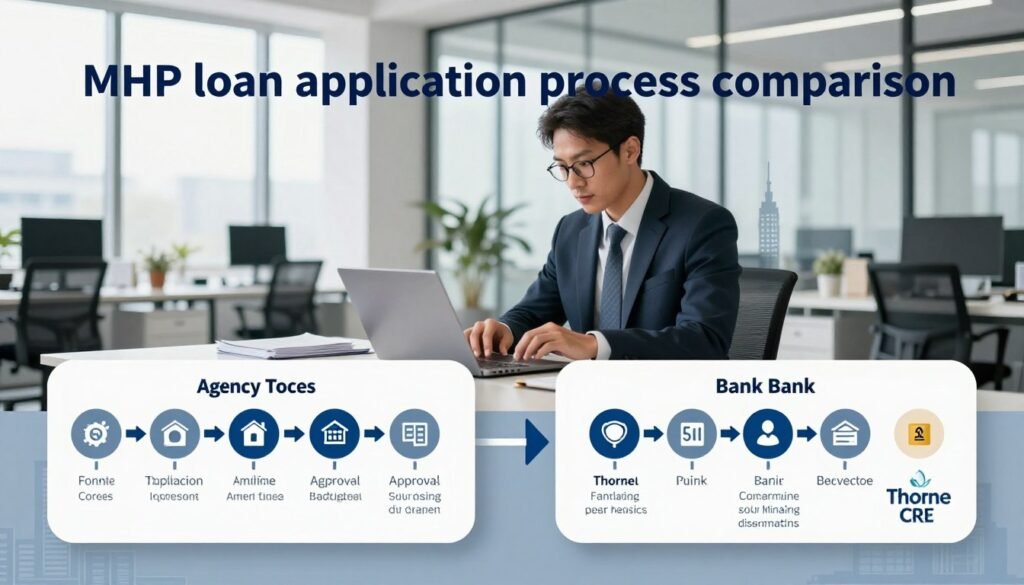
Bank Loan Application Timeline and Steps
Bank loans are faster, taking 30 to 60 days. The steps are:
- Pre-application consultation
- Formal application submission
- Credit analysis and property evaluation
- Loan committee review
- Approval and closing
| Loan Type | Timeline | Key Steps |
|---|---|---|
| Agency Loan | 60-90 days | Detailed due diligence, underwriting, and credit committee review |
| Bank Loan | 30-60 days | Credit analysis, property evaluation, and loan committee review |
Knowing these differences helps investors prepare better. This makes the financing process smoother and more successful.
Common Challenges with MHP Financing
Getting financing for mobile home parks is tough, whether through agency loans or bank financing. Investors face a complex world of rules, financial needs, and lender criteria.
Agency Financing Obstacles and Solutions
Agency financing is popular for its good terms but has its own hurdles. The underwriting process is strict and takes time. To beat this, investors need to have all financial documents ready and make sure their properties fit agency standards.
Key Solutions:
- Work with experts who know agency financing well.
- Have detailed records of your property’s income and costs.
Bank Financing Hurdles and Workarounds
Bank financing might be more flexible but comes with its own problems. These include high interest rates and strict rules. A big challenge is meeting the bank’s loan-to-value and debt-service coverage ratio needs.
| Challenge | Workaround |
|---|---|
| High Interest Rates | Negotiate with multiple banks to get the best rate. |
| Strict LTV Requirements | Consider a bigger down payment or look at other lenders. |
By knowing these challenges and using smart solutions, investors can make it through the MHP financing world.
Closing Costs and Fees Analysis
Closing costs and fees can greatly affect the cost of financing a mobile home park. It’s key to know the differences between agency and bank loans.
Investors must look at loan terms and costs when choosing between agency and bank financing. This choice impacts their mobile home park ventures.
Agency Loan Fee Structure
Agency loans, from Fannie Mae, Freddie Mac, and HUD, have their own fees.
- Origination fees
- Servicing fees
- Potential prepayment penalties
Table: Agency Loan Fees
| Fee Type | Typical Range |
|---|---|
| Origination Fee | 0.5% – 1% |
| Servicing Fee | 0.25% – 0.5% |
Bank Loan Fee Structure
Bank loans have their own fee structures. These can include:
- Origination fees
- Closing costs
- Potential late payment fees
Table: Bank Loan Fees
| Fee Type | Typical Range |
|---|---|
| Origination Fee | 1% – 2% |
| Closing Costs | 0.5% – 1.5% |
Knowing these fee structures helps investors make smart choices for their MHP financing.
Case Studies: Successful Mobile Home Park Financing
Looking at successful mobile home park financing shows why picking the right strategy is key. Real-world examples teach us what makes a deal work.
Agency Financing Success Stories
Agency financing has helped many mobile home park deals succeed. For example, a 200-unit park in the Midwest got a loan from Fannie Mae. This deal got a good interest rate and terms.
Key benefits were non-recourse financing and a longer payback time. This boosted the investor’s cash flow.
Bank Financing Success Stories
Bank financing has also been crucial for mobile home park investments. A community bank in the Southeast helped finance a 150-unit park. They offered flexible terms and a fast closing.
The investor got personalized service and could negotiate terms directly with the bank.
| Financing Aspect | Agency Financing | Bank Financing |
|---|---|---|
| Interest Rate | Competitive, fixed rates | Variable; potentially higher |
| Loan Term | Longer amortization periods | Shorter terms; more flexible |
| Recourse | Typically non-recourse | Usually recourse financing |
These examples show both agency and bank financing have their benefits. The right choice depends on the investor’s needs and goals.
When to Choose Agency Financing
Understanding when to choose agency financing for mobile home parks is key to success. Agency financing is great for specific investments and investors. It offers benefits that can boost your returns.
Ideal Scenarios for Agency Loans
Agency financing is perfect for certain mobile home park investments. These include:
- Large-scale investments with significant property value
- Properties with stable cash flow and low vacancy rates
- Refinancing existing debt to take advantage of lower interest rates
- Investments requiring non-recourse loans for liability protection
Loans from Fannie Mae, Freddie Mac, and HUD come with good terms. They can make your investment more profitable.
Investor Profiles Best Suited for Agency Financing
Some investors are better off with agency financing. These include:
- Experienced investors with a proven track record in mobile home park investments
- Institutional investors seeking large-scale financing options
- Long-term investors looking for stable, long-term returns
These investors can use agency financing to reach their goals. They get competitive rates and terms.
When to Choose Bank Financing
Bank loans can be a good choice for financing mobile home parks. They offer flexibility and advantages that agency financing might not. This is true for certain investors and under specific circumstances.

Ideal Scenarios for Bank Loans
Bank financing is great for mobile home park investments needing flexibility in loan structuring. This includes properties that need renovation or have complex ownership. Banks can offer more customized loan terms that fit the investor’s plans.
| Loan Feature | Bank Financing | Agency Financing |
|---|---|---|
| Flexibility in Loan Structuring | High | Low |
| Customization of Loan Terms | Yes | No |
| Speed of Approval Process | Variable | Standardized |
Investor Profiles Best Suited for Bank Financing
Investors with a strong financial profile are best for bank financing. They seek flexibility in loan terms. This includes experienced investors with a proven track record and enough down payment.
Knowing when to choose bank financing helps investors make better decisions for their mobile home park investments.
Conclusion: Making the Right Mobile Home Park Financing Choice
Choosing the right financing is key for mobile home park success. Agency MHP loans and bank loans meet different investor needs.
Agency financing, from Fannie Mae, Freddie Mac, and HUD, offers non-recourse loans with good terms. This is great for big or stable mobile home parks. Bank loans, on the other hand, are flexible and quick. They’re best for small parks or those wanting recourse financing.
When picking between agency and bank financing, think about your goals, park size, and finances. Knowing the differences helps you choose the best for your strategy.
The best financing choice depends on your situation. Look at loan terms, interest rates, and who can get them. This way, you get the best financing for your mobile home park.