

Surprising fact: 72% of successful transactions close faster when teams prepare underwriting and tenancy data before lender outreach.
This guide frames practical strategy for buyers, owners, and investors who need certainty and speed in a shifting market. We define strategic approaches as aligning capital structure to how a property performs and to business goals, from acquisition to refinance and construction.
Our local teams in Wisconsin and Minnesota act as knowledgeable, responsive advisors. We focus on flexible solutions across property types, bridge and permanent loans, value-add work, and 1031 exchange support.
Lenders now weight income durability, tenant credit, DSCR, and leverage more heavily. Early preparation improves pricing and speed.
Start by sharing the property, your timeline, and target terms so we can confirm fit and move from planning to closing with clarity and service beyond a rate quote.
Key Takeaways
- Prepare underwriting and tenancy info early to speed approvals.
- Align capital with property performance and business goals.
- Local advisory teams offer quicker, clearer guidance.
- Options include acquisition/refinance, construction, bridge, and permanent loans.
- Discuss property, timeline, and target terms to confirm next steps.
Why Wisconsin Commercial Real Estate Financing Demands a Strategy in Today’s Market
Underwriting now centers on predictable income and clear risk controls. Lenders want concise cash narratives that match leases and expense forecasts.

What lenders evaluate now: cash flow, risk, and fundamentals
Underwriters review in-place and pro forma cash flow, tenant credit, and lease rollover timing.
They also size proceeds by checking location, condition, rents, occupancy, and market comparables.
How local decision-making speeds execution
Local teams reduce handoffs. Decisions made and serviced nearby mean faster responses from planning through servicing.
That continuity improves terms, cuts negotiation cycles, and keeps closings on schedule.
- Risk controls: reserves, contingency plans, insurance, and clear exit strategies.
- Documentation: realistic stabilization schedules and credible takeout plans improve pricing.
| Underwriter Focus | Borrower Action | Expected Outcome |
|---|---|---|
| In-place & Pro forma cash flow | Provide rent rolls and realistic budgets | Better terms and faster approvals |
| Tenant quality & lease rollover | Supply tenant credit info and lease abstracts | Reduced perceived risk |
| Property fundamentals & comps | Share market comparables and condition reports | Accurate sizing of proceeds |
Next, we outline solution pathways for acquisition/refi, construction, bridge, permanent, and exchange-driven transactions.
Wisconsin Commercial Real Estate Financing Solutions Built Around Your Property and Business Goals
When a loan strategy reflects a company’s growth goals, execution and costs improve. Our approach positions financing as a tool to support acquisition growth, portfolio optimization, repositioning, or long-term income stability.
Flexible financing means practical choices: tailored structures for stabilized versus transitional properties, varied amortization schedules, and milestone-based construction draws that link funding to progress.

Advisory-first support from planning through servicing
We align timeline, capital stack, and documentation before formal underwriting to reduce surprises. This advisory-first model creates trust and a disciplined approach.
Development and stabilization scenarios change underwriting. Lenders weigh leases, preleasing rates, realistic budgets, contingency reserves, and sponsor experience differently for each plan.
- Options include: acquisition, refinance, construction, rehab, and bridge-to-perm pathways.
- Service continuity: planning → approval → closing → servicing reduces friction and keeps execution on schedule.
| Goal | Practical Financing Feature | Result |
|---|---|---|
| Acquisition growth | Competitive loan terms and rate hold options | Faster closings and predictable costs |
| Development projects | Milestone draws, interest-only periods, contingency reserves | Aligned cash flow and reduced construction risk |
| Stabilization / Repositioning | Bridge-to-perm paths, flexible amortization | Smoother transition to long-term debt |
| Portfolio optimization | Refinance or restructure loans to improve terms | Improved liquidity and portfolio returns |
Below, identify the property types and loan categories that match your plan so you can quickly find the best fit.
Commercial Property Types We Finance Across Wisconsin
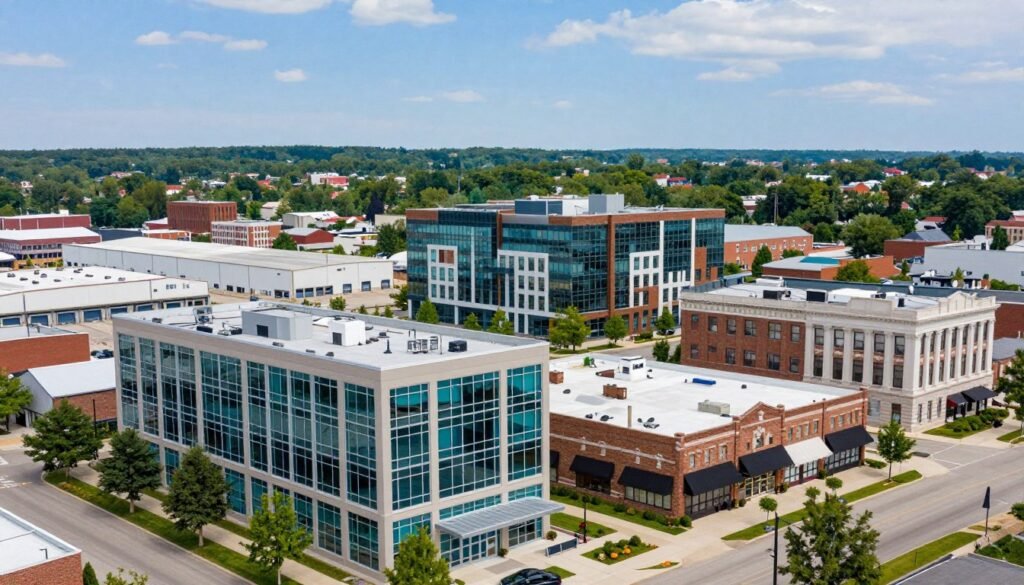
Identifying the right lending conversation starts with a clear view of the asset class and its operating drivers. Below is a concise snapshot of the main property types we support and what underwriters focus on for each.
Multi-family units
Evaluation themes: in-place rents versus market, turnover, operating expense trends, and renovation or lease-up plans.
Office buildings
Key sensitivities: tenant concentration, lease term lengths, renewal probability, and repositioning strategies for modern workplace demand.
Industrial buildings
Fundamentals: clear heights, dock access, site circulation, and tenant credit matter most as logistics and light manufacturing drive demand.
Retail buildings
Underwriting focuses: tenant mix, lease structures, traffic and visibility, and how income will hold up through economic cycles.
Hospitality
Variables: seasonality, brand or flag affiliation, and management strength. These influence cash flow forecasts and loan structure.
Senior housing and healthcare-focused real estate
Special considerations: operational risk review, sponsor experience, regulatory compliance, and a strong management platform are essential.
| Property Type | Top Underwriter Focus | Typical Loan Conversation | Broker/Owner Prep |
|---|---|---|---|
| Multi-family housing | Rent vs. market, turnover, expenses | Stabilized or value-add bridge | Rent roll, operating pro forma |
| Office | Tenant concentration, lease term | Reposition or long-term debt | Lease abstracts, tenant credit |
| Industrial | Clear height, access, tenant credit | Long-term debt or construction loans | Site plans, tenant covenants |
| Retail / Hospitality / Senior housing | Mix, seasonality, operations, compliance | Flag-specific or specialized loans | Performance metrics, management bios |
Acquisition and Refinance Loans for Commercial Buildings
Commercial real purchase and refinance choices require a clear debt plan that fits income and timing.

Commercial mortgages for purchases and long-term ownership
Acquisition loans aim to secure a purchase while matching debt service to the asset’s income profile.
Well-structured mortgages give predictable payments, underwrite on income and property quality, and protect liquidity for operations and reserves.
Refinancing strategies to improve terms, rates, or cash flow
Refinance can lower rates, extend term length, or reshape amortization to improve cash flow.
Borrowers also use cash-out refis to fund reinvestment or pay down higher-cost obligations.
Financing for owner-occupied and investment properties
Lenders review owner strength differently for owner-occupied versus investment property loans.
Owner-occupied deals often rely on the operating company’s global cash flow. Investor loans focus on rent rolls and stabilized performance.
- Prepare targeted terms, preferred interest approach, and timing tied to contracts or maturities.
- For refi requests, supply updated rent rolls, trailing financials, and recent appraisals.
- Decide whether straight purchase/refi fits or if construction/rehab/value-add lending is a better path.
| Goal | Typical Benefit | Key Borrower Prep |
|---|---|---|
| Acquire property | Secure title and matching debt service | Purchase agreement, pro forma, reserves |
| Lower cost of debt | Reduced rate and monthly interest | Trailing financials, appraisal, debt schedule |
| Cash-out for reinvestment | Liquidity for upgrades or portfolio moves | Stabilized income evidence, use plan |
Construction, Rehab, and Value-Add Financing for Growth-Oriented Projects
Ground-up development and targeted rehab support growth by tying capital to clear milestones. Lenders expect tight budgets, realistic timelines, and a sponsor history that shows delivery.

Ground-up construction lending
Key features: thorough budget review, milestone draws, on-site inspections, and contingency reserves.
Lenders evaluate sponsor experience, general contractor contracts, and a clear sources-and-uses schedule.
Managing development risk
Teams weigh GMP versus cost-plus agreements, track hard and soft costs, and build realistic permitting and delivery buffers.
Rehab, repositioning, and value-add
Rehab loans fund improvements that increase NOI and speed lease-up. Value-add projects use targeted capital to lift rents and cut vacancy.
- Prepare plans/specs, contractor info, and a stabilization pro forma.
- Include a sources-and-uses and realistic takeout plan from a company or lender.
- Understand how preleasing, recourse, and takeout options change terms, interest, and rates.
| Contract Type | When Used | Risk Control |
|---|---|---|
| GMP | Fixed price projects | Lower cost overrun risk |
| Cost-plus | Scope-flexible development | Higher contingency needs |
| Bridge/interim | Compressed timelines | Quick close, planned takeout |
Transition: when stabilization is incomplete or timing is tight, bridge and interim financing provide a practical short-term option.
Bridge Loans and Interim Financing When Timing Matters
When timing is tight, short-term capital can bridge a gap between purchase and stabilization. Bridge loans are short-duration loans designed to close quickly and carry a property through transition or renovation. They prioritize speed and execution over the lowest possible rate.
Bridge loans to close quickly while transitioning or renovating
Common scenarios include vacancy burn-off, tenant improvements, delayed takeout, or renovation phases before a permanent term. Lenders underwrite these deals on as-is cash flow and a clear path to stabilization.
Interim financing options to support leasing, stabilization, or takeout planning
Interim structures require a defined refinance or sale plan. Typical terms run short—usually one to three years—so alignment with a takeout plan reduces refinancing risk.
- Underwriting focus: current cash flow, stabilization milestones, and exit strategy.
- Timing advantage: quick closes cut contract delays when a business needs certainty.
- Approval boosters: credible leasing pipeline, detailed renovation scope, and strong sponsor liquidity.
| Feature | Typical Expectation | Borrower Prep |
|---|---|---|
| Term length (years) | 1–3 years | Takeout plan and timeline |
| Rate & interest | Higher than permanent loans | Clear stabilization milestones |
| Exit | Refinance to long-term debt | Evidence of lease-up or sale strategy |
Once stabilized, borrowers typically move to permanent loans to secure predictable payments and longer amortization. Bridge and interim options are a tactical tool when speed and certainty match business needs.
Permanent Loans and Longer-Term Structures for Predictable Payments
Permanent loans lock in a debt structure intended for stable ownership and predictable payments. These loans support owners who plan to hold a property for multiple years and want clarity on cash flow and capital costs.
How term length and amortization support long-range planning
Term length and amortization shape monthly obligations and the total cost of capital. Longer amortization lowers monthly debt service and improves cash flow.
Shorter terms can reduce overall interest but may force a refinance when market conditions are uncertain. Align the term with your hold period to avoid timing risk.
Aligning interest approach with investment horizon and market conditions
Fixed interest locks certainty in the rate for the loan term and protects cash flow against rising rates.
Floating rate options can lower initial cost but add exposure if market rates climb. Choose based on your investment timeline and tolerance for rate movement.
- Stabilized performance: consistent occupancy, lasting tenant income, and clean operating statements prove takeout readiness.
- Permanent as takeout: use long-term loan to replace bridge or construction debt once milestones are met.
- Borrower items: prepayment flexibility, expected renewals, and matching maturity to hold strategy matter greatly.
| Feature | Benefit | Consideration |
|---|---|---|
| Fixed rate | Payment certainty | May cost more upfront |
| Floating rate | Lower starting payments | Exposure if rates rise |
| Long amortization | Stronger cash flow | Higher total interest paid |
1031 Exchange Financing for Commercial Real Estate Investment in Wisconsin
1031 exchanges force tight windows that make coordinated lending plans essential. These tax‑advantaged swaps set non‑negotiable identification and closing deadlines, so loan readiness must match the exchange timeline.
Arrange financing options early and build contingencies if the first replacement property falls out. Lenders can structure bridge or permanent loans to fit identification periods and closing windows. Clear contract language that ties closing and funding requirements reduces deadline risk.
Discipline matters: start underwriting conversations, prepare a sources‑and‑uses, and deliver responsive documentation. Lenders evaluate the replacement property’s fundamentals while weighing timing pressure and exit plans.
- Coordinate purchase terms with funding milestones.
- Use qualified intermediaries, legal and tax advisors, and an experienced lending team as core resources.
- Keep borrower readiness—cash flow, credit, and risk practices—aligned to strengthen loan outcomes.
| Need | Action | Result |
|---|---|---|
| Tight timeline | Pre‑underwrite and set contingency | Reduce deadline risk |
| Replacement property | Fast fund or bridge loan | Secure exchange |
| Documentation | Clear sources & responsive delivery | Faster approvals |
Cash Flow, Credit, and Risk Management That Strengthens Loan Outcomes
Strong treasury practices keep operations liquid and make loan underwriting simpler. Visible cash controls and clear reporting shorten review cycles. Lenders look for steady cash, documented reserves, and a plan for variability across the market.
Cash management strategies that protect liquidity and operating stability
Focus on collections, payables, and reserves. Improve collections, tighten aging, and schedule payables to preserve funds for taxes, insurance, and repairs.
Managing risk across projects, tenants, and market cycles
- Limit tenant concentration and stagger lease rollovers.
- Keep contingency reserves for vacancy or expense spikes.
- Use clear takeout plans to reduce project execution risk.
Credit readiness for businesses and owners: what underwriters want to see
Underwriters want consistent financials, manageable leverage, and transparent repayment sources. Clean statements and timely taxes reduce last‑minute conditions and speed closings.
| Action | Why it matters | Outcome |
|---|---|---|
| Operating account control | Shows liquidity | Fewer lender conditions |
| Reserve planning | Protects cash flow | Improved loan terms |
| Transparent credit docs | Proves repayment | Faster underwriting |
Work with a responsive team that flags issues early and helps craft a fast-track lending checklist like this one: fast-track lending checklist.
What to Expect From a Wisconsin Commercial Real Estate Lending Team
A clear roadmap from first call to loan servicing keeps milestones visible and reduces surprises. That roadmap starts with a planning call, moves through document collection and underwriting, then to approval, closing coordination, and ongoing servicing.
From initial planning to loan approval, closing, and servicing
Practical steps: set timing, gather financials and rent rolls, and confirm third‑party reports. Underwriting follows with clear conditions and a projected close date.
Specialized industry teams and customized loan structures for middle-market businesses
Specialized teams design tailored solutions for middle-market needs instead of one-size templates. They map options—acquisition, construction, bridge, permanent, or exchange-driven loans—into a coherent plan.
Responsive, efficient service designed around your financing needs
Local decision-making and servicing speed responses on covenants, renewals, and growth requests. Expect a consistent point of contact, proactive condition checklists, and clear timelines to maintain momentum.
| Process Step | What Borrower Provides | Expected Outcome |
|---|---|---|
| Planning call | Deal summary, timeline | Scoping and lender fit |
| Underwriting | Financials, rent rolls | Term sheet and conditions |
| Servicing | Ongoing reports | Fast responses and scalable solutions |
Conclusion
Effective outcomes start when a financing plan matches a property’s cash flow, timeline, and risk controls.
We cover a full range of solutions — acquisition and refinance, construction and value‑add, bridge and interim, permanent structures, and 1031 coordination — so you can pick the right path for your asset.
Before you call, prepare a clear property overview, rent roll, recent financials, project budget, and target timing. That makes underwriting faster and reduces last‑minute conditions.
Advisory continuity from planning through servicing means fewer surprises, clearer options, and stronger execution. Ask our team to review your deal, compare loans and bank services, and map next steps to closing.
Partnering with the right lender also unlocks cash management and other resources that support long‑term success and homegrown portfolio growth.