

Surprising fact: more than half of major commercial developments now blend three or more funding sources, reshaping how risk and returns are split across a deal.
This guide shows you how layered financing works in large-scale commercial real estate. It explains why the order of payments matters and how different lenders and equity partners fit into a single plan.
Readers will learn to evaluate advanced capital stack options, weigh repayment priority, and link current market drivers—rates, liquidity, and return targets—to stack design.
Who should read this: developers, sponsors, asset managers, and investors assessing big projects and recapitalizations.
Why it matters: large deals rarely rely on a single loan. Sophisticated structures can lower overall cost, balance risk, and improve negotiation leverage with lenders and equity partners.
Key Takeaways
- Understand how layered financing allocates risk and return across debt and equity tranches.
- Learn why repayment priority changes valuation and investor incentives.
- Use the Texas Capital Stack as a decision tool for comparing financing options.
- See how market conditions drive stack design and underwriting metrics.
- Apply practical structuring principles for large-scale real estate projects.
Large-Scale Commercial Real Estate Financing in Texas Today
Financing for big commercial projects now requires layered lenders and bespoke terms to match complex cash flows and execution risk.
Why it differs from residential lending: commercial real estate deals are larger, hinge on variable income streams, and depend on sponsor execution and business plans. Legal documents are more detailed and underwriting focuses on property performance, not just borrower credit.

Common funding sources and lender roles
Banks provide senior loans with tighter covenants and lower pricing but expect strong DSCR and collateral. Private lenders accept higher risk for speed and flexible terms.
Institutional capital underwrites via equity or large debt pools and demands governance, reporting, and yield targets from investors.
Major financing channels
- Traditional bank loans — lower cost, restrictive covenants.
- CMBS — securitized debt with fixed terms and market trading.
- Hard money loans — bridge funding at higher interest for execution gaps.
- Equity financing — sponsor and investor capital for upside exposure.
“Structure must balance liquidity, interest sensitivity, and investor return expectations to support long-term value.”
| Channel | Typical Use | Key Tradeoffs |
|---|---|---|
| Bank Loan | Stabilized assets | Lower cost vs. stricter covenants |
| CMBS | Large transactions | Fixed pricing vs. prepay limits |
| Hard Money | Short-term bridge | Speed vs. high interest |
| Equity | Value-add or growth | Upside potential vs. dilution |
Present market conditions — fluctuating interest rates and tighter liquidity — change leverage comfort, refinance risk, and how investors blend debt and equity. The next section describes the layered framework investors use to price these tradeoffs across every capital layer.
Texas Capital Stack: The Layered Framework Investors Use to Price Risk and Returns
Understanding how payments flow through financing layers is the core of deal analysis.
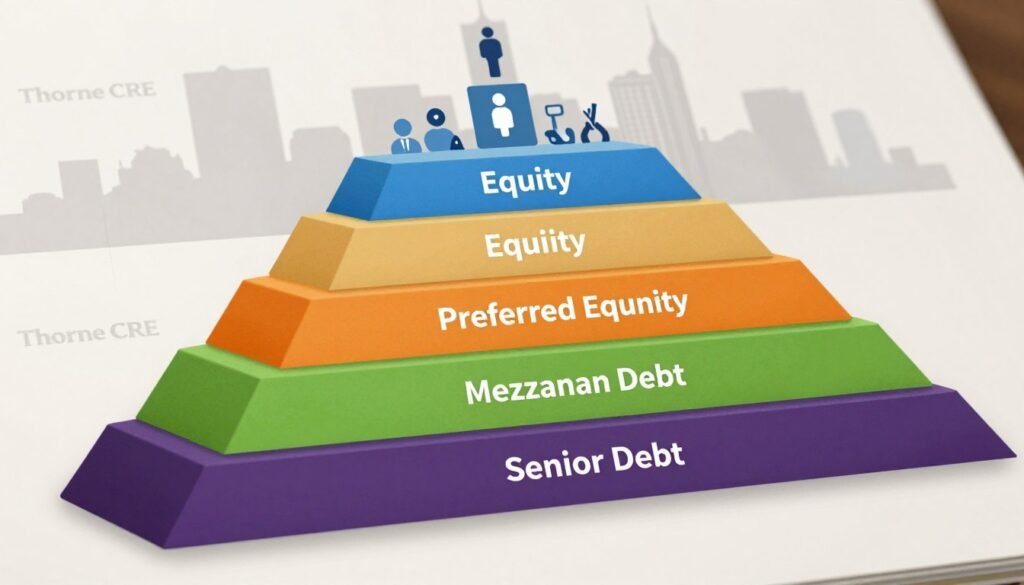
A capital stack is the ordered set of financing layers used to fund a commercial project. Repayment priority determines who is paid first and who is paid last. That order affects cash distributions in upside scenarios and loss allocation in downside events.

Who is paid first vs. paid last
Senior debt is paid first; it sits closest to collateral and gets priority on cash. Mezzanine and preferred equity follow, with common equity paid last.
How position drives risk and return
Lower positions accept lower returns because they face less risk. Higher positions demand bigger returns to compensate for loss exposure and uncertain repayment.
Debt holders vs. equity holders
Debt holders have contractual repayment and enforcement rights. Equity holders share ownership and only earn returns after obligations are met. This difference explains why debt pricing, covenants, and control rights tighten as you move up the payment order.
- Senior debt: lowest risk, first repayment.
- Mezzanine: subordinated debt or hybrid with conversion rights.
- Preferred equity: fixed-like returns, paid before common equity.
- Common equity: upside capital, paid last.
Investors use this layered framework to price risk and returns in real time. When rates or liquidity shift, mixing layers financing can preserve proceeds while aligning sponsor and investor incentives. The next section breaks down typical sizing, pricing norms, and documentation for each layer.
Deep Dive Into Capital Stack Layers and Typical Allocation Ranges
How you weight each financing layer shapes cash flow priorities and loss allocation in big deals.
Senior debt as the cornerstone layer
Senior debt typically represents 40%–60% of the funding mix. It is secured by the property and has first repayment priority, which makes it the lowest risk capital.
Senior lenders focus on collateral value, stabilized cash flow, and protective covenants to limit downside.
Mezzanine and mezzanine financing as bridge capital
Mezzanine commonly fills gaps at 10%–20%. As subordinated loans, mezzanine debt carries higher interest and tighter documentation.
Mezzanine financing often avoids rewriting senior loans while adding remedies or conversion rights if performance falters.
Preferred equity and common equity
Preferred equity sits after debt but before common equity, usually 10%–20%, and may include current-pay or accrual features.
Common equity is upside capital (20%–60%) and bears the most risk while offering the greatest potential returns when the business plan succeeds.
Hybrids, governance, and reading a term sheet
Advanced structures blur debt equity lines through conversion rights, control remedies, and intercreditor mechanics. These features shift risk, control, and economics across layers.
- Check where repayment sits and who controls remedies on default.
- Note conversion triggers and waterfall priorities for potential returns.
For a strategic primer on layering and negotiation, see navigating the capital stack.
Structuring the Stack for Liquidity and Downside Protection in Texas CRE
Designing a resilient financing plan starts with linking leverage to liquidity needs and downside triggers.

Balancing leverage and flexibility
Right-size senior debt to avoid tight covenants that limit amendments and heighten refinance sensitivity.
Over-using senior loans can strip optionality and force costly restructures when leasing or timing slips.
Using mezzanine to fill gaps
Mezzanine financing can bridge funding shortfalls without rewriting senior agreements.
Expect higher cost and more complexity, but keep the project solvent during execution stress.
Optimizing preferred vs. common equity
Preferred equity can give investors seeking priority cash a buffer while protecting common equity upside.
Common equity stays for true upside participation and sponsor alignment.
Key underwriting metrics and capital markets context
Use simple metrics to test stack resilience and repayment capacity.
| Metric | Formula | Decision Impact |
|---|---|---|
| LTV | Loan Amount ÷ Appraised Property Value | Limits proceeds and affects pricing; lower LTV = more lender comfort |
| Debt Yield | NOI ÷ Total Loan Amount | Shows leverage risk independent of rates; higher yield = safer debt |
| DSCR | NOI ÷ Annual Debt Service | Indicates repayment capacity as rates rise; target >1.25–1.35 on stressed models |
With U.S. capital raising projected at $339.7B by 2025, competition among investors may ease access to capital but tighten underwriting.
How market cycles impact commercial loan is a useful reference for matching financing moves to cycles.
Conclusion
Designing a financing mix means matching each funding source to the asset’s timing, risk, and exit path. , This approach makes the capital stack a working framework for managing outcomes in both steady and stressed markets.
Practical takeaway: each layer’s position drives pricing, control, and performance hurdles. Use senior debt, mezzanine, preferred and common equity in proportions that fit the business plan and preserve liquidity.
Recap typical ranges and why they matter: lower senior leverage reduces refinance risk, mezzanine and preferred equity bridge gaps, and common equity captures upside. Apply simple metrics to compare term sheets and defend downside while pursuing competitive returns.
Use the structuring principles and underwriting checks from this guide to evaluate commercial real estate opportunities and to negotiate smarter financing.