

Surprising fact: Nearly 40% of project delays come from mismatched layers of funding, not from construction issues.
This introduction explains what the Oregon Capital Stack means in practical terms for modern commercial real estate decisions. We will show how senior debt, mezzanine loans, preferred equity, and common holders combine to form a stack that shapes risk, return, and control.
Readers will learn how underwriting in Portland and statewide markets can shift priority, affect covenants, and change the cost of capital. The focus is on choices for acquiring, renovating, or building a property and on how timelines measured in years often drive structure as much as headline rates do.
This is an informational overview for the United States market with local considerations, not legal or investment advice. Expect a clear preview of each layer and how it performs in downturns and when a property stabilizes.
Key Takeaways
- Understand how senior debt and subordinate layers interact to shape returns and risk.
- Learn why lender covenants and execution timelines matter as much as pricing.
- See the roles of mezzanine, preferred, and common equity during stress and stabilization.
- Get practical points for sponsors, investors, and owner-users weighing financing options.
- Know that local underwriting nuances can change the final capital structure.
Capital stack basics for Oregon commercial real estate financing
Before financing starts, a clear plan maps who is protected and who shares upside.
How debt and equity work together
Debt provides downside protection and predictable cash flow. Equity accepts more risk for larger gains when a project performs. Lenders price loans to protect principal and enforce covenants. Investors take timing and market upside in return for ownership claims.
Priority and the waterfall
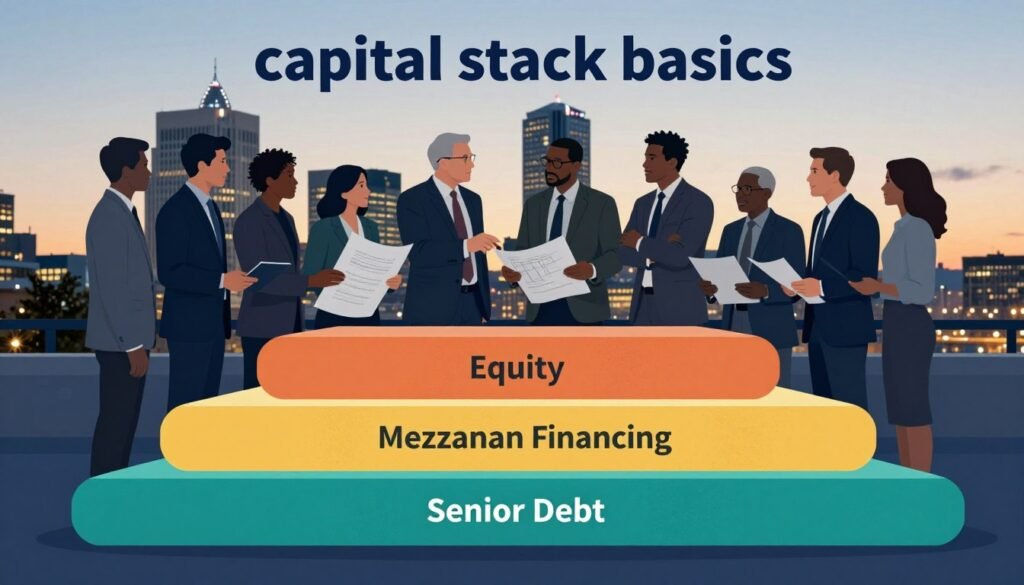
The payment waterfall sets order: senior loans get paid first, then mezzanine, then equity. That priority lowers returns for senior lenders but cuts their risk. Subordinate layers demand higher returns because recovery rates drop lower in the stack.
Where mezzanine sits
Mezzanine debt sits contractually between senior debt and equity. It often uses higher interest or equity kickers to reflect added risk. Mezzanine helps bridge funding gaps without diluting ownership like pure equity would.
Key terms that change outcomes
Interest mechanics, amortization versus interest-only, maturity dates, and extension options alter carry costs. Longer time horizons and multi-year plans raise refinancing and covenant risk. Structure in practice means lien position, guarantees, and intercreditor terms that define remedies on default.
Next, we’ll apply these basics to real-world deal choices for construction, improvements, and stabilization.
Oregon Capital Stack components and when to use each layer
Choosing the right layers in a capital mix determines who bears risk through construction and who captures upside at stabilization.
Senior construction loan vs. permanent loan
Construction loans use draw schedules and holdback contingencies. Lenders require budgets, contractor vetting, and a clear takeout plan.
Permanent loans replace construction debt at stabilized occupancy. They tighten the long-term stack by lowering leverage and changing covenants.
Preferred equity versus common equity
Preferred equity targets defined returns and can limit dilution for sponsors. It often takes priority over common equity in distributions.
Common equity absorbs variability and aligns sponsors with outsized upside on a successful exit or lease-up.
Mezzanine financing and completion risk
When senior proceeds fall short, mezzanine fills funding gaps without re-trading the entire deal. Mezzanine providers price higher to reflect subordination.
Lenders and mezzanine investors both assess budget fidelity, contractor capacity, contingency reserves, and leasing assumptions before committing.
Equity sources, intercreditor rights, and decision framework
Funds and private placements supply common and preferred capital with mandates that influence leverage, covenants, and exit timing.
Intercreditor agreements set cure rights, standstills, and transfer limits that govern control during distress.
| Layer | When used | Key trade-off | Typical control rights |
|---|---|---|---|
| Senior construction loan | Ground-up build or heavy improvements | Lower cost, higher execution oversight | Draw controls, inspection rights |
| Mezzanine | Funding gap to completion | Flexible capital, higher price | Subordination terms, transfer limits |
| Preferred equity | Targeted returns, limit dilution | Defined cash priority, capped upside | Distribution preference, limited control |
| Common equity (funds/private) | Long-term upside and sponsor alignment | Highest risk, greatest upside | Voting rights, exit timing influence |
Decision framework: weigh cost of capital against flexibility, execution certainty, dilution tolerance, and timeline sensitivity. Identical structures will price and underwrite differently by submarket liquidity and lender appetite.

Portland vs. statewide Oregon: what changes in underwriting and structure
Local market depth and tenant demand change how lenders size loans and require reserves across regions.
Market and asset differences
Large employment nodes, university and medical anchors, and strong transit corridors raise rent expectations and shorten lease-up timelines in the city core.
Smaller towns rely more on tourism, logistics, or government presence, which creates wider rent range sensitivity and greater dispersion in comps.
Risk adjustments by area
Lenders use comparable sales and leasing data to set leverage and DSCR limits. Thin or dated comps push lower loan proceeds and higher reserves.
Space factors — tenant size needs, parking, clear heights, and reconfiguration cost — directly affect projected rent and operating assumptions.
“Stronger markets can support tighter pricing; thinner areas often need more local equity and larger buffers.”
Construction feasibility varies with contractor access, entitlement timelines, and local cost swings. That reality changes financing mix for a building or project and influences which funds or local partners will commit.

Real-world Oregon example: funding and phasing lessons from the Oregon State Capitol renovation
When a public building must be usable after a major quake, financing assumptions shift from pure yield to operational performance.
Why resiliency goals change capital planning
Performance targets such as being operational within 30 days after an event change how sponsors size contingencies and set procurement rules.
These targets raise reserves, tighten draw controls, and push more conservative debt terms. Lenders demand clearer milestones before releasing funds.
Phased construction and operational continuity
Phasing keeps legislative functions running but lengthens on-site time and raises general conditions. That increases interest and capitalized carry.
Financing documents often tie disbursements to completion milestones, so phased work complicates payment waterfalls and completion triggers.
Managing stakeholders and permitting
Multiple owners and a separate permitting authority add negotiation cycles. Each cycle can extend schedules by months or years and shift cash-flow timing.
Construction realities that shape the stack
High water tables and deep excavation require permanent dewatering wells. These hard-cost items raise scrutiny from both debt and equity providers.
Hazard modeling and period assumptions
Designing for a range of seismic events pushes teams toward more robust solutions. That rebalances the mix of debt and equity and often increases capital needs.

| Issue | Financing implication | Typical mitigation |
|---|---|---|
| 30-day operational target | Higher reserves; stricter covenants | Contingency sizing; performance bonds |
| Phased construction | Longer carry; complex draws | Stage-based loans; clear milestone schedules |
| High water-table | Increased hard costs; geotech risk | Geotech reporting; lender approval and larger holdbacks |
“Resiliency goals convert durability into a financial requirement, not just a design preference.”
Takeaway for private sponsors: scope risks early, size contingencies to real hazard models, and align funds and debt equity partners with schedule-driven performance milestones.
Funding tools and compliance: what Oregon investors and borrowers should know today
Program-backed loan matches can be a practical solution when lenders tighten credit. These tools change lender economics by creating a loan-loss reserve that reduces loss exposure and can make lenders more willing to extend credit.
Oregon Capital Access Program (CAP): how the loan-loss reserve match works
CAP enrolls loans and lines of credit so lenders build reserve contributions. Each enrollment triggers a lender fee that the program partially matches, lowering net loss risk on enrolled loans.
CAP loan parameters: enrollment fees, lender-set rates, and borrower limits
Enrollment fees typically range from 3% to 7%, set by the lending institution. The program matches the fee up to $35,000 per borrower.
Interest rates, repayment schedules, and other terms remain lender-controlled. That means pricing and amortization depend on the bank or program partner.
Use restrictions that affect real estate plans
CAP proceeds may not buy or improve residential housing, nor fund property not used for business operations. They also cannot refinance non-enrolled balances.
Use a short checklist before committing: confirm property use, verify enrollment eligibility, and map timing so draws and closing align with lender reporting.
Investor-side considerations: accredited rules, liquidity, and disclosures
Private offerings tied to funds or equity raises often require accredited investor status and delivery of an offering circular before any sale.
“Private placements are not bank deposits, are not FDIC insured, and may be illiquid or lose value.”
Plan for longer holding timeframes, detailed risk disclosures, and the need to coordinate fundraising communications to meet compliance and close on schedule.
For a deeper look at how this fits into a broader financing mix and capital priorities, see navigating the capital stack.
Conclusion
Effective capital stack design links risk, pricing, and execution from underwriting through refinance. Match the asset story, building plan, and market liquidity to the financing mix and timeline.
Mezzanine and subordinate layers can bridge gaps and lower upfront dilution, but they increase fragility if reserves and rent assumptions lack buffer. Evaluate sources of funds by covenants, control rights, and liquidity expectations—not just headline returns.
Regional differences matter: Portland markets often support tighter terms than smaller submarkets, so tailor the capital stack accordingly. As a next step, build a stress-tested model for debt service, downside rent ranges, and exit options, and align documentation to that path. For tactical rate and loan advice, see how to secure the best possible.