

Surprising fact: an adaptive reuse in Long Beach closed in under 100 days from first application to closing by combining a construction bridge loan, Historic Tax Credit equity, and C‑PACE financing.
That speed changed the outcome. Sponsors competing in los angeles and across the region learned that bankability and execution beat the lowest cost on paper. A pragmatic “California Capital Stack” maps sources, sequencing, and an underwriting story that lenders and investors can rely on when timelines are tight.
This section frames the article as a deal‑structure guide anchored to Ocean Center Apartments. Expect a focus on what makes a stack executable: specialty programs that lower blended cost and credit tools that shift proceeds and leverage.
Key players and numbers—X‑Caliber Funding, CastleGreen Finance, CSCDA Open PACE, Sherwin Williams as a tax credit investor—will be unpacked later alongside $34.4M bridge, $20.6M C‑PACE, and $12.4M HTC to show repeatable structure for competitive closings.
Key Takeaways
- Execution speed and bankability often trump lowest cost when bids are aggressive.
- A three-part approach (bridge + HTC equity + C‑PACE) can close complex deals fast.
- Specialty programs and tax credit equity are the two major levers across the region.
- Real-world numbers and named parties show what an executable structure looks like.
- This guide prioritizes deal‑structure decisions that enable competitive closings.
Why capital stack design wins deals in Los Angeles and other major California CRE markets
When deals move fast, the design of the financing tells lenders and sellers whether a bid can actually close.
Bankable here means more than a model that “pencils.” It means clear collateral, intercreditor logic, and reliable repayment or takeout tied to a schedule. Lenders want credits they can stress-test and close on a firm timeline.
Competitive bids fail when plans rely on uncertain approvals, slow term sheets, or sources that need extra signoffs. High construction-period pricing and carrying costs turn delays into real dollars. Speed affects underwriting and the final blended costs of debt and equity.
Better design gives a developer leverage: cleaner offers to sellers, earlier starts, and a lower blended cost of capital. Modern signals — milestone-tied funding, asset-backed facilities, and familiar templates from climate and project finance — help credit committees say yes.
In markets with tight supply and strong rental demand, presenting a sequenced, executable funding plan is as important as the property itself. The next section shows the common, fast layers that form those winning stacks.
| Bankability Signal | Effect on Close | Example |
|---|---|---|
| Milestone-tied capital | Speeds follow-on funding | Elemental Impact D-SAFE |
| Third-party advisors | Reduces diligence friction | ERM, Marsh review |
| Asset-backed facility | Gives lenders clear collateral | Chestnut Carbon non-recourse |
California Capital Stack fundamentals: sources of capital and the role each layer plays
Successful deals rely on a layered funding plan that assigns each dollar a specific job and a clear timeline.
Senior debt, construction financing, and bridge loans
Senior debt is the backbone: construction loans, mini-perm and long-term takeouts give schedule certainty and lender comfort.
Construction loans underwrite draws to a schedule. Lenders need budgets, schedules, and environmental reports to release funds.
Bridge loans act as a timeline tool. They fill gaps between qualified expenditures, tax credit closings, and permanent takeouts.
Equity layers: sponsor equity, tax credit equity, and preferred equity
Sponsor equity aligns interests and signals skin in the game. Preferred equity can limit dilution and set return hurdles.
Tax credit equity (for example, Historic Tax Credit proceeds) can replace a large slice of sponsor cash and cover approved hard and soft rehab costs.
Public funding and credit enhancement
Public funding can improve DSCR or add reserve support and thus lower perceived risk.
But it adds compliance, extra approvals, and timing uncertainty. Use these sources only when their risk reduction outweighs the schedule cost.
Specialty financing: C‑PACE for energy, water, and seismic upgrades
C‑PACE is a long-term, fixed-rate, self-amortizing program that funds energy, water, and seismic shoring retrofits.
As a cost-of-capital optimizer, PACE reduces refinancing pressure and can lower blended cost versus loading all work into construction-period capital.
Practical map
| Layer | Role | When to use |
|---|---|---|
| Senior debt | Schedule certainty; primary collateral | When permits and budget are stable |
| Bridge / mezz | Timeline gap filler | Before tax credit equity or permanent takeout |
| Preferred & sponsor equity | Alignment and return allocation | To limit dilution or meet lender ratios |
| Tax credit equity | Replaces sponsor cash; funds approved rehab costs | When credits are awarded and timelines align |
| C‑PACE assessment | Long-term, low-rate funding for qualifying scopes | For efficiency, water, or seismic work |

Connection to Ocean Center: Ocean Center’s three-part approach shows the rule: use specialty capital where it is accretive and executable, sequence bridge funding to keep work moving, and let tax credit equity replace sponsor cash only when timing is certain.
Case study overview: Ocean Center Apartments and a three-part financing plan
The Ocean Center project shows how a compact, three-part financing plan can turn a tight deadline into a win.
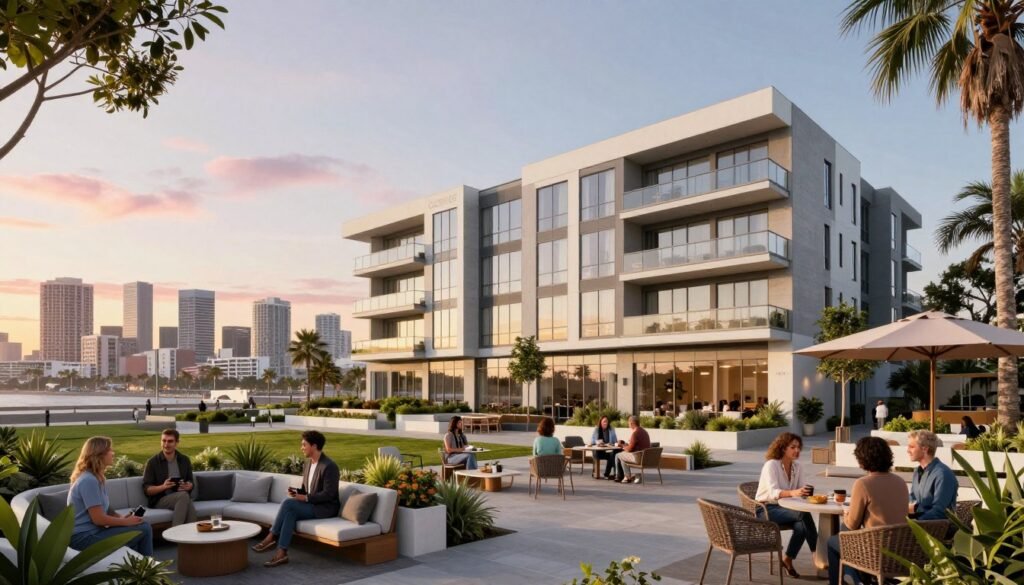
Project snapshot: Adaptive reuse of a landmark office building into 80 market-rate apartments with energy and water efficiency plus seismic upgrades. The conversion kept exterior character while modernizing systems for long-term savings.
The stack at a glance: $34.4M short-term construction loan (X‑Caliber Funding), $20.6M C‑PACE (CastleGreen via CSCDA Open PACE), and $12.4M in Historic Tax Credit equity. Each layer had a clear job: move construction, fund long-life efficiency and seismic work, and monetize eligible rehab costs.
Who did what
- Pacific6 Enterprises — sponsor/developer and owner.
- X‑Caliber Funding — first mortgage and short-term financing.
- CastleGreen Finance / CSCDA — C‑PACE provider for efficiency, water, and seismic scope.
- Sherwin Williams — tax credit investor; Novogradac and Historic Consultants supported HTC compliance.
Timing as advantage: Closing inside 100 days required a placeholder for the HTC bridge and tight sequencing. That preserved proceeds while reducing execution risk and kept the project competitive in fast-moving markets.
| Feature | Capital used | Why it mattered |
|---|---|---|
| Construction moves | $34.4M short-term loan | Enabled immediate work and draws |
| Long-life upgrades | $20.6M C‑PACE | Fixed-rate, long-term funding for HVAC, lighting, water, seismic |
| Rehab monetization | $12.4M HTC | Replaced sponsor cash for eligible historic rehab costs |
Deep dive: how Historic Tax Credits and C-PACE reshaped the project’s capital stack structure
Two specialty instruments — Historic Tax Credits and C‑PACE — reshaped how proceeds flowed and which upgrades were prioritized.

Historic Tax Credits as quasi‑equity
HTC proceeds act like investor equity: credits are monetized by a tax investor (Sherwin Williams in this deal) and deliver cash to the project in exchange for future tax benefits.
These proceeds can cover approved hard costs, certain financing fees, and allowable soft costs tied to the rehab. That reduces sponsor cash and fills gaps lenders will not underwrite.
C‑PACE mechanics and term structure
C‑PACE is an assessment-based repayment on the property, delivered through a public‑private program (CastleGreen via CSCDA Open PACE) without taxpayer guarantees.
Key features: fixed rate, self‑amortizing payments, and a 30‑year term that matches long-life upgrades better than short-term construction loans.
Eligibility and cost strategy
In this market, PACE supports energy upgrades, water conservation, and seismic shoring — expanding eligible scopes beyond standard efficiency work.
Using PACE to fund long-life measures helped the team “average down” expensive construction‑period pricing and improve blended cost of capital.
Underwriting, collateral, and lender comfort
“Structure the assessment and intercreditor terms so the first mortgage lender retains primary remedies and cashflow priority.”
Lenders view PACE as a property assessment that sits alongside the first mortgage. Clear intercreditor agreements and lender consents were essential to keep X‑Caliber comfortable.
| Instrument | Role | Why it mattered |
|---|---|---|
| Historic Tax Credits ($12.4M) | Quasi‑equity for rehab | Reduced sponsor cash and funded eligible rehab basis |
| C‑PACE ($20.6M) | Long-term assessment | Lowered blended cost; funded energy, water, seismic work |
| Construction loan ($34.4M) | Immediate work | Kept schedule moving while credits and assessments closed |
- Practical tip: prioritize scope items that maximize eligible basis for tax credits without adding unnecessary cost.
- Quantify outcomes: track energy and water savings and estimated CO2 reductions to frame upgrades as financeable infrastructure.
What California’s public funding complexity teaches about timelines, costs, and stack planning
Adding public funding sources can solve feasibility gaps, but it usually lengthens the calendar and raises costs.
LIHTC is often necessary but not sufficient. Terner Center data on 699 awards shows 92% relied on at least one additional public funding source, and 76% used two or more. That means most affordable housing deals need multiple funding buckets to close.
The timeline penalty is real: each added public funding source adds about four months on average. Developers often face sequential applications, misaligned award cycles, and an average 12‑month gap between the last state award and LIHTC allocation.

The cost penalty is also measurable. Each extra public source is associated with roughly $20,460 higher per‑unit costs in 2024 dollars. Those dollars show up in higher soft costs, larger contingencies, and more carry during delays.
Why complexity drives higher costs
- More compliance and reporting across agencies increases legal and admin fees.
- Additional predevelopment and holding costs raise exposure to inflation and interest risk.
- Reapplications (about 27% did at least once) add months and unpredictable expense.
Practical implication for developers
Fewer, well‑timed sources can beat cheaper but fragmented funding when speed matters. Use this framework: quantify added months and the ~$20,460 per‑unit cost, model rate‑lock and carry contingencies, and decide whether deeper affordability justifies the added complexity.
Design patterns for competitive California CRE deals: building a stack that gets to closing
Clear sequencing and repeatable tools turn timing risk into a competitive edge for developers.
Design each tranche with a specific job: start dates, placeholder funding, and lender consents should all be mapped before signatures. Ocean Center used a placeholder for its HTC bridge so construction could start without waiting for final tax equity.
Sequencing and placeholders
Use parallel-path diligence: run permit applications and tax credit applications at the same time. That reduces idle time if one application slips.
Placeholders—short-term bridge notes or milestone loans—protect the construction start date. In Ocean Center, a bridge placeholder kept crews moving while the HTC tranche closed.
De-risking tools lenders recognize
Contracted revenues or binding offtakes act like pre-leasing. Nitricity’s sold-out-through-2028 offtakes show how bought demand lowers underwriting risk.
Asset-backed structures and conservative collateral packages make novel revenue models underwritable. The Chestnut Carbon facility paired a 25-year offtake and third-party technical advisors to satisfy credit committees.
Creative early-stage finance
Milestone-tied notes such as Elemental Impact’s D‑SAFE fund site control, design, and permits. These instruments recycle capital when milestones are met and unlock follow-on institutional finance.
Repeatability and templates
Standardized documents and steady advisor relationships reduce friction on every new project. A repeatable playbook lets a developer scale wants across markets and compresses close timelines.
| Pattern | Purpose | Real-world example |
|---|---|---|
| Placeholder bridge | Protects construction start | Ocean Center HTC placeholder |
| Milestone-tied note | Funds pre-construction risk | Elemental Impact D‑SAFE |
| Asset-backed facility | De-risks novel revenue | Chestnut Carbon non-recourse facility |
Practical playbook: align lender consents early, run parallel applications, and use milestone finance to close the gap between application cycles and construction. For a deeper guide on sequencing and execution, see navigating the capital stack.
Conclusion
A well-designed financing plan turns project ideas into firm closings under market pressure.
Key lesson: the right capital stack is a competitive weapon. Ocean Center proved it — adaptive reuse paired with HTC equity, C‑PACE, and a short-term bridge closed in under 100 days through tight sequencing and aligned parties.
Statewide data warns that adding public funding often adds ~4 months and about $20,460 per unit in hidden costs. Pick layers that materially change proceeds or risk, and align terms early to avoid carry and compliance drag.
Stack design checklist: define the underwriting story, sequence funding for schedule certainty, integrate specialty programs from the start, and standardize documents and advisors.
For rate and loan structuring guidance, see how to secure the best possible. strong,