

Surprising fact: more than 40% of commercial deals stall during closing due to structural misalignment between lenders and sponsors.
This guide explains how a Connecticut Capital Stack should be planned so sponsors close on schedule at the right cost.
Capital Stack Advisors frames work around a client-first strategy and integrated expertise from appraisal through underwriting, negotiation, and closing.
That approach, paired with long-term lender relationships, expands capital options and makes execution reliable.
Readers will learn to design a bankable capital stack, match financing to asset risk, and avoid common structural problems that derail underwriting.
The guide covers the CRE lifecycle—acquisition, construction, bridge, takeout, and refinance—and shows why sequencing matters as much as headline leverage.
Core thesis: the best capital plan is the one you can close on schedule while protecting control and long-term value.
Key Takeaways
- Design a bankable capital stack that aligns with the business plan and lender needs.
- Match debt and equity to asset risk across acquisition, construction, and refinance phases.
- Execution—documentation and lender alignment—drives outcomes more than theoretical capital supply.
- Use long-term relationships and integrated advisory to widen viable financing options.
- This guide is for sponsors, developers, and owner-operators seeking structure over leverage.
Why Capital Stack Design Matters for Connecticut CRE Debt Financing
A well-engineered capital plan sets the rules that lenders and investors use to price risk. How you layer sources decides weighted average cost of capital, cash flow priority, and sponsor control. Small structural choices often matter more than headline rates.
Bankability in practice means clear sources and uses, verifiable cash flows, realistic underwriting, and third‑party reports lenders accept. Clean priority rules and enforceable documentation make a deal lendable.
How structure drives outcomes
- The stack sets repayment order and who takes losses first. That affects pricing and covenants.
- Design items like DSCR tests, reserves, and recourse carveouts can flip a loan from fundable to unlendable.
- Equity sits differently when preferred claims or common rights change cash waterfalls and lender remedies.
An experienced advisor translates sponsor risk into a stack lenders can underwrite without last‑minute fixes. Optimize for certainty of close and long‑term flexibility, not just peak proceeds. Delays and re-trades usually cost more than modestly lower leverage.
| Element | Effect on Cost | Impact on Control | Bankability Signal |
|---|---|---|---|
| Senior debt | Lowest cost | High lender control | Clear repayment priority |
| Mezzanine / Preferred equity | Mid-range cost | Limited sponsor control | Requires intercreditor clarity |
| Common equity | Highest expected return | Most sponsor control | Depends on documented exit plan |
| Reserves & covenants | Raise effective cost if restrictive | Can protect lenders; limit sponsors | Third-party reports and realistic assumptions |
For a practical primer on structuring a bankable stack and execution playbook, see this capital stack guide.
Connecticut Market Context That Shapes Lending and Underwriting
Budget guardrails passed in 2017 have a clear ripple effect on commercial underwriting.
Fiscal rules improve perceived stability by forcing surpluses into reserves and reducing sudden borrowing. That discipline can support long-hold confidence for lenders and investors.
At the same time, limits on spending lower flexibility for education, infrastructure, and health programs that drive local demand. Over the next few years this can tighten public-sector support for certain property types.

How reserves and liabilities change investor views
Strong reserves reduce short-term shock risk, while pension obligations signal multi-year liabilities that may raise risk premiums.
Private capital matters when budgets are constrained
When public budgets cannot expand, sponsors rely more on private financing and precise capital structures to close deals. Lenders still underwrite on property cash flows and sponsorship quality.
| Fiscal Factor | Signal | CRE Impact | Practical Sponsor Action |
|---|---|---|---|
| Revenue caps | Governance discipline | Stable long‑hold outlook | Stress-test rent and growth |
| Budget reserve strength | Shock absorber | Lower short-term volatility | Highlight reserve sensitivity in models |
| Pension liabilities | Long-duration burden | Higher investor conservatism | Build conservative exit caps |
| Limited flexibility | Higher private capital demand | Greater need for precise financing | Structure resilient waterfalls |
Finally, a finance director or investment committee will weigh these state constraints when sizing insurance, forecasting growth, and judging long-term demand. Sponsors should build a stack that survives downside variance without triggering defaults.
Connecticut Capital Stack Fundamentals for Commercial Real Estate
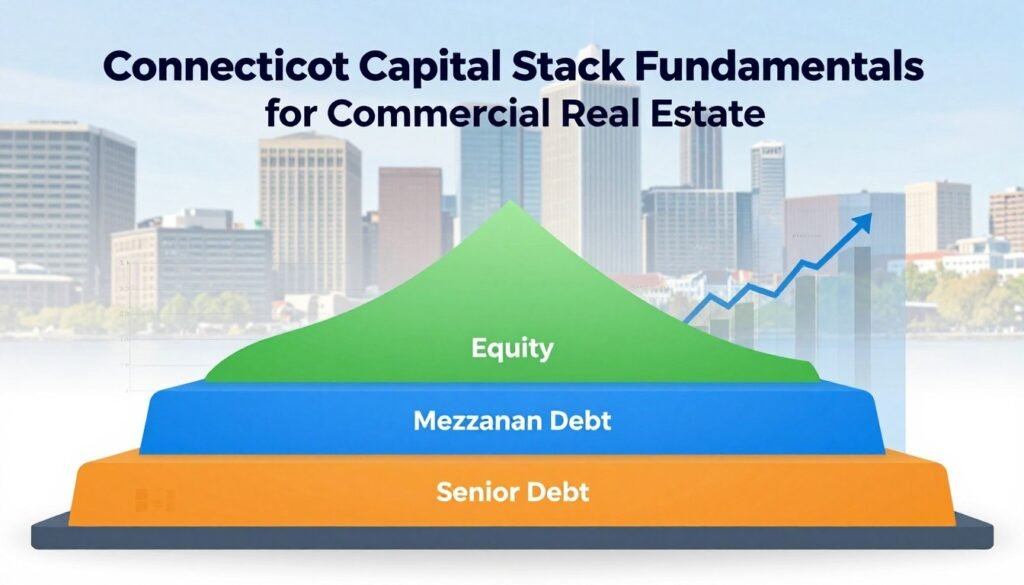
Designing debt and equity layers begins with a simple question: who gets paid first if cash tightens? That repayment order drives pricing, covenants, and sponsor control.
Senior debt placement and underwriting
Senior debt sits first-lien in the waterfall. Lenders underwrite using DSCR, LTV/LTC, debt yield, sponsor liquidity, property type, and tenancy.
Why it matters: these metrics define how much the top of the stack will support and what covenants follow.
Mezzanine and structured capital
Mezzanine fills gaps between senior debt and sponsor equity. Use it when you need leverage without diluting control.
- Intercreditor agreements set priority, cure periods, and remedies.
- Watch for control rights and cash-sweep triggers that can alarm senior lenders.
Equity roles and interactions with debt
Common equity takes residual risk; preferred equity offers contracted returns and remedies.
Align equity documents with lender covenants to avoid hidden defaults that block draws or trigger remedies.
Credit facilities, bridge executions, and timing
Credit facilities and bridge loans buy time to season NOI or complete construction. They often outperform permanent finance when speed or flexibility is essential.
Principles for a clean, bankable stack
- Map the waterfall: senior → mezzanine/structured → preferred/common equity.
- Avoid conflicting collateral pledges and keep reporting lines simple.
- Sequence third‑party reports to match lender requirements and speed closing.
Approach: start from the business plan risk, then choose instruments that match it. Integrated execution from appraisal through closing makes the stack lendable and reliable.
Structuring the Stack Across the CRE Lifecycle in Connecticut
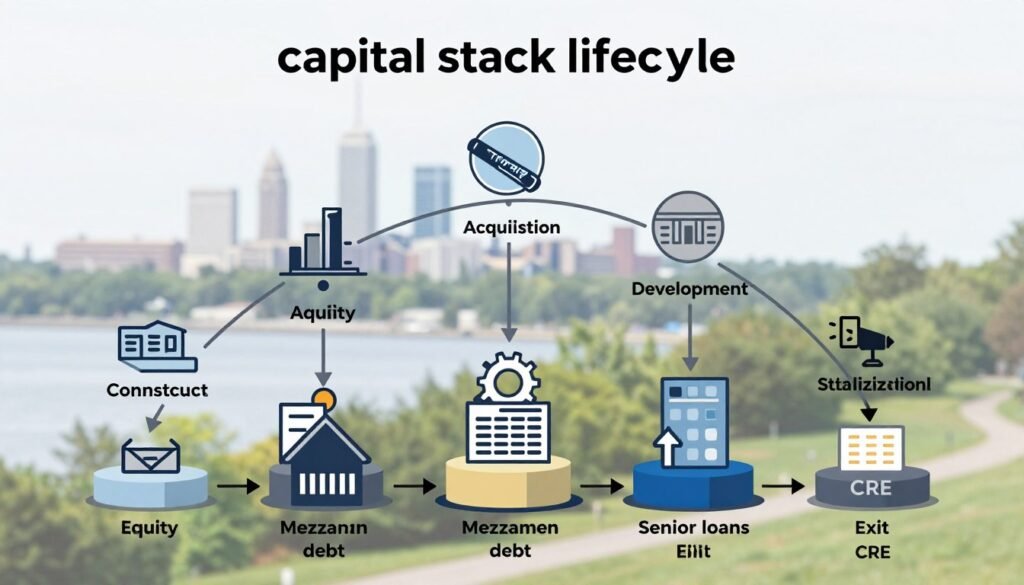
Lifecycle planning turns an isolated facility into a predictable multi‑year financing program. Design each phase so proceeds match real risk and the intended exit.
Acquisition financing aligned to business plan risk
Set leverage based on whether the asset is stabilized or transitional. Stabilized deals support higher senior loan-to-value; transitional projects need more equity or mezzanine cushion.
Practical steps: size earnest money and diligence budgets to the lender timetable. That prevents funding gaps and last-minute re-trades.
Construction financing mechanics
Construction differs: draw mechanics, retainage, and interest reserves matter. Contingency sizing and GMP terms reduce completion risk and protect proceeds.
Use clear draw schedules, third-party inspections, and realistic reserves so lenders will release tranches on time.
Bridge strategy with takeout execution in mind
Structure bridges for the intended takeout—seasoning, reserves, and documentation must match HUD/FHA or agency requirements. Plan covenants now to avoid later conflicts.
“We planned for a HUD takeout before acquisition close, which smoothed the later conversion,” a client noted.
Refinance: untangling complex financials
Normalize trailing 12 revenues, audit leases, and document capex to make complex histories lendable. Clear related-party agreements and management fees so new underwriters see a clean facility.
Adding C-PACE without creating a puzzle
Integrate C-PACE by clarifying lien priority, consent paths, and DSCR effects. Present the structure plainly in underwriting so senior lenders accept the increment without surprise.
| Phase | Primary Risk | Key Action |
|---|---|---|
| Acquisition | Timing & leverage | Match earnest money and lender diligence calendar |
| Construction | Completion | Use draws, retainage, and contingency; require inspections |
| Bridge | Seasoning / takeout fit | Document reserves and HUD/FHA pathway early |
| Refinance | Financial complexity | Normalize statements; audit leases and capex |
Think in years: rate resets, maturity cliffs, and capex cycles require multi-year planning, not just the next close. An experienced advisor coordinates stakeholders early so facility terms, construction docs, and takeout paths stay compatible.
Modern “Creative Capital Stack” Tools CRE Sponsors Can Learn From
New milestone-driven instruments bridge the pre-construction funding gap that traditional lenders often avoid.

Milestone-tied development capital funds early work—permitting, environmental, engineering, and design—by releasing tranches only after objective deliverables. Elemental Impact’s D‑SAFE shows how this works: $7M deployed and follow-on funding exceeding $70M after de-risking early stages.
Applying milestone-based notes to pre-construction budgets means tranche funding against site control, permits, completed plans, and an executed GMP. This reduces blind risk and makes financing more acceptable to permanent lenders.
Asset-backed, non-recourse facilities are viable when collateral produces contract-like cash flows. Chestnut Carbon’s $210M facility demonstrates the model: long-term offtakes, durable land ownership, and independent technical and insurance advisors made a novel facility underwritable.
De-risking tactics lenders respect include independent technical reviews, robust insurance frameworks, conservative stress cases, and crisp documentation. Apply these to construction and design risk to convert novelty into bankable finance.
Finally, build repeatable systems—templates, checklists, underwriting models, and reporting packages—so creative solutions scale across projects and support steady growth. Creativity should simplify access to cheaper, faster capital by matching instruments to real risk.
Execution Playbook: How to Build, Negotiate, and Close a Connecticut CRE Debt Stack
Start from outcomes: what return, control, and timelines must the sponsor preserve for the project to succeed? That client-first view drives every financing choice and keeps negotiation focused on terms that support the business plan.
Client-first strategy: map hold period, refinance path, risk tolerance, and recourse appetite. Reverse-engineer a capital stack that meets those endpoints rather than chasing maximum leverage.
Integrated execution aligns appraisal, third-party reports, and underwriting early so negotiations fix price and covenants — not assumptions. Alex Ades and Marc Kassai stress synchronizing HUD/FHA pathways and appraisal timing to avoid last-minute rework.
Use independent technical and insurance advisors to validate construction budgets, environmental risk, and insurability. The ERM/Marsh/CFC model reduced lender friction on Chestnut Carbon’s facility and can do the same here.
Systems and relationships matter. Maintain a responsibilities matrix, version control, weekly calls, and escalation paths. Long-term lender ties let teams pivot to alternate capital sources without restarting diligence.
- Assign a director-level owner for timeline and decisioning.
- Run a closing checklist with title, survey, and BOI items tracked.
- Pre-clear rate cap, DSCR cliffs, and intercreditor terms before doc signing.
Approach: Combine client-first design, integrated workflows, and trusted advisors to protect timing and preserve structure integrity through close.
Conclusion
The practical edge in CRE is a structure lenders can underwrite and close on schedule.
An optimized capital plan balances proceeds, pricing, and flexibility while prioritizing bankability. Keep the focus on documents, verified reports, and clear cash rules so lenders and sponsors align.
Lifecycle thinking matters: acquisition, construction, bridge, takeout, and refinance each need tailored financing tools and sequencing to avoid costly re-trades or delays.
Draft equity and debt to cooperate on cash management, cure rights, reserves, and takeout paths. Execution wins—deliver third‑party reports and lender conditions on time.
Use this guide as a repeatable reference for cleaner financings and lower friction. For practical loan packaging and rate strategies, see how to secure the best possible rate on your next CRE loan.