

Surprising fact: many transitional projects now rely on three or more layered funding sources to close deals that once seemed unfinanceable.
The modern capital arrangement for value-add real estate lets sponsors and investors tailor risk and returns. This has changed how renovations, repositioning, and redevelopment get done.
Optimization means lowering the weighted cost of funds, protecting sponsor equity, matching term to the business plan, and de-risking construction and lease-up phases. It also shapes control rights, downside protection, and return profiles for operators versus passive investors.
We frame this piece as a comparison-driven guide. It walks through sources, pricing, rate realities, and timing tradeoffs in today’s market. Expect practical tools to evaluate mezzanine versus PACE and other gap-fill options.
Local lenders, agency programs, and public/private offerings can alter deal feasibility and timelines. For deeper structural context, see this strategic guide on navigating the broader capital framework: navigating the capital stack.
Key Takeaways
- Layered financing gives flexibility to complete value-add projects under tighter lending conditions.
- Optimization targets cost, equity preservation, timing alignment, and construction de-risking.
- Mezzanine and PACE often serve as gap-fill options with distinct cost and control tradeoffs.
- Local public/private programs and agency lenders materially affect pricing and timelines.
- Use a comparison framework to ask better lender questions and model tradeoffs before closing.
What Value-Add Sponsors Need From a Colorado CRE Capital Stack
Value-add sponsors need financing that matches a rehab timeline, safeguards equity, and keeps execution flexible.
How senior debt, mezzanine layers, and equity allocate risk, control, and returns
Senior debt prioritizes principal protection and covenant compliance. Lenders focus on coverage tests and first‑lien remedies.
Mezzanine bridges the gap between primary mortgages and sponsor equity. Typical mezzanine lenders provide 10%–20% of project value to conserve equity and lower weighted cost of capital. Terms vary by provider and reflect higher risk pricing.
Equity absorbs residual volatility and earns upside through promotions and distributions. Equity holders also carry most control shifts when returns fall short.
Why creative financing matters more today
Higher rates, tighter senior leverage, and rising construction cost compress coverage. That makes pure equity or straight senior debt less competitive for many deals.
Creative mixes give sponsors access to contingency and working capital up front. That access often decides whether a renovation finishes on budget and on time.
- Sponsors’ must-haves: sufficient proceeds, predictable covenants, aligned control rights, and a plan that matches acquisition through stabilization.
- Intercreditor dynamics affect approvals for change orders, leasing pivots, and extension options when schedules slip.
- Decide to preserve equity with subordinate tools when returns justify dilution; simplify the structure when execution risk is the bigger threat.
- Tell a clear story to capital providers: business plan, scope, contingency, exit, and realistic underwriting.
| Layer | Primary Objective | Typical Size | Control/Terms |
|---|---|---|---|
| Senior debt | Protect principal | 60%–75% LTC | Strict covenants, first‑lien remedies |
| Mezzanine | Conserve equity | 10%–20% of value | Subordinate claims, higher pricing |
| Equity | Upside capture | Residual | Control via ownership and waterfall |

Colorado Capital Stack Components and Where Each Fits
A well-ordered capital mix determines who gets paid first and how execution risk is allocated.
Senior mortgage debt and first-lien execution for stabilized and transitional properties
Senior mortgage debt anchors most deals. Lenders focus on NOI durability and DSCR. For stabilized properties, underwriting is tighter and covenants stricter.
Transitional projects face shorter interest reserves and construction draws. First‑lien status drives remedies and recovery priority.
Mezzanine and other subordinate debt as the gap-filler
Subordinate capital fills the gap between senior proceeds and total funding. Mezzanine debt often sits behind the primary lender in a second‑lien position and preserves sponsor equity.
Common equity structures for redevelopment and repositioning
Equity can be GP sponsor, LP passive investors, or preferred equity. Structures affect control, promote splits, and waterfall terms.
Public-private sources that appear in deals
State programs, mission lenders, and programmatic funding can supplement private loans. Not every property qualifies, but these sources shift the fit for development and rehab plans.
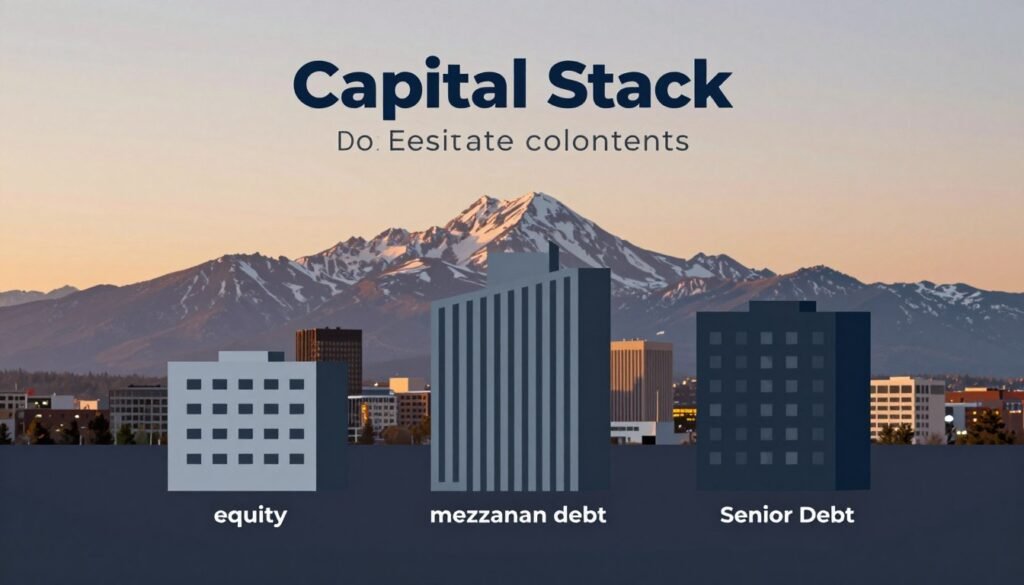
| Layer | Role | When used |
|---|---|---|
| Senior debt | Anchor; first repayment | Stabilized refinance |
| Mezzanine / Subordinate | Gap-fill; preserve equity | Value-add rehab |
| Equity / Public funding | Upside / program support | Heavy renovation or mission deals |
- Fit test: stabilized vs. heavy renovation vs. new development—match sources to execution risk.
- Next: compare mezzanine pricing to tax‑tied repayment tools and how those mechanics differ.
Mezzanine Debt vs. PACE Financing for Value-Add Projects in Colorado
Choosing between subordinate debt and assessment-backed funding shapes cost, lender consent, and short-term cash flow.
How mezzanine lenders price and where mezzanine sits
Mezzanine debt sits behind the primary mortgage, usually as a second‑lien. Lenders typically provide between 10% and 20% of project value to conserve equity.
Pricing commonly falls in the low double-digits. That higher rate buys sponsors reduced equity checks at the cost of more complex intercreditor terms.
What PACE funds and how repayment works
PACE covers discrete building and energy upgrades: HVAC, lighting, windows, roof, insulation, plumbing, solar, and geothermal.
Repayment runs through a property tax assessment that stays with the asset. This changes lender consent demands and transferability compared with conventional loan payments.

Side-by-side: cost, term, cash-flow, and complexity
| Criterion | Mezzanine | PACE |
|---|---|---|
| Rate exposure | Higher, often floating or fixed in low double-digits | Usually fixed, long-term |
| Term (years) | Shorter—matches rehab and refinance | Longer—up to ~20 years |
| Interim cash flow | Higher debt service during value-add | Lower near-term burden; spreads over tax term |
| Documentation | Intercreditor agreements, lender consents | Engineering, energy modeling, county opt-in |
Where PACE fits in new development and underwriting reality
For new development, local programs can fund roughly 10%, 15%, or 20% of the total stack, capped by modeled energy savings over the measure life.
Buildings need not be ultra‑green. They must outperform the asset-class average—better efficiency often unlocks more proceeds.
- Decision criteria sponsors care about: cost of financing, certainty of execution, lien position and lender consent, interim cash-flow impact, and refinance/sale implications.
- Practical fit: use mezzanine to bridge an equity gap; use PACE to fund eligible energy and building systems with long-term, tax-based repayment.
Colorado Deal Structures in Practice: Affordable Housing, Community Preservation, and Agency Loans
Real-world deals show how layered funding solves preservation and new-build puzzles in affordable housing.
Preservation example: Columbine Towers closed with a Freddie Mac Targeted Affordable Housing loan of $27,721,000, paired with HUD, the City and County Department of Housing Stability, DOLA, and Impact Development Fund support. Renovations covered the roof, exterior walkways, common areas, and in-unit finishes to protect residents and units.
New construction: West Holden Place used a Freddie Mac forward commitment so the construction lender could increase proceeds. Combined with CHFA and DOLA funding, the 77-unit modular project closed with defined AMI mixes that shaped underwriting and timing.

Community preservation: Montevista Comunidad paired a five-year, fixed-rate Fannie Mae first-lien loan with $5.85M in subordinate mission loans. That stack enabled a Resident Owned Community outcome to prevent displacement.
Policy matters: HB26-1001 shortened land-use review by ~28% for qualifying nonprofits, reducing unpredictability in schedules and construction cost assumptions.
| Project | Primary loan | Support |
|---|---|---|
| Columbine Towers | Freddie Mac TA | HUD, City Dept of Housing Stability, DOLA, Impact Fund |
| West Holden Place | Freddie Mac (forward) | CHFA, DOLA |
| Montevista Comunidad | Fannie Mae (5-yr) | City funds, DOLA, foundations, CDFIs |
Why this matters: mission-driven funding lowers the equity check, but it also adds affordability covenants, longer compliance, and reporting that affect closing timelines and underwriting. Sponsors should map these requirements early and review how loan terms respond to programmatic financing.
Conclusion
A clear decision framework helps sponsors choose the right layers and avoid costly surprises at closing.
Match instruments to your business plan, protect downside with realistic coverage, and favor execution certainty over theoretical proceeds.
Mezzanine remains a flexible gap‑filler but brings higher pricing and more complex terms. PACE can provide long‑term, fixed financing when the building scope qualifies and the property can absorb assessment repayments.
Real-world deals show how agency loans and state or local funding lower equity needs and protect residents. Track legislation and permitting changes closely; they change timelines and costs.
Next steps: map sources to uses, confirm lien and consent requirements early, validate modeled savings for PACE, and stress‑test exit assumptions under current liquidity.