

Surprising fact: nearly half of mid‑sized development deals shift funding sources mid-project, turning a single loan plan into a layered financing puzzle.
This guide helps owners, developers, and investors in the region make clear choices in a changing market. It will translate the theory of capital stacks into concrete financing options and show the tradeoffs between cost, control, and execution certainty.
You’ll learn which strategies fit sponsors raising capital, operators refinancing, and partners evaluating returns across office, retail, multifamily, and development projects. Projects that are under construction or repositioning often need more than a bank loan—creative mixes of senior debt, mezzanine, preferred equity, and common equity are common.
By the end, you will be able to compare major debt options, map stack layers, and design a resilient financing plan that matches timeline and exit goals. For detailed scenarios and execution tips, see our strategic guide on navigating these structures here.
Key Takeaways
- Purpose: This guide turns complex stack theory into practical financing choices.
- Audience: Sponsors, refinancers, and partners across property types.
- Tradeoffs: Cost, control, and certainty drive structure decisions.
- Creativity: Construction and repositioning often need layered capital.
- Outcome: Compare debt options and design a resilient plan to support exit timing.
How the Idaho Capital Stack Works in Today’s Commercial Real Estate Market
When projects rely on mixed funding, the way each layer is paid back shapes risk, control, and exits. A clear, simple definition helps sponsors and their partner understand priorities and tradeoffs.
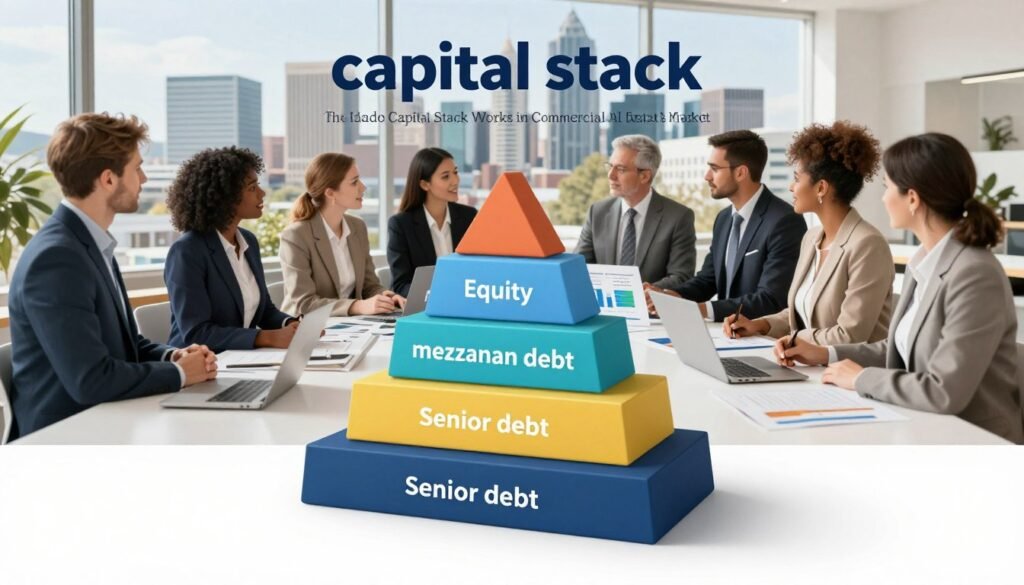
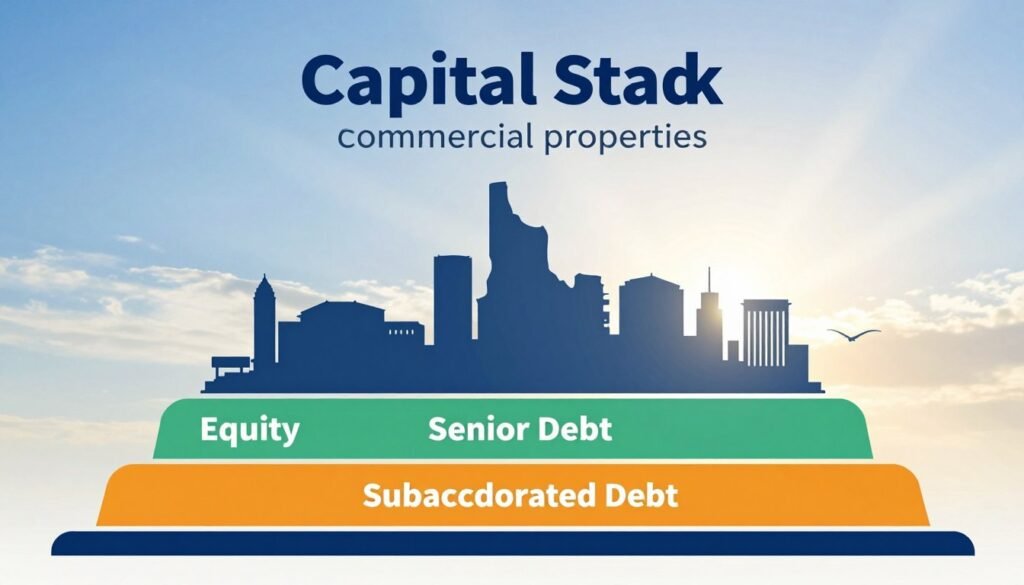
What a capital stack is: it lists who gets paid first, who takes more risk, and who holds decision rights. That ordering guides underwriting, budgets, and timelines.
Core layers and their profiles
- Senior debt: lowest return, strict covenants, first repayment.
- Mezzanine debt: higher yield, subordinate position, tighter reporting.
- Preferred equity: fixed return expectations and control triggers.
- Common equity: highest upside, greatest risk, active sponsor roles.
Weighted cost includes fees, reserves, amortization, and the friction of control rights—not just headline interest or rate. Markets today prize speed and flexibility as much as price.
Federal supports often catalyze private participation, but they also add layers that must be integrated early.
Practical note: view public programs and funds as complements to private capital, and test integration risk before finalizing structure.
Debt Financing Options for Idaho Commercial Properties
Choosing the right debt mix starts with matching lender appetite to a project’s lifecycle and timeline. That alignment shapes proceeds, speed, and execution risk for acquisition, development, or refinancing.
Senior loans for acquisition, refinance, and stabilized assets
Lenders underwrite stabilized cash flow, tenant quality, and market fundamentals. Typical terms focus on DSCR, loan-to-value, and amortization. For acquisitions or refi, expect strict covenants and conservative underwriting of future rents.
Construction loans for development projects
Construction financing uses draw schedules, interest carry, completion guarantees, and contingencies. Completion risk means timeline slips or bid resets can trigger higher costs or holdbacks. Lenders want realistic budgets, contractor credit, and reserves for cost overruns.
Mezzanine debt and subordinate loans to increase leverage
Mezzanine can boost leverage while preserving sponsor equity. It raises returns but adds fragility through intercreditor rules, cash sweeps, and refinance sensitivity. Use subordinate debt only when cash-flow buffers and exit plans are solid.
C-PACE clean energy financing as a debt alternative
C-PACE can lower blended cost or preserve senior loan proceeds for core construction needs. A concrete proof point: Nuveen Green Capital closed $15M in C-PACE for Madison Station in Rexburg, financing envelope and MEP upgrades to support Phase II after Phase I delivered 144 units.

Public-sector credit supports and loan programs
Public programs and credit supports expand lending capacity and fill gaps for strategic projects. They can tie incentives to job creation or resilience. Early coordination avoids execution delays and ensures program requirements align with private loan terms.
- Decision criteria: timeline certainty, total proceeds, all-in cost, lender flexibility, and recourse.
- Construction risks: how each option affects supply chain exposure, contingency needs, and budget resilience.
Capital Stack Design Strategy for Idaho Deals: Cost, Leverage, Rate, and Terms
Start with stress testing. Use multiple market scenarios to size DSCR cushions, debt yield thresholds, and realistic exit caps before increasing leverage.
Structuring for resiliency: DSCR, debt yield, and exit assumptions
Set a conservative DSCR buffer that survives vacancy upticks and slower rent growth. Apply debt yield discipline to cap senior proceeds and keep refinancing risk manageable.
Model at least three scenarios: base, downside, and recovery. Vary rent growth, vacancies, cap rates, and refinance spreads to understand breakpoint sensitivity.
Negotiating terms that shape returns: covenants, recourse, reserves, and prepayment
Negotiate covenants and recourse limits first—these often change sponsor returns more than a small rate move. Insist on clear reserve definitions (replacement, TI/LC) and flexible prepayment triggers when possible.
Intercreditor dynamics across stacks: priorities, remedies, and cash flow waterfalls
Document payment priority, cure rights, and remedies in intercreditor agreements. A well‑drafted waterfall clarifies who absorbs shortfalls and preserves exit optionality for sponsors and partner lenders.
Managing construction and market volatility: contingencies, rate hedging, and timeline risk
Size contingencies to reflect supply volatility and labor constraints. Choose GMP or cost‑plus terms based on contractor risk appetite. Use short hedges to lock interest exposure during long builds.
When to add a financing partner versus rebalancing sponsor equity
Add a financing partner when you need capital, specialized underwriting, or to share execution risk. Rebalance sponsor equity to simplify approvals and retain control when capital markets permit.
Design decisions should link to project management: draw cadence, inspections, and lender reporting affect execution speed and change‑order flexibility.

| Decision Area | Resiliency Focus | Impact on Returns | Practical Tip |
|---|---|---|---|
| DSCR & Debt Yield | Buffers, conservative underwriting | Reduces default risk; may lower short‑term leverage | Model downside vacancy and slower rent recovery |
| Loan Terms & Covenants | Limits on recourse and triggers | Big effect on sponsor IRR versus small rate cuts | Negotiate reserve flexibility and cash management |
| Intercreditor Waterfalls | Priority rules, cure rights | Shifts value between senior, mezz, and equity | Define remedies and refinance protocols up front |
| Construction Risk | Contingency sizing, hedging | Protects schedule and preserves exit timing | Align draw conditions with critical path milestones |
What Recent U.S. Capital Stacks Reveal for Idaho Financing and Development
Recent megaprojects prove federal support can unlock far more private money than headline totals suggest.
The CHIPS era shows that federal funds are often a minority share but act as a catalyst. Targeted grants, proposed loans, and tax credits change lender appetite and attract large corporate balance-sheet commitments.
CHIPS-era lesson
Example: TSMC, Intel, and Micron paired huge company funding with CHIPS direct grants, proposed loans, and tax incentives to braid public and private resources.
Beyond the building
Large deals require stack-adjacent capital for roads, utilities, workforce pipelines, and R&D. Those elements reduce execution risk and stabilize supply and labor over time.
Micron and national templates
Micron’s multi-state footprint paired balance-sheet investment with CHIPS allocations and state incentives. That mix lowered refinance risk and aligned local community commitments.
Idaho proof point and takeaways
Nuveen’s $15M C-PACE for Madison Station proved clean energy financing can lower the weighted cost of construction debt while funding efficiency scope.
- Checklist: plan infrastructure early, align workforce programs, document sources/uses, and avoid overreliance on one incentive.
- Model timing for program disbursements and lender covenants before closing a deal.
Conclusion
A resilient financing plan survives shocks by pairing prudent underwriting with clear decision rules across partners.
Recap: build a balanced stack that protects cash flow, sizes reserves, and assigns control when conditions change. Match tools to stage — senior loans for stabilized assets, construction debt for builds, mezzanine or preferred equity to bridge gaps.
Remember that the best outcome is not just the lowest rate. Timelines, covenants, refinance optionality, and operational impact matter as much as headline interest.
Use public programs and specialized funds to improve feasibility, but manage compliance and timing so incentives don’t delay the deal or strain community relations.
Next step: draft sources-and-uses, list target lenders and program options, then pressure-test the stack with advisors before issuing term sheet requests.