

Surprising fact: nearly one in three mixed-use projects today depend on blended public-private funding to clear financing gaps.
This introduction explains what a Maryland Capital Stack means in practice: a deliberate layering of debt, equity, and catalytic public sources to make a real estate deal financeable and durable.
When feasibility is tight and markets are volatile, structuring matters more than ever. Higher rates change the math: sponsors must rethink leverage, contingency, and takeout assumptions before committing cash.
The piece helps sponsors, owners, and public partners compare urban versus suburban approaches and shows why similar projects need different capital stack strategies.
We preview case studies—Reservoir Square, Yard 56, and the Crisfield vs. South Baltimore resiliency comparison—to show where risk sits, how lenders price it, and how to act when costs outpace value.
Practical outcome: early questions for your financing team, ways to build optionality, and steps to keep deals moving when incentives shift.
Key Takeaways
- Understand the layered role of debt, equity, and public sources in making deals fundable.
- Higher rates force lower leverage and clearer contingency planning.
- Urban and suburban projects require different structuring despite similar goals.
- Case studies reveal practical underwriting and resilience lessons.
- Ask financing teams early about takeout plans, incentive timing, and appraisal gaps.
Why capital stack strategy is changing for Maryland CRE in the years ahead
Developers now face an environment where interest pressures and time risk reshape feasibility.
Higher interest rates, construction costs, and the appraisal gap
Higher interest squeezes debt service coverage and makes permanent takeout less certain.
This often forces more equity or subsidy into the plan so a project can meet underwriting tests.
Volatile construction costs widen the appraisal gap, especially for neighborhood retail and first-mover mixed-use where stabilized value can lag replacement cost.
Why “place-based” investment is shaping underwriting in city and suburban areas
Underwriters now favor deals with clear community anchors and execution certainty over generic pro formas.
That shift directs money to projects that show credible demand and measurable outcomes.
Timing risk and shifting eligibility for public programs and tax incentives
Timing matters: grant cycles, procurement windows, and bond calendars can create funding gaps even when the overall plan looks sound.
Reservoir Square shows how an NMTC reclassification and misaligned CORE cycles turned a cost-exceeds-value problem into a timing emergency.
- Practical edge: optionality—phased scopes, alternate takeouts, and contingency sources—wins when money and timelines tighten.

Maryland Capital Stack fundamentals for urban and suburban deals
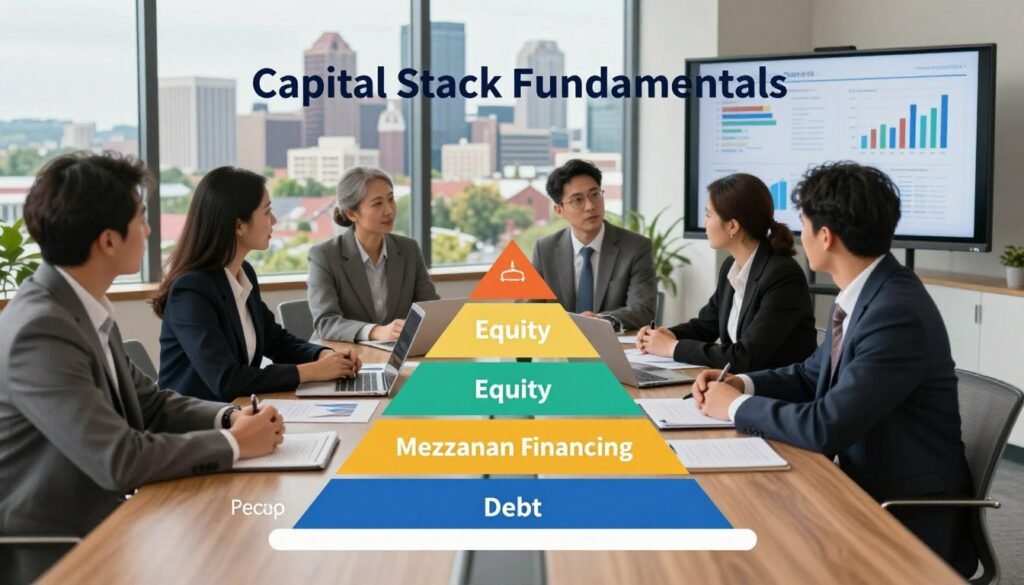
How you place debt, equity, and public support determines whether a development is fundable and resilient.
Baseline model: senior debt (often a bank or bond proceeds), sponsor equity, and public or catalytic layers—grants, tax credits, and subordinated loans—that close gaps and improve feasibility.
Where risk sits and how pricing shifts
Entitlements, environmental clearance, leasing, construction, and takeout are the usual risk points. Senior lenders focus on collateral and coverage. Equity holders price upside and downside protection.
“Reduce risk through documented milestones and strong lender communication — that moves pricing in your favor.”
Common funding sources and practical moves
- Traditional banks and bond issuers for senior debt.
- CDFIs (NIIF-style) for bridge or gap capital.
- State programs and quasi-public issuers (DHCD, MEDCO) for tax-exempt bonds and credits.
When costs exceed value: chase incentives, sharpen tenancy strategy, or phase delivery so early wins restore underwriting. Run debt and equity in parallel and be ready to firm terms once GMP pricing and approvals land.
For a deeper process guide, see navigating the capital stack.
Urban Maryland deal structures that unlock redevelopment and community value
Complex city deals succeed when public grants, bridge loans, and tax-exempt tools align around a clear delivery plan.
The Reservoir Square project turned an 8-acre former public-housing site into a phased development with measurable community benefits.
Phase one delivered 120 builder-ready townhome lots by funding demolition, restoring the street grid, and connecting utilities.
How grants and state funds de-risk early work
Early DHCD Project CORE grants and a small state capital allocation paid for demolition and grading that private lenders would not fund first.
That public portion reduced immediate risk and made lot sales and front-foot fees a viable path to recover infrastructure costs.
Bridge finance, tax-exempt bonds, and public-tenant anchoring
When timing gaps threatened progress, CDFI bridge loans kept the team moving—initial $3M followed by $6.1M for the office phase.
Mesirow underwrote $24M in tax-exempt lease revenue bonds issued by MEDCO, lowering interest roughly 200 basis points and stabilizing payments.
Using a public tenant (MOED) as the anchor translated into a modified sale/leaseback approach that attracted lower-cost, long-duration capital.
Closing complexity and practical lessons
Last-minute shifts happen: an NMTC lender withdrew weeks before closing and the deal was reworked by replacing that portion with CORE funding so momentum stayed intact.
| Component | Source | Result |
|---|---|---|
| Demolition & early infrastructure | CORE grants + state funds | Reduced appraisal-gap risk; enabled lot sales |
| Bridge financing | NIIF (CDFI) | Maintained schedule during funding cycles |
| Long-term financing | MEDCO tax-exempt bonds | ~200 bps lower interest; stabilized payments |
| Anchor strategy | Public-tenant lease (MOED) | Supports lower-cost capital via sale/leaseback |
“Design a stack that can be simplified quickly without breaking the deal.”
Suburban and small-city Maryland CRE: simpler stacks, different constraints
Suburban and small-city projects often rely on straightforward financing because market signals are clearer and execution paths are shorter.
Why simpler stacks work: when comps, leasing deals, and exit value are visible, a senior bank loan plus sponsor equity usually suffices. That model keeps costs and oversight low and speeds closings.

When traditional bank loans work and when they don’t
Bank lenders favor predictable absorption and liquid collateral. A conventional loan fits when tenant commitments and comparables support the appraisal.
Banks stop working when appraised value trails costs, tenant demand is weak, infrastructure burdens balloon, or the schedule creates high completion risk. In those cases, debt must be supplemented or restructured.
Infrastructure, site readiness, and construction timeline realities
Site readiness is a gating item: utilities, stormwater, access, and approvals often add months and real money before vertical work begins.
Delays push carry costs higher, force extensions, and raise contingency needs. That erodes equity returns and reduces lender comfort.
- Underwriting shifts: lenders in smaller areas stress local demand drivers, absorption timelines, and resale liquidity.
- Practical tactics: conservative leverage, realistic interest reserves, early lender conversations, and clear partner roles for infrastructure scope.
“Simpler stacks still require disciplined sequencing: firm site work before committing to full construction finance.”
Resilient capital stacks: building flexibility into the plan when money, time, and policy shift
Plans that survive shocks layer diverse sources so one loss doesn’t stop construction or operations. A resilient capital stack is a practical playbook. It lets a development absorb rate spikes, grant delays, or partner turnover without a full restart.
Lessons from Crisfield and South Baltimore: Crisfield stalled when a $36M BRIC award was rescinded in April 2025 and only later ordered reinstated on Dec. 11, 2025. That single-grant exposure froze work and raised costs.
By contrast, the South Baltimore Middle Branch initiative used federal, state, local, philanthropic, and potential revenue streams (carbon credits, stormwater fees) so the project could continue at reduced scope. Diversification is financial risk management in action.

Phased delivery and fallback tactics
Pre-plan phases: identify what must finish first and what can wait. Match each portion to a replaceable source so the critical path keeps moving.
Lifecycle funding and incentives
Operations and maintenance often lack steady funding in public-heavy plans. Build recurring reserves or revenue mechanisms up front to avoid gaps after ribbon-cutting.
Common incentive tools—NMTCs, Opportunity Zone equity, and brownfield credits—can fill big gaps. Yard 56 shows how advancing debt and equity in parallel, securing zoning and cleanup agreements, and using NMTC/OZ equity unlocked a $157M stack with ~$96M debt and ~$61M equity.
“Relationship capital—trusted lenders and long-term investors—creates optionality when markets turn.”
For a deeper primer on how market cycles change loan terms and lender behavior, see how market cycles impact commercial loan.
Conclusion
Durable deals are built on layered choices that can be resized or reordered as markets change.
Core takeaway: winning financing is less about a single perfect source and more about assembling a flexible mix that fits location, asset type, and schedule. Reservoir Square shows how public grants, bridge loans, and bonds can be combined and reworked to save a complex urban project.
Crisfield versus South Baltimore underlines why diversification and lifecycle planning reduce single-point failure. Yard 56 demonstrates how advancing debt and equity in parallel — and layering incentives — unlocks bigger outcomes.
Practical next steps: identify the biggest risk, assign which layer should absorb it, and confirm backup sources before you commit major predevelopment capital. Do this with lenders, investors, and your team so the plan can be simplified, resized, or resequenced without losing the investment thesis.
, as policy and underwriting shift, the most bankable approach is a modular plan that keeps the project moving and preserves optionality for future investment.