
Debt Financing and Capital Stack Tactics for Michigan Commercial Assets

cars parked on side of the road near buildings during daytime

Surprising fact: more than 60% of mid‑market commercial projects face a funding shortfall during stabilization, creating delays and cost overruns that erode returns.

The term Michigan Capital Stack means a clear, practical blueprint for how capital enters a commercial real estate project from acquisition through stabilization.

This introduction outlines how debt and financing commonly layer together, where funding gaps appear, and how to build a plan that meets lender rules and market reality in the state.

MSCG positions innovative financial pathways that favor security and institutional trust. Their approach emphasizes compliant, auditable systems and offerings like cash flow stabilization projects and asset‑backed lending structures.

This guide focuses on execution: choosing mixes of capital sources to protect timing, limit surprises, and keep a project bankable as conditions shift. It previews senior bank debt, subordinated/mezzanine debt, C‑PACE, and equity, and explains how each moves risk and funds through the lifecycle.

Key Takeaways

  • Understand the practical definition of the Michigan Capital Stack and its role in a project.
  • Layer debt and financing to close common funding gaps and protect timing.
  • Prioritize compliance and auditable documentation when multiple parties provide funds.
  • Use actionable solutions: size proceeds, sequence funds, and negotiate terms to avoid midstream shortfalls.
  • Expect senior debt, mezzanine, C‑PACE, and equity to each shape risk and lender appetite.

How commercial debt financing works in Michigan development

Commercial development loans move through planned stages, matching cash flow to work completed. Lenders underwrite a project’s ability to repay, then release funding in staged draws tied to milestones, documentation, and risk controls.
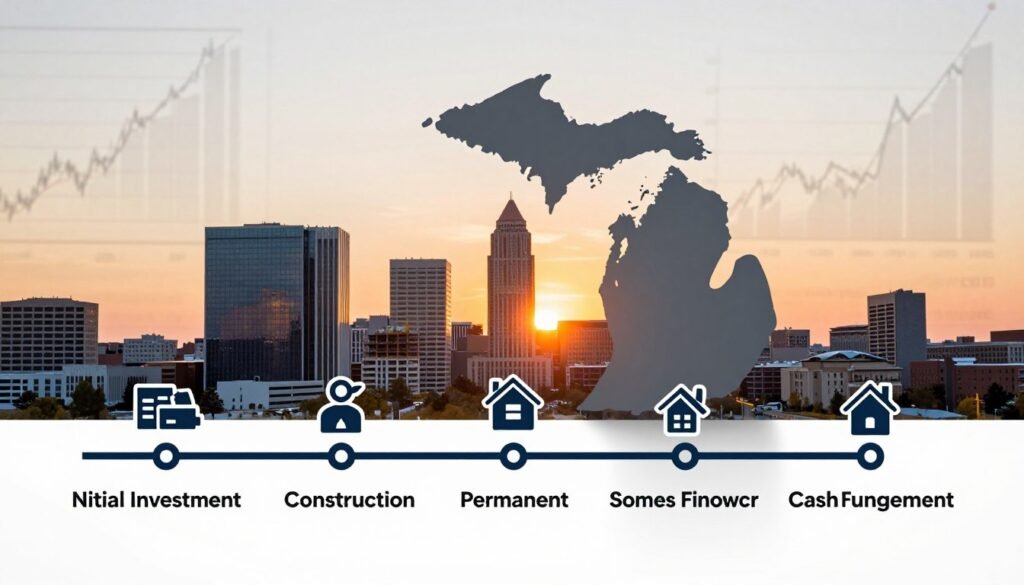
A detailed capital financing timeline illustrated in a sleek, modern style. In the foreground, a series of distinct milestones represent different stages of debt financing: initial investment, construction loans, permanent financing, and cash flow management. Each milestone is marked with icons symbolizing finance, construction, and property management. The middle ground features a stylized cityscape of Michigan, showcasing commercial buildings under development against a vibrant sunset. The background includes softly blurred outlines of financial charts and graphs, emphasizing the economic context. The overall mood is professional and optimistic, suggesting growth and opportunity. The illustration is well-lit with a warm glow, focal points enhanced by gentle shadows. The brand name "Thorne CRE" subtly integrated into the design, reinforcing the industry's focus on commercial real estate finance.

The capital stack is practical: it sets interest, fees, reserves, and the draw cadence that affects closing speed and sponsor flexibility. Each layer shifts the risk profile and changes pricing, approvals, and required covenants.

Where debt fits across the timeline

During acquisition and due diligence, senior bank debt often anchors the plan. In construction, lender draws follow inspections and invoices. During lease-up and stabilization, mezzanine or gap financing commonly fills shortfalls for industrial, multifamily, self-storage, mixed-use, and owner-occupied expansions.

Construction-phase uncertainty—permits, material lead times, and tenant delivery dates—makes time a critical variable. Build contingency and alternative capital solutions into the budget to reduce schedule-driven funding risk.

Quick decision framework

  • Lenders first check repayment source, collateral, and sponsor track record.
  • Prepare audited statements, pro formas, permits, and a clear draw schedule.
  • Show a plan for reserves and contingency so approvals move faster in the state.

Michigan Capital Stack components for commercial real estate projects

A clear parts list makes it easier to price and prioritize each layer of project financing.

A modern office space filled with elements representing capital components for commercial real estate projects in Michigan. In the foreground, a sleek conference table with financial documents, charts, and architectural blueprints showcasing different types of capital stacks, such as equity and debt financing. In the middle, a professional team of diverse individuals in business attire, engaged in discussion, analyzing data on a laptop. The background features a large window revealing a skyline of Michigan's cityscape, bathed in soft afternoon light. The atmosphere is one of collaboration and strategic planning, emphasizing professionalism and insight. The image should convey a sense of purpose and innovation, incorporating the brand name "Thorne CRE" subtly in the display on the conference table. The mood is optimistic and focused, ideal for an article about commercial asset financing.

Senior bank debt as the foundation

Senior bank debt sits first in payment priority and usually offers the lowest interest. It is highly structured, with strict underwriting that shapes the entire financing plan.

Subordinated and mezzanine debt to extend proceeds

Mezzanine and subordinated debt bridge gaps when senior proceeds hit limits. They increase leverage but raise costs, add covenants, and limit refinance flexibility.

Property-assessed financing options that sit alongside traditional loans

Property-assessed programs provide infrastructure-focused funds for energy and resilience upgrades. These loans often run long and require tight compliance documentation so they can co-exist with bank liens.

Equity and sponsor capital as the risk buffer lenders expect

Equity absorbs first losses and reduces lender exposure. Sponsor capital supports construction volatility and improves the project’s bankability.

Sequencing matters: set intercreditor rules, lien priority, and reporting before closing. Practical solutions for common gaps include contingency funding, staged draws, and short-term bridge capital tied to lease-up milestones.

Senior bank loans in Michigan: underwriting, terms, and leverage tactics

Lenders size senior proceeds by clear repayment metrics, not sponsor optimism. Underwriting ties loan amounts to the project’s documented economics, projected cash flow, and repayment sources. Banks expect clean entity structures, timely reporting, and complete closing docs to avoid delays.

A modern bank office interior featuring a professional meeting scene focused on senior bank loan financing in Michigan. In the foreground, two businessmen in tailored suits discuss loan documents at a sleek conference table, highlighting the seriousness of underwriting and terms. In the middle ground, a large digital screen displays financial charts and graphs, emphasizing leverage tactics related to commercial assets. The background showcases large windows with a view of a Michigan cityscape, bathed in warm, natural light filtering through, creating a productive atmosphere. The overall mood is focused and professional, reflecting trust and expertise. Branding subtly visible as "Thorne CRE" on the meeting materials.

Key credit metrics lenders use to price risk and size proceeds

Underwriters focus on debt service coverage, loan-to-cost (LTC), and loan-to-value (LTV). They also review sponsor liquidity, experience, and sponsor equity at risk.

Common expectations:

  • Debt service coverage ratios tied to stabilized operations.
  • LTC/LTV limits that cap leverage and affect pricing.
  • Sponsor track record and available liquidity to handle overruns.

Construction loan structures, draws, and contingency planning

Construction loans use staged draws, lien waivers, inspections, and retainage to control costs and funding reliability. These mechanics increase administrative work but protect lenders and investors.

Contingency planning should include time buffers, line-item allowances for maintenance and punch lists, and a short-term reserve to absorb schedule slips without breaking the plan.

Negotiating covenants, reserves, and recourse to protect cash flow

Banks often require reserves for interest, taxes/insurance, and replacement. Negotiating reserve sizing or timing can improve project cash flow while keeping lender controls intact.

Recourse and guarantees vary: full, partial, or burn-off structures are common. Aim to align guarantee triggers with project milestones and lender risk tolerance.

For practical guidance on sequencing financing and intercreditor terms, see navigating the capital stack.

C-PACE financing in Michigan: using long-term debt to complete the capital stack

C-PACE is long-term, property-assessed financing designed to fund qualifying energy and infrastructure upgrades. It often becomes the missing part that completes a tight funding plan without draining sponsor equity.

A professional office setting in Michigan, showcasing sleek modern architecture. In the foreground, a diverse group of business professionals, dressed in business attire, consult over graphs and charts related to C-PACE financing, displayed on a digital screen. They exude focus and collaboration. In the middle ground, a large, glass-walled conference room reveals a cityscape view with skyscrapers and greenery, symbolizing growth and investment potential. The background features clear blue skies and the silhouette of Michigan landmarks. Soft, natural light floods the room, creating an atmosphere of innovation and forward-thinking. Include branding elements subtly incorporating "Thorne CRE" in the design of the digital charts. The angle of the shot should be slightly above eye level, emphasizing the professionals' engagement with the material.

Romulus self-storage case

PACE Loan Group closed a $1.5M, 25-year C-PACE loan on a 475-unit self-storage project under construction. That loan closed out a $9M capital stack alongside a $5.465M senior bank loan. Extra Space Storage is expected to manage the asset.

Eligible scopes and savings

Scope: building envelope, ENERGY STAR windows, high-efficiency HVAC, plumbing, and LED lighting. Each measure cuts operating costs and improves asset quality.

“Self-storage is a strong C-PACE use case due to the importance of climate-controlled operations.”

— Matthew McCormack, PACE Loan Group SVP-Originations

Intercreditor, timing, and underwriting

Pairing C-PACE with a senior loan needs lender consent, clear lien and tax assessment mechanics, and compliance reporting. Engineers, M&V assumptions, and maintenance plans must be documented so projected savings hold up in underwriting.

Item Value Underwriting impact
Loan amount $1,500,000 Long-term debt improves cash flow timing
Annual savings $57,616 Boosts NOI and supports coverage
Payback 8.5 years Reasonable M&V horizon for bankers

Mezzanine and subordinated debt in Michigan: Grow Michigan II as a stack extender

Mezzanine capital often becomes the practical lever sponsors use to convert growth opportunity into funded reality. It sits below senior loans and above equity, adding flexible proceeds when banks reach conservative limits.

Who typically qualifies

Eligible borrowers are profitable small businesses with strong management teams expanding operations in the state. Underwriting emphasizes operating performance and leadership, not real‑estate only metrics.

Loan sizes and complementary roles

Grow Michigan II, LLC provides subordinated loans sized from $250,000 to $5,000,000. These funds support expansion, equipment, buildouts, and other development that strengthen the operating business behind a real property project.

Coordinating with senior lenders

Mezzanine is meant to complement senior relationships, not replace them. Coordinate intercreditor terms and covenants early to manage risk and avoid conflicting requirements.

Feature Typical Value Impact
Loan range $250k–$5M Bridges funding gaps for growth
Primary use Expansion, equipment, buildouts Strengthens operating cash flow
Documentation Board approvals, reporting, covenants Supports compliance and reduces execution risk

Decide between mezzanine and equity by testing refinance exposure, cash flow variability, and covenant pressure. Operational durability matters: realistic budgets and maintenance plans keep higher‑cost layers manageable.

Do this: ensure the president and executive team align on reporting and lender communication. That clarity protects the capital structure and supports sustained growth.

Conclusion

Successful projects align senior loans, long-term assessments like C-PACE, mezzanine/subordinated debt, and equity with the construction and lease-up timeline.

Start with a proactive plan that maps underwriting triggers to draws so money arrives before schedule pressure becomes a crisis. Size each capital piece to actual lender rules and the asset’s cash flow profile.

Recall practical examples: C-PACE can be a long-term complement to senior lending for qualifying improvements, and Grow Michigan II offers subordinated support for expansion in the state as a flexible part of the capital mix.

Next steps: define use of proceeds, confirm eligibility and fit, stress-test the model, and validate interdependencies before pursuing term sheets. For tactics on timing and rate strategy, see how to secure the best possible.

Choose sources that match the business plan, avoid over-leverage, and keep the capital picture clear to protect execution and returns.


FAQ

How does commercial debt financing work for development projects in Michigan?

Commercial debt financing provides the primary capital for acquisition, construction, and stabilization. Lenders underwrite based on property cash flow, sponsor experience, and exit strategies. Typical structures include construction-to-permanent loans with draw schedules, interest reserves, and required debt-service coverage once stabilized. Borrowers often layer additional products—mezzanine loans or property-assessed financing—to cover gaps between senior loan proceeds and total project costs.

What is a capital stack and why does it matter for project funding, costs, and timing?

The capital stack is the mix of senior debt, subordinated debt, and equity that finances a project. It defines priority of repayment, pricing, and risk allocation. A well-structured stack lowers overall funding costs, reduces timing risk by securing longer-term commitments, and improves lender confidence at key milestones like construction completion and lease-up.

Which commercial project types commonly use debt during construction and stabilization?

Office, industrial, multifamily, self-storage, and retail projects all use construction loans to fund hard and soft costs. Industrial and multifamily often stabilize faster, which helps achieve permanent financing sooner. Self-storage and adaptive reuse projects may rely more heavily on mezzanine or PACE lending to bridge shortfalls during lease-up or retrofit.

What are the core components of a commercial real estate capital stack?

Core components include senior bank debt as the first-loss lender, subordinated or mezzanine debt to extend proceeds, property-assessed financing for eligible energy and resilience upgrades, and sponsor equity that absorbs initial risk. Each layer carries different terms, interest rates, and covenants tied to priority and borrower position.

How does senior bank debt function as the foundation of the stack?

Senior bank loans hold first priority on collateral and set maximum leverage via loan-to-cost and loan-to-value ratios. They define amortization, interest rate risk, covenants, and reserves. Lenders focus on stabilized cash flow, replacement reserves, and sponsor track record when sizing these loans.

When should a sponsor consider subordinated or mezzanine debt?

Sponsors use subordinated or mezzanine debt when senior proceeds don’t fully cover total project costs or when they want to limit equity dilution. Mezzanine fills the gap between senior loan limits and required funding, but it costs more and may demand warrants or higher fees. It’s ideal when projected returns justify the added expense.

What is property-assessed financing and how does it sit alongside traditional loans?

Property-assessed financing (PACE or C-PACE) provides long-term, non-recourse funding repaid via a special assessment on the property tax bill. It finances energy, resiliency, and water-efficiency upgrades and usually sits alongside senior debt with intercreditor agreements to clarify priority and remedies. C-PACE can improve NOI and support longer-term operating savings.

What role does sponsor equity play as a risk buffer for lenders?

Sponsor equity absorbs initial development and market risk, signaling commitment to the project. Higher equity reduces leverage, improves lender coverage ratios, and can unlock better rates and fewer covenants. Lenders expect a meaningful sponsor stake to protect their position during cost overruns and revenue shortfalls.

What credit metrics do lenders use to price risk and size proceeds?

Lenders rely on loan-to-cost (LTC), loan-to-value (LTV), debt-service coverage ratio (DSCR), and stabilized net operating income (NOI) projections. They also assess sponsor liquidity, experience, and market comparables. These metrics determine leverage limits, margin over index rates, and required reserves.

How are construction loans structured and what should borrowers plan for?

Construction loans use draw-based disbursements tied to construction milestones and inspections. Borrowers should budget for contingencies, interest reserves, and holdback percentages. Proper draw schedules, clear disbursement requirements, and proof of permits and contracts reduce delays and fund shortfalls.

What covenants, reserves, and recourse terms are commonly negotiated to protect cash flow?

Common covenants include minimum DSCR, limits on additional indebtedness, and reporting requirements. Reserves often cover capital expenditures, tenant improvements, and leasing commissions. Recourse terms vary from full recourse for sponsor obligations to non-recourse with carve-outs for fraud, environmental issues, or sponsor bankruptcy.

How does C-PACE financing work to complete a capital stack for commercial properties?

C-PACE provides long-term, assessment-backed financing for eligible energy and resiliency improvements. It typically covers up to 100% of project costs for qualified measures and repays through the property tax assessment. C-PACE can close funding gaps and extend loan maturities beyond conventional lenders’ terms, improving project economics.

Can you give an example of C-PACE used to close a financing gap?

A recent self-storage refinancing used a 25-year C-PACE loan to fund energy and HVAC upgrades, closing out a larger $9 million stack. The C-PACE tranche provided long-term savings and strengthened cash flow projections, allowing the sponsor to secure a favorable senior loan and reduce out-of-pocket equity.

What eligible upgrades typically qualify for property-assessed financing?

Eligible upgrades include HVAC replacement, ENERGY STAR windows, LED lighting retrofits, plumbing efficiency systems, solar arrays, and other measures that reduce operating costs or increase resilience. Projects must demonstrate projected energy or water savings to qualify.

How does C-PACE pair with a local bank senior loan and what intercreditor issues arise?

C-PACE and senior lenders negotiate intercreditor agreements that define lien priority, payment triggers, and cure periods. Banks typically require subordination language or remedies that protect their collateral position while allowing C-PACE to proceed as an assessment on the tax roll.

How should sponsors evaluate C-PACE savings and payback?

Sponsors should run a cash-flow model that compares incremental debt service to expected operating savings, factoring in maintenance and performance risk. A typical analysis includes annual savings and an estimated payback period; for example, a project showing $57,616 in annual savings with an 8.5-year payback can justify long-term C-PACE financing.

Who qualifies for mezzanine and subordinated debt programs like Grow Michigan II?

Qualification generally requires a profitable small or mid-size business expanding within the state, strong management, and a clear use of proceeds tied to growth. Lenders look for established senior relationships, measurable cash flow to cover incremental debt, and a sponsor track record of executing similar projects.

What are typical mezzanine loan sizes and how do they complement senior lender relationships?

Mezzanine loan sizes vary widely but commonly range from several hundred thousand to multiple millions, depending on project scale. Mezzanine lenders coordinate with senior banks via subordination agreements and often perform additional due diligence. Effective mezzanine financing preserves senior lender covenants while enabling higher leverage and accelerated growth.

Leave a Comment

Your email address will not be published. Required fields are marked *

Scroll to Top