

Surprising fact: more than 40% of hospitality projects face cash-flow stress within five years of opening when the funding layers are misaligned. That gap shows why a clear capital structure matters for every real estate venture.
This introduction lays out a practical framework for owners, developers, and investors working on hotels, multifamily, mixed-use, and other commercial estate projects. You will learn how debt and equity fit together, which claims get paid first, and why that order drives risk, pricing, and control.
We preview an “ultimate guide” that explains each layer, the tradeoffs between financing sources, and how underwriting metrics shape proceeds and approvals. Expect clear next steps: term-sheet structure, funding sequence, lender packages, and common stacking mistakes to avoid.
Key Takeaways
- Understand payment priority: the stack order determines risk and pricing.
- Balance debt and equity to protect against rate shifts and refinance windows.
- Structure term sheets with practical sequencing for ground-up and renovation deals.
- Prepare lender and investor packages that highlight underwriting metrics.
- Design a resilient plan for operational swings across the hold period.
How a capital stack works in commercial real estate and why it matters
A clear funding hierarchy determines who gets paid, who controls decisions, and how much each investor can expect to earn.
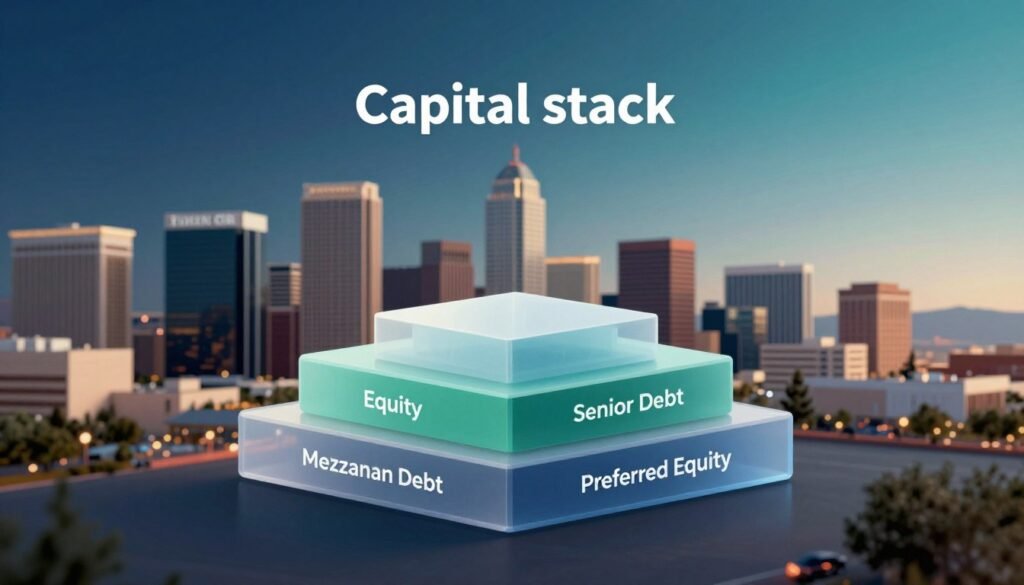
Definition in plain terms: a capital stack is layered funding that combines debt and equity to cover total project costs. Developers use multiple sources of money — senior loans, mezzanine debt, preferred and common equity — to build a viable financing plan.
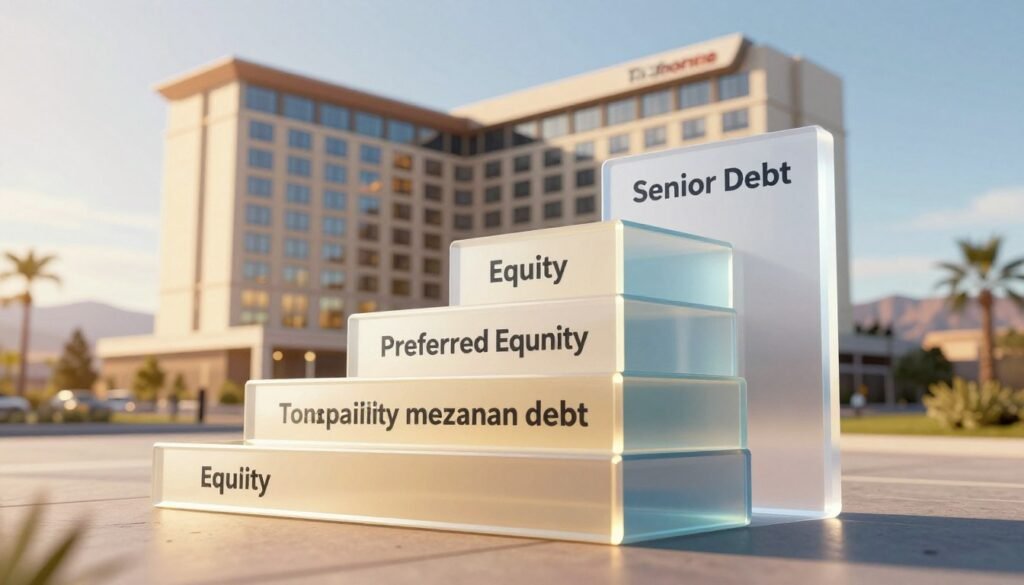
Payment priority and claim position
In default, obligations follow a strict order: senior debt first, then mezzanine, preferred equity, and common equity last. That sequence sets who receives cash and collateral when stress occurs.
How lenders and investors assess the stack
Lenders focus on certainty of repayment through structure, collateral, and covenants. Investors underwrite upside and downside protections like waterfalls, prefs, and promote structures.
- Why position matters: senior positions accept lower interest and lower return expectations because they have first claim on payments.
- Junior positions demand higher yields or participation because they sit behind other claims and carry more risk.
- A well-designed stack can lower weighted cost of capital and improve feasibility; a brittle stack raises refinancing and cash-flow risk.
Think of the stack as a living process that changes from construction draws to stabilization, refinance, and recapitalizations. For deeper tactical guidance, see navigating the capital stack.
Nevada Capital Stack fundamentals for hospitality and commercial real estate projects
A project’s ability to absorb revenue swings drives lender comfort and the overall mix of funding that gets approved.
Nevada market realities that shape financing: income stability, property type, and underwriting conservatism
Underwriting in this market prizes stabilized income. Lenders expect clear evidence that a hotel or mixed-use property can hit pro forma cash flow before they increase leverage.
Property type matters. Hotels carry more revenue volatility than multifamily. That means sponsors often need more equity for hospitality projects to bridge underwriting gaps.
Common capital sources in Nevada CRE: banks, institutional lenders, private investors, and mission-driven lenders
Senior loans typically come from banks and institutional lenders that offer the lowest cost of capital but stricter covenants.
Private investors supply equity and speed. CDFIs and mission-driven lenders fill flexible gaps with patient terms when conventional debt falls short.

Public-sector and tax-advantaged tools that can complement CRE funding
Tax credit equity and community programs — LIHTC, HOME, Affordable Housing Trust Fund, NMTC, USDA programs, and clean energy incentives — can improve feasibility for certain projects.
Future-focused planning: building flexibility for refinance windows, rate shifts, and operational volatility
Plan the stack for years, not months. Anticipate refinance windows, reserve needs, and interest rate resets so the project stays financeable at key milestones.
Decision lens: weigh speed versus cost, flexibility versus covenants, and certainty versus maximum proceeds. Strong pro formas and clear contingency plans reduce perceived risk and improve execution odds.
Core layers of the capital stack: debt and equity options, benefits, and tradeoffs
Project financing succeeds when each funding layer is matched to its role in risk, timing, and return.
Senior debt from banks and institutional lenders
Senior debt anchors the stack because it has first payment priority and the lowest cost of capital. Lenders require covenants, regular reporting, and cash controls that limit sponsor flexibility.
Specialized loan programs for targeted upgrades
Supplemental loans or a loan program for energy efficiency can improve NOI and long-term value.
These programs often carry favorable benefits like below-market interest or longer terms tied to performance.
Mezzanine debt
Mezzanine sits below senior debt and demands higher interest. Mezz lenders may also receive participation rights that affect exit economics and control.
Preferred equity and common equity
Preferred equity pays fixed dividends after debt service and offers limited upside compared with common equity.
Common equity is sponsor capital. It carries the most risk but captures the largest upside when a project outperforms.
“Layering financing can lower blended cost of capital, but it increases negotiation and intercreditor complexity.”
| Layer | Amount ($M) | Percent | Typical cost |
|---|---|---|---|
| Senior debt (banks) | 64 | 64% | Lowest interest |
| Specialized loan (energy) | 5 | 5% | Below-market interest |
| Mezzanine debt | 15 | 15% | Higher interest |
| Preferred equity | 10 | 10% | Fixed dividend |
| Common equity | 6 | 6% | Residual returns |
Benefits of adding layers include improved feasibility and a lower blended cost of capital. Tradeoffs are more negotiation, execution time, and intercreditor coordination.
Underwriting and ROI: how lenders and investors evaluate risk, returns, and payments
Underwriting turns a sponsor’s story into numbers that lenders and investors can test.
Start with two headline tests: loan-to-value and debt service coverage. These metrics show how much proceeds a borrower can expect and whether property income covers debt.
Loan-to-Value mechanics
Typical targets center on 70%-80% LTV. Appraisals set the value percent that lenders use. A low appraisal cuts proceeds even if the business plan looks strong.
Debt Service Coverage Ratio (DSCR)
DSCR proves income supports payments. Hospitality projects usually need higher cushions because revenue swings raise risk and operating leverage.
Profitability and the funding mix
Interest expense, preferred dividends, and payment timing change equity yield and refinance risk. More junior layers raise expected investor returns but reduce cash available for debt.
Lender versus investor decision rules
Lenders want predictable payments and enforceable remedies. Investors want a clear path to targeted returns and alignment with their goals and time horizon.
- Borrower factors that affect terms: track record, liquidity, and completion guarantees.
- Reduce uncertainty with third-party appraisals, sensitivity tables, and clear sources-and-uses.
| Metric | Typical Target | Why it matters |
|---|---|---|
| LTV | 70%–80% | Determines maximum loan proceeds and leverage level |
| DSCR | 1.25×–1.5× (higher for hotels) | Shows income cover for periodic payments |
| Equity return hurdle | 10%–20% IRR | Sets investor return expectations after interest and dividends |
Submission checklist: clear pro forma, appraisal, sensitivity to rate and NOI drops, sponsor resume, and a clean sources-and-uses schedule so every dollar is visible to investors and lenders.

Layering financing in Nevada: public programs, private capital, and tax credit equity
Layering public programs with private capital can turn marginal pro formas into bankable developments. Use grant-like soft funds and tax equity to reduce expensive borrowing. This approach is common for affordable housing, mixed-use, and community-serving projects.
LIHTC overview and long-term compliance
The 9% credit is competitive; the 4% option is non-competitive but useful with tax-exempt bonds. Credits are claimed over a 10-year period. Affordability rules usually extend for at least 30 years and shape asset management for decades.
State-administered soft funds and CDFI tools
The state housing division administers the QAP, HOME, Affordable Housing Trust, and National Housing Trust Fund. Soft funding from these programs lowers hard debt and improves feasibility.
Federal and local catalytic sources
The Capital Magnet Fund channels grants to CDFIs and nonprofits. NMTCs attract private investments to eligible tracts; some cities run local NMTC programs. USDA Section 515 and Section 538 help rural rental housing.
| Source | Best use | Typical term | Effect on pro forma |
|---|---|---|---|
| 9% LIHTC equity | Affordable rental | 10-year credit | Reduces need for hard debt |
| HOME / Trust Funds | Gap financing | Soft loan/grant | Improve cash flow |
| NMTC / CDFI | Mixed-use & community | 7–10 years | Attracts private capital |
| USDA 515 / 538 | Rural rental | Long-term loans | Lower borrowing cost |
Execution realities
Stacking sources often creates duplicative environmental reviews and timing mismatches. Align each program to the right cost category early. That prevents delays and preserves investor confidence.
Case study: Allegiance Apartments in Las Vegas and what it teaches about stack design
Allegiance Apartments shows how mission-driven financing can shape a development’s long-term stability.
Project overview: a new construction, supportive affordable housing property for veterans. It includes 50 units plus a manager unit and sits about 3.7 miles east of the Strip. Accessible Space, Inc. (ASI) will sponsor, manage, and provide services on site.
The income mix targets 30%–60% AMI. Rent stability is reinforced by 24 project-based Section 8 vouchers and 25 HUD-VASH vouchers. That mix helps predict cash flow and payments capacity for investors and lenders.
Funding mix and why no hard debt matters
The development uses 9% LIHTC equity, an ASI sponsor loan, cash-flow contingent loans, and a deferred developer fee. Pending requests include a proposed 12% LIHTC increase, $490,000 AHP, and $600,000 housing trust funds.
No hard debt reduces default risk where rent caps limit NOI growth. For this building, long-term sustainability and service delivery matter more than short-term returns.
| Source | Role | Effect |
|---|---|---|
| 9% LIHTC equity | Primary subsidy | Reduces need for bank loans |
| Sponsor loan (ASI) | Bridge / alignment | Maintains control, supports operations |
| Cash-flow contingent loans | Payable from excess NOI | Limits fixed payments, lowers pressure |
| Deferred developer fee | Back-end pay | Improves early liquidity |
Conclusion
Smart layering of debt and equity shapes outcomes more than the headline amount of money raised.
A capital stack is a risk-and-control architecture that sets payment priority, governance, and resilience for years. Thoughtful design balances debt and equity to manage interest and rate exposure while protecting the project through refinance windows.
Careful layering delivers practical benefits: more feasible deals, greater flexibility, and alignment among investors and lenders. It also adds complexity that requires disciplined execution and clear source documentation.
Underwriting drives proceeds and approvals, so confirm LTV and DSCR readiness and stress-test cash flow under different occupancy, ADR, or rent scenarios. When public programs or a loan program apply, they can reduce hard debt pressure and improve long-term sustainability.
Next steps: finalize sources-and-uses, run sensitivity tests, then sequence outreach to capital providers. The right stack fits the property, the business plan, and stakeholder goals—not just the most money you can raise.