


Surprising fact: research on creatine dates back to the 1980s, and it remains one of the most-studied sports nutrition supplements today.
This short guide turns the “scenario → term sheet” idea into a simple, buyer-friendly path for daily supplement choices. We call this the Thorne CRE Process to map goal setting, ingredient checks, testing, dosing, and cost into clear steps for U.S. shoppers.
Medical note: this is educational content, not medical advice. Supplements are not pre-approved by the FDA for safety or effectiveness; consult a licensed healthcare provider for personal guidance.
We preview a focused review of thorne creatine monohydrate powder and the key factors that drive purchase decisions: testing, purity, mixability, price per serving, and diet fit. By the end, you will know whether this product suits your performance and muscle goals and the safest buying path in the United States.
Key Takeaways
- Creatine is well-studied and worth a careful buying approach for daily use.
- The Thorne CRE Process gives a stepwise way to evaluate supplements for fitness goals.
- We cover testing, dosing, taste, allergens, and price per serving.
- Content is educational only; consult a licensed health provider for advice.
- Readers will learn if thorne creatine fits their goals and where to buy safely in the U.S.
Why this process matters for choosing a creatine supplement in the United States
When you take creatine every day, the buying decision should focus on safety, cost, and proven results.
In the U.S. market many creatine supplements look similar on the label but differ in quality controls and verification. Manufacturers are not inspected by a single federal approval for efficacy, so third-party checks matter.
Commercial reality: daily use makes quality, price, and trust non-negotiable
Daily consistency drives results, so cost per serving, subscription savings, and return policies affect real-world value.
What “streamlined” means for supplement decisions
Trust means verifiable testing, banned-substance screening for competitive athletes, and reliable label claims.
- Prioritize the few variables that change outcomes: form, dose, testing, price, and tolerance.
- This method reduces choice overload and helps compare creatine supplement options without falling for marketing.
- It applies to both competitive athletes and everyday gym-goers, with different risk thresholds.
“Third-party testing reduces the risk of label-claim inaccuracies and hidden ingredients.”
Follow this path and you focus on how creatine supports strength, training capacity, lean-mass gains, and other performance benefits while protecting your nutrition and health priorities.
Initial scenario: define your goal for creatine supplementation
Start by picking the one outcome you most want creatine to help you achieve. That primary outcome directs how you dose, when you take it, and which metrics you track.
Muscle growth and lean body mass goals
If your aim is bigger muscles, use creatine supplementation to boost training output. More volume and higher-quality sets can translate to greater muscle growth when nutrition and recovery are solid.
Expect gradual changes over weeks. Early scale increases may reflect water shifts more than true lean body mass gains.
Strength, power output, and exercise capacity priorities
For higher strength and better power output, creatine helps short, intense efforts—heavy reps, sprints, and explosive sets.
It also supports improved exercise capacity, letting you do extra reps or sets that compound into long-term performance gains.
Cognitive function and brain performance considerations
Interest in creatine for cognitive function is growing. Some data suggest it helps brain energy, but outcomes vary.
If brain support is the priority, try morning dosing and track mental focus or reaction-time tasks alongside physical metrics.
Practical tip: choose 1–2 metrics to track—gym performance, body-weight trend, or training volume—so your supplement decision stays measurable and useful.
| Primary Goal | Key Metric | Recommended Focus | Typical Timeline |
|---|---|---|---|
| Muscle growth | Training volume / body mass | Consistent dosing, pair with progressive overload | Weeks to months |
| Strength & power | Max lifts / sprint time | Near-workout timing, 3–5 g daily | Weeks |
| Cognitive function | Focus / reaction tasks | Morning dosing, monitor subjective changes | Weeks to months |
Product snapshot: Thorne creatine at a glance
Below is a quick, no-frills summary of the product’s core specs and what buyers actually get.
What it is
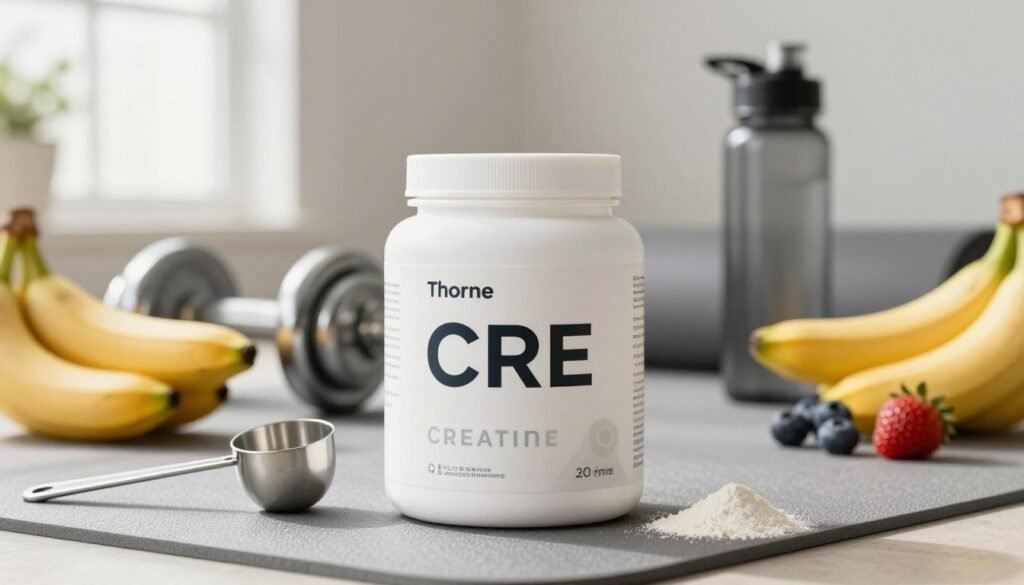
This is an unflavored creatine monohydrate powder with a single ingredient: pure monohydrate. No sweeteners, no fillers, no added flavors.
Per scoop details
Each scoop delivers 5 grams of creatine monohydrate. That dose contains zero calories and mixes with plain water or other drinks. The unflavored profile means you will not taste masking agents and can stack it into shakes easily.
Container size and supply
The tub provides 90 servings. For most users taking one daily scoop, that equals about a three-month supply.
- Form: powder
- Flavor: unflavored (no sweeteners)
- Ingredient list: single ingredient — monohydrate
- Serving size: 5 g
Made in the United States, this product favors a “no extras” label for buyers who want a plain supplement baseline.
Next up: ingredient due diligence, testing, and dosing guidance to judge value and usability.
Ingredient due diligence: creatine monohydrate and why it’s the benchmark
If you want predictable results, focus first on the raw ingredient and its proven role in the body.
How it works: creatine is made in the body from glycine, arginine, and methionine. It supports rapid ATP regeneration through the phosphocreatine system. That boost to cellular energy helps you repeat short, intense exercise efforts.
Why monohydrate remains the standard
Decades of trials back creatine monohydrate as the most studied and cost-effective choice. Newer forms exist, but the bulk of evidence favors monohydrate for performance and safety.
Micronized and mixability
Micronized monohydrate means smaller particles to improve dispersal in liquids and reduce clumps. It can still settle, so a shaker or stirring helps.
Practical decision rule
If the label lists creatine monohydrate at an evidence-based dose, you have met a major quality gate. Consider testing and mixability next.
| Characteristic | Why it matters | Typical finding | Buyer note |
|---|---|---|---|
| Form | Determines evidence base | Monohydrate = strongest support | Prefer labeled monohydrate |
| Cellular energy | ATP regeneration speed | Improves repeat efforts | Helps short, intense sets |
| Micronized | Mixability | Smaller particles, less clump | Use shaker, may still settle |
| Alternative forms | Marketing vs evidence | Less research than monohydrate | OK, but weigh cost vs data |
Quality gate: NSF certified and third-party testing for athletes
Independent verification matters when your sport eligibility or daily routine depends on a supplement. An NSF Certified for Sport label is a buyer-facing signal that the product underwent specific tests for label accuracy and banned substances.
What NSF Certified for Sport verifies
NSF Certified means an independent lab checked that ingredient amounts match the label and screened for a long list of banned compounds. That testing reduces the chance of hidden contaminants and confirms the stated 5 g serving is genuine.
Why banned-substance screening matters
Athletes face strict rules under WADA, and even trace contamination can cause disqualification. Certified screening helps lower that risk and protects competitive careers.
How third-party testing reduces label-claim risk
Third-party testing also helps everyday buyers. It gives peace of mind about purity, lowers the odds of unexpected side effects from unknown ingredients, and supports reliable performance expectations.
- What certification does: verifies label claims and screens for banned items.
- What it does not do: guarantee individual results or eliminate all risk.
- Value note: certified testing can add cost, so weigh the premium against your goals.
“Third-party testing lowers the risk of inaccurate labels and unlisted ingredients.”
Clean-label fit: diet restrictions and allergen considerations
A single-ingredient creatine helps remove guesswork when you manage allergies, audits, or strict meal plans.
Gluten-free, dairy-free, and soy-free positioning
This product is gluten-free, dairy-free, and soy-free. That matters for buyers with sensitivities or for teams with strict testing rules.
Free-from labeling reduces the chance of an unexpected trigger and supports consistent use in validated nutrition plans.
No fillers or additives: when “one ingredient” is a feature
One-ingredient supplements are easier to evaluate. Fewer components mean fewer questions about cross-reactivity or hidden additives.
No fillers also makes stacking simpler. You can mix with protein powders, pre-workouts, or smoothies without competing flavors or sweeteners.
- Free-from claims aid athletes under audit-heavy programs.
- Simpler labels reduce the risk for sensitive users.
- Plain powder improves flexibility in your nutrition routine.
Clean labels don’t guarantee superior results, but they can improve adherence when the product fits your diet and daily habits.
| Feature | Why it matters | Buyer takeaway |
|---|---|---|
| Gluten-free / Dairy-free / Soy-free | Reduces allergen risk and audit flags | Safe choice for sensitive and competitive users |
| Single ingredient | Simpler evaluation and fewer triggers | Best for buyers who want creatine only |
| No fillers/additives | Easier stacking and neutral taste | Mixes cleanly with shakes and meals |
Quick decision lens: if your goal is creatine only — not an all-in-one blend — a single-ingredient product is the most direct route. Once label fit is confirmed, the next question becomes what outcomes are realistic with consistent use.
Evidence-backed creatine benefits you can expect from consistent use
Consistent creatine use produces measurable gains in training quality and recovery over weeks.
Muscle performance and strength outcomes
Creatine improves short-burst energy by helping replenish ATP. That boost supports greater power and higher-quality reps during heavy sets.
Lean body mass and body mass changes over time
Scale weight may rise early from intramuscular water. Over months of training and proper nutrition, creatine can support real gains in lean body mass and muscle mass.
Training volume and long-term muscle growth potential
Small increases in reps or sets add up. More consistent exercise capacity and extra training volume often translate into meaningful muscle growth over time.
Potential brain and nervous system support
Creatine stores in both muscle and brain. Emerging data suggest a plausible role in neural energy and cognitive function, but evidence is less mature than for strength and performance.
Realistic timeline: expect strength and exercise capacity changes in weeks; lean body mass gains often take months with steady training and intake.
| Benefit | Typical effect | When seen |
|---|---|---|
| Muscle performance | More high-quality reps, better power | Weeks |
| Strength | Higher max output in short efforts | Weeks |
| Lean body mass | Gradual muscle mass gains (with training) | Months |
| Body mass | Early water increase, later true mass gains | Weeks to months |
Dosage decision: how to use Thorne Creatine for real-world results
A clear dosing plan turns daily creatine use into steady performance gains.
Maintenance approach: daily 3–5 grams and why 5 grams is common
Practical guide: one scoop (5 g) daily keeps muscle creatine stores topped off for most adults.
Clinical guidance commonly recommends 3–5 g/day for maintenance. The 5 g serving is standard because it matches evidence-based ranges and is easy to remember.
Optional rapid saturation method
If you want faster saturation, take 5 g four times daily for 5–7 days, then switch to 3–5 g/day maintenance.
Note: this is optional. It speeds initial loading but is not required for eventual benefits.
Timing and tolerability: pick a routine you can keep
Timing matters less than consistency. Morning dosing can support cognitive aims, while near-workout dosing suits gym sessions.
Higher total daily doses during loading may upset some stomachs. If GI discomfort occurs, reduce single doses or spread them through the day.
Adherence rule: choose the schedule you will repeat every day—creatine only works when you stick with it.
| Strategy | Typical dose | Pros | Cons |
|---|---|---|---|
| Maintenance | 3–5 g/day (1 scoop 5 g) | Simple, well-tolerated, evidence-based | Slower to saturate stores |
| Rapid saturation | 5 g x4/day for 5–7 days, then 3–5 g/day | Faster muscle saturation | Higher GI risk, more pills/powder |
| Timing choices | Morning or near-workout | Fits routine or training | Timing less critical than daily use |
Once you set a dosage and schedule, the next practical hurdle is mixability. That affects whether you can take creatine daily with minimal fuss.
Mixability and taste: what “unflavored” actually feels like
How an unflavored powder behaves in a glass affects whether you take it daily.
Sensory reality: testers report that thorne creatine tastes largely neutral. Most users call it minimally flavored. A few first-time users notice a faint “supplement” character on the tongue.

Texture and settling
Even micronized creatine can settle. Small particles sink and collect at the bottom if left standing.
That is why stirring again mid-drink sometimes helps. Settling affects mouthfeel, not the product’s biological effects.
Best ways to take it
Use a shaker bottle for the cleanest mix with water. Colder water reduces perceived grittiness.
Alternatively, blend the scoop into a post-workout protein shake or a fruit smoothie to mask any texture.
- Add to a morning glass of water for a simple habit.
- Mix into a protein shake after training for convenience.
- Blend with fruit and ice if you dislike grit.
Practical note: the best supplement is the one you take consistently. Small prep choices—shaker, colder water, or a smoothie—improve adherence and keep your nutrition routine simple.
Side effects and tolerability: water retention, bloating, and GI comfort
Before you start daily dosing, know the typical tolerability signals people report with creatine. Most are mild and temporary, but awareness helps you stick with an effective routine.
Common side effects reported in the literature
Reported effects include bloating, temporary water retention, and abdominal discomfort. These are possibilities, not guarantees, and vary by person and dose.
Water shifts versus true tissue gains
Early increases on the scale often reflect added intramuscular water rather than fat. Over weeks and months, consistent training paired with creatine may produce real gains in lean body mass.
Diarrhea risk at very high doses
Evidence links diarrhea mainly to very high single-day doses. Splitting servings or staying with a maintenance dose reduces GI upset risk.
Mitigation and long-term safety
- Start with a steady maintenance dose (3–5 g/day) and take with food if needed.
- Avoid giant single scoops; split doses if you have sensitivity.
- If problems persist, stop and consult a clinician.
Long-term observational data (up to several years) show no clear adverse health outcomes in healthy adults, but individual medical conditions warrant professional advice.
Special populations: people with kidney disease, pregnant or breastfeeding individuals, and those with chronic health issues should consult a clinician before use.
Price review: cost per serving and what you’re paying for
Understanding price per serving helps you judge value beyond the label.
Typical price math: a tub listed around $40–$42 with 90 servings works out to roughly $0.44–$0.46 per 5 g serving. That math shows a sub-$0.50 daily cost for a standard maintenance dose.
The product sits in the middle of the monohydrate market. It is not always the cheapest option, but the price is reasonable when you factor in extra quality steps and U.S. manufacturing overhead.
What you pay for beyond powder
- NSF Certified for Sport testing adds lab costs and routine audits that raise unit price.
- Made in the United States means domestic quality-control, shipping, and labor expenses.
- Brand systems for traceability, batch testing, and customer support also factor into cost.
Value and risk trade-offs
For competitive athletes or anyone who needs low contamination risk, NSF certification can turn a marginally higher price into a practical necessity. Certification often separates an acceptable buy from a non-starter.
Budget lens: view creatine as a long-game supplement. Monthly cost and subscribe-and-save discounts matter more than one-off sticker prices when you plan for daily use.
When two products list the same ingredient and dose, testing, price per serving, form, and user experience decide the winner.
Competitive set: Thorne vs other creatine supplements
When shoppers compare creatine options, the true differences often live outside the ingredient panel.
Thorne creatine and Optimum Nutrition both use micronized creatine monohydrate at 5 g per serving. Efficacy is similar when dose and form match. Buyers then choose based on testing, price bands, and user experience.
Thorne vs Optimum Nutrition
Plain facts: both are unflavored powders with zero calories. Optimum Nutrition can be cheaper per tub depending on size ($0.36–$0.66/serving range). Thorne lands near $0.44.
Decision point: pick the brand with the certification and trust signals that match your risk tolerance.
Flavored options and sweeteners
Flavored competitors add palatability but often include artificial sweeteners like sucralose or acesulfame potassium. That helps adherence for some users but adds ingredients others avoid.
When capsules make sense
Capsules solve taste and mixability, and they suit travel. Downsides: high pill count to hit 5 g and higher cost per gram. Use the same gates—dose, form, testing, cost, and adherence—to choose any supplement.
“If dose and form match, trust signals and convenience usually decide the winner.”
Who this product is best for and who should pass
This supplement fits clear use cases; matching one to your goals saves time and money.
Best-fit profiles
Competitive athletes who need banned-substance screening and predictable label claims will find value here. These athletes want a product that supports training and keeps muscle creatine stores full.
Maintenance and simplicity buyers
The maintenance buyer is someone already sold on creatine and focused on keeping stores topped up with a steady 3–5 g daily dose.
Simplicity buyers dislike blends and prefer to stack protein or electrolytes themselves. They want a single-ingredient option that keeps choices clean.
Who should pass
If you need flavored shakes, strong sweetness, or an all-in-one powder for convenience, this product is not ideal. New users sensitive to texture may also prefer capsules or flavored options to avoid settling or mild grit.
| Buyer | Why it fits | Key expectation |
|---|---|---|
| Athletes | Certification, purity | Reliable performance |
| Maintenance users | Simple daily dosing | Consistent stores |
| Simplicity buyers | Single ingredient | Easy stacking |
Buying pathway: where to purchase Thorne creatine in the US
Buying channels differ in convenience, return rules, and how products are handled before they reach you. Choose the seller with the best balance of price, shipping, and post-sale support for your needs.
Direct site vs Amazon vs big-box retailers
Direct from the manufacturer often gives the easiest refunds and clear warranty coverage. Brand sites may also list authorized retailers and subscription discounts.
Amazon and big-box stores (Target, Walmart) offer fast shipping and broad availability. However, third-party sellers on marketplaces can vary by storage and return policies.
Authorized retailers and why it matters for returns
Buying from authorized retailers or recognized marketplaces (iHerb, Target, Walmart, Amazon sold-by listings) improves the odds of proper storage and easier returns under brand rules.
- Verify seller authorization on the brand site before purchase.
- Check the seal and expiration date on arrival.
- Keep your order confirmation and photos for returns.
Buyer safety note: the purchase is not final until shipping, delivery condition, and return terms meet your expectations.
Signed term sheet moment: subscription savings, shipping, and return policy
Before you click buy, confirm the economics, delivery certainty, and post-sale protections that make daily use realistic.
Subscribe-and-save options and typical discount ranges
Subscription discounts can cut the per-serving cost and improve long-term adherence. On the brand site, subscribe-and-save runs up to 20% off; Amazon tends to offer around 10% on recurring orders.
For a tub priced near $0.44 per serving, a 10–20% discount lowers daily cost from about $0.44 to roughly $0.35–$0.40. That saves several dollars each month and often justifies committing to a regular schedule.
Delivery expectations and what can vary by seller
Standard ground shipping in the continental U.S. typically takes about 3–7 business days after processing. Expedited 2‑day and overnight options exist for faster needs.
Keep in mind weekends, holidays, and Alaska/Hawaii exceptions can extend transit time. Marketplace sellers may use third‑party fulfillment, which changes handling, tracking accuracy, and return complexity.
60-day satisfaction guarantee and common return scenarios
Practical guarantee: U.S. purchases from the official site or authorized resellers include a 60‑day satisfaction window. Returns may yield a refund, store credit, or exchange depending on the seller and condition.
Common return triggers include damaged seals, crushed containers, or dissatisfaction with texture or mixability. Expired products at the time of return are usually excluded.
Document the unboxing with photos of the seal, lot number, and any damage. This makes customer service faster and smoother if you need a refund or replacement.
“Check the subscribe discount, confirm delivery windows, and photograph the package on arrival — these steps close the deal with confidence.”
Conclusion
A final purchase should balance evidence, cost per serving, and ease of use.
Thorne creatine is a single-ingredient, micronized creatine monohydrate dosed at 5 g per serving. It fits buyers who want a simple, verified option that supports muscle, strength, and performance when paired with training.
Skip it if you want flavored blends, hate any settling or grit, or prefer an all-in-one powder for convenience. For daily supplementation, consistency beats perfect timing; stick to 3–5 g daily for steady results.
Most healthy adults tolerate creatine well, but check with a clinician for personal medical concerns. Now pick your seller, confirm subscription and return terms, and commit to a routine that delivers measurable fitness and nutrition benefits.