
Surprising fact: a recent PwC investor survey values the U.S. IOS market near $200 billion, with over $1.7 billion in institutional capital raised recently.
This guide starts with a clear purpose: teach investors, lenders, asset managers, and brokers a repeatable underwriting template for yard-focused assets. Underwriting here means forecasting cash flow, stress-testing tenancy, and validating site functionality as the true income engine—more than building square footage alone.
Yard-based property types—trailer and container yards, cross-dock terminals, fleet hubs, and contractor yards—each deliver different KPIs and risk profiles. Zoning limits and municipal reluctance create a supply-constrained backdrop that lifts value for well-positioned sites.
Why this matters now: as institutionalization grows, expectations for lease docs, reimbursement rules, and reserve planning rise. The Ultimate Guide that follows ties revenue, expenses, lease clauses, tenant credit, zoning, and cap rates into a defensible NOI and valuation story.
Key Takeaways
- IOS demand is large and increasingly institutional, raising underwriting standards.
- Focus underwriting on land utility, circulation, and permitted uses over building size.
- Different yard types produce distinct KPIs and lease risks to model.
- Zoning scarcity supports value but increases vacancy and entitlement risk.
- Use clear lease terms, reimbursements, and reserves to protect cash flow.
Industrial outdoor storage explained: what an IOS property is and why it matters
For this asset type, the improved land—the yard—often carries more value than any single building.
Definition: industrial outdoor storage refers to properties where the usable yard, gated parking, and paved circulation are the primary income source. These sites differ from bulk warehouses and truck stops because they monetize open area, not enclosed dock space.
Low building coverage is common. Think of a 12,000–15,000 SF building on 10–15 acres. That yields a FAR under 0.25 and shows why the land and usable area drive revenue.
Core physical attributes
- Secured yard with gates and fencing
- Durable, drivable surfaces and drainage
- Lighting, circulation geometry, and loading areas
- Minimal specialized improvements to keep replacement cost low
| Attribute | Typical metric | Underwriting impact |
|---|---|---|
| Building coverage | <20% / FAR ≤0.25 | Yard-focused rent model |
| Yard quality | Paved, graded, gated | Utilization and price-per-spot |
| Location | Near highways/ports | Demand durability |
Why it matters: these properties support logistics functions—parking, staging, and laydown—in infill corridors where land is scarce. Underwriting should treat the yard as the rent-producing product and the building as supporting infrastructure unless heavy maintenance is the tenant’s core use.
IOS market dynamics in the United States: demand drivers, scarcity, and institutional capital
Why now: demand has migrated down the chain. Each new distribution center and manufacturing node creates follow-on need for fenced parking, staging, and laydown areas. That structural linkage keeps utilization high near ports and highway junctions.

Size and capital flow
Scale matters. The PwC Investor Survey (2024 2Q) pegs the U.S. market at roughly $200B, with more than $1.7B in institutional capital raised recently. That inflow explains why more investors are allocating to the sector over the past five years.
Fragmentation and the aggregator playbook
Supply is fragmented, so aggregators build portfolios from many small deals. Operators such as Industrial Outdoor Ventures, Alterra Group, Transport Properties, Triten IOS, and Zenith buy $1M–$5M value-add yards and roll them into institutional assets.
Scarcity, cycle nuance, and underwriting
Zoning reluctance and NIMBYism constrain supply, which supports rent growth and low vacancy in prime corridors. Short-term freight softness can temper leasing, but scarcity creates a durable pricing catalyst. Underwriting must separate cyclical tenant headwinds from structural supply limits to assess long-term opportunity.
| Driver | Evidence | Underwriting impact |
|---|---|---|
| Demand uplift | New warehouse nodes → follow-on yard needs | Stable utilization; predictable cash flow |
| Institutional capital | $1.7B+ recent fundraising; $200B market size | Lower cap-rate premium; more lender options |
| Supply constraint | Zoning, NIMBY, entitlement friction | Scarcity premium; lower new supply |
Property types and how each changes underwriting
Yard-use assets come in distinct subtypes, and each subtype calls for its own underwriting playbook.
Why a taxonomy matters: treat properties by use, not as one monolith. Metrics, capex needs, and lease clauses vary by tenant and function.
Trailer and container yards
Underwriting centers on parking density, striping, and circulation efficiency. Price-per-space and utilization assumptions drive revenue. Local competition for secure parking affects achievable rents and turnover.
Cross-dock truck terminals
Doors and throughput are the primary value drivers. Model using price-per-door per month and expected daily throughput. Operational layout and dock count directly affect revenue per space.
Fleet maintenance and repair hubs
Service bays and specialty improvements raise capex and downtime sensitivity. These upgrades can boost tenant stickiness when maintenance is mission-critical, but factor higher reserve lines.
Contractor and utility yards
Laydown needs for reels, pipe, and heavy equipment require load-bearing surfaces and staging geometry. Environmental diligence and permitted outdoor rights can materially change underwriting and lease terms.
Takeaway: revenue quoting, expense pass-throughs, and lease restrictions must be customized by type to protect cash flow and value.
Site fundamentals that drive cash flow: location, layout, and functional utility
A site’s layout and nearby links often determine whether the asset cash flows or just sits idle. Underwriting should start with physical utility before the rent roll.
Infill versus mega-sites
Infill parcels typically range 0.5–3 acres and command higher per-acre rents. They suit dense customers and deliver quick occupancy.
Mega-sites (50+ acres) provide scale, more amenities, and different tenant profiles. Larger areas can support staged development and stronger exit liquidity.
Access, adjacency, and the improvement stack
Proximity to ports, intermodal hubs, and highways lifts occupancy and pricing because transportation efficiency is the tenant’s ROI.
The improvement stack matters: paving depth, drainage, fencing, lighting, gates, and security systems all increase usable space and uptime.
Construction reality and underwriting checklist
New construction often faces permit friction and local resistance, so existing well-located sites carry a scarcity premium in supply-constrained markets.
| Item | What to verify | Underwriting impact |
|---|---|---|
| Acreage & shape | Usable acres, odd corners | Functional capacity and price-per-acre |
| Ingress/egress | Turning radii, curb cuts | Operational efficiency and safety |
| Surface & drainage | Paving type, base thickness | Maintenance costs & utilization |
| Security & lighting | Fencing, cameras, gates | Occupancy, renewal probability |
Revenue underwriting for IOS: how rents are quoted, blended, and marked-to-market
Rents for yard-centric assets are quoted in multiple ways, and a clear normalization step is essential for valid comps. CBRE reports quotes per acre, per land SF, per building SF, or as blends; treat each as a distinct unit before comparing.
Quoting conventions and normalization
Convert comps to a single basis—usually per usable land SF—to avoid mixing per-building SF with per-acre figures. That yields an apples-to-apples rental and lets you compare rates across the market.
Parking and storage monetization
Model stalls, trailer spots, and container slots by usable area and circulation efficiency. Striping, turning radii, and aisle width change capacity and utilization, which directly affects revenue per space.
Decomposing “eye-popping” building rents
Example: a quoted $28/SF building rent can be an accounting artifact when the yard is folded into the denominator. Decompose rents into building and yard to avoid overvaluing income streams.
Mark-to-market and renewal strategy
Identify in-place rental, estimate true market by your chosen quote method, and add realistic downtime for re-tenanting. Today, many underwriters prefer modest renewals (10–15% bumps) rather than risking vacancy to chase 30%+ growth noted by brokers.
- Key driver: local demand and scarcity determine whether higher market rates are achievable.
Operating expenses and reimbursements: building a durable IOS NOI model
Durable NOI starts with a clear split of expense responsibility and realistic reserves for surface wear and gates.

Typical triple-net framework
Modeling approach: assume a triple-net lease where tenants reimburse most routine opex—security monitoring, insurance, and utilities—while the landlord keeps structural repairs for the building and major drainage fixes.
Expense lines that behave differently here
Yard surfaces, stormwater systems, and lighting wear faster than interior finishes. Budget these as recurring operating costs, not one-time items.
- Surface repairs and re-striping occur more frequently under heavy trailer traffic.
- Stormwater maintenance and drainage checks must be scheduled annually.
- Security systems, gates, and fencing require periodic replacement cycles.
Reserve and capex planning
Set reserves by use-case so underwriting matches real wear over years. Clear budgets reassure lenders and investors and make reimbursements auditable.
| Yard type | Reserve cadence | Annual reserve / acre |
|---|---|---|
| Heavy trailer traffic | Annual | $1,200–$2,000 |
| Contractor laydown | Biennial | $800–$1,200 |
| Mixed-use yard | Annual | $900–$1,500 |
Property management must enforce access, after-hours controls, and storage boundaries to limit expense leakage. Transparent leasing, clear management rules, and disciplined reserve funding protect long-term real estate cash flow as the asset class attracts more capital.
Lease structures for industrial outdoor storage: clauses that protect cash flow
A precise lease turns ambiguous yard use into enforceable rights and measurable income.
Comparing lease templates: a ground lease isolates land revenue and shifts most site risk to the tenant, making it the most protective for owners. A building lease centers on structures and leaves yard duty with the landlord. A blended site lease combines elements to align incentives when both paved areas and buildings produce rent.
Defining the yard
Detail the legal description, fenced boundaries, storage pads, and circulation lanes in exhibits. Call out permitted spots, height limits, and gate access to avoid future disputes.
Use limits and prohibited materials
List banned materials and hazardous items to match local zoning and lower environmental exposure. These clauses aid underwriting and lender acceptance.
| Lease Element | What to specify | Underwriting benefit |
|---|---|---|
| Term & options | Base term, renewals, landlord/tenant options | Predictable cash flow; reversion timing |
| Escalations | Fixed CPI or market reopeners | Balance growth with tenant retention |
| Maintenance standards | Paving, striping, stormwater, gate repair | Lower capex surprise; stable NOI |
Insurance & indemnity: require high limits, pollution riders, and tenant-held environmental policies for equipment and materials storage. Clear obligations reduce lender risk and improve valuation.
For drafting tips and capital considerations, see navigating the capital stack.
Tenant underwriting: credit, business models, and concentration risk in the IOS sector
Good underwriting separates property risk from operator risk. Credit depth, mission-critical use, and local market share determine whether a site produces steady cash flow or faces churn.

Common tenant profiles
National logistics and carriers: XPO, FedEx, UPS, Amazon — large company users whose scale can stabilize demand.
Local and regional operators: building suppliers, equipment rental, contractors, utilities, and school bus fleets. These users are often cash-heavy but smaller in credit size.
Trucking and freight-cycle sensitivity
Trucks and transportation firms drive a meaningful share of demand. When freight slows, renewal probability falls, especially at sharp rent resets.
Underwrite trucking exposure by stress-testing three scenarios: base, down-cycle (30–40% utilization drop), and recovery.
Concentration risk and replacement assumptions
Quantify re-tenanting needs: security upgrades, surface refresh, and marketing. Typical underwriting assumptions:
| Item | Assumption | Underwriting impact |
|---|---|---|
| Downtime | 6–18 months (location dependent) | Vacancy loss; leasing commissions |
| Rehab costs | $25k–$150k (parking vs. repair shop) | Capex reserve requirement |
| Lease concessions | 1–6 months free or TI allowance | Cash flow smoothing for first years |
Assess tenant credit even when filings are absent. Use business durability, local share, and whether the site is mission-critical to the operator.
Investment committees should separate real estate risk (zoning, site utility) from company risk (cycle sensitivity). A balanced tenant mix and tailored lease structure can turn perceived risk into a repeatable opportunity for stable cash flow over years.
Zoning and entitlement risk: the underwriting edge that can make or break returns
Zoning can turn a desirable lot into a financeable asset or a stranded cost overnight.
“Allowable by right” uses and valuation
Allowable by right status is a cornerstone for valuing outdoor storage and industrial outdoor uses. When outdoor activity is permitted outright, lenders view the property as lower risk.
This reduces headline risk, improves financeability, and deepens buyer pools.
Municipal reluctance, NIMBY, and supply effects
Towns are increasingly hesitant to approve new yards. That reluctance limits supply in prime corridors.
Limited supply supports long-term rent growth even when short-term demand softens.
Due diligence checklist and nonconforming risk
- Verify zoning classification and permitted outdoor storage uses.
- Review conditional use permits, expirations, and recorded restrictions.
- Document operating constraints: hours, truck routing, screening, and stormwater mandates.
- Assess nonconforming status: intensity changes can trigger compliance costs or shutdown risk.
| What to verify | Why it matters | Underwriting impact |
|---|---|---|
| Zoning designation | Confirms permitted uses | Stronger valuation if by-right |
| Conditional permits | May limit operations | Conservative growth assumptions |
| Operating limits | Direct cash flow constraints | Adjust revenue and capex forecasts |
Bottom line: entitlement expertise separates durable investments from cheap yards that later become obsolete. Underwrite conservatively when entitlements are fragile; assume stronger growth when the site is fully compliant and defensible.
Future-proofing IOS investments: electrification, amenities, and evolving tenant demands
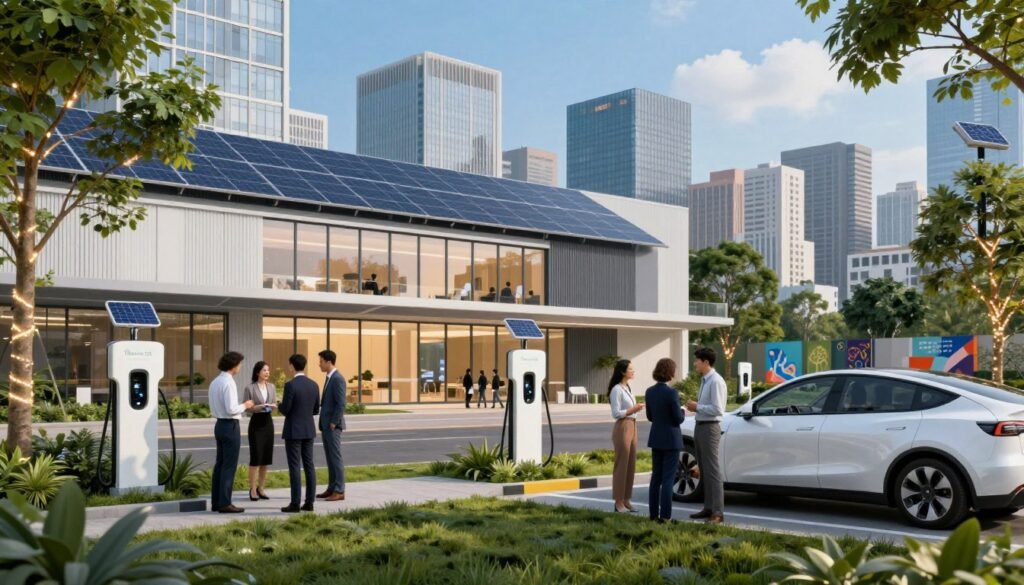
Modern yard investments require a roadmap for power, amenities, and phased upgrades to stay competitive. Underwriters should price upgrades as deliberate, staged projects tied to tenant adoption timelines.
EV fleet readiness
Plan conduit, service capacity, and utility agreements early. Run conduit during initial construction to avoid costly trenching later. Size switchgear and meter capacity to support phased charger rollouts as fleets adopt EV vans.
Model capital and construction timing against tenant demand and carrier decarbonization goals from DHL, UPS, and FedEx.
Mega-site amenities that matter
Mega hubs increasingly add repair bays, driver lounges, restrooms/showers, and dispatch offices. These features reduce downtime and improve driver retention.
- Leasing impact: repair facilities and dispatch space expand the tenant universe.
- Capex tradeoff: higher upfront construction widens demand but must match rent premiums and renewal probability.
| Upgrade | Benefit | Underwriting trigger |
|---|---|---|
| Charging conduit | Low retrofit cost later | Signed EV tenant or capital plan |
| Repair bay | Reduced downtime | Fleet operator LOI |
| Driver facilities | Higher retention | Regional hub demand |
Valuation and capital markets for IOS: cap rates, financing, and portfolio premiums
Valuation in this niche depends more on use clarity and financing depth than on headline comparables. Underwriters must marry site fundamentals with capital market expectations to set defensible pricing.
Cap rate context and observed spreads
Market dialogue shows deals often trade a modest spread to core warehouse comps. Examples cluster near 6–7% versus roughly 5–5.75% for traditional assets.
Choose a cap rate that reflects zoning defensibility, tenant cyclicality, site utility, and renewal risk—not only industrial headline comps.
Financing and lender behavior
Triple-net leases, clear permitted use, and strong site fundamentals materially improve lender terms. Better documentation lowers perceived risk and can shrink borrowing costs.
Institutionalization and portfolio value
As aggregators like Alterra scale portfolios, the average deal size (~$10M) becomes institutional-grade. That drives cheaper capital and can compress spreads over time.
| Input | Impact on cap rate | Practical trigger |
|---|---|---|
| Zoning defensibility | Lower cap rate | By-right use confirmed |
| Tenant stability | Lower cap rate | Long-term NN lease |
| Portfolio scale | Premium pricing | Aggregation / sale process |
Opportunity: underwrite for both asset-level realities and capital-market exits over multi-year holds to capture growth as markets and lenders evolve.
Conclusion
The underwriting lens must start with the lot—its usable area, access, and permit status—before any rent math.
In short: for industrial outdoor storage the yard and entitlements drive value, so cash-flow forecasts should begin with site utility and permitted use.
Market demand remains durable while supply is constrained, which explains why investors keep allocating capital despite some cyclical tenant pressure.
Use the frameworks here: subtype-based underwriting, rent-quote normalization, blended revenue logic, triple-net NOI modeling, and lease clauses that protect cash flow.
Be disciplined on tenant renewals and realistic about downtime and re-tenanting friction. Zoning diligence is the main hedge against downside when municipalities limit new industrial outdoor uses.
Finally, future-proof with electrification readiness and hub amenities. A strong decision combines on-the-ground site facts, clear documentation, and data-backed assumptions—one practical example of underwriting that preserves value.