

33% of new businesses fail because they run out of cash. That stark fact shows how funding choices shape outcomes and why a clear plan matters before you shop for property.
This buyer’s guide is for business owners, investors, and operators who are buying, refinancing, or expanding. It explains how a loan works and how preparation changes approval odds.
Credit, documentation, and deal structure directly affect results. In 2020, 43% of small businesses applied for loans and 20% faced denials for credit issues. Location also matters: rural applicants saw higher approval rates than urban peers.
Read on to learn what lenders prioritize—cash flow, down payment, collateral value, and borrower strength—and what you should prepare next. This guide previews loan types, property classes, underwriting checkpoints, required documents, lender comparisons, negotiation levers, and refinancing paths.
Key Takeaways
- Prepare credit and paperwork early to improve approval chances.
- Lenders focus first on cash flow, down payment, and collateral.
- Understand loan types and how they match different properties.
- Local market signals affect terms and lender activity.
- Compare lenders and negotiate on pricing and covenants.
- Refinancing can free cash for growth or renovations.
How Commercial Real Estate Loans Work for Oklahoma Buyers and Business Owners
Understanding how a commercial loan flows from application to repayment helps business owners plan cash needs and timelines.

Borrower profile and how these loans differ
Unlike a home mortgage, a commercial real estate loan usually sits with an operating company, LLC, partnership, or investor entity.
Lenders judge the entity and the individuals behind it. They focus on income, cash flow, and property performance rather than consumer credit alone.
Lifecycle: from application to repayment
The typical path is application → underwriting → approval and terms → closing → disbursement → repayment.
Underwriting verifies financials, rent rolls, and business plans. Closing sets covenants and funding dates so borrowers can schedule work or acquisition.
How monthly payments are built
Monthly payments most often include principal and interest. Many loans also escrow property taxes and insurance into the monthly bill.
Amortization, interest type, and required reserves determine true carrying costs. Terms and pricing vary by property type and borrower profile.
Prepare before you apply:
- Clean business financials and tax returns
- Detailed property info and pro forma cash flow
- Clear ownership documents and a simple strategy memo
| Stage | What lenders check | Typical timing |
|---|---|---|
| Application | Entity formation, credit, intent | 1–2 weeks to assemble |
| Underwriting | Income, appraisal, DSCR/LTV | 2–6 weeks |
| Closing & Disbursement | Title, covenants, funding | 1–3 weeks after approval |
Today’s Oklahoma Commercial Lending Landscape and What It Signals for Borrowers
Market activity in the metro shows lenders are still moving capital across many deal sizes. In the past 90 days the market closed 835 loans, with amounts ranging from $100,000 to $381,118,756.

Oklahoma City snapshot
The breadth of loan sizes means funding is available for owner-occupied purchases, small-balance acquisitions, and large portfolio deals. Active participants include MidFirst Bank and Rain City Capital, alongside highly active local banks.
What active deal volume means
Well-prepared borrowers benefit most. When volume is high, underwriters move faster and multiple lenders may compete for the same credits.
- Faster execution is possible for clean files, but timing matters for rate locks and appraisals.
- Competition can improve pricing, reduce fees, and soften covenant demands.
- “Most active” lenders range from national bank participants to nimble local institutions; fit and flexibility will vary.
For a checklist to speed closings and leverage competition, see our guide on fast-track loan execution.
Oklahoma Commercial Real Estate Financing Options by Loan Type
Ask first: how will the property generate the cash to repay the loan? That answer drives the choice of product and the lender’s view of risk.

Commercial mortgages for stabilized properties
Best for: operating assets with steady income.
These mortgages use predictable cash flow and standard underwriting. Terms are longer and payments match amortization for long-term owners.
Owner-occupied mortgage requirements
Best for: businesses that run from the building.
Lenders usually expect the owner to occupy at least 50% of the space. This shows commitment and lowers perceived risk.
Investment property mortgages
Best for: passive holdings and leased buildings.
Underwriters treat these as higher risk. Expect larger down payments—commonly 20%–35%—and tighter covenants.
SBA 504 and small business options
Best for: owner-occupied purchase, rehab, or ground-up work.
SBA 504 pairs a certified lender with a CDC loan and needs extra program docs and approvals.
Construction and bridge loans
Construction: funds draws during builds or major rehab. Budgets, timelines, and contractor docs must be clean.
Bridge: short-term capital for lease-up or repositioning. It buys time but costs more.
- Pick the type that matches how you will repay the loan—operating income, lease revenue, or an exit refinance.
Choosing the Right Property Types for Financing in Oklahoma
Match your business goals to asset classes lenders prefer for smoother deal execution.

Use local activity as a guide: industrial (32 deals), general commercial (30), retail (19), multi-family (8), hotel (5), and medical services (2) show what lenders are funding now.
Cash flow stability differs by asset class. Industrial and multi-family often score well for consistent receipts. Retail and hotel depend on foot traffic and tourism cycles. Medical tenants bring long leases and stronger tenant credit.
What lenders watch by asset
- Industrial: low vacancy risk, strong value durability.
- General commercial & retail: tenant mix and location drive underwriting.
- Multi-family: steady rent streams but sensitive to local employment.
- Hotel & hospitality: operational metrics matter; lender sector experience helps.
- Medical: specialized build-outs and longer leases usually support better terms.
| Asset Class | Activity (deals) | Underwriting Focus |
|---|---|---|
| Industrial | 32 | Occupancy, lease terms, local logistics demand |
| General Commercial | 30 | Tenant mix, rental history, market rent |
| Retail | 19 | Traffic, anchor tenants, lease escalations |
| Multi-Family | 8 | Rent roll, turnover, local employment |
Decide if you are an owner-occupied business or an investment holder. That choice steers which property types and loan options best match your strategy and lender expectations.
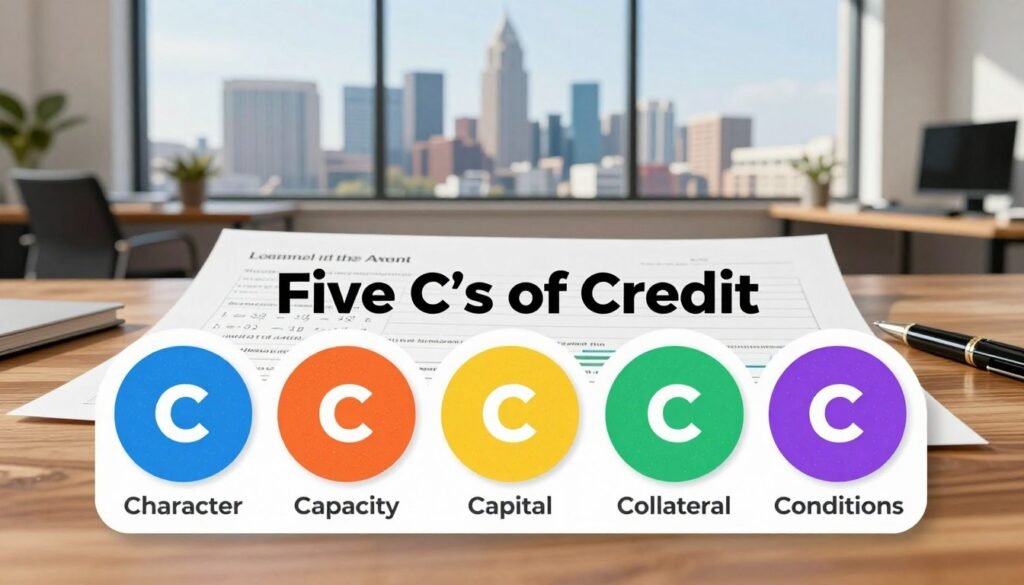
How Lenders Evaluate Your Loan Application Using the Five C’s of Credit
Underwriting uses a simple framework to judge risk and set terms. This approach helps borrowers know what to fix before they submit a loan application.
Character
Character is about trust and track record. Lenders review credit history, payment patterns, and any past defaults.
Misstatements or missing details on an application often trigger denials. In 2020, about 20% of applicants were denied due to credit issues.
Capital
Capital shows your cash reserves and working liquidity. Lenders expect clean financial records to see how a business absorbs slow months.
Collateral
Collateral is the appraised property and its market value. Higher-quality appraisals and good condition lower risk and can improve pricing.
Capacity
Capacity measures cash flow and the borrower’s ability to repay loan obligations. Underwriters run DSCR and stress tests that include other debt and operating needs.
Conditions
Conditions cover industry trends, local market history, and environmental factors. These items can tighten or loosen what lenders will offer.
Quick takeaways: fix credit history early, document capital clearly, and show realistic cash flow to prove your ability to repay loan requests.
Key Underwriting Metrics That Shape Terms, Rates, and Approval
A handful of ratios and timing decisions often determine whether a loan closes and at what cost.
Debt Service Coverage Ratio (DSCR)
DSCR compares net operating income to required debt payments. Lenders use it to judge repayment ability.
A higher DSCR signals lower risk and can improve interest and pricing. Stress-test your cash flow for vacancies or slower revenue months.
Loan-to-Value (LTV)
LTV is the loan amount divided by appraised value. Lower LTVs reduce lender risk and widen options.
Larger down payments often buy better rates, fewer covenants, and more flexible loan options.
Interest Structures
Interest may be fixed or variable. Fixed interest simplifies budgeting but can cost more up front.
Variable interest can lower initial cost but raises rate risk over time. Match your risk tolerance and exit plan to the choice.
Term vs. Amortization
Terms commonly run 5–30 years; many loans are 5–10 year terms with longer amortization schedules.
Short term with long amortization creates a balloon at maturity. Plan refinance or sale timing to avoid payment shocks.
| Metric | What it measures | Why it matters |
|---|---|---|
| DSCR | NOI / Debt payments | Shows repayment ability; higher = better rates |
| LTV | Loan / Appraised value | Affects approval, pricing, and covenants |
| Interest Type | Fixed vs. variable | Impacts budgeting, refinancing flexibility |
| Term vs Amortization | Maturity vs. payment schedule | Determines balloon risk and exit planning |
Document Preparation for Faster Approvals and Cleaner Underwriting
A clear document package can cut weeks from underwriting and give your team a stronger negotiation position. Lenders want consistency and quick verifiable facts. A tidy submission reduces questions and speeds the review of your application.
Core package lenders expect
Prepare business financial statements, recent tax returns, and bank statements. Include rent rolls or leases when the property produces income.
When a business plan helps
Newer operations or special-use projects benefit from a short plan. Lenders look for a clear revenue model, tenant or occupancy strategy, and a repayment timeline.
SBA Form 912 and required signers
SBA Form 912 may be required. It applies to general partners, owners with 20%+, officers, managing members, day-to-day managers, trustors, guarantors, and sole proprietors. Honesty matters: false answers can cause denial.
Prevent common delays
- Match entity names across all documents.
- Use current financials and verify deposits.
- Collect all signatures before submission.
| Document | Why it matters | Tip to avoid delay |
|---|---|---|
| Financial statements | Shows cash flow and credit strength | Use year-to-date and prior year; reconcile variances |
| Tax returns | Verifies reported income | Provide full business and owner returns if requested |
| Leases / rent roll | Proof of income from property | Include signed leases and tenant contact info |
Comparing Lenders in Oklahoma: Local Banks, National Banks, and Non-Bank Options
Different lender types bring distinct trade-offs in speed, covenants, and relationship depth for business borrowers.
Why banks often offer stability
Local banks and national bank platforms generally withstand funding stress better when regulations tighten or capital costs rise.
Stability can mean steadier pricing and deeper portfolio relationships. Personal guarantees remain common with bank lenders and can improve pricing when the underwriting is solid.
What to look for in a lender review
Use this quick framework when you run a lender review:
- Responsiveness: clear timelines and fast answers reduce closing risk.
- Sector experience: lenders that know industrial, retail, or hospitality underwrite faster and more predictably.
- Structure flexibility: willingness to adjust covenants, reserves, or amortization to match your exit plan.
How local activity helps execution
“Most active” lenders in the metro—MidFirst Bank and Rain City Capital among them—often understand appraisal and market norms. That familiarity can smooth underwriting and speed closings.
Compare term sheets, not just quoted rates. Fees, reserves, covenants, and closing timeline affect the all-in cost and your negotiation power.
| Category | Strength | Typical trade-off |
|---|---|---|
| Local banks | Relationship lending; local market knowledge | May require personal guarantees; moderate speed |
| National bank platforms | Scale and standardized products | Less flexible on structure; competitive pricing |
| Non-bank lenders | Speed and creative structures | Higher cost of capital; may tighten when markets shift |
Start rate and term talks early. Begin negotiating cost and covenants before you sign a letter of intent so you keep options open and can secure the best possible rate as the deal advances.
Costs, Fees, and Deal Terms Buyers Should Negotiate Up Front
Upfront cost details shape whether a deal closes smoothly or stalls at the finish line. Identify the cash-to-close and recurring impacts before you sign any term sheet.
Prepayment penalties, closing costs, and reserves
Surface major deal costs early: lender fees, appraisal and environmental reports, legal counsel, and escrows for taxes and insurance.
These items raise your initial cash need and can affect monthly payments and liquidity during the first year.
Prepayment penalties exist to protect the lender’s yield. They can be fixed, yield-maintenance style, or step-down schedules.
Know when a prepay applies—sale, refinance, or whole-loan transfers—and how it changes your refinance or sale math.
Personal guarantees and when they’re commonly required
Many bank lenders require a personal guaranty when the borrower credit or deal risk is higher. That makes owners personally responsible if the property or business cannot cover debt.
Guarantee scope varies: full recourse, limited carve-outs, or time- or amount-limited versions. Stronger borrower financials can reduce guarantee demands.
- Compare pricing not just by interest rate—calculate APR-equivalent costs to judge all-in capital expense.
- Clarify reserves: tax/insurance escrows, capex, and tenant-improvement funds influence cash flow and reserve releases.
- Negotiate levers: request carve-outs for casualty, ask for step-down prepay language, set defined reserve-release triggers, and demand transparent fee schedules.
| Cost Type | Why it matters | Negotiation tip |
|---|---|---|
| Lender fees | Affect cash-to-close and APR | Ask for itemized fees and waiver where feasible |
| Third-party reports | Required for underwriting; timely costs | Shop vendors or share acceptable alternatives |
| Reserves / escrows | Raise ongoing monthly payments and tie up liquidity | Define release triggers and reduce initial holdbacks |
Align negotiated terms with your intended hold period and exit plan. That reduces surprises and keeps refinance or sale options practical for owners and borrowers alike.
Refinancing Commercial Real Estate Loans in Oklahoma’s Current Market
Refinancing can reshape a loan’s cash flow and strategic utility when market conditions or property performance change.
Why borrowers refinance: lower monthly payments, cut total interest, or pull cash out to invest in growth. Owners often refinance after occupancy stabilizes, cash flow improves, or a short-term bridge is repaid.
When refinancing makes sense
- Stabilized occupancy after lease-up improves DSCR and LTV, unlocking better options.
- Stronger business results can move a loan into lower-cost lender tiers and reduce interest expense.
- Replacing a bridge loan with a longer-term product lowers carrying costs and balloon risk.
Using cash-out as an investment tool
Cash-out refinancing converts equity to working capital for renovations, acquisitions, or reserves.
Note the trade-off: higher leverage raises risk and may tighten covenants.
How appreciation and new valuations change choices
Higher property value improves LTV and can open better pricing, longer terms, or access to different lender categories.
Decision checklist
- Compare new loan costs (fees, prepay penalties, and rate) to projected savings in monthly payments and total interest.
- Plan around maturity dates and prepayment windows to avoid rushed closings.
- Balance rate savings with desired structure and covenant flexibility for the property’s next phase.
Conclusion
Clarity wins: lenders respond to concise plans that show how a loan will be repaid and how the property supports payments.
Start by assessing borrower readiness, modeling payments, and shortlisting lenders. Prepare a tidy application with current financials, valuation support, and clear use of capital.
Focus on the Five C’s—credit, capital, collateral, capacity, and conditions—to improve pricing and speed approval. Compare local and national options, weighing total cost and structure flexibility.
Next steps: gather documents, validate value assumptions early, and engage lenders proactively to reduce time-to-close. Keep this guide handy as you evaluate properties, refinance opportunities, or changing market conditions.