
Advanced Capital Stack Structures for Large-Scale CRE Deals in Texas

cows on grassy field under blue cloudy sky

Surprising fact: more than half of major commercial developments now blend three or more funding sources, reshaping how risk and returns are split across a deal.

This guide shows you how layered financing works in large-scale commercial real estate. It explains why the order of payments matters and how different lenders and equity partners fit into a single plan.

Readers will learn to evaluate advanced capital stack options, weigh repayment priority, and link current market drivers—rates, liquidity, and return targets—to stack design.

Who should read this: developers, sponsors, asset managers, and investors assessing big projects and recapitalizations.

Why it matters: large deals rarely rely on a single loan. Sophisticated structures can lower overall cost, balance risk, and improve negotiation leverage with lenders and equity partners.

Key Takeaways

  • Understand how layered financing allocates risk and return across debt and equity tranches.
  • Learn why repayment priority changes valuation and investor incentives.
  • Use the Texas Capital Stack as a decision tool for comparing financing options.
  • See how market conditions drive stack design and underwriting metrics.
  • Apply practical structuring principles for large-scale real estate projects.

Large-Scale Commercial Real Estate Financing in Texas Today

Financing for big commercial projects now requires layered lenders and bespoke terms to match complex cash flows and execution risk.

Why it differs from residential lending: commercial real estate deals are larger, hinge on variable income streams, and depend on sponsor execution and business plans. Legal documents are more detailed and underwriting focuses on property performance, not just borrower credit.

In the foreground, feature a confident business professional in a tailored suit, standing with a laptop and documents on a sleek table, exemplifying the role of an advisor in commercial real estate financing. In the middle ground, depict a modern high-rise building under construction, symbolizing large-scale CRE projects in Texas, with cranes and construction workers in hard hats. The background showcases a skyline of iconic Texas architecture against a clear blue sky, representing growth and opportunity. Utilize natural lighting to create a bright and optimistic atmosphere, with soft shadows for depth. Incorporate elements that suggest financial data, like charts and graphs, subtly integrated into the scene. Include the brand name "Thorne CRE" prominently, emphasizing its affiliation with the commercial real estate sector.

Common funding sources and lender roles

Banks provide senior loans with tighter covenants and lower pricing but expect strong DSCR and collateral. Private lenders accept higher risk for speed and flexible terms.

Institutional capital underwrites via equity or large debt pools and demands governance, reporting, and yield targets from investors.

Major financing channels

  • Traditional bank loans — lower cost, restrictive covenants.
  • CMBS — securitized debt with fixed terms and market trading.
  • Hard money loans — bridge funding at higher interest for execution gaps.
  • Equity financing — sponsor and investor capital for upside exposure.

“Structure must balance liquidity, interest sensitivity, and investor return expectations to support long-term value.”

Channel Typical Use Key Tradeoffs
Bank Loan Stabilized assets Lower cost vs. stricter covenants
CMBS Large transactions Fixed pricing vs. prepay limits
Hard Money Short-term bridge Speed vs. high interest
Equity Value-add or growth Upside potential vs. dilution

Present market conditions — fluctuating interest rates and tighter liquidity — change leverage comfort, refinance risk, and how investors blend debt and equity. The next section describes the layered framework investors use to price these tradeoffs across every capital layer.

Texas Capital Stack: The Layered Framework Investors Use to Price Risk and Returns

Understanding how payments flow through financing layers is the core of deal analysis.

A capital stack is the ordered set of financing layers used to fund a commercial project. Repayment priority determines who is paid first and who is paid last. That order affects cash distributions in upside scenarios and loss allocation in downside events.

A pattern of us one hundred dollar bills.

Who is paid first vs. paid last

Senior debt is paid first; it sits closest to collateral and gets priority on cash. Mezzanine and preferred equity follow, with common equity paid last.

How position drives risk and return

Lower positions accept lower returns because they face less risk. Higher positions demand bigger returns to compensate for loss exposure and uncertain repayment.

Debt holders vs. equity holders

Debt holders have contractual repayment and enforcement rights. Equity holders share ownership and only earn returns after obligations are met. This difference explains why debt pricing, covenants, and control rights tighten as you move up the payment order.

  • Senior debt: lowest risk, first repayment.
  • Mezzanine: subordinated debt or hybrid with conversion rights.
  • Preferred equity: fixed-like returns, paid before common equity.
  • Common equity: upside capital, paid last.

Investors use this layered framework to price risk and returns in real time. When rates or liquidity shift, mixing layers financing can preserve proceeds while aligning sponsor and investor incentives. The next section breaks down typical sizing, pricing norms, and documentation for each layer.

Deep Dive Into Capital Stack Layers and Typical Allocation Ranges

How you weight each financing layer shapes cash flow priorities and loss allocation in big deals.
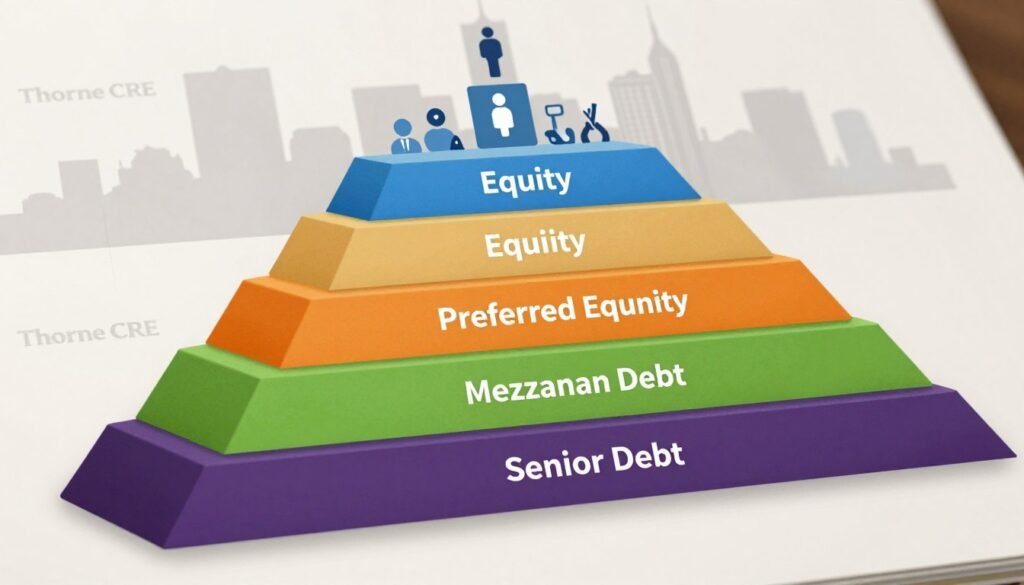
A detailed illustration of a capital stack layered structure, visually representing the different layers involved in large-scale commercial real estate deals. In the foreground, vibrant, color-coded layers showcase equity, preferred equity, mezzanine debt, and senior debt, each section clearly defined with distinct textures. The middle ground features stylized icons symbolizing investors and financial instruments, creating a dynamic contrast with the layers. The background displays a subtle abstract pattern representing the Texas skyline, enhancing the relevance to the locale. Soft, ambient lighting highlights the depth and texture of the layers, while a slight tilt-angle perspective adds an engaging depth to the composition. A professional atmosphere is created, aiming for a formal yet accessible vibe, aligning with the concept of advanced capital stack structures. Include the brand name "Thorne CRE" subtly integrated into the design elements.

Senior debt as the cornerstone layer

Senior debt typically represents 40%–60% of the funding mix. It is secured by the property and has first repayment priority, which makes it the lowest risk capital.

Senior lenders focus on collateral value, stabilized cash flow, and protective covenants to limit downside.

Mezzanine and mezzanine financing as bridge capital

Mezzanine commonly fills gaps at 10%–20%. As subordinated loans, mezzanine debt carries higher interest and tighter documentation.

Mezzanine financing often avoids rewriting senior loans while adding remedies or conversion rights if performance falters.

Preferred equity and common equity

Preferred equity sits after debt but before common equity, usually 10%–20%, and may include current-pay or accrual features.

Common equity is upside capital (20%–60%) and bears the most risk while offering the greatest potential returns when the business plan succeeds.

Hybrids, governance, and reading a term sheet

Advanced structures blur debt equity lines through conversion rights, control remedies, and intercreditor mechanics. These features shift risk, control, and economics across layers.

  • Check where repayment sits and who controls remedies on default.
  • Note conversion triggers and waterfall priorities for potential returns.

For a strategic primer on layering and negotiation, see navigating the capital stack.

Structuring the Stack for Liquidity and Downside Protection in Texas CRE

Designing a resilient financing plan starts with linking leverage to liquidity needs and downside triggers.

A dynamic business scene illustrating "structuring stack liquidity downside protection" in a Texas commercial real estate context. In the foreground, a diverse group of professionals, dressed in smart business attire, collaboratively discusses financial charts and models on a conference table strewn with documents and a laptop displaying the "Thorne CRE" logo. The middle ground features presentations on a large screen showcasing complex capital stack diagrams and liquidity flow charts. The background shows a modern high-rise skyline of a Texas city, with warm sunset lighting casting an optimistic glow. The atmosphere is one of focused determination and strategic negotiation, highlighting the importance of risk management in real estate investments. The image conveys professionalism, collaboration, and innovation in the CRE sector.

Balancing leverage and flexibility

Right-size senior debt to avoid tight covenants that limit amendments and heighten refinance sensitivity.

Over-using senior loans can strip optionality and force costly restructures when leasing or timing slips.

Using mezzanine to fill gaps

Mezzanine financing can bridge funding shortfalls without rewriting senior agreements.

Expect higher cost and more complexity, but keep the project solvent during execution stress.

Optimizing preferred vs. common equity

Preferred equity can give investors seeking priority cash a buffer while protecting common equity upside.

Common equity stays for true upside participation and sponsor alignment.

Key underwriting metrics and capital markets context

Use simple metrics to test stack resilience and repayment capacity.

Metric Formula Decision Impact
LTV Loan Amount ÷ Appraised Property Value Limits proceeds and affects pricing; lower LTV = more lender comfort
Debt Yield NOI ÷ Total Loan Amount Shows leverage risk independent of rates; higher yield = safer debt
DSCR NOI ÷ Annual Debt Service Indicates repayment capacity as rates rise; target >1.25–1.35 on stressed models

With U.S. capital raising projected at $339.7B by 2025, competition among investors may ease access to capital but tighten underwriting.

How market cycles impact commercial loan is a useful reference for matching financing moves to cycles.

Conclusion

Designing a financing mix means matching each funding source to the asset’s timing, risk, and exit path. , This approach makes the capital stack a working framework for managing outcomes in both steady and stressed markets.

Practical takeaway: each layer’s position drives pricing, control, and performance hurdles. Use senior debt, mezzanine, preferred and common equity in proportions that fit the business plan and preserve liquidity.

Recap typical ranges and why they matter: lower senior leverage reduces refinance risk, mezzanine and preferred equity bridge gaps, and common equity captures upside. Apply simple metrics to compare term sheets and defend downside while pursuing competitive returns.

Use the structuring principles and underwriting checks from this guide to evaluate commercial real estate opportunities and to negotiate smarter financing.


FAQ

What makes large-scale commercial real estate (CRE) financing more complex than residential lending in the United States?

Large CRE deals use multiple capital sources, longer underwriting cycles, and detailed cash‑flow models. They require layered financing, customized covenants, and coordination among lenders, investors, and servicers. Market factors like interest rates, liquidity, and investor return expectations also influence structure and pricing in ways seldom seen in residential loans.

What common funding sources are used for major commercial projects?

Large projects tap banks, private lenders, and institutional capital such as pension funds, insurance companies, and private equity. They may also use conduit CMBS, mezzanine lenders, and bridge or hard money providers to fill timing or risk gaps.

Which financing channels are typical in large CRE transactions?

Sponsors blend traditional bank loans, commercial mortgage‑backed securities (CMBS), mezzanine debt, bridge loans, and equity capital. The mix depends on cost, risk tolerance, loan term, and the sponsor’s exit strategy.

How do market conditions shape capital structures today?

Higher interest rates and tighter liquidity push sponsors to dial back leverage, seek creative mezzanine or preferred equity, and offer stronger investor returns. Capital costs, lender appetite, and competitive capital raising affect borrower terms and stack composition.

What is a capital stack and how does repayment priority work?

A capital stack is the hierarchy of funding sources that supports a property. Repayment priority follows the stack: senior debt is paid first, then mezzanine and preferred equity, and common equity is last. Those lower in the stack accept more risk in exchange for higher upside.

How does position in the stack affect risk and return for investors?

Lenders at the top—senior debt—face lower risk and earn lower returns, with priority on repayment. Mezzanine and preferred equity take intermediate risk for higher yields. Common equity holders carry the most downside risk but capture residual upside from operations and appreciation.

What core layers appear in most CRE capital stacks?

Typical layers include senior debt, mezzanine financing, preferred equity, and common equity. Some structures also incorporate bridge loans or convertible/hybrid instruments that mix debt and equity features.

What are typical allocation ranges for each layer in large deals?

Senior debt often represents about 40%–60% of total capital. Mezzanine debt and preferred equity commonly each range from 10%–20%. Common equity frequently accounts for 20%–60%, depending on leverage and sponsor equity.

Why is senior debt considered the cornerstone of a capital plan?

Senior debt usually carries the lowest interest cost and first claim on cash flow and collateral. Its stability underpins lender confidence and helps set leverage limits, making it central to financial feasibility.

When is mezzanine financing used and what are its characteristics?

Mezzanine fills funding gaps without amending the senior loan. It is subordinated to senior debt, carries higher interest or yield, and often includes equity kickers or conversion rights to balance risk and return.

How does preferred equity differ from mezzanine debt and common equity?

Preferred equity sits between debt and common equity. It’s paid after debt but before common equity and typically offers fixed preferred returns. It provides downside protection superior to common equity while preserving control and upside for sponsors more than debt would.

What role does common equity play in a project’s returns?

Common equity absorbs the first losses and receives remaining profits after all other claims. It provides the primary upside via property appreciation and cash‑flow distributions, but it carries the highest risk.

How do hybrid features alter standard stacks?

Hybrids add conversion rights, control remedies, or structured pay‑downs that blend debt and equity features. They can align incentives, manage refinance risks, and provide bespoke control or exit options for lenders and investors.

How should sponsors balance leverage and flexibility when structuring a stack?

Overreliance on senior loans can limit options at distress or refinance. Using mezzanine or preferred equity can preserve borrowing capacity and operational flexibility while matching investor return targets and project timelines.

What underwriting metrics best evaluate stack resilience and repayment capacity?

Key metrics include loan‑to‑value (LTV), debt yield (NOI ÷ total loan amount), and DSCR (NOI ÷ annual debt service). Stress testing cash flows, vacancy scenarios, and interest‑rate sensitivity also helps assess risk across the stack.

How is Debt Yield calculated and why does it matter?

Debt Yield equals net operating income divided by the total loan amount. Lenders use it to judge return on the loan independent of property valuation. Higher debt yields mean greater cushion against value declines.

What is DSCR and how should investors interpret it?

DSCR is net operating income divided by annual debt service. It shows the property’s ability to cover debt payments. A higher DSCR signals safer servicing capacity; lenders set minimum DSCR thresholds based on risk tolerance.

How do market capital raising trends affect competition and terms?

Growing capital availability increases competition for quality assets, often compressing yields and loosening terms. Conversely, tighter markets raise pricing and tighten covenants. Sponsors must adapt stack mixes to prevailing capital supply conditions.

Can preferred equity include control or governance rights?

Yes. Preferred equity can include governance remedies, approval rights, or step‑in provisions that protect preferred holders while preserving sponsor economics. Those rights are negotiated to balance control and return expectations.

Leave a Comment

Your email address will not be published. Required fields are marked *

Scroll to Top