Surprising fact: more than 40% of recent regional commercial projects shifted financing structure in the past two years due to changing bank leverage and program rules.
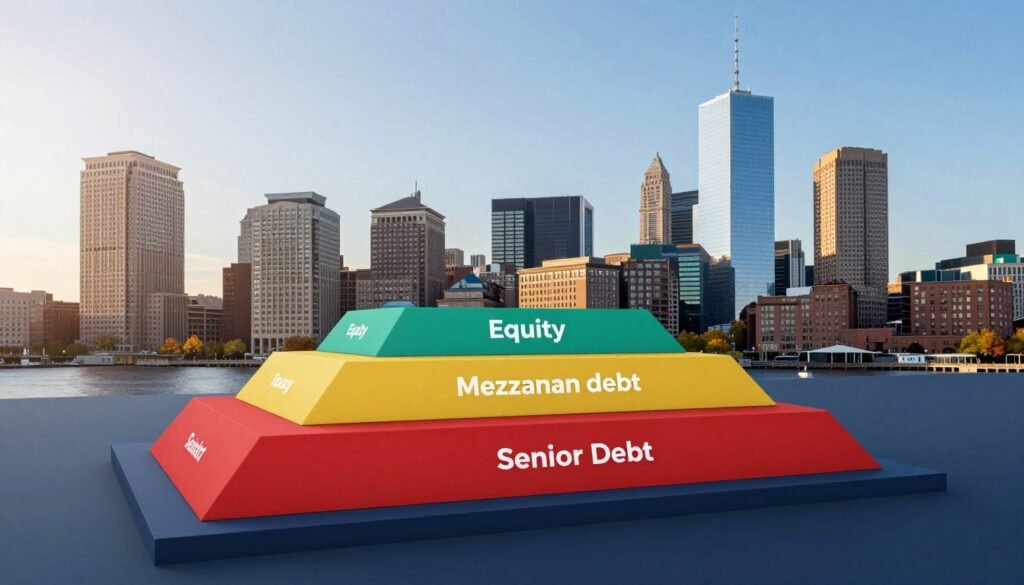
Capital stack design explains how sponsors layer funds for acquisition, construction, and recapitalization. It shows who gets repaid first and who bears the most risk, from equity to senior debt, mezzanine/preferred, and specialty sources.
This guide is the ultimate resource for comparing options by speed, pricing, covenants, and certainty of close. It highlights how today’s market reshapes leverage assumptions and why local rules matter.
Local permitting, municipal programs, and competitive Boston pricing change underwriting and negotiation. Developers, sponsors, LP investors, nonprofit owners, and community stakeholders will find practical frameworks here.
We use a simple evaluation lens—cost of capital vs flexibility vs execution risk—and introduce stack resilience, showing why diversified sources protect projects when one tranche shifts or delays.
Key Takeaways
- Understand the major layers: equity, senior debt, mezz/preferred, specialty sources.
- Compare financing by speed, price, covenants, and certainty of close.
- Local permitting and municipal programs materially affect underwriting.
- Use cost of capital vs flexibility vs execution risk as the core evaluation framework.
- Build stack resilience with diversified funding to reduce execution shocks.
How Capital Stack Design Works in Massachusetts CRE Projects Today
An effective capital stack maps payment priority, control rights, and the ripple effects when schedules slip. In the Boston market, that clarity guides underwriting, pricing, and lender demands.
Practical mechanics for deals
The stack shows who gets paid first and who takes the last loss. That priority drives covenant strength, interest pricing, and sponsor control.
- Construction: draw schedules and completion risk shape senior lender leverage and reserves.
- Acquisition: speed and certainty favor larger senior tranches.
- Recapitalization: re-tranching can extend hold periods or de-lever for stabilization.
Today’s trade-offs
Lenders now trim proceeds vs prior cycles, so developers widen the stack with more equity or alternatives.
Flexibility in documents — extensions, interest reserves, and release prices — matters as much as headline rate. Time-to-close is a competitive edge, but added tranches raise diligence, intercreditor work, and overall cost of funds.
Risk alignment and a decision lens
From groundbreaking to stabilization, completion guarantees, sponsor recourse, and takeout risk determine who shoulders exposure. Use a simple rule: accept lower leverage for certainty when markets tighten, or layer structured subordinate capital when feasibility depends on higher gearing.
Massachusetts Capital Stack: Core Layers, Common Sources, and Real-World Structures
A clear map of funding layers helps developers weigh cost, speed, and execution risk for each project.
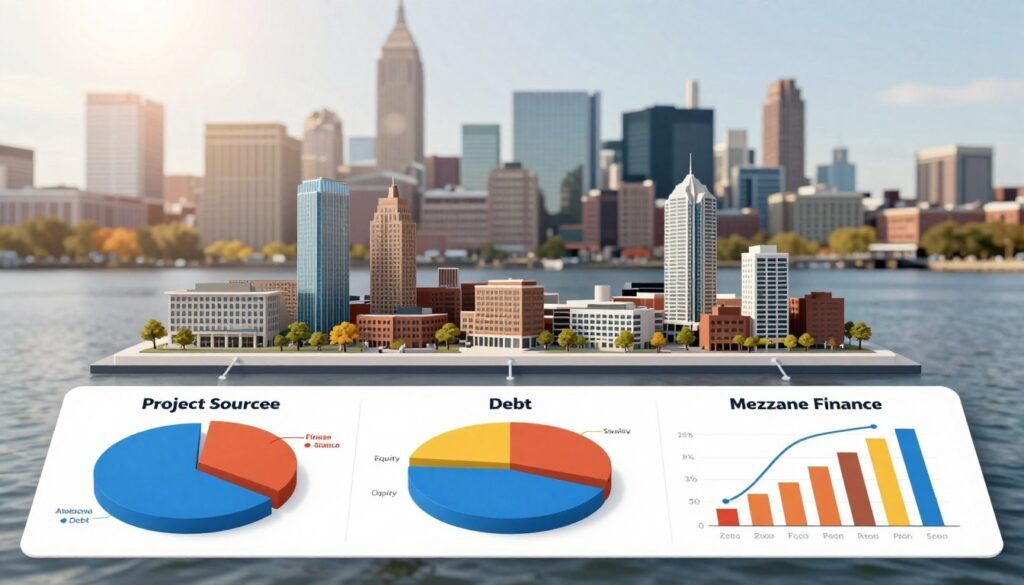
Core layers: sponsor equity sits at the top for control and promote economics. LP equity often takes preferred returns and less daily control. Senior debt covers construction and acquisition but now often funds under 50% of condo builds, shifting more burden to subordinate capital.
Sponsor equity vs LP equity
Sponsor equity provides governance rights and the promote. LP equity typically receives a preferred return and downside protection through waterfalls and catch-up mechanics.
Senior lender constraints
Banks now tighten leverage, DSCR, and debt-yield tests. Appraisals and absorption assumptions can lower proceeds and surprise seasoned developers.
Mezzanine, preferred, and alternative funds
Mezzanine debt sits below senior and above equity with higher pricing and enforcement remedies. Preferred equity can mimic mezz pricing but uses equity remedies. High-yield funds, hedge funds, and foreign investors offer speed and higher proceeds at higher costs and stricter covenants.
| Layer |
Position |
Typical Return |
Control / Remedies |
| Sponsor Equity |
Last loss |
High upside |
Operational control, promote |
| Mezzanine / Preferred |
Subordinate debt/equity |
12–20%+ |
Foreclosure substitutes, equity conversion |
| Senior Debt |
First lien |
Low single digits |
Strict covenants, cash sweeps |
Real-world moves: projects often shift from simple two-layer financing to multi-tranche structures by adding mezz, preferred, or EB-5/crowdfunding to reach pro forma leverage. That increases legal work, intercreditor terms, and overall costs. For a deeper framework on arranging layered financing, see this strategic guide.
PACE Massachusetts in the Capital Stack for Energy and Building Upgrades
PACE programs layer long-term assessment financing under property tax law to unlock deep energy retrofits.

What it is and how the lien works
PACE is a betterment assessment recorded as a lien on eligible property. The assessment stays with the parcel and transfers to a new owner if the property sells, providing continuity for lenders and buyers.
When PACE can substitute for mezz or equity
When senior lenders cut proceeds, PACE can fill gaps tied to energy scopes. It often replaces pricier mezzanine or incremental equity for eligible measures because repayment links to the property and project savings.
Typical terms, eligibility, and underwriting
Terms run up to 20 years with competitive rates and a “no upfront costs” positioning. Applicants must show a savings-to-investment ratio (SIR) where projected energy savings exceed project cost.
Process, providers, and municipal opt-in
Owners assemble an application, document SIR, and select a capital provider from a registry of registered providers. MassDevelopment offers support and can help the owner team compare options.
Availability depends on whether a city or town has opted in; community adoption affects timing and underwriting certainty across the state.
| Feature |
Typical Terms |
Notes / Use Cases |
| Repayment |
Up to 20 years, quarterly/annual collections |
Transfers on sale; lien-backed by tax assessment |
| Eligible properties |
Commercial/industrial, multifamily 5+ units, nonprofits |
Examples: 100,000 sf office modernization; 20-unit retrofit |
| Underwriting |
SIR requirement; open-market capital providers |
MassDevelopment helps identify providers; registration ≠ certification |
For context on how market shifts affect loan terms and layering decisions, see how market cycles impact commercial loan.
Building Resilient Capital Stacks for Massachusetts Communities and Climate-Driven Investments
A diversified funding plan turns a fragile grant into one of several fail-safes, not the whole solution. Use layered approaches so a single program change does not stop multi-year work.
Why diversified funding matters: Crisfield’s stalled $36M flood work shows how reliance on one federal grant can freeze a project even if funding is later restored. By contrast, South Baltimore’s MBRI kept moving by blending federal, state, city, philanthropic, and revenue-like streams.

Blending public, private, and revenue streams
Mix state grants, local contributions, NGO support, and monetizable co-benefits like carbon credits or recreation fees. These revenue-like options help recover costs and increase long-term value.
Lifecycle funding and fallback strategies
Budget for maintenance, monitoring, and adaptive management across years. Plan phasing, rescoping, and sequencing so construction can proceed when some funds lag.
| Resilience Tool |
Typical Use |
Benefit |
Example |
| Layered grants |
Combine federal/state/local |
Reduces single-point failure |
MBRI: multiple grant sources |
| Revenue-like streams |
Fees, credits, partner payments |
Long-term cost recovery |
Carbon credits, recreation fees |
| Phasing & rescoping |
Stage construction |
Keeps momentum under delays |
Sequence critical works first |
Underwriting checklist: ask who covers maintenance, which funds can be delayed without stopping work, and how broad the stakeholder coalition is. Broader coalitions reduce political exposure and lower time and execution risk.
Conclusion
Well-designed funding layers turn financing choices into strategic levers for project certainty and long-term value.
Today’s environment pushes tighter senior proceeds, more complexity, and a premium on certainty. Developers should weigh cost, time-to-close, and risk when choosing a mix of capital and funds.
PACE assessment-based financing remains a practical tool for energy upgrades. It works alongside tax credits and other incentives to support building performance and stronger investment outcomes.
Checklist: define capital needs, validate lender constraints, model multiple stack scenarios, confirm program eligibility, and align the project team early to reduce execution risk.
Across the state, diversified funding and thoughtful structuring help projects stay viable amid policy shifts, market volatility, and evolving climate and office demand.
FAQ
What does “capital stack” mean for construction, acquisition, and recapitalization in the Boston market?
The capital stack describes how a project’s funding is layered — from sponsor equity and limited partner equity to senior loans, mezzanine debt, and preferred equity. For construction and acquisition in the Boston-area commercial real estate market, it determines who controls the project, who absorbs losses first, and how returns are distributed. Developers often combine local bank financing with institutional debt and private equity to balance cost, speed, and control while meeting lender covenants and city permitting timelines.
How do teams balance flexibility, cost of capital, and time-to-close in a shifting lending environment?
Teams balance those factors by optimizing the mix of cheaper senior debt and more flexible but costlier subordinate layers. Quick closings favor committed bank or agency loans; constrained markets push sponsors to accept higher-cost mezzanine, preferred equity, or bridge financing to meet construction schedules. Effective sponsors work with experienced attorneys and lenders to align covenants and use contingency reserves to shorten time-to-close while protecting returns.
How is risk aligned across sponsors, lenders, and investors from groundbreaking through stabilization?
Risk alignment comes from contractual priorities and protections: senior lenders hold first liens and strict covenants, mezzanine lenders and preferred equity take subordinate positions with higher yields, and sponsors retain equity subject to dilution or promotes tied to development milestones. Interim reporting, completion guarantees, and intercreditor agreements allocate construction, lease-up, and operating risks so each party understands loss exposure during development and stabilization.
What roles do sponsor equity and LP equity play in control, returns, and downside protection?
Sponsor equity (the developer’s capital and sweat equity) secures control and promotes alignment with project success, while limited partner equity provides most passive capital and return expectations. Sponsors typically carry management rights and promote interest; LPs receive preferred returns and downside protection via priority distributions and return hurdles. Together, they reduce reliance on debt and signal commitment to lenders and public funders.
Why are senior debt constraints causing banks to lend less than developers expect?
Banks have tightened underwriting due to higher interest-rate volatility, regulatory capital demands, and concentration limits. Appraisal uncertainty and longer lease-up projections reduce allowable loan-to-cost or loan-to-value ratios. As a result, borrowers often face lower leverage, higher reserves, and shorter amortization schedules, pushing projects to subordinate financing to reach target capital structures.
When should sponsors consider mezzanine debt or preferred equity?
Sponsors consider mezzanine or preferred equity when senior debt won’t achieve target leverage or when bridge financing is needed to close quickly. These instruments fill funding gaps, support construction draws, or bridge timing differences between entitlements and long-term financing. Sponsors should weigh higher cost and stricter intercreditor terms against the value of closing on schedule and preserving upside.
How do high-yield funds, hedge funds, and foreign investors fit into complex stacks?
High-yield funds, hedge funds, and overseas capital often provide flexible subordinated debt or equity to achieve higher leverage or speed. They accept shorter-term horizons and higher returns in exchange for looser covenants or creative structures. Sponsors use these sources for difficult assets or transitional plays, but must manage higher interest costs and more aggressive enforcement risk compared with traditional lenders.
Can EB-5 capital and crowdfunding effectively supplement larger or layered deals?
EB-5 capital and accredited-investor crowdfunding can supplement larger deals by bringing nontraditional, lower-cost equity or quasi-debt, especially when institutional sources fall short. EB-5 requires immigration program compliance and extended timelines; crowdfunding has marketing and investor-relations overhead. Both can diversify funding but need careful integration with legal, immigration, and securities requirements.
How do added financing layers change project costs, intercreditor terms, and execution risk?
Each additional layer raises overall cost of capital, complicates payment priority, and tightens intercreditor controls. Mezzanine and preferred equity increase interest expenses and may add prepayment or consent barriers. These complexities can slow decision-making during distress, increasing execution risk. Clear waterfall provisions and experienced counsel help manage those trade-offs.
What is PACE and how does it function as a betterment assessment and lien on property?
PACE (property assessed clean energy) is a financing mechanism where approved energy or resilience upgrades are funded upfront and repaid via a municipal betterment assessment on the property tax bill. The assessment attaches as a lien that can transfer on sale. For eligible projects, PACE offers long terms and predictable payments tied to the property rather than the owner.
Why might PACE replace pricier mezzanine or equity for eligible energy improvements?
PACE can offer lower, fixed rates and long terms (often up to 20 years), reducing near-term cash outflows. Because repayment is a property assessment, it can be cheaper and more predictable than subordinated financing. For qualifying efficiency, renewable, or resilience upgrades, PACE reduces the need for expensive subordinate capital, improving project returns.
What are typical PACE terms and what does “no upfront costs” mean?
Typical PACE terms include fixed interest rates, long amortizations (up to 20 years), and payments collected through local tax assessments. “No upfront costs” means the capital provider funds the project at closing so building owners avoid paying cash at installation. Owners repay over time via the assessment, often aligned with projected energy savings.
Which properties and projects qualify for PACE financing?
Eligible properties include commercial, industrial, and multifamily buildings with five or more units, plus qualifying nonprofit-owned facilities. Qualifying projects focus on energy efficiency, renewable energy installations, and resilience upgrades. Each program has technical eligibility requirements and savings-to-investment ratios to ensure economic viability.
How does the PACE process work, including savings-to-investment and provider selection?
The process begins with an eligibility review and energy audit to demonstrate savings-to-investment. The owner selects a registered capital provider who funds the project and places the assessment. Municipal opt-in is required; MassDevelopment and similar entities often provide program oversight and registration for providers. Successful projects must meet technical standards and deliver projected savings over time.
Why does municipal opt-in matter for PACE underwriting and timelines?
PACE operates through local assessments, so a municipality must adopt an enabling ordinance to allow assessments. Where a town or city opts in, underwriting is simpler and the assessment process is available; where it does not, property owners cannot use that program. Municipal adoption affects project timelines and availability of the mechanism for borrowers in certain jurisdictions.
What does “open-market capital provider model” and “registered providers” mean for PACE?
An open-market model allows multiple private capital providers to compete to fund PACE assessments, giving owners choice on pricing and terms. Registered providers meet program requirements and are approved to place assessments under municipal rules. This model increases capital availability and can lower costs through competition.
Why does diversified funding matter when a single grant or program changes course?
Relying on one funding source risks delay or cancellation if policy or program priorities shift. Diversified funding — blending public grants, philanthropic capital, debt, and revenue-like streams — preserves project momentum and reduces refinancing risk. It also improves resilience against schedule slippage and cost overruns.
How can teams blend public dollars, philanthropy, and revenue-like streams to keep projects moving?
Teams layer grants and tax credits to reduce upfront costs, use revenue-like instruments (such as energy savings or lease revenue) to support debt service, and bring in philanthropic gap funding for social or community benefits. Coordinated closing timetables and sound legal structures ensure each source delivers on time and under clear priority rules.
What is lifecycle funding and why plan for maintenance, monitoring, and adaptive management?
Lifecycle funding anticipates not just construction but long-term operations, monitoring, and capital replacement. Planning for maintenance and adaptive management preserves asset value and ensures performance goals (energy savings, resiliency) are met. Budgeting for these phases reduces deferred maintenance risk and supports investor confidence.
What fallback strategies help when costs rise or timelines slip?
Fallback strategies include phasing work to reduce initial capital need, rescoping to retain core benefits while lowering cost, securing bridge or contingency financing, and renegotiating supplier or contractor terms. Sponsors should maintain transparent communication with lenders and investors to preserve relationships and find cooperative solutions.