


Surprising fact: More than 40% of urban mixed-use projects change financing plans between bid day and closing, often due to misaligned layer design.
This buyer’s guide is for mixed-use sponsors, CRE owners, and acquisition teams who need a bankable blueprint. You’ll get a clear view of how each financing layer shapes control rights, risk, and whether a project pencils at offer and at close.
By the end, readers can compare capital sources, understand repayment priority, and evaluate incentives. Use the checklist with lenders, counsel, and tax advisors to test assumptions.
This piece covers development, redevelopment, new construction, and refinance scenarios common in urban cores and growth corridors. It offers a practical framework—not a one-size-fits-all template—so every team can tailor the mix to costs, timeline, and investor appetite.
Key Takeaways
- Identify who benefits from this guide: sponsors, owners, and acquisition teams.
- Learn how layer design drives control and risk allocation.
- Compare capital sources and repayment priority quickly.
- Evaluate incentives and tax tools to improve returns.
- Use a practical checklist when engaging lenders and advisors.
Why capital stack planning matters for Kentucky mixed-use and commercial real estate projects right now
Rising construction costs and soft demand are changing how sponsors and buyers approach funding. When hard costs climb, owners often need a larger equity check or must accept smaller senior debt commitments. That shift alters control, returns, and timing.

How rising labor and material costs reshape financing
Lenders tighten underwriting. They push for realistic contingencies, guaranteed maximum price terms, and clearer completion risk remedies. Investors demand firmer schedules and verified cost buffers before committing.
What buyers and sponsors should know about cash flow, repayment, and risk
When net operating income is squeezed, the order of repayment determines who gets paid first. That makes repayment priority a critical negotiation point.
- Higher hard costs → bigger equity needs or reduced senior leverage.
- Lenders increase scrutiny on timelines and guarantees.
- Model cash flow during construction and after stabilization to test debt service coverage.
- Use credits and incentives to strengthen the equity position when traditional underwriting falls short.
Kentucky Capital Stack fundamentals for CRE and mixed-use development
A clear capital plan maps who funds a project and who claims returns at each stage.
What a capital stack is: A capital stack is the layered mix of financing used to fund development and construction. It acts as the project’s “who gets paid when” map and sets control provisions, approval rights, and priority on repayment.
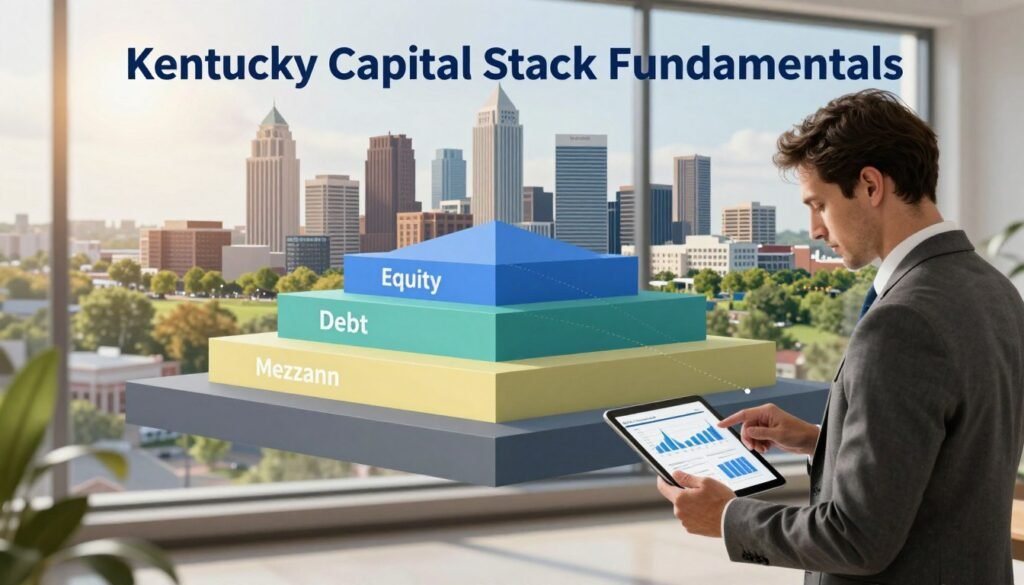
Debt vs. equity: practical differences
Debt holders receive principal and interest first. They win priority and often hold security and covenants.
Equity investors are last in line but capture upside after obligations are met. Equity absorbs early risk and targets higher returns.
Timing and structure across the project lifecycle
Timing drives structure: pre-development costs, construction draws, carry and lease-up reserves, then a refinance at stabilization. Each period changes who must provide funding and the amount required.
- Portion of capital (senior debt, mezzanine, equity) sets weighted cost of capital and feasibility.
- Returns flow through a waterfall: lenders, then preferred returns, then sponsor splits.
- Credits and incentives can reduce the cash equity portion without changing the physical scope.
“Model cash flow conservatively and align contingencies with lender covenants to avoid surprises at close.”
Choosing the right capital stack layers for your project’s risk profile
Match the financing layers to your project’s execution risk and the certainty investors require. Start by mapping who must provide cash and who accepts timing or completion risk.
Equity basics: cash equity vs. sweat equity
Cash equity is money invested for ownership and clear voting rights. It boosts lender confidence and reduces required credit enhancements.
Sweat equity credits labor or management time for ownership stakes. It can preserve cash but usually limits institutional investors unless paired with measurable performance guarantees.
Senior debt and bonds: interest, security, and priority
Senior lenders sit first in repayment. Use a buyer’s checklist: collateral/security, covenants, recourse expectations, and interest terms.
Clear security and conservative LTVs increase leverage certainty and may lower financing cost.

Mezzanine financing: preferred equity & convertible debt
Mezzanine fills gaps when senior loans limit loan-to-cost. It often takes the form of preferred equity or convertible debt.
The tradeoff: higher cost and tighter intercreditor terms, but less dilution than issuing more common equity.
Government contributions as equity substitutes
Grants or direct-pay mechanisms can act like equity because they do not require mandatory repayment. They reduce sponsor cash needs and improve feasibility.
Documentation note: each layer adds stakeholders, approvals, and closing conditions that affect schedule and certainty. Account for diligence time in your timeline.
Tax equity and the Inflation Reduction Act as capital stack tools for CRE
Tax equity lets owners attract investors who chase tax savings rather than operating cash flow. The Inflation Reduction Act widened eligibility, making tax-driven funding practical for more real estate projects.
What tax equity investors want
Tax equity investors underwrite certainty. They value documented eligibility, placed-in-service timing, and firm compliance more than upside from rent.
- Eligibility and technical certification of credits
- Timing of construction and service date
- Documentation, depreciation position, and tax appetite

IRA-eligible asset pairings for mixed-use sites
Owners can pair rooftop solar, battery storage, EV charging, electrification, and energy efficiency upgrades with real estate. These measures generate tax credits and other tax benefits.
ITC versus PTC: upfront value vs. performance
| Feature | ITC | PTC |
|---|---|---|
| Basis | Percentage of eligible capital cost | Value per unit of production over time |
| Timing | Upfront credit at placed-in-service | Streamed over operations (years) |
| Best for | Capital-heavy installs (storage, solar) | Generation-focused assets (wind, clean hydrogen) |
When to use tax equity: it can cut overall cost of capital when credits offset sponsor cash or when the sponsor lacks tax appetite. Manage complexity early—policy rules, prevailing wage requirements, and structured legal documents are common constraints.
Structuring tax equity investments into a bankable stack
To convert tax credits into bankable capital, sponsors must match investor appetite with operational roles. Choice of structure defines who controls operations, who claims depreciation, and how long each party stays in the deal.
Partnership flips and the flip point
Partnership flips allocate most tax credits and some cash to the tax equity partner early. The flip occurs when credit utilization or a target return is reached.
After the flip, economics typically shift toward the sponsor, restoring operational upside and majority economics.
Sale-leaseback mechanics
Sale-leasebacks monetize tax benefits while sponsors retain day-to-day control through a lease. This converts tax-driven value into immediate capital without losing onsite operations.
Inverted leases at a glance
In inverted leases separate lessor and lessee partnerships manage ownership and operations. Rent flows from operator to the tax equity-owned lessee, allowing targeted credit allocation while preserving operational roles.
Transferable credits under the IRA
Transferable credits let owners sell credits directly. They offer timing flexibility but usually trade at a discount versus partnership structures because buyers do not get depreciation or operating cash flow.
Execution checklist and risk controls
- Engage tax and real estate counsel early and secure a clear tax opinion.
- Provide placed-in-service evidence, eligibility diligence, and an investor underwriting package.
- Align senior lender consents with tax equity documents and set compliance monitoring for the required period.
| Structure | Main benefit | Main tradeoff |
|---|---|---|
| Partnership flip | Maximizes early tax credits and investor returns | Complex intercreditor and flip mechanics |
| Sale-leaseback | Immediate capital while sponsor runs operations | Lessor retains tax attributes; lease terms must protect sponsor |
| Inverted lease | Flexible credit allocation with operating continuity | Layered partnerships and rent-flow complexity |
| Transferable credits | Simple monetization and timing flexibility | Lower pricing; no operating cash flow for buyer |
Other tax credit equity options that can attract investors to Kentucky CRE
Non-IRA tax credits can bridge funding gaps and bring specialized equity investors to mixed-use project finance. Use these programs to reduce sponsor cash and widen investor interest.
Historic Tax Credits (HTC): For certified historic buildings, federal HTC equals 20% of Qualified Rehabilitation Expenditures. Credits are claimed ratably over five years. Certification requires the National Park Service and the State Historic Preservation Office, and investors usually expect a five-year ownership hold after placed-in-service.
New Markets Tax Credits (NMTC): NMTCs generate credits equal to 39% of equity invested over seven years via Community Development Entities. They are tied to low-income census tracts and typically cover roughly 10%–20% of total project costs, making them useful gap capital.
Low-Income Housing Tax Credits (LIHTC): When mixed-use plans include affordable housing, LIHTC equity commonly supplies 30%–70% of needed equity. Credits are claimed over 10 years with a 15-year compliance period that affects exit timing and investor returns.
Energy and state/local options: IRC Section 48 credits can be up to 30% of system costs; Section 179D deductions may exceed $5.00 per square foot. State abatements, exemptions, and infrastructure support further enhance feasibility.
- Gather before outreach: site eligibility, use mix, census-tract data, historic status, energy scope, and sources-and-uses.
- Match programs to sponsor timing and lender consents early.
Why it matters: Combining these tax incentives with traditional capital can unlock redevelopment, preserve buildings, expand affordable housing, and attract private capital—delivering measurable economic development outcomes.
Debt options and long-term repayment structures to compare in your buyer’s checklist
Compare long-term debt options side-by-side to see how each affects your borrowing cost and project cash flow. Focus on term, amortization, payment timing, and how a loan fits the broader capital stack before you sign.
Assessment-based financing is long-term, fixed-rate capital repaid via a property tax assessment. It often offers up to 30-year, fully amortized terms, fixed spreads over the 10-year Treasury, and no payments during the construction period.
Underwriting and sizing signals to request early
- Max portion of value: originations commonly size up to ~35% of property value.
- DSCR at stabilization: expect targets near ~1.10–1.30.
- Recourse: typically non-recourse with a completion guarantee for new construction or major redevelopment.
Prepayment flexibility and refinance timing
These loans are usually prepayable anytime with a step-down premium and no lockout. They can be originated at construction, mid-build, or for refinance up to ~3 years after completion—so plan your post-completion refinance window accordingly.
Tip: deferred construction payments preserve cash for contingencies and tenant improvements; align lender consents with tax-credit or incentive timelines to avoid conflicts.
| Feature | Typical Term | Practical Impact |
|---|---|---|
| Amortization | Up to 30 years, fully amortized | Lower long-term debt service, simpler refinance planning |
| Construction deferral | No payments during build | Improves cash flow and liquidity during the critical period |
| Prepayment | Anytime; step-down premium | Gives exit flexibility with predictable premium schedule |
| Sizing | Up to ~35% of property value | Fills a portion of capital needs without diluting equity |
For a clear negotiation roadmap, add this list to your lender outreach and cross-reference financing covenants with incentive documents. For a deeper guide on designing a bankable layer mix, see navigating the capital stack.
Conclusion
A clear financing plan turns funding complexity into executable milestones that protect returns and reduce surprises.
Use this buyer’s guide to confirm that your capital stack aligns repayment priority, control, and risk so the project reaches completion and stabilization with fewer surprises.
Today’s market rewards sponsors who actively manage equity needs and pursue efficient sources of capital, including tax credits and tax equity where eligible.
Tax equity is most powerful when tax benefits are meaningful, an investor can use them, and the structure meets lender underwriting cleanly. Test scenarios that reduce overall cost by monetizing credits or pairing incentives with renewable energy and energy tax strategies.
Next steps: build a sources-and-uses model, size the exact amount of the equity gap, and stress-test alternatives that reduce cash needs and lower cost of capital.
Who to involve: experienced real estate counsel, tax credit advisors, lender or assessment-financing providers, and an accounting firm to validate allocations and compliance.
For practical financing guidance and rate strategy when negotiating loans, see guidance on how to secure the best possible rate on your next CRE.