
Capital Stack Strategies for Northern VirginiaVirginia and Statewide CRE Projects

wide-angle photography of buildings during daytime

Surprising fact: nearly half of investors in syndications say payout timing, not projected yield, determined whether a deal met their goals.

What this means: a clear grasp of the Virginia Capital Stack buyer’s guide helps you see who gets paid first, who shares upside, and who bears losses if a deal f

lters.

Virginia Capital Stack

In plain English, a capital stack explains the order of repayment among debt and equity participants in a real estate syndication. Typical layers in multifamily and broader commercial estate deals are agency or senior debt → preferred equity → common equity → sponsor or GP interests.

This short guide frames how stack design affects payout timing, downside protection, and upside participation. It shows how priority and risk move in opposite directions and why two deals with similar projections can produce very different returns.

Use this guide to compare offerings, interpret distribution priority, and align stack position with investor goals like passive income or appreciation.

Key Takeaways

  • Know your spot in the stack—priority determines when you get paid.
  • Debt brings safety; equity offers upside but more risk.
  • Preferred equity can blend steady distributions with some upside.
  • Compare payout timing across deals, not just headline returns.
  • Stack design matters as much as asset selection and sponsor quality.

Why the capital stack matters to CRE investors in Northern Virginia and across Virginia

Where you sit in the financing ladder decides your cashflow timing, downside protection, and upside potential.

A stylized illustration of a capital stack, visually represented as a multilayered structure, featuring various tiers labeled strategically, such as senior debt, mezzanine financing, and equity. In the foreground, glossy gold and silver bars symbolizing investors' returns, layered meticulously to show their hierarchical relationships. In the middle, a sleek cityscape of Northern Virginia's skyline, showcasing modern architecture with a clear blue sky. The background transitions to rolling hills, indicating statewide reach across Virginia. Soft, warm lighting casts an inviting glow, enhancing the professional atmosphere. The scene should capture a sense of ambition and growth, representing Thorne CRE's expertise in capital stack strategies for commercial real estate investments. No text or watermarks present.

Capital stack basics: how priority and risk move in opposite directions

Think of the capital stack as a ladder. Senior lenders sit at the top and get paid first. Subordinate debt follows. Then preferred equity. Common equity and the sponsor sit last.

This ladder shows the inverse link between priority and risk: higher priority usually means lower risk and lower expected returns, and vice versa.

Portfolio diversification beyond asset classes

Investors can use position within the stack as a tool for diversification. Blending steadier cashflow roles with higher-upside positions balances a portfolio without changing property types.

That approach helps manage exposure while keeping access to different return profiles.

How deal dynamics and the economic climate shape expectations

Changing interest rates, rent collection, expense growth, and refinance windows can shift outcomes even when a business plan looks sound.

Floating-rate debt, execution risk on value-add projects, and paused distributions in downturns change what reasonable returns look like.

Practical takeaway: before comparing projected returns, investors should verify their priority, estimate what could interrupt distributions, and test how long capital may be tied up. That assessment also reveals opportunity cost from earlier capital return and faster redeployment.

Virginia Capital Stack explained for real estate syndication and multifamily deals

Every syndication uses a layered financing recipe that determines payment order, protections, and upside allocation.
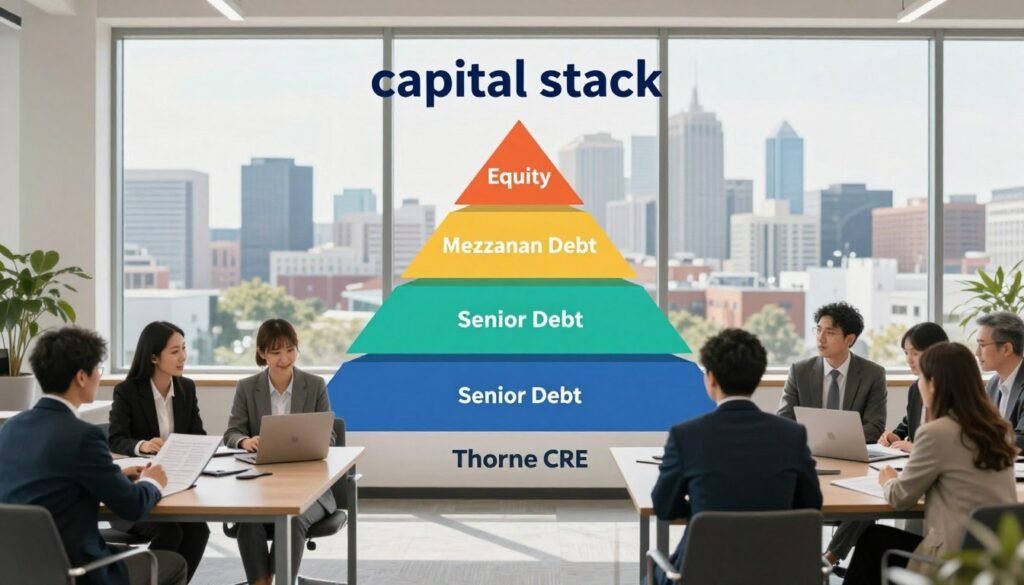
A detailed and visually engaging representation of a "capital stack" diagram, showcasing various layers of financing in a multifamily real estate context. In the foreground, a modern office space filled with professionals in business attire discussing a financial model. The middle ground features a stylized 3D capital stack diagram, clearly delineating different funding sources—equity, mezzanine debt, senior debt—using vibrant colors to differentiate each layer. In the background, a large window reveals a city skyline of Northern Virginia, suggesting the location's significance in real estate syndication. Soft, natural lighting pours in, enhancing the professionalism of the scene. The overall mood conveys collaboration and strategic planning, underscored by the brand name "Thorne CRE" elegantly integrated into the visual presentation.

The financing hierarchy that funds a transaction

The capital stack is the complete financing plan used to buy and operate a CRE asset. Each layer has different rights, protections, and expected returns.

In a typical syndication, senior or agency debt (including Fannie Mae/Freddie Mac loans) supplies most purchase funding. Equity fills the remainder and is often split into preferred and common tiers.

Who gets paid first and why priority matters

Priority means payment order: debt holders are paid before preferred equity, and preferred before common equity. Being higher reduces risk but usually caps upside.

Where LPs and the GP typically sit

Limited partners commonly sit in common equity, sometimes preferred equity, accepting more upside and more risk. The General Partnership is last in line and is compensated after other tiers are satisfied.

  • Checklist: Which layer am I in?
  • Who is senior to me?
  • What must be paid before I receive distributions?
  • Do I participate at sale or refinance?

Practical point: contractual payment priority does not change with projected returns, so confirm your place in the stack before you invest.

Understanding the waterfall and what to look for in the PPM

A waterfall is the payment rulebook for a syndication deal. Money from operations first covers operating expenses and lender obligations. What remains is distributable cashflow that then “trickles down” by class and priority.

A detailed visualization of cashflow distributions, showcasing a sophisticated chart with colorful, flowing curves and bars symbolizing various financial streams. In the foreground, a professional in business attire, analyzing data on a tablet, deeply engaged. The middle layer features a strikingly detailed graph with different segments representing the waterfall structure, highlighted in vibrant colors to illustrate varying cash flows. In the background, a sleek office environment with large windows showing a skyline view of Northern Virginia, bathed in warm, natural light, creating an optimistic ambiance. The composition is shot at a slight overhead angle, emphasizing both the professional and the data analytical aspects. At the bottom right corner, discreetly incorporate the brand name "Thorne CRE" as part of the chart layout, ensuring it blends seamlessly into the image.

Where the waterfall lives in the PPM

The Private Placement Memorandum defines the waterfall schedule near the deal’s structure section. Look for class definitions, preferred return mechanics, split percentages, catch-up clauses, and distribution pause conditions.

Cashflow distributions vs capital returns

Cashflow distributions are ongoing payments from operations (monthly or quarterly). Capital returns occur at refinance or sale and return principal or profit to investors, boosting investing velocity.

  • What must happen before I get paid?
  • Is my return cumulative or non-cumulative?
  • Do I share upside beyond my pref?
Feature Cashflow distributions Capital returns
Source Operating income after expenses and debt Refinance proceeds or sale surplus
Timing Regular (monthly/quarterly) Event-driven (refi/sale)
Effect on velocity Lower—capital remains invested Higher—returns permit redeployment
Typical classes paid Preferred and some common classes All equity classes, per priority

Debt layers in CRE deals: senior debt, agency loans, and mezzanine financing

Loan structure often dictates whether investors see steady monthly payouts or wait for a sale to realize gains.

Senior debt and mortgage loans: why lenders are first in line

Senior debt (first mortgages and core loans) forms the foundation of most real estate transactions. Lenders get contractual payment rights and hold security interests in the property, so they have the highest priority for money in collections and liquidation.

Agency debt (Fannie Mae and Freddie Mac) in multifamily real estate

Agency debt is a common, long-term loan source for multifamily real assets. These loans often bring lower spreads, fixed-rate options, and underwriting standards that shape reserves and refinance windows.

Mezzanine-style debt: second mortgages and bridge loans

Mezzanine or subordinate debt fills gaps between senior proceeds and required equity. Examples include second mortgages and short-term bridge loans that sit below senior lenders but above equity in priority.

Collateral and recourse basics

Debt is typically secured by the property, so default remedies can include foreclosure and ownership transfer. Equity rarely has such collateral rights.

Practical prompts: Is the debt senior-only or layered? How much bridge debt is used, what are maturities, and how will debt payments affect distributable cashflow to investors?

Preferred equity: the institutional favorite for steadier capital returns

Preferred equity sits above common equity in the payout order and is designed to deliver steadier distributions when a property performs.

A sophisticated financial setting showcasing a diverse group of professionals in smart business attire, engaged in a strategic meeting around a luxurious glass table. In the foreground, a detailed document on preferred equity lies open, filled with charts and graphs illustrating steady capital returns. The middle ground features the individuals deep in discussion, with expressions of focus and determination, while a laptop displays data analytics related to real estate investments. The background captures a panoramic city skyline of Northern Virginia, symbolizing growth and opportunity, with soft, natural lighting illuminating the scene, creating a warm and collaborative atmosphere. The image is enhanced with a slight depth of field effect, emphasizing the professionals and the document, with the brand name "Thorne CRE" subtly integrated into the scene.

Why preferred equity outranks common equity in priority

Priority in distributions means preferred holders receive cashflow before common owners. That ordering reduces first-loss exposure compared with plain equity.

What preferred investors typically receive

Investors in preferred equity usually get a targeted preferred return focused on current cashflow or cash-on-cash payouts.

Structures often pay a fixed yield and provide limited upside beyond the stated pref, making them attractive for institutions seeking predictable money and steady returns.

Key trade-offs and due diligence

Distributions can be paused in stress periods if operating cashflow cannot cover expenses and debt service. Preferred equity is not secured by the property like a mortgage.

Due-diligence questions:

  • Is the preferred return cumulative or paid current?
  • What triggers a distribution hold?
  • How is preferred treated at refinance or sale?

Fit for passive investing: preferred equity suits investors who prioritize income and priority over maximum appreciation. For a deeper guide to stack design and financing, see navigating the capital stack.

Common equity for limited partners: highest risk, biggest upside potential

Common equity is the typical entry point for limited partners in multifamily syndications. It sits below debt and preferred equity in payment priority, so it carries the highest risk.

How it pays: common equity can receive both regular cashflow distributions and capital returns at refinance or sale. That mix supports blended return profiles and can improve IRR for long‑term investing.

Classes and internal priority

Common equity often splits into Class A, Class B, and Class C. Each class changes who gets paid first among equity holders and how much upside each class shares.

  • Class A: higher distribution priority, usually lower upside participation.
  • Class B: middle level—some current cashflow and moderate upside.
  • Class C: last among equity classes but often the largest share of appreciation.

Upside vs downside

Upside: appreciation, operational gains, and cap‑rate compression flow most to common equity. Opportunistic buyers who bought deeply discounted assets during the 2008 downturn saw outsized returns when values recovered.

Downside: common equity is last paid in liquidation and most exposed to distribution holds. There is no mortgage lien protecting this investment, so total loss is possible if execution fails.

How to evaluate

Match your time horizon and income needs to the class level offered. Review pro formas for sensitivity to rent, occupancy, and refinance timing. If you want a deeper look at how market cycles affect loan terms that influence equity outcomes, read this market cycle guide.

Choosing a stack structure that fits your goals: single-tier vs dual-tier stacks

A clear financing layout tells you whether you’ll see steady payouts, upside, or a mix of both.

Single‑tier stacks pair senior debt with common equity classes. One class may get a preferred return and then split profits with the sponsor. This keeps the structure simple and ties cashflow and appreciation to the same equity holders.

Dual‑tier approach

Preferred equity often forms a cashflow‑only tier that gets a higher pref yield but no capital participation. Separate common equity classes chase appreciation and capital events. That segmentation gives buyers clearer choices by position.

Class level, cashflow and outcomes

Which class you buy changes how distributable cash is routed. A higher class gets priority on distributions but usually gives up some upside. Lower classes accept more risk for bigger long‑term returns.

Match structure to intent

For passive investing, choose higher‑priority pref or pref‑like common classes. If you want appreciation, accept a lower position and more equity exposure. Blended investors can pick participating common equity with a modest pref and splits.

Refinance, opportunity cost and velocity

Refinances can return capital to some positions and boost investing velocity. That opportunity cost matters: faster redeployment of returned capital often increases portfolio returns over time.

  1. Confirm whether Class A receives capital back at refinance.
  2. Verify splits after preferred returns are paid.
  3. Ask how shortfalls affect distributions and refinance allocation by class.

Conclusion

,Reading the waterfall and class language in the PPM clarifies when and how you actually receive money.

Takeaway: the capital structure is not a footnote — it sets distribution order, defines risk exposure, and tests whether projected outcomes are realistic for multifamily and other CRE deals.

Start with the practical order: property performance creates cashflow, obligations are paid first, and then distributions move down the waterfall by class and priority.

Be disciplined when comparing opportunities. Confirm where you sit, check if returns are cashflow or capital-event driven, and vet the sponsor team’s assumptions and track record.

Next steps: read the PPM waterfall carefully, ask targeted questions about class rights and distribution holds, and match your investment position to your goals. Aligning both the asset and the structure gives the best chance for consistent outcomes.


FAQ

What is a capital stack and why does it matter for commercial real estate projects in Northern Virginia and statewide?

The capital stack is the layered mix of debt and equity used to fund a CRE deal. It matters because each layer carries different risk, priority for payments, and return expectations. Knowing the stack helps investors assess where they sit relative to lenders and other equity holders, and how economic shifts may affect cashflow and capital returns.

How do priority and risk move in opposite directions within the capital stack?

Higher-priority positions, like senior mortgages, get paid first and therefore carry lower risk and lower expected returns. Lower-priority positions, such as common equity, are paid last, face the greatest downside in default, and typically target higher returns to compensate for that risk.

How can investors diversify their portfolio by position in the stack rather than by asset class?

Investors can spread risk by taking different capital stack positions across deals—mixing senior debt, preferred equity, and common equity. This approach smooths income volatility and balances the trade-off between steady cashflow and upside appreciation without changing the underlying asset classes.

In what ways do deal dynamics and the economic climate influence expected risk and return?

Interest rate trends, local market rent growth, and lending standards shift risk profiles. Tight credit or weaker fundamentals compress underwriting margins, raising the risk for lower-priority equity and increasing the importance of stronger covenants for debt and preferred equity.

How is the capital stack structured in a typical real estate syndication or multifamily deal?

A typical stack places senior debt at the top, followed by mezzanine or preferred equity, and common equity at the bottom. Syndication agreements define classes of equity and waterfall terms that determine distribution priority and split of profits at refinance or sale.

Who gets paid first and who bears the highest risk in the stack?

Lenders with senior debt are paid first and face the lowest risk. Preferred equity holders occupy a middle position with priority over common equity but usually without property collateral. Common equity holders have last claim and therefore the highest risk and potential upside.

Where do Limited Partners and General Partners typically sit in the capital stack?

Limited Partners (LPs) usually provide passive capital as preferred or common equity, depending on the structure. General Partners (GPs) may invest alongside LPs but also manage operations and often receive promote structures that reward performance, placing them in equity classes with varying priority.

How does the waterfall distribution work in a syndication?

The waterfall defines distribution tiers: operating cashflow first covers expenses and debt service, then preferred returns, and finally equity splits per waterfalls. Cashflow “trickles down” through tiers so higher-priority distributions are fulfilled before lower-priority equity receives profit share.

Where in the Private Placement Memorandum (PPM) is the waterfall schedule defined?

The PPM, operating agreement, or subscription documents contain the waterfall schedule, distribution priorities, and promote mechanics. Investors should review these sections carefully for hurdles, catch-up clauses, and how fees or reserves affect net distributions.

What’s the difference between cashflow distributions and capital returns at refinance or sale?

Cashflow distributions are periodic payments from net operating income. Capital returns come from sale proceeds or refinancing paydowns, returning invested principal and any appreciation. Both follow the waterfall but may be treated differently in tax and return calculations.

Why are senior debt and mortgage lenders first in line in CRE deals?

Senior lenders hold secured collateral and enforceable repayment terms, giving them legal priority in distributions and claim on property in default. That security reduces lender risk and typically results in lower interest rates compared with subordinated capital.

How do agency loans from Fannie Mae and Freddie Mac fit into multifamily capital stacks?

Agency debt often offers competitive, long-term financing for stabilized multifamily assets with favorable loan-to-value and interest rates. Because of their priority and predictability, these loans sit high in the stack and can improve overall deal returns by lowering capital costs.

What role does mezzanine financing play in the stack?

Mezzanine debt fills the gap between senior mortgages and equity. It sits below senior debt but above equity, offering higher yields than senior loans and often containing option-like features for lenders. Mezzanine typically carries higher interest and greater risk than senior debt.

What collateral and recourse can debt holders claim in a default?

Senior lenders generally have a lien on the property and rights to foreclosure. Recourse terms vary—full recourse allows lenders to pursue borrower personal assets, while non-recourse limits recovery to collateral. Investors should verify recourse clauses in loan documents.

Why does preferred equity rank above common equity in distribution priority?

Preferred equity holders receive set returns or priority cashflow before common equity. They lack the upside of common equity but gain greater distribution stability and partial downside protection through their priority position.

What do preferred equity investors typically receive?

Preferred investors often receive a fixed or targeted cash yield and priority distributions. They may also have downside protections and covenants, though they generally do not hold mortgage liens on the property.

What are the trade-offs of investing in preferred equity?

Preferred equity offers steadier distributions and higher priority than common equity but usually lacks collateral protection and has limited upside participation. Distributions may pause during financial stress, and recovery depends on deal performance.

How does common equity participate in cashflow and capital appreciation?

Common equity receives residual cashflow after debt, preferred distributions, and reserves. At refinance or sale, common equity benefits from capital appreciation and promote structures, making it the primary source of upside for investors seeking growth.

What are common equity classes and their priorities?

Common equity may be split into classes—often labeled Class A, B, C—to define differing distribution priorities, voting rights, and promote splits. Higher-classed equity can have preferential cashflow or earlier catch-up rights compared to lower classes.

Why do some investors prefer common equity for long-term appreciation?

Common equity captures residual upside from rent growth, value-add execution, and market appreciation. Investors targeting capital gains and promote upside may accept higher near-term risk for larger long-term returns.

What are the main downsides of common equity?

Common equity is last in line for distributions and recovery in liquidation. During operating stress, distributions can be suspended, and equity value can be wiped out, making due diligence and sponsor track record critical.

What is a single-tier stack and when is it appropriate?

A single-tier stack pairs senior debt with equity layers that often include a preferred return and a profit split. It suits investors focused on straightforward governance and when sponsors seek simpler waterfall mechanics for stabilized or core-plus investments.

What is a dual-tier stack and why use it?

A dual-tier stack separates a preferred-equity cashflow tier from a common-equity participation tier. This structure allows some investors to prioritize steady income while others chase appreciation, supporting blended investor goals within one deal.

How do class levels affect cashflow, capital returns, and investor position?

Class levels define who gets paid first, what return targets apply, and how promote splits allocate upside. Higher-class investors often receive earlier cashflow and lower upside, while lower-class holders may accept later payments for greater profit participation.

How should an investor match stack structure to their intent—passive income versus appreciation?

Investors seeking steady income should favor senior debt or preferred equity positions. Those seeking appreciation should target common equity or lower-priority classes. A blended approach mixes tiers to balance cashflow and growth.

What is opportunity cost and how can refinances increase investing velocity?

Opportunity cost is the return forgone by keeping capital tied up. Successful refinances can return equity to investors sooner, freeing capital to redeploy into new deals and increasing overall portfolio velocity and compound returns.

Leave a Comment

Your email address will not be published. Required fields are marked *

Scroll to Top