
Capital Stack Strategies for Suburban and Urban CRE Deals in Maryland

a large clock tower towering over a city street

Surprising fact: nearly one in three mixed-use projects today depend on blended public-private funding to clear financing gaps.

This introduction explains what a Maryland Capital Stack means in practice: a deliberate layering of debt, equity, and catalytic public sources to make a real estate deal financeable and durable.

When feasibility is tight and markets are volatile, structuring matters more than ever. Higher rates change the math: sponsors must rethink leverage, contingency, and takeout assumptions before committing cash.

The piece helps sponsors, owners, and public partners compare urban versus suburban approaches and shows why similar projects need different capital stack strategies.

We preview case studies—Reservoir Square, Yard 56, and the Crisfield vs. South Baltimore resiliency comparison—to show where risk sits, how lenders price it, and how to act when costs outpace value.

Practical outcome: early questions for your financing team, ways to build optionality, and steps to keep deals moving when incentives shift.

Key Takeaways

  • Understand the layered role of debt, equity, and public sources in making deals fundable.
  • Higher rates force lower leverage and clearer contingency planning.
  • Urban and suburban projects require different structuring despite similar goals.
  • Case studies reveal practical underwriting and resilience lessons.
  • Ask financing teams early about takeout plans, incentive timing, and appraisal gaps.

Why capital stack strategy is changing for Maryland CRE in the years ahead

Developers now face an environment where interest pressures and time risk reshape feasibility.

Higher interest rates, construction costs, and the appraisal gap

Higher interest squeezes debt service coverage and makes permanent takeout less certain.

This often forces more equity or subsidy into the plan so a project can meet underwriting tests.

Volatile construction costs widen the appraisal gap, especially for neighborhood retail and first-mover mixed-use where stabilized value can lag replacement cost.

Why “place-based” investment is shaping underwriting in city and suburban areas

Underwriters now favor deals with clear community anchors and execution certainty over generic pro formas.

That shift directs money to projects that show credible demand and measurable outcomes.

Timing risk and shifting eligibility for public programs and tax incentives

Timing matters: grant cycles, procurement windows, and bond calendars can create funding gaps even when the overall plan looks sound.

Reservoir Square shows how an NMTC reclassification and misaligned CORE cycles turned a cost-exceeds-value problem into a timing emergency.

  • Practical edge: optionality—phased scopes, alternate takeouts, and contingency sources—wins when money and timelines tighten.

A detailed urban construction scene showcasing professionals in business attire analyzing construction costs and interest rates. In the foreground, a diverse group of three consultants, one woman and two men, are engaged in a discussion with blueprints and tablet computers in hand, surrounded by various architectural plans. The middle ground features a partially constructed building with cranes and scaffolding, symbolizing ongoing urban development in Maryland. The background displays a bustling city skyline under a bright sky, emphasizing growth and opportunity. The lighting is warm and inviting, capturing a dynamic yet serious atmosphere. Use a slight tilt-shift lens effect for added depth. Include the brand name "Thorne CRE" subtly incorporated into the architecture or blueprints without explicit display.

Maryland Capital Stack fundamentals for urban and suburban deals

How you place debt, equity, and public support determines whether a development is fundable and resilient.

Baseline model: senior debt (often a bank or bond proceeds), sponsor equity, and public or catalytic layers—grants, tax credits, and subordinated loans—that close gaps and improve feasibility.
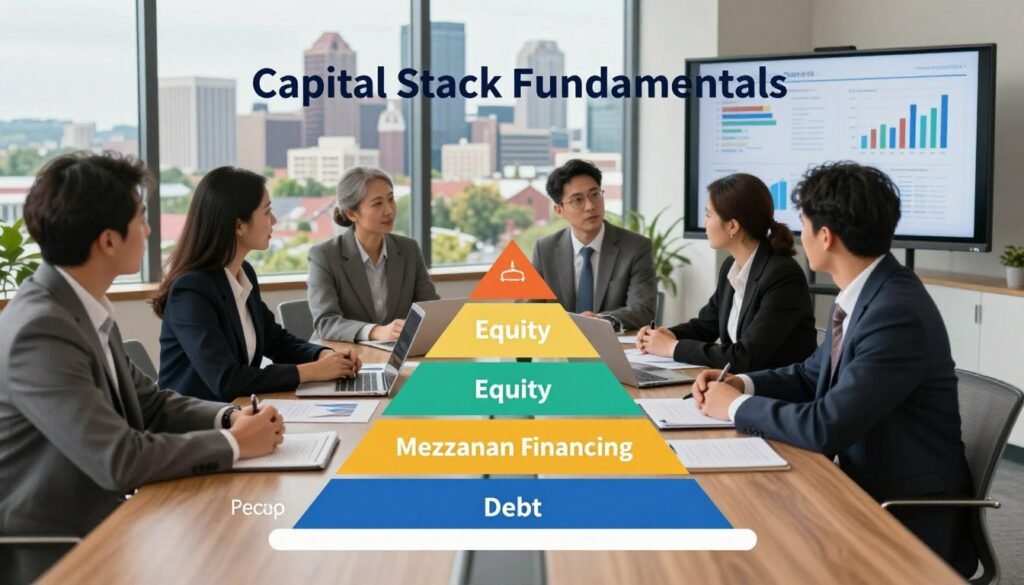
A visually engaging representation of "Capital Stack Fundamentals" relevant to urban and suburban commercial real estate (CRE) deals in Maryland. The foreground features a detailed diagram of a capital stack, showcasing different layers such as equity, mezzanine financing, and debt, illustrated with clear labels and symbols. In the middle ground, a professional business meeting scene with diverse individuals in business attire discussing real estate strategies, surrounded by charts and graphs on a large screen. The background reveals a panoramic skyline of an urban Maryland city juxtaposed with suburban landscapes, emphasizing the dual focus. Soft natural lighting enhances the professional atmosphere, while a slight depth of field adds focus to the capital stack diagram. Include the brand name "Thorne CRE" subtly integrated into the design.

Where risk sits and how pricing shifts

Entitlements, environmental clearance, leasing, construction, and takeout are the usual risk points. Senior lenders focus on collateral and coverage. Equity holders price upside and downside protection.

“Reduce risk through documented milestones and strong lender communication — that moves pricing in your favor.”

Common funding sources and practical moves

  • Traditional banks and bond issuers for senior debt.
  • CDFIs (NIIF-style) for bridge or gap capital.
  • State programs and quasi-public issuers (DHCD, MEDCO) for tax-exempt bonds and credits.

When costs exceed value: chase incentives, sharpen tenancy strategy, or phase delivery so early wins restore underwriting. Run debt and equity in parallel and be ready to firm terms once GMP pricing and approvals land.

For a deeper process guide, see navigating the capital stack.

Urban Maryland deal structures that unlock redevelopment and community value

Complex city deals succeed when public grants, bridge loans, and tax-exempt tools align around a clear delivery plan.

The Reservoir Square project turned an 8-acre former public-housing site into a phased development with measurable community benefits.

Phase one delivered 120 builder-ready townhome lots by funding demolition, restoring the street grid, and connecting utilities.

How grants and state funds de-risk early work

Early DHCD Project CORE grants and a small state capital allocation paid for demolition and grading that private lenders would not fund first.

That public portion reduced immediate risk and made lot sales and front-foot fees a viable path to recover infrastructure costs.

Bridge finance, tax-exempt bonds, and public-tenant anchoring

When timing gaps threatened progress, CDFI bridge loans kept the team moving—initial $3M followed by $6.1M for the office phase.

Mesirow underwrote $24M in tax-exempt lease revenue bonds issued by MEDCO, lowering interest roughly 200 basis points and stabilizing payments.

Using a public tenant (MOED) as the anchor translated into a modified sale/leaseback approach that attracted lower-cost, long-duration capital.

Closing complexity and practical lessons

Last-minute shifts happen: an NMTC lender withdrew weeks before closing and the deal was reworked by replacing that portion with CORE funding so momentum stayed intact.

Component Source Result
Demolition & early infrastructure CORE grants + state funds Reduced appraisal-gap risk; enabled lot sales
Bridge financing NIIF (CDFI) Maintained schedule during funding cycles
Long-term financing MEDCO tax-exempt bonds ~200 bps lower interest; stabilized payments
Anchor strategy Public-tenant lease (MOED) Supports lower-cost capital via sale/leaseback

“Design a stack that can be simplified quickly without breaking the deal.”

Suburban and small-city Maryland CRE: simpler stacks, different constraints

Suburban and small-city projects often rely on straightforward financing because market signals are clearer and execution paths are shorter.

Why simpler stacks work: when comps, leasing deals, and exit value are visible, a senior bank loan plus sponsor equity usually suffices. That model keeps costs and oversight low and speeds closings.

A suburban Maryland landscape showcasing a commercial real estate site readiness scene. In the foreground, a diverse group of professionals in business attire discusses blueprints spread out on a table, illustrating collaboration and planning. The middle ground features a partially developed site with construction equipment like cranes and bulldozers, conveying progress and development potential. In the background, there are charming small-town houses and modern urban buildings, representing the unique blend of suburban and city environments. The lighting is warm and inviting, with a late afternoon sun casting soft shadows, highlighting the activity and vibrancy of the area. The overall atmosphere is optimistic, reflecting the potential of capital stack strategies in real estate. Include the branding "Thorne CRE" subtly in the scene.

When traditional bank loans work and when they don’t

Bank lenders favor predictable absorption and liquid collateral. A conventional loan fits when tenant commitments and comparables support the appraisal.

Banks stop working when appraised value trails costs, tenant demand is weak, infrastructure burdens balloon, or the schedule creates high completion risk. In those cases, debt must be supplemented or restructured.

Infrastructure, site readiness, and construction timeline realities

Site readiness is a gating item: utilities, stormwater, access, and approvals often add months and real money before vertical work begins.

Delays push carry costs higher, force extensions, and raise contingency needs. That erodes equity returns and reduces lender comfort.

  • Underwriting shifts: lenders in smaller areas stress local demand drivers, absorption timelines, and resale liquidity.
  • Practical tactics: conservative leverage, realistic interest reserves, early lender conversations, and clear partner roles for infrastructure scope.

“Simpler stacks still require disciplined sequencing: firm site work before committing to full construction finance.”

Resilient capital stacks: building flexibility into the plan when money, time, and policy shift

Plans that survive shocks layer diverse sources so one loss doesn’t stop construction or operations. A resilient capital stack is a practical playbook. It lets a development absorb rate spikes, grant delays, or partner turnover without a full restart.

Lessons from Crisfield and South Baltimore: Crisfield stalled when a $36M BRIC award was rescinded in April 2025 and only later ordered reinstated on Dec. 11, 2025. That single-grant exposure froze work and raised costs.

By contrast, the South Baltimore Middle Branch initiative used federal, state, local, philanthropic, and potential revenue streams (carbon credits, stormwater fees) so the project could continue at reduced scope. Diversification is financial risk management in action.

A dynamic urban and suburban landscape illustrating a "resilient capital stack." In the foreground, a diverse group of professionals in smart business attire are engaged in a collaborative discussion over blueprints and financial documents. The middle ground features a modern skyline with a mix of urban high-rises and suburban developments, showcasing a blend of commercial and residential properties. The background shows a vibrant sunset casting warm, golden light that creates a hopeful atmosphere. Incorporate visual elements like strategically stacked financial graphs and flexible architectural designs subtly blended into the urban backdrop, suggesting adaptability in capital strategies. Ensure the inclusion of the brand name "Thorne CRE" subtly in the scene without text overlays, creating a harmonious and professional vibe.

Phased delivery and fallback tactics

Pre-plan phases: identify what must finish first and what can wait. Match each portion to a replaceable source so the critical path keeps moving.

Lifecycle funding and incentives

Operations and maintenance often lack steady funding in public-heavy plans. Build recurring reserves or revenue mechanisms up front to avoid gaps after ribbon-cutting.

Common incentive tools—NMTCs, Opportunity Zone equity, and brownfield credits—can fill big gaps. Yard 56 shows how advancing debt and equity in parallel, securing zoning and cleanup agreements, and using NMTC/OZ equity unlocked a $157M stack with ~$96M debt and ~$61M equity.

“Relationship capital—trusted lenders and long-term investors—creates optionality when markets turn.”

For a deeper primer on how market cycles change loan terms and lender behavior, see how market cycles impact commercial loan.

Conclusion

Durable deals are built on layered choices that can be resized or reordered as markets change.

Core takeaway: winning financing is less about a single perfect source and more about assembling a flexible mix that fits location, asset type, and schedule. Reservoir Square shows how public grants, bridge loans, and bonds can be combined and reworked to save a complex urban project.

Crisfield versus South Baltimore underlines why diversification and lifecycle planning reduce single-point failure. Yard 56 demonstrates how advancing debt and equity in parallel — and layering incentives — unlocks bigger outcomes.

Practical next steps: identify the biggest risk, assign which layer should absorb it, and confirm backup sources before you commit major predevelopment capital. Do this with lenders, investors, and your team so the plan can be simplified, resized, or resequenced without losing the investment thesis.

, as policy and underwriting shift, the most bankable approach is a modular plan that keeps the project moving and preserves optionality for future investment.

FAQ

What is a capital stack strategy for suburban and urban commercial real estate deals?

A capital stack strategy outlines how a project is financed using layers of debt, equity, and public funding. In urban and suburban deals this plan balances risk and return across lenders, private investors, and government programs to make a project feasible while protecting sponsors and community interests.

How are recent higher interest rates and rising construction costs affecting underwriting?

Higher rates increase debt service and tighten loan-to-cost ratios, while material and labor cost inflation widens the appraisal gap. Lenders demand larger equity cushions, and sponsors must model longer stabilization timelines or pursue alternative financing such as bridge loans or tax-exempt bonds to keep returns intact.

What does “place-based” investment mean for deal selection and underwriting?

Place-based investing prioritizes local context — market demand, community priorities, and infrastructure capacity. Underwriters now weigh neighborhood trajectory, public support, and resilience against shocks, which can shift acceptable cap rates and subsidy expectations for projects in both city and suburban settings.

How should sponsors manage timing risk tied to public programs and tax incentives?

Build contingency plans and parallel paths: secure conditional approvals early, layer private bridge financing, and include schedule buffers in contracts. Where possible, structure agreements to convert grants or awards into takeout financing and maintain close communication with agency partners to reduce delays.

How do debt, equity, and public capital typically interact in a deal?

Senior bank debt covers a portion of hard costs; mezzanine or preferred equity fills gaps between senior debt and common equity; public capital and incentives de-risk early phases or site work. Each layer has different security, return expectations, and covenants that dictate how risk is shared across stakeholders.

Where does risk usually concentrate and how is it priced?

Risk concentrates in junior layers — mezzanine and common equity — because they absorb first losses. Lenders price senior debt conservatively with covenants and higher spreads in volatile markets. Equity demands higher IRRs to compensate for development and market risk, while public dollars often target early-stage risk reduction.

What common funding sources should developers expect to use?

Typical sources include commercial banks, community development financial institutions (CDFIs), state grant programs, local agencies, tax credit investors, and private equity partners. Successful deals blend these funds to optimize cost of capital and align incentives across public and private partners.

How can teams structure projects when costs exceed current value?

Consider phased delivery, value-engineering, securing interim financing, or accessing tax-credit equity to improve returns. Sponsors can also negotiate seller concessions, request increased public gap funding, or pursue tax-exempt bond structures to reduce interest burden and preserve feasibility.

What financing models unlock complex mixed-use redevelopment?

Layered approaches work best: tax-exempt bonds for long-term financing, CDFI bridge loans for early work, state capital budget grants for site remediation, and equity partnerships for market risk. Combining these tools with strong tenant pre-leases and public support helps bridge complexity and attract investors.

How do bridge loans and CDFI partnerships keep projects moving?

Bridge loans provide short-term capital for acquisition or early construction before permanent financing closes. CDFIs offer flexible underwriting and mission-aligned patience, often taking on initial risk to unlock mainstream lenders and tax-credit investors later in the deal cycle.

When are tax-exempt bonds and MEDCO-like mechanisms appropriate?

Tax-exempt bonds suit projects with public benefit, stable cash flow, and qualified tenants to lower interest costs. Using municipal or economic development authority structures can yield favorable terms and longer amortizations, improving debt service coverage and stabilizing payment obligations.

How can modified sale/leaseback structures support public-anchored projects?

Modified sale/leasebacks allow public or nonprofit tenants to access capital while retaining occupancy. They can convert owner-occupied facilities into financed assets, freeing up sponsor equity and enabling long-term financing that aligns with the tenant’s credit profile and service mission.

What are key challenges when layers shift at the last minute?

Last-minute shifts create closing delays, covenant renegotiations, and higher costs. Mitigate risk with contingency reserves, flexible funding commitments, expedited title and legal work, and named alternate sources. Clear documentation and escrow arrangements reduce exposure when partners change.

When do traditional bank loans work for suburban and small-city deals?

Traditional bank loans work when sites are shovel-ready, credit tenants are secured, and local market fundamentals are stable. Banks prefer predictable cash flow, lower construction complexity, and clear collateral. If sites need significant remediation or gap funding, alternative sources become necessary.

How do infrastructure and site readiness affect financing outside core cities?

In suburban or small-city settings, off-site infrastructure and utility upgrades can add cost and schedule risk. Lenders expect completed entitlements and site work or require contingency reserves. Public partners can help by funding infrastructure or providing tax increment financing to improve feasibility.

What lessons about diversification apply to resilient capital stacks?

Diversify funding sources to avoid single-grant exposure. Use layered commitments from banks, CDFIs, and tax-credit investors, and keep alternative equity partners engaged. Diversification reduces the chance that one funding hiccup derails the entire project.

What are effective fallback strategies in phased delivery?

Prioritize early revenue-generating phases, maintain construction holdbacks, and secure standby letters of credit. Plan for modular construction and temporary uses that generate cash while later phases await additional funding or market improvement.

How should teams plan for operations and maintenance after development?

Include lifecycle budgets in pro forma models, secure reserves for replacements, and consider contracting for extended warranties or service agreements. Investors and lenders look for realistic post-construction operating projections to protect long-term asset value.

Which tax-credit and incentive tools are practical for these deals?

Tools include low-income housing tax credits, new markets tax credits, Opportunity Zone equity, and brownfield remediation credits. Combining credits with public grants and private equity often closes financing gaps and improves project returns while delivering community benefits.

How do parallel paths for debt and equity improve closing reliability?

Pursuing multiple binding term sheets and conditional commitments reduces single-source dependency. Maintain active dialogue with investors and lenders, stage due diligence, and align milestones so one path can replace another quickly if necessary, keeping the critical path intact.

Leave a Comment

Your email address will not be published. Required fields are marked *

Scroll to Top