
Capital Stack Strategy for Chicago and Illinois Commercial Real Estate

a river with Chicago River and boats

Surprising fact: more than 70% of returns in a typical deal come from the lowest-risk layer of the pyramid when underwriting is tight.

This guide defines the Illinois Capital Stack in practical terms for Chicago and statewide commercial real estate. Think of the capital stack as a payment pyramid: who gets paid first shapes both risk and reward.

We preview the four main layers—senior debt, mezzanine debt, preferred equity, and common equity—so readers see how a stack becomes a decision framework, not just jargon.

Expect an informational walk-through for acquisition, refinance, and development in the present market, including what shifted for underwriting and liquidity this cycle.

A well-designed strategy aligns capital sources with a property’s business plan and cash-flow profile while protecting downside. It also highlights how access to capital differs between stabilized suburban assets and projects in historically underinvested Chicago neighborhoods.

This article later shows a real multifamily refinance example using agency debt plus preferred equity so you can see how numbers fit together in one stack.

Key Takeaways

  • The payment order in a capital stack drives risk and return.
  • Senior debt usually has first claim and lowest risk.
  • Mezzanine, preferred, and common equity balance yield and downside.
  • Current underwriting and liquidity trends affect structuring decisions.
  • Access to capital varies between stabilized suburbs and underserved city neighborhoods.
  • A practical example will show real numbers for a multifamily refinance.

Why Capital Stack Structure Matters in Illinois Commercial Real Estate Financing

Priority of payment decides who is protected first and who absorbs losses. This ordering directly drives pricing, covenants, and control rights in a deal.

How “priority of payment” shapes risk, returns, and control for owners, lenders, and investors

Senior debt sits at the top and usually carries the lowest return because it has the strongest remedies if a borrower defaults. Equity sits below debt and carries higher upside and higher risk. Lenders and investors price their required returns based on this ordering.

The closer a party is to the top, the more protections and remedies it often has. That positioning limits an owner’s flexibility when performance weakens and influences governance and covenants.

What changes in the present market cycle mean for access to capital and underwriting

Higher-for-longer rates and tighter underwriting mean teams must build disciplined stacks and realistic exits. Even as rates soften, underwriting standards — coverage tests, reserves, and sponsor strength — still dictate actual access to funds.

A detailed and organized illustration of a capital stack structure, depicted in a sleek, modern office environment to represent commercial real estate financing strategies in Illinois. In the foreground, a transparent, three-dimensional layered diagram shows various components of the capital stack, such as equity, mezzanine debt, and senior debt, each labeled clearly but without text. The middle backdrop features a well-lit conference room with professionals in business attire discussing financial plans, emphasizing collaboration and strategy. The background portrays a skyline of Chicago with iconic buildings, subtly integrating urban elements. Soft, natural lighting streams through large windows, creating a professional and optimistic atmosphere. Incorporate elements of technology, such as digital screens displaying market trends. The overall mood conveys expertise, stability, and strategic investment, branded with “Thorne CRE” subtly in the design.

Small shifts in cost of capital can change proceeds, debt service, and required equity enough to flip a deal from workable to unworkable. For a deeper walkthrough of structuring choices, see navigating the capital stack.

“Senior debt offers the lowest return because it has the lowest risk; if the borrower defaults, the lender may take possession of the asset.”

Holland & Knight

Illinois Capital Stack Fundamentals: The Main Levels of Capital in a Deal

Breaking a transaction into funding levels reveals the trade-offs between protection and reward. This section maps the main layers you’ll meet in a real estate financing plan and explains how each level affects outcomes for owners, lenders, and investors.

Senior debt from banks and agencies

Senior debt holds first claim on the asset and usually comes from a bank or agency. It commands the lowest returns because it gets paid first and has strongest remedies on default.

Loan terms—LTV, amortization versus interest-only, covenants, and reserves—set the ceiling for lower layers. Every other source must fit beneath the senior loan’s underwriting.

Mezzanine debt mechanics

Mezzanine lending is typically made to the 100% parent of the property owner. The mezz lender takes a pledge of ownership interests and perfects that security with a UCC filing.

If the borrower defaults, foreclosure on those equity interests can leave the mezz lender as the indirect owner of the property. That path makes mezzanine more expensive than senior debt but cheaper than common equity in many cases.

Preferred equity position

Preferred equity is negotiated to receive a minimum return before common equity. It is structured like equity but often includes fixed priority economics to protect the investor’s yield without full lender remedies.

Common equity upside

Common equity is the residual claim. After debt service and preferred returns, common owners capture remaining cash flow and appreciation.

Because common equity is last in line, it carries the most risk and the greatest upside volatility for ownership economics.
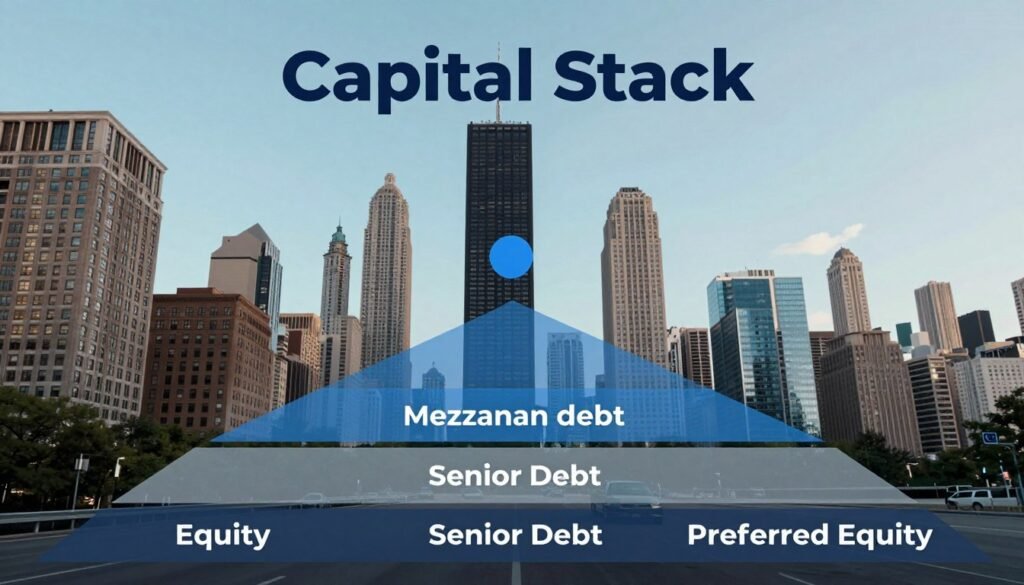
A detailed illustration of a "Capital Stack" for Chicago and Illinois commercial real estate, showcasing a structured layering of capital components. In the foreground, depict distinct levels represented as stacks: equity, mezzanine debt, senior debt, and preferred equity, each labeled in a professional manner. The middle ground should include urban Chicago skyscrapers, symbolizing the commercial real estate landscape. The background features a clear blue sky, suggesting opportunity and growth. Use soft, natural lighting to create a positive and professional atmosphere. The overall mood should be ambitious and informative. Viewpoint from a low angle, highlighting the importance of the capital structure. Include the brand name "Thorne CRE" subtly integrated into the scene without any text overlays.

Level Typical Provider Priority Typical Return/Role
Senior debt Bank / Agency First claim Lowest cost, strict covenants
Mezzanine debt Specialty lender Second (via equity pledge) Mid cost, pledge of ownership, UCC
Preferred equity Private investor / fund Priority over common Fixed preferred return, equity-like treatment
Common equity Sponsor / investors Last Residual upside, highest risk

“Preferred equity investors receive their minimum return before common equity investors; common equity receives remaining income after all stack participants are paid.”

Holland & Knight

  1. More senior debt favors lower cost and lender protections when cash flow is tight.
  2. Mezzanine fits when sponsors want to avoid diluting ownership but accept higher cost and equity-pledge risk.
  3. Preferred equity bridges percentage gaps with negotiated returns, often preserving sponsor control.

Small shifts in percent allocations between senior, mezzanine, and preferred equity change the blended cost of capital. Higher coupons or preferred returns compress cash flow and can make a project fail to pencil at today’s rates. Use these fundamentals to test scenarios before committing to a deal.

Chicago and Illinois Capital Access Realities in Underinvested Neighborhoods

Developers working on the South and West sides face a different path to project funding than peers in more established markets.

Why access differs: lenders and banks often view these areas as higher risk due to weaker comparables, perceived liquidity gaps, and political complexity. That means developers plan for greater complexity and longer timelines from day one.

A vibrant urban landscape depicting a Chicago neighborhood with a struggling commercial area. In the foreground, a diverse group of professionals in business attire discuss investment strategies, holding documents and charts. The middle ground features modest commercial buildings with "For Lease" signs, reflecting the challenges of capital access in underinvested neighborhoods. The background showcases the iconic Chicago skyline under a warm sunset, casting a hopeful glow. Soft lighting enhances the mood of collaboration and determination. Use a wide-angle view to capture both the bustling activity and the urban environment. Ensure the logo "Thorne CRE" is subtly integrated into a document in the hands of one professional.

Building “lasagna” capital stacks with public and private sources

The lasagna approach layers sources—tax credits, TIF or bonds, CDFI loans, and faith-based or community capital—so each slice brings rules, approvals, and pacing. Combining these slices reduces single-source exposure but raises execution risk.

Common tools and players

  • State tax credits: lower net cost but require compliance and time.
  • City TIF or bonds: provide gap financing; they can tie control to public goals.
  • CDFIs: mission-aligned lenders that accept tougher deals at a higher cost and slower underwriting.
  • Community/faith capital: flexible but usually limited in size.

Timeline risk and bank reluctance

Approvals and term sheets can stretch for months. As costs rise, developers must chase more money and rework the capital stack repeatedly. That cycle increases the percent of financing coming from expensive sources and strains feasibility.

“Major banks are often not the first target; proof of concept through community engagement precedes bank conversations.”

A.J. Patton / Bisnow

Tradeoffs: CDFI debt brings alignment with community impact but can triple financing cost and slow closing. The honest tradeoff is mission fit versus higher cost and longer time.

Tool Typical effect on cost Control
Tax credits Lower net cost Moderate
TIF / bonds Gap financing High (public conditions)
CDFI loans Higher cost, slower Low–moderate

Make the deal pencil: higher financing costs and longer timelines force higher rents, larger reserves, and tighter contingencies. That changes investor appetite and whether a property can move from concept to financed project.

Illinois Example: Schaumburg Multifamily Refinance Using Agency Debt and Preferred Equity

The 21 Kristen Apartments refinance is a clear example of pairing agency senior debt with preferred equity to meet refinancing goals. Greystone provided a $55,620,000, five-year, interest-only Freddie Mac Optigo® loan. At closing, 7Acres placed $6,000,000 of preferred equity, bringing total capitalization to $61.6 million.

A professional office setting showcasing a modern conference room in Schaumburg, Illinois, with a panoramic view of the city skyline through large windows. In the foreground, a diverse group of four business professionals in business attire—two men and two women—are engaged in a discussion at a sleek glass table, with charts and financial reports spread out. In the middle ground, a digital display shows graphs related to preferred equity refinance, highlighting financial strategies. The background features a well-lit urban landscape and tall buildings, with warm, natural light streaming in, creating an atmosphere of collaboration and ambition. The scene conveys a sense of professionalism and strategic planning in commercial real estate finance. The brand "Thorne CRE" is subtly integrated into the room's decor elements, enhancing the corporate ambiance without being overt.

What the structure signals

This combination keeps common equity upside while layering in a priority return for preferred investors. The senior debt supplies the bulk of proceeds and low-cost financing, while preferred equity bridges the gap without converting to common ownership.

Key underwriting signals:

  • Large, stabilized property—357 units and significant recent rehab (>$2.5M).
  • Affordability set-aside—30% of units at 30%-80% AMI improves public-profile and lender comfort.
  • Agency execution—Greystone originated the Optigo loan through Eric Rosenstock and Dan Sacks, showing lender confidence.

For owners and investors, this deal shows when preferred equity can be a fit: to boost closing proceeds, limit common ownership dilution, and sit ahead of equity in payment priority. Expect detailed diligence from the lender on cash flow and from preferred investors on the waterfall and return mechanics.

Practical takeaway: a well-placed preferred tranche can turn a refinance into a strategic repositioning for the next market cycle. For more on how market cycles change loan terms, see how market cycles impact commercial loan.

Conclusion

Building the right mix of debt and equity turns financing from a guess into a risk-management tool.

Match each layer to the property’s cash flow, timeline, and exit plan. Senior debt, mezzanine, and equity each have defined roles: cost, control, and claim on returns.

Treat capital decisions as governance choices, not just pricing questions. Evaluate term sheets for rights and remedies so you know who can act if stress appears.

Start by defining constraints—cash flow, approvals, and timeline—then pick the level of the capital stack that balances proceeds with flexibility. Conservative assumptions and aligned partners reduce execution risk in today’s real estate financing environment.


FAQ

What is the capital stack strategy for Chicago and Illinois commercial real estate?

The strategy layers different sources of funding — senior debt, mezzanine loans, preferred equity, and common equity — to match risk, return, and control needs. Lenders like banks or Fannie Mae and Freddie Mac typically occupy the lowest-risk position with priority repayment, while equity investors take residual upside. Structuring the stack correctly helps developers and investors hit target returns and manage financing costs and ownership dilution.

How does the “priority of payment” affect risk and returns for owners, lenders, and investors?

Priority of payment determines who gets paid first from cash flow and sale proceeds. Senior debt holders receive distributions before mezzanine lenders and equity investors, which lowers their risk and interest rates. Preferred equity often receives a fixed return ahead of common equity, reducing upside for owners but improving lender comfort. Understanding these priorities clarifies control rights, foreclosure remedies, and expected returns at each level.

What do current market cycle changes mean for access to capital and underwriting?

Tighter monetary policy or higher interest rates reduce bank leverage and raise debt costs, forcing more reliance on alternative capital like mezzanine or preferred equity. Underwriting becomes more conservative on rents, vacancy, and exit caps. Lenders expect stronger covenants and lower loan-to-value ratios, which can squeeze deals unless sponsors adjust equity contributions or accept higher financing costs.

What are the main levels of capital in a typical deal?

A standard deal includes senior debt (bank or agency loans) at the bottom, mezzanine debt that fills gaps between senior debt and equity, preferred equity providing a priority return over common equity, and common equity bearing the last-in-line risk but capturing residual upside. Each layer carries distinct cost, control, and protection terms that influence project feasibility.

Why is senior debt considered the lowest-risk layer and what protections do lenders require?

Senior lenders have first claim on the asset and its cash flow, often secured by a mortgage or deed of trust. They require loan-to-value and debt-service-coverage covenants, appraisals, and environmental reviews. Agencies like Freddie Mac or Fannie Mae may offer more competitive pricing and longer terms but demand strict underwriting and eligibility criteria.

How does mezzanine debt work and what security is used?

Mezzanine loans are made to the ownership entity rather than in first-lien position on the property. They typically rely on pledges of equity interests and UCC filings for security. Mezzanine lenders accept higher risk and charge higher yields, and they may have special foreclosure rights like equity takeout in default scenarios to protect recovery.

What is preferred equity and how does it differ from mezzanine debt?

Preferred equity sits between debt and common equity. It usually provides a negotiated minimum return paid before common distributions but does not have a mortgage lien. Preferred holders often receive priority cash flow and specific liquidation preferences, but they typically have less control than debt holders. Pricing is higher than senior debt but may be more flexible than mezzanine financing.

How does common equity capture upside and why is it last in line?

Common equity owners absorb the most risk because they are paid after all creditors and preferred investors. In exchange, they receive residual cash flow, appreciation, and tax benefits. Their returns depend on project performance, making effective asset management and market timing critical to realizing gains.

How do stack percentages and financing costs impact whether a project “pencils” at today’s rates?

The mix of debt and equity, interest rates, and required investor returns determine project feasibility. Higher rates increase debt service and reduce allowable loan sizing, often requiring more equity or accepting lower returns. Sponsors run pro formas with sensitivity analyses on rates, vacancy, and exit cap rates to see if projected cash flows meet target returns.

How can developers build layered financing for underinvested Chicago neighborhoods?

Developers often combine private capital with public tools such as tax credits, tax-increment financing (TIF), municipal bonds, and grants, alongside community development financial institutions (CDFIs). This “lasagna” approach blends lower-cost public subsidies with flexible private equity to bridge financing gaps and make projects viable in historically undercapitalized areas.

What common public and private tools support projects in South and West Side communities?

Typical tools include state and federal historic and low-income housing tax credits, city TIF districts, municipal bond programs, CDFI loans, and investments from community organizations or faith-based groups. These instruments often come with reporting and affordability requirements but can substantially lower the sponsor’s required equity or debt burden.

How does timeline risk and rising development costs affect financing plans?

Prolonged timelines increase exposure to inflation in construction, rising interest rates, and market shifts, often forcing sponsors to seek additional capital mid-project. That chasing of funds raises costs and dilutes returns. Accurate contingency planning, fixed-price contracts, and staged draws can help manage timeline and cost escalation risks.

Why do traditional banks sometimes reject community projects, and how can developers respond?

Banks may cite perceived market risk, low cash-flow projections, or unfamiliarity with nonstandard revenue models. Developers can build credibility through community engagement, letters of support, pilot phases that show demand, and partnering with CDFIs or mission-driven investors to demonstrate proof of concept.

What are the tradeoffs when using CDFI financing?

CDFIs provide mission-aligned capital and local expertise but often charge higher interest or require longer approval times and stricter reporting. They may accept nontraditional underwriting, which helps deals move forward, but sponsors must weigh increased financing costs and slower term-sheet timelines against the benefits of access and flexibility.

Can you give an example of combining agency debt with preferred equity for a multifamily refinance?

A common structure uses a Freddie Mac Optigo or Fannie Mae loan to secure competitive long-term senior financing, paired with preferred equity at closing to fill the remaining capital need. This reduces sponsor dilution while delivering predictable senior debt terms. Such combos can improve refinance proceeds and provide targeted returns to preferred investors while preserving upside for common equity.

How should sponsors choose between different funding sources for a specific deal?

Evaluate cost, speed, covenants, control implications, and eligibility. Senior agency loans offer low long-term rates but strict criteria. Mezzanine and preferred equity provide flexibility at a higher price. CDFIs and public subsidies can bridge gaps for community-focused projects. Align the capital mix with project goals, risk tolerance, and exit strategy.

What key metrics should investors and developers monitor across the stack?

Track loan-to-cost, loan-to-value, debt-service coverage ratio, internal rate of return, cash-on-cash return, and projected exit cap rate. Monitor construction budget variance, lease-up pace, operating expenses, and covenant compliance to anticipate refinancing needs or capital calls.

Leave a Comment

Your email address will not be published. Required fields are marked *

Scroll to Top