
In short
Commercial bridge loan rates are often floating, commonly quoted as a SOFR benchmark plus a lender spread, with upfront points and possible exit or extension fees. Published lender guidance dated May 2026 placed many institutional commercial bridge quotes around 8.0% to 11.5%, but a property’s leverage, business plan, sponsor, and refinance exit determine the real quote.
Key takeaways
- A bridge rate is only one part of cost, because points, exit fees, lender legal costs, and extension fees can materially change the result.
- Every 100 basis points of annual interest equals $10,000 per year for each $1 million outstanding.
- Two points equal 2% of the original loan amount, so two points on a $1 million loan cost $20,000 at closing.
- An interest reserve can protect project cash flow during stabilization, but it reduces usable proceeds and must be reviewed carefully.
Commercial bridge pricing should be treated as a dated market reference, not a live quote. A lender-published rate guide released in September 2026 says its commercial bridge pricing was last updated in May 2026, which is why an active borrower should confirm the benchmark, spread, fees, and expiration date in writing before relying on any range. Review the published May 2026 market snapshot. (avanacapital.com)
What rate should I expect on a commercial bridge loan?

Published May 2026 lender guidance placed institutional commercial bridge rates at roughly 8.0% to 11.5%, with higher pricing possible for more complex, smaller, time-sensitive, or asset-driven transactions. A rate range is useful for initial underwriting, but it cannot replace a loan-specific quote.
A lender may quote an institutional bridge loan as a floating rate, such as an index plus a spread. A lender guide dated May 2026 described institutional bridge pricing around SOFR plus 350 to 600 basis points, while its broader all-in rate reference was 8.0% to 11.5%. Those are published reference bands, not an October 2026 promise. See the dated commercial bridge rate guidance. (avanacapital.com)
Commercial bridge loans are usually short-term financing for a property that needs acquisition speed, renovation funding, lease-up time, stabilization, or a refinancing bridge. For the basic use cases and structure, see bridge loan fundamentals.
The rate matters, but the underwriting question is bigger: can the property execute its business plan and refinance or sell before the loan matures?
Why is a bridge quote often SOFR plus a spread?
SOFR is a U.S. dollar reference rate published by the Federal Reserve Bank of New York. The lender adds a spread to compensate for the property, sponsor, leverage, liquidity, and execution risk in the transaction. Check the New York Fed’s SOFR reference-rate publication.
A basis point is one-hundredth of one percentage point. A spread of 450 basis points equals 4.50%, so a quote of SOFR plus 4.50% changes when the applicable SOFR rate resets, subject to the loan agreement’s timing, floor, and rate-convention language.
Ask which benchmark the note uses. A document may reference daily simple SOFR, compounded SOFR, or a term SOFR convention. Borrowers should also confirm the reset frequency, any SOFR floor, the interest calculation method, and whether the lender can charge a default-rate spread.
The benchmark is only the starting point. The lender spread and loan documents determine the pricing that a borrower actually pays.
How much does a $1,000,000 commercial bridge loan cost?
A $1,000,000 bridge loan at 9.00% interest-only for 18 months would produce $135,000 of simple interest if the full balance stayed outstanding. Add two points at closing ($20,000) and a 0.25% exit fee ($2,500), and the illustrative financing cost is $157,500 before lender legal fees, appraisal, title, insurance, deposits, or extension charges.
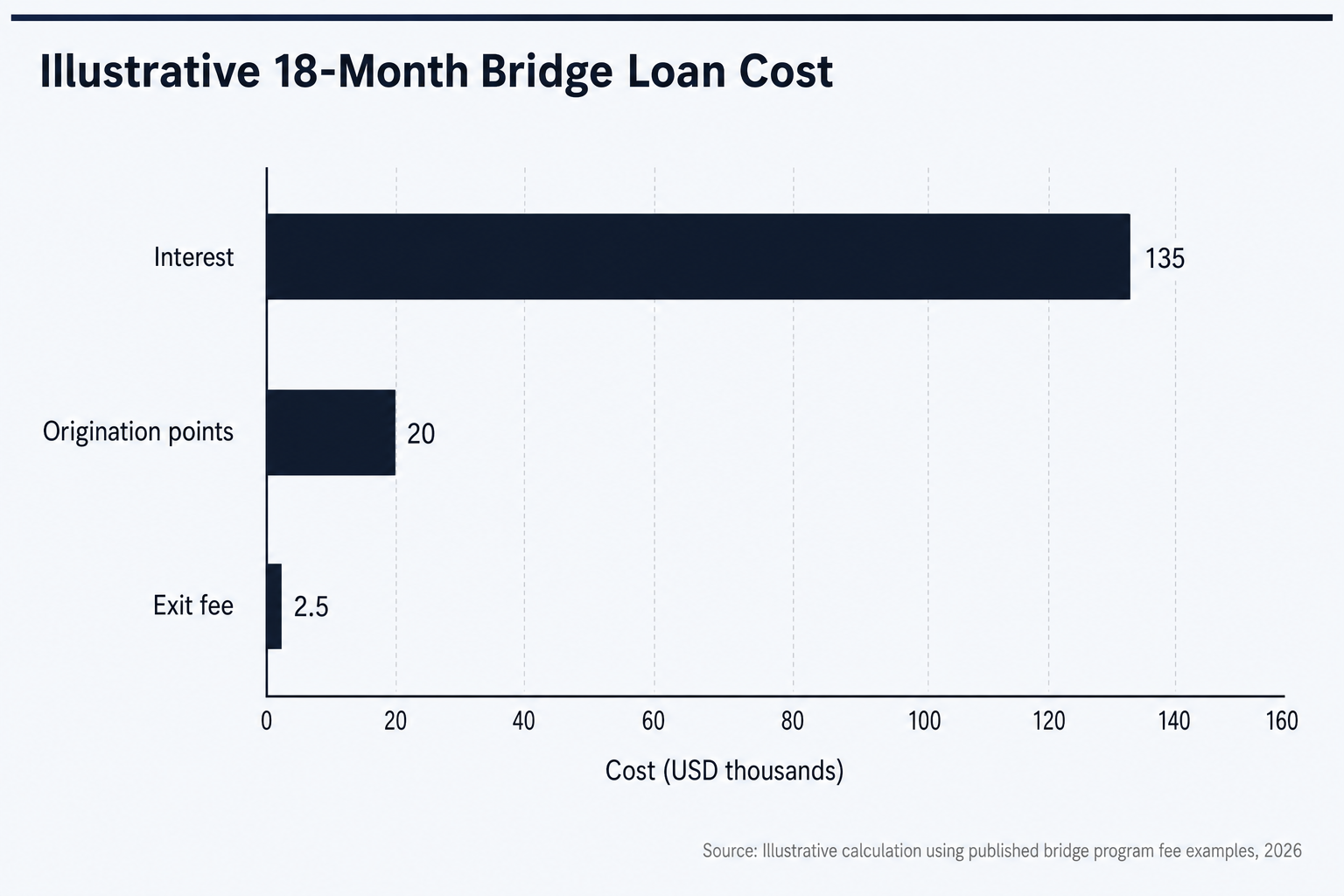
The math is straightforward:
| Cost component | Assumption | Illustrative cost |
|---|---|---|
| Interest | $1,000,000 × 9.00% × 18/12 | $135,000 |
| Origination points | $1,000,000 × 2.00% | $20,000 |
| Exit fee | $1,000,000 × 0.25% | $2,500 |
| Total before third-party costs | $157,500 |
This example has an effective simple annualized cost of 10.50% over the 18-month hold, before third-party costs. It also assumes the borrower does not need an extension and does not draw additional future funding.
For an interest-only bridge note, the monthly interest payment in this example is $7,500 while the $1,000,000 principal is generally due at maturity or refinancing. The total cost must be modeled against the expected exit date, not only against the initial monthly payment.
Which fees can change the total cost?
Points, exit fees, extension fees, interest reserves, and third-party closing costs can move a bridge loan’s all-in cost well beyond its stated interest rate. The term sheet should identify each charge, its calculation base, its payment date, and whether it is refundable.
A published commercial bridge program, for example, lists a 1.00% origination fee, 0.25% or higher exit fee, 0.25% or higher extension fee, interest-only payments during the initial term, and potential interest and carry reserves. Those are program-specific terms, not universal market standards. Review the published fee structure. (readycapital.com)
Origination points. One point equals 1% of the original loan amount. Points are commonly paid or netted from proceeds at closing, so they affect the borrower’s cash requirement and usable funds.
Exit fees. These fees may become due when the loan is repaid, sold, or refinanced. Check whether the charge is calculated on the original commitment, funded balance, or another amount.
Extension fees. An extension is not automatic. The lender may require a fee, new underwriting, a rate increase, an additional reserve, or a principal paydown. Price the first extension before signing the original note.
Interest reserve. A reserve sets aside part of the financing to make scheduled interest payments during renovation or stabilization. It can preserve project liquidity, but borrowers should ask whether interest accrues on the reserved amount and how unused funds are handled at payoff.
A low headline rate can lose its advantage when the hold period is short and upfront or maturity fees are high.
What moves a quote toward the low or high end?

The strongest quotes generally pair conservative leverage with a credible sponsor and a documented exit. Higher leverage, weak in-place cash flow, property-specific uncertainty, and an unclear refinance plan usually increase lender risk and pricing.
Key pricing drivers include:
- Leverage: Loan-to-value and loan-to-cost affect the lender’s loss exposure. A lower leverage request can improve pricing, but only if the deal moves into a better underwriting tier.
- Property type and condition: Stabilizing multifamily, retail, hospitality, office, industrial, mixed-use, and specialty assets can attract different lender appetites.
- In-place income and business plan: Lenders examine current income, renovation scope, leasing assumptions, operating costs, and timing to stabilization.
- Sponsor strength: Experience with comparable projects, liquidity, net worth, credit history, and guaranty structure may affect both rate and recourse.
- Exit certainty: A refinance or sale must be plausible at maturity. The lender will test projected net operating income, permanent-loan sizing, valuation assumptions, and the time allowed for execution.
A borrower considering a refinance exit should also compare the bridge structure with commercial mortgage versus bridge financing. The right choice depends on whether the property can qualify for permanent debt now or needs time to stabilize first.
The most persuasive rate argument is a well-supported business plan with enough time and capital to reach the exit.
How should you compare commercial bridge loan quotes?
Compare quotes using the same requested loan amount, assumed hold period, and exit date. A lender with a higher nominal rate can still be less expensive if its points, exit fee, reserve requirements, extension terms, and execution risk are lower.
Use this comparison sequence:
- Normalize the loan amount and funding schedule. Identify whether the quote funds all proceeds at closing or includes future advances for renovations, leasing costs, or reserves.
- Calculate interest for the expected hold. Use the quoted index, spread, floor, and payment convention. Run a downside case for a longer hold and a higher floating benchmark.
- Add every lender fee. Include points, underwriting fees, exit fees, extension fees, servicing fees, legal costs, and any lender-required deposits.
- Test the exit. Model the refinance or sale six months before maturity, not in the final weeks of the loan term.
- Compare conditions, not just numbers. Recourse, cash-management triggers, reserve release conditions, prepayment provisions, and lender approval rights can change the practical cost of the loan.
Before requesting formal terms, use a commercial financing application checklist to organize property financials, sponsor information, sources and uses, renovation scope, and the projected exit.
The best quote is the one that funds the actual business plan and leaves enough time to execute the exit without relying on an expensive extension.
What else do borrowers ask about bridge loan costs?
How much would a $350,000 bridging loan cost?
A $350,000 bridge loan at 9.00% interest-only for 12 months would produce $31,500 of interest. Add two points of $7,000, and the illustrative cost becomes $38,500 before exit fees, lender legal costs, appraisal, title, insurance, or any extension. Actual cost depends on the term, funding schedule, and payoff date.
What is the payment on a $1,000,000 business loan?
On a $1,000,000 interest-only commercial bridge loan at 9.00%, the monthly interest payment is $7,500 while the principal remains due at maturity. This is not a fully amortizing payment. A borrower must have a documented refinance, sale, or other repayment source for the $1,000,000 balloon balance.
What does Dave Ramsey say about bridge loans?
Personal-finance commentary about bridge loans is generally aimed at household borrowing, not commercial real estate underwriting. A commercial borrower should evaluate the property’s cash flow, leverage, reserve needs, guaranty exposure, maturity date, and realistic refinance or sale exit instead of relying on residential borrowing guidance.
What is the typical interest rate on a bridge loan?
Published lender guidance dated May 2026 placed many institutional commercial bridge loans around 8.0% to 11.5%, with other lender types and higher-risk situations potentially costing more. The applicable rate can change with the benchmark index, leverage, property condition, sponsor profile, and exit strength. See the dated rate reference. (avanacapital.com)
What should you request before choosing a bridge loan?
Request a written term sheet that states the benchmark, spread, rate floor, interest-payment method, points, all lender fees, reserve requirements, extension conditions, maturity date, recourse, and expected closing conditions. Then model the base case and a slower stabilization case before selecting a lender.
For a deal-specific conversation, start by reviewing the commercial bridge financing checklist and prepare the property, sponsor, sources-and-uses, and exit information that lenders will need. The most useful rate quote is one that shows the full path from closing through refinance or sale.