

Surprising fact: nearly 40% of approved loans today hinge on realistic cash-flow forecasts rather than headline rates. That shift changes how owners and investors plan deals.
This guide positions itself as a decision tool for Idaho Commercial Real Estate Financing for buyers, owners, and sponsors. Expect clear pathways for purchase, refinance, renovation, or construction outcomes.
Capital is available, but underwriting is disciplined. Lenders now focus on cash-flow durability, prudent leverage, expense realism, and defensible exit timing.
Strategy matters more than sticker rates. The variables that drive loan outcomes include cash flow, leverage, property type, sponsor strength, and exit planning. Rates and terms will vary by program and asset profile.
Different lenders—local banks, credit unions, and national platforms—have distinct appetites across Boise and secondary markets. Before you request options, identify your property, timeline, and business profile to get targeted guidance.
Key Takeaways
- Underwriting now prioritizes realistic cash flow and exit plans over low headline rates.
- Know your target outcome: buy, refinance, renovate, or build.
- Loan terms, rates, and structure vary by lender and asset type.
- Local and national lenders differ in appetite across primary and secondary markets.
- Prepare clear sponsor and property data to improve approval odds.
Idaho Commercial Real Estate Financing Solutions for Investors and Owner-Occupied Businesses
A targeted lending strategy begins by separating investor goals from owner-operator needs. Below are three practical solutions that lenders commonly offer and how each fits different goals.

Purchase loans for commercial property across Idaho
Purchase loans reward stabilized income, strong tenant profiles, and a liquid location. Lenders review historical NOI, lease terms, and sponsor experience.
Fit check: timeline, available equity, and DSCR decide which program suits an investment or an owner-occupied purchase.
Refinancing and cash-out strategies to support business growth
A rate-and-term refinance lowers payment or extends maturity. Cash-out refinances free equity for expansion, equipment, working capital, or capex.
Underwriting for cash-out is conservative: lower leverage, strict documentation, and required post-close liquidity. Proceeds must be defensible in the credit story.
Renovation and repositioning financing for value-add properties
Repositioning means a leasing plan, clear renovation scope, budget controls, and a realistic timeline. Lenders apply discounts to aggressive rent-up assumptions.
Tip: bridge or construction options are available case-by-case for repositioning, but lenders expect staged draws and measurable milestones.
- Purchase: focuses on income stability and sponsor track record.
- Refi/Cash-out: choose based on use of proceeds and DSCR impact.
- Renovation: needs disciplined budgets and conservative rent projections.
Services and solutions should match the borrower profile: investors often seek scalability and portfolio tools, while owner-occupied borrowers want predictable payments and business continuity.
Idaho Commercial Loan Rates and Terms in Today’s Market
Today’s loan quotes shift quickly based on leverage, occupancy, and underwriting depth. Below is a compact view of current program ranges and typical maximum LTVs to help you compare options fast.

Current rate ranges by program and why pricing varies
Snapshot: program pricing varies by risk profile, loan size, asset quality, and timing. Lenders charge higher rates for transitional assets, small balance loans, or weaker sponsor credit.
| Program | Rate Range | Typical Max LTV |
|---|---|---|
| Conventional | 5.05% – 8.95% | 80% |
| Conduit / CMBS | 5.96% – 7.92% | 75% |
| Insurance | 5.36% – 8.75% | 75% |
| FHA / HUD | 5.00% – 6.35% | 83.3% |
| USDA | 5.45% – 9.80% | 85% |
| Bridge | 5.95% – 12.95% | 80% |
| Construction | 5.70% – 8.95% | 83.3% |
| SBA | 5.45% – 8.95% | 85% – 90% |
How rates, leverage, and repayment affect total cost
Interest rates and repayment terms both shape the true cost of capital. A lower headline rate can still yield higher overall cost if amortization is short or prepayment penalties are severe.
Leverage in practice: lenders judge risk by LTV and DSCR. Higher leverage typically raises the rate, tightens covenants, and forces larger reserves.
Adding equity lowers pricing friction. More equity improves spreads, smooths approvals, and cuts conditionality during underwriting. Strong credit profiles often secure the best terms; transitional deals commonly move to higher-priced bridge structures.
Choose term length and amortization to match your strategy: longer terms and slower amortization favor stability. Shorter terms or interest-only options increase flexibility but can raise rate or covenant stringency given current lender conservatism.
Commercial Real Estate Loan Programs Available in Idaho
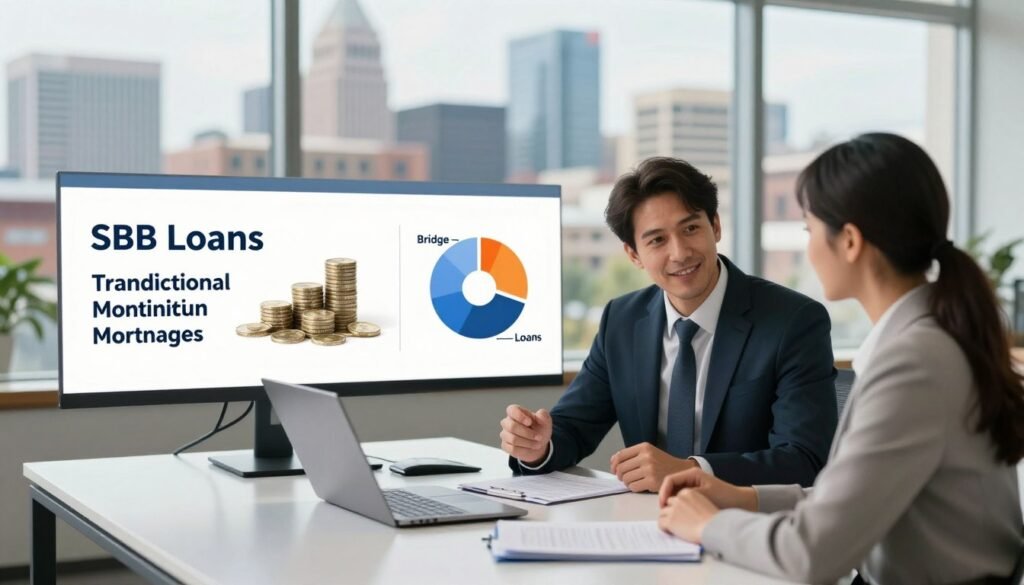
Lenders offer a wide range of loan programs that map to different ownership goals and hold periods.
Conventional mortgages
Workhorse loans from a bank or regional lender. Best for stabilized assets with predictable NOI.
Minimums typically start at $1,000,000 and max LTV is about 80%.
Conduit / CMBS
Suited for larger investment properties that need standardized underwriting and tight reporting.
Programs usually begin near $2,000,000 with up to 75% LTV.
Insurance and agency programs
Insurance loans reward long holds and lower volatility for larger assets ($5,000,000+; ~75% LTV).
FHA/HUD and USDA offer higher leverage and attractive pricing when projects qualify.
SBA, bridge, and construction
SBA loans support owner-occupied buildings with high LTV (85–90%) from $1,000,000 up.
Bridge loans fix timing gaps for transitional assets. Construction loans fund development with staged draws and contingency planning.
| Program | Minimum Loan | Typical Max LTV |
|---|---|---|
| Conventional | $1,000,000+ | 80% |
| Conduit / CMBS | $2,000,000+ | 75% |
| Insurance | $5,000,000+ | 75% |
| FHA / USDA | $1,000,000 – $5,000,000+ | 83.3% – 85% |
| SBA / Bridge / Construction | $1,000,000 – $1,500,000+ | 80% – 90% |
Choose the program that matches asset stability, timeline, and sponsor strength. For tips on accelerating approvals, see fast-track commercial financing.
Property Types We Finance Across Idaho’s Commercial Real Estate Market
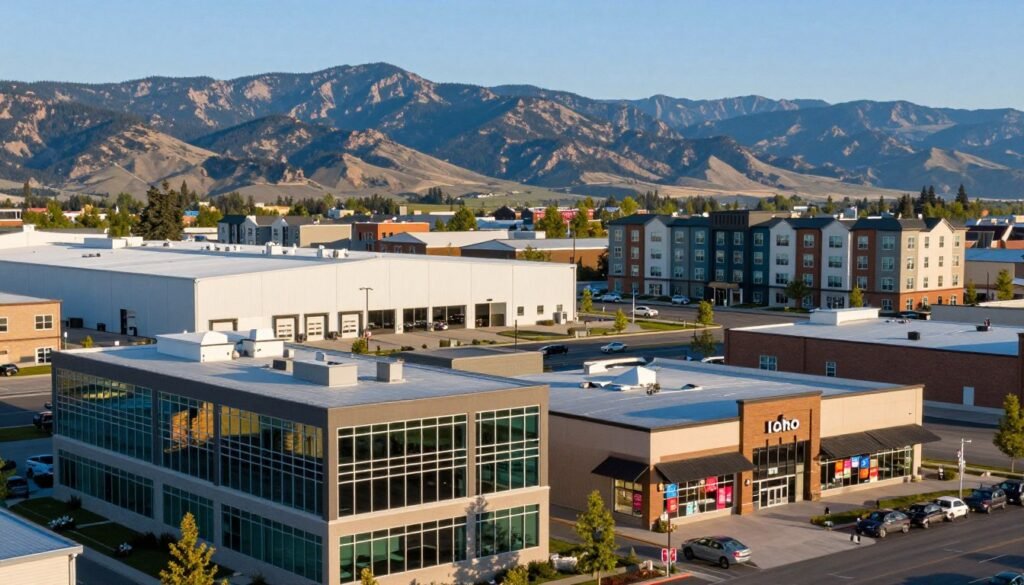
Lenders view different property types through the twin lenses of tenant strength and location quality.
Industrial and flex along major corridors
Why lenders like these properties: steady tenant demand tied to distribution, manufacturing, and regional supply chains. Locations near major transportation routes usually get preferential underwriting.
Retail with necessity and service-based tenancy
Preferred retail: grocery-adjacent, medical services, and local service providers. Lenders value long lease terms, strong tenant financials, clear rent escalations, and renewal options.
Office and current lender scrutiny
What underwriters check: tenant depth, rollover risk, re-leasing assumptions, and building quality. Remote and hybrid work trends force tighter assumptions on future occupancy and cash flow.
Multifamily and mixed-use assets
Stabilized multifamily wins approval when occupancy and collections are solid. Lenders also probe expense trends, insurance costs, and whether recent rent gains are realistic.
Special-use assets
Self-storage, healthcare, and hospitality underwriting is operator- and model-driven. Demonstrated operational experience and strong reporting matter most for these commercial properties.
| Asset Type | Why Lenders Like It | Key Lease/Operator Traits | Typical Concern | Market Tilt |
|---|---|---|---|---|
| Industrial / Flex | Distribution demand, supply constraints | Long leases, credit tenants | Obsolescence, location | Strong near corridors |
| Retail | Necessity services, steady foot traffic | Lease term, escalations, tenant financials | Vacancy risk for discretionary retail | Prefer neighborhood centers |
| Office | Core tenants, stable cash flow | Tenant depth, recent concessions | Re-leasing and remote work | Primary markets preferred |
| Multifamily / Mixed-use | Durable income, diversified uses | Occupancy, collections, expense control | Insurance and capex surprises | Strong where demand is steady |
| Special-use | Operator-driven returns | Operator experience, strong reporting | Model risk and management quality | Case-by-case |
Bottom line: what we finance depends on property fundamentals, sponsor experience, and market liquidity. The same asset type can receive different treatment based on location and execution risk, so present clear data to improve outcomes for clients.
What Idaho Lenders Look for Right Now
Underwriting today demands verifiable income histories and tight assumptions, not hopeful projections. Lenders prioritize a clear, documented income story and conservative stress testing when assessing risk. This approach is practical as cap rates and expenses shift.

Cash-flow durability and historical NOI
Cash-flow durability means stable in-place income, defensible vacancy assumptions, and supporting docs for historical NOI. Underwriters look for rent rolls, leases, and three-plus years of operating statements.
Conservative leverage, equity, and liquidity
Expect lower LTVs and clear equity contributions. Post-close liquidity and reserves often decide covenants, recourse, and approval odds.
Expense realism
Lenders pressure-test utilities, insurance, maintenance, and replacement reserves. Conservative expense lines prevent surprise shortfalls after close.
Exit plans and market liquidity
Exit strategy must match market depth. Metro cores show stronger liquidity than secondary or rural towns, which lowers acceptable leverage and shortens assumed hold horizons.
Where underwriting tightens
Office, speculative development, and deals built on aggressive rent growth face higher scrutiny. Improve the story with pre-leasing, phased capex, or stronger sponsor guarantees.
- Focus on clean financials and conservative underwriting assumptions.
- Document historical NOI and tenant stability.
- Present clear equity and post-close liquidity plans.
| Underwriting Focus | What Lenders Need | Borrower Actions |
|---|---|---|
| Income durability | Lease docs, NOI history, realistic vacancy | Supply 3+ years statements and signed leases |
| Leverage & liquidity | Lower LTV, equity, post-close reserves | Show liquid reserves and equity sources |
| Expense verification | Utilities, insurance, maintenance budgets | Include contractor bids and historical bills |
| Exit & market risk | Refinance/readiness in weaker markets | Provide exit options and market comps |
How the Commercial Real Estate Loan Process Works
A clear process reduces surprises and speeds approvals for most loan requests. The path from application to funding has set steps. Knowing them helps owners and businesses prepare and avoid delays.
Pre-qualification
Start by defining the requested loan amount, property profile, timeline, and goals such as purchase, refinance, renovation, or construction.
Why it matters: these inputs steer program selection, terms, and documentation needs. Lenders match the request to appropriate loans based on risk and hold strategy.
Required documentation
Collect clear business and owner records early. Typical application items include:
- Loan amount requested and property being financed/refinanced.
- Business info: name, address, year established, entity type, Tax ID, annual sales, employees.
- Owner info: name, home address, SSN, title, ownership %, photo ID, personal financials.
- Most recent business and personal tax returns and financial statements.
Underwriting and valuation
Underwriting evaluates DSCR, credit, and guarantor liquidity. Lenders order appraisals and review them against income projections.
Tip: clean rent rolls, three years of statements, and prompt responses speed review.
Closing and funding
Expect conditions: third-party reports, insurance, entity docs, and reserves. “Clear to close” means all conditions are met and funds are scheduled.
Post-close, some programs require periodic reporting. Solid financial reporting preserves refinancing options and supports growth.
| Step | Key Deliverable | Common Friction |
|---|---|---|
| Pre-qualification | Loan amount, goals, property data | Unclear timeline or program fit |
| Documentation | Tax returns, financials, IDs | Missing owner or business records |
| Underwriting | Appraisal, DSCR, credit review | Appraisal delays, weak DSCR |
| Closing | Signed documents, insurance, funding | Last-minute conditions or title issues |
Choosing the Right Lending Partner in Idaho
Choosing the right lending partner starts with matching your asset profile to the lender’s appetite and decision style.
Community and regional banks win many local deals because they combine local decision-making with relationship banking.
They often approve nuanced credits and understand submarket differences outside Boise. These banks are a top choice for borrowers who value speed and flexible structures.
Community/regional banks vs. credit unions vs. national lenders
Credit unions compete for owner-occupied and smaller-balance loans. They can offer low fees and straightforward services, but membership and underwriting rules vary.
National and institutional lenders work best for larger, stabilized assets. Their scale suits standardized reporting and attractive pricing when the asset profile is clean and well-documented.
When agency and institutional platforms fit best for multifamily
Agency execution via Fannie Mae or Freddie Mac is often ideal for multifamily. These platforms deliver low spreads and long terms for qualifying properties with strong occupancy and reliable cash flow.
Why local market knowledge improves outcomes
Local lenders provide realistic rent and expense assumptions. They also coordinate easily with local appraisers, brokers, and contractors, which reduces friction and speeds closing.
- Asset type: small vs. large.
- Loan size: local banks or national lenders.
- Speed vs. reporting tolerance.
- Recourse preference and relationship value.
| Lender Type | Best For | Key Advantage |
|---|---|---|
| Community / Regional Bank | Small to mid loans, nuanced credits | Local decisioning, relationship strength |
| Credit Union | Owner-occupied, smaller balances | Competitive rates, member services |
| National / Institutional | Large, stabilized assets | Scale, standardized products, attractive terms |
| Agency Platforms | Multifamily | Long terms, low spreads (Fannie/Freddie) |
Conclusion
The fastest path to approval is a simple lender story: durable NOI, sufficient equity, and clear exit options.
Bottom line: the market today has capital, but underwriting drives outcomes. Match your loan choice to the asset and plan exits with real liquidity in mind.
Focus on improving cash flow quality, clean documentation, and sensible equity. These actions often matter more than chasing the lowest interest or headline rates.
Prepare early: follow the process, deliver complete packages, and set realistic assumptions to speed approvals and simplify closing conditions.
Next steps: define goals for purchase, refinancing, or construction; validate property performance; then align with a lending partner that fits the deal profile.