
Commercial real estate financing in Oregon encompasses the structured debt and equity solutions used by investors and business owners to purchase, develop, refinance, or reposition commercial properties across the state.
Surprising fact: nearly one in three flexible commercial loans now offers terms that stretch up to 120 months, fundamentally reshaping long-term capital planning for property owners and investors.
Today, Oregon borrowers balance rate uncertainty, tighter underwriting guidelines, and higher equity expectations while pursuing growth opportunities. A focused commercial loan can support acquisition, repositioning, ground-up construction, or recapitalization for owner-users and institutional investors alike. Working with local lending teams often accelerates credit decisions, as nearby underwriting improves communication and streamlines execution when closing timelines matter.
Key Takeaways
- Flexible commercial loans cover purchase, refinance, construction, and term lending paths.
- Local underwriting enhances speed, clarity, and deal execution for Oregon borrowers.
- Term lengths—including options up to 120 months—directly impact refinancing risk and exit timing.
- Lender decision criteria focus on property cash flow, credit profile, collateral quality, and DSCR.
- Strategic borrowers match financing structure to project risk tolerance and long-term business goals.
Financing Options for Commercial Real Estate Projects in Oregon
Different commercial loan structures solve for transaction speed, cost of capital, or development complexity depending on your specific project goals.
Purchase Loans to Buy a Property and Grow Your Business
Purchase loans represent the primary debt vehicle for acquiring commercial real estate, stabilizing occupancy, and establishing predictable debt service for expanding companies.
Refinance Solutions to Lower Rates and Access Cash-Out Equity
Refinance strategies allow property owners to secure lower interest rates, extend amortization schedules, or extract accrued equity for property renovations and tenant improvements.
Construction-Only Financing for Ground-Up Builds
Construction-only loans fund building projects through milestone-based draws. Underwriters focus heavily on construction budgets, general contractor credentials, and contingency reserves.
Construction-to-Permanent Loans for Smoother Transitions
Construction-to-permanent financing seamlessly combines the build phase with long-term debt, eliminating the friction, fees, and execution risk of closing two separate loans.
Commercial Term Lending for Larger Transactions
Commercial term lending supports retail, industrial, mixed-use, and multifamily assets ranging from $500,000 to over $25,000,000, providing scale for expanding portfolios.
Agency Lending for Multifamily via GSE Programs
Agency programs through Fannie Mae and Freddie Mac deliver standardized execution with competitive terms for both affordable and market-rate apartment communities.
How to choose: Carefully weigh project timelines, complexity, and interest-rate exposure. Following structured steps such as these 7 proven steps to secure commercial real estate financing can help clarify borrower requirements and expedite lender approval.

| Option | Best For | Key Features |
|---|---|---|
| Purchase loan | Owners buying properties | Predictable payments; stabilizes occupancy |
| Refinance | Rate relief or cash-out needs | Lower rate, extend amortization, access equity |
| Construction-only | Ground-up builds | Draws by milestone; strict budget controls |
| Construction-to-perm | Build then stabilize | Single closing transitioning to permanent term |
| Commercial term | Portfolio growth | Scales to $25M+; structured term options |
| Agency lending | Multifamily assets | GSE underwriting, long amortization, non-recourse options |
Oregon Commercial Real Estate Financing for Key Property Types
Each commercial asset class carries distinct underwriting metrics and risk profiles. Lenders evaluate lease duration, tenant creditworthiness, and stabilization timing to determine loan pricing, reserve requirements, and recourse structures.
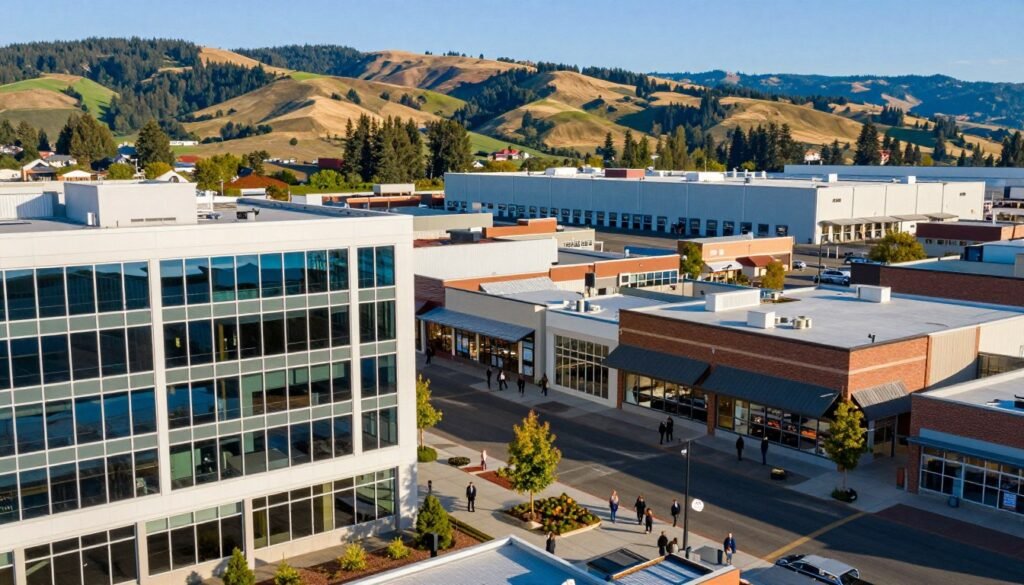
Retail and Storefront Locations
Retail underwriting focuses on site visibility, co-tenancy, and lease rollover schedules. Lenders stress-test historical sales data and anchor tenant stability. Assets with short remaining lease terms or frequent tenant turnover typically demand higher interest reserves or personal guarantees.
Office and Warehouse/Industrial Properties
Office and industrial loans vary significantly by occupancy type: owner-occupied properties receive different covenants than multi-tenant investment assets. Underwriters evaluate functional utility, clear height, loading dock access, and tenant build-out allowances.
Apartment and Multifamily Buildings
Multifamily underwriting hinges on in-place net operating income (NOI), regional vacancy trends, and structural reserve funds. Lenders model regional employment growth and debt service coverage ratios (DSCR) to size maximum loan amounts.
Senior Living and Care Facilities
Senior living represents an operational real estate niche. Lenders closely analyze state licensing, staffing ratios, and operator track records, applying higher regulatory scrutiny and stricter financial covenants.
Mixed-Use and Community Developments
Mixed-use developments blend retail, residential, and office spaces, requiring sophisticated capital structures. To understand how senior debt, mezzanine financing, and equity fit together in these complex transactions, explore our detailed analysis on navigating the capital stack.
Property Type Sizing & Feature Comparison
| Property Type | Typical Loan Features | Underwriting Focus |
|---|---|---|
| Retail | Shorter terms; tenant recourse; higher reserves | Lease rollovers; sales velocity; anchor strength |
| Office / Industrial | Owner-user options; build-out allowances | Occupancy stability; functional utility; location |
| Multifamily | Longer amortization; strict DSCR; reserves | Effective gross income; operating expenses; submarket demand |
| Senior Living | Stricter reporting; operator covenants | Licensing; nurse staffing ratios; occupancy trends |
| Mixed-Use | Layered capital; phased draws; execution covenants | Project phasing; contingency plans; revenue diversification |
Loan Terms, Rates, and Structures in Today’s Market
Commercial loan structuring requires balancing ongoing debt service obligations against property stabilization timelines and ultimate exit strategies.

Understanding Loan Terms Up to 120 Months
Loans offering terms up to 120 months typically feature a 10-year loan horizon paired with 25- or 30-year amortization schedules. This structure ensures predictable monthly payments while requiring a clear refinancing or property disposition strategy prior to loan maturity.
Short-Term vs. Long-Term Financing Ranges
Short-term bridge products range from 3 to 36 months, catering to value-add repositioning. Long-term commercial mortgages can extend up to 240 months. Total loan amounts generally span between $25,000 and $30,000,000 depending on capital requirements.
How Rates, Points, and Fees Impact Capital Costs
Prevailing market interest rates typically fluctuate between 8.49% and 14.00%, while origination points range from 1.00% to 6.00%. High upfront points directly inflate the effective interest rate, shifting the deal’s break-even holding period. Small business owners seeking lower down payments often review programs backed by the U.S. Small Business Administration (SBA).
Fixed vs. Variable Rates and Borrower Credit
- Fixed Rates: Offer payment certainty over the term, shielding cash flows from rate hikes.
- Variable Rates: Feature lower initial yields but require stress-testing against potential benchmark adjustments.
- Credit Impact: Strong borrower liquidity, track record, and verified cash flows command superior pricing tier placement.
| Metric | Typical Market Range | Financial Impact |
|---|---|---|
| Loan Amounts | $25,000 to $30,000,000 | Determines overall transaction scale |
| Loan Terms | 3 to 240 months | Establishes refinancing timeline and maturity risk |
| Interest Rates | 8.49% to 14.00% | Reflects asset quality, credit score, and market risk |
What Lenders Look For and How the Commercial Loan Process Works
Lenders render underwriting approvals efficiently when presented with transparent property cash flows, strong debt coverage metrics, and a well-documented borrower track record.

Credit, Cash Flow, and DSCR Metrics
Underwriters analyze global cash flow, borrower liquidity, and Debt Service Coverage Ratios (DSCR). Most commercial lenders mandate a minimum DSCR of 1.20x to 1.25x. Clean corporate balance sheets, updated tax returns, and certified rent rolls significantly streamline credit approvals.
Down Payment, Equity, and Collateral Requirements
Stabilized commercial properties command higher loan-to-value (LTV) ratios than transitional assets. High-risk or value-add acquisitions require greater equity contributions and post-closing liquidity reserves. Investors looking across state borders can compare local market dynamics with regional guidelines such as commercial real estate financing in Washington.
From Application to Loan Closing
- Initial Review & Sizing: Financial analysis and preliminary term sheet issuance.
- Third-Party Reports: Ordering commercial property appraisals, Phase I Environmental Site Assessments, and property condition reports.
- Formal Underwriting: Full credit committee review and commitment letter issuance.
- Closing & Funding: Execution of loan documentation and capital disbursement.
Conclusion
Aligning your commercial real estate debt with your long-term business strategy is critical for success in Oregon’s evolving market. By evaluating term lengths, interest rate structures, origination fees, and property-specific underwriting requirements, investors and owner-users can secure capital that supports long-term value creation.