

Surprising fact: more than 70% of deals over $1,000,000 in this state rely on relationship-based lenders rather than rate auctions.
What this means for borrowers: practical strategy beats generic rate shopping. Lenders here favor stable income, strong sponsors, and defensible valuations over aggressive growth forecasts.
Our focus is owner-occupied buyers and investors seeking stabilized income properties. We outline when conventional loans, SBA, bridge, construction, agency/HUD/USDA, CMBS, or insurance lenders typically fit a deal.
Decision framework: evaluate property type, cash flow, borrower profile, timeline, and leverage needs. The smaller local market affects liquidity and underwriting, so preparation and positioning are key.
Guideline ranges are for planning and education. Final terms depend on underwriting and can change based on sponsor strength and market conditions.
Key Takeaways
- Relationship-driven lenders dominate deals above $1,000,000.
- Focus on stable cash flow and strong sponsorship, not only rates.
- Match loan type to property use and timeline for best outcomes.
- Smaller market size can tighten liquidity and underwriting.
- Guideline ranges help planning; underwriting sets final terms.
Rhode Island commercial lending outlook in today’s market
Local lenders are ready to lend, but they prize predictability over growth bets.
Why capital is available but structures stay conservative: smaller buyer pools and limited market liquidity raise execution risk. Lenders price and size loans to protect against thin resale markets and slower exits.
What underwriters want: demonstrable cash flow history, tenant durability, and expense transparency. Sponsors with proven track records get better traction in a relationship-driven environment.

Where scrutiny increases
Underwriting tightens for office, hospitality, and transitional/value-add deals. Vacancy trends, lease rollovers, and seasonal income swings trigger deeper review.
How location changes terms
- Providence Metro: most active lenders and looser liquidity.
- Coastal communities: insurance, flood exposure, and seasonality affect pricing.
- Secondary markets: relationships and tenant quality drive approvals.
| Factor | Impact on Terms | Borrower Action |
|---|---|---|
| Cash flow stability | Lower spreads, higher LTV | Provide 3–5 years of NOI and leases |
| Sponsor experience | Faster approvals, better pricing | Document track record and references |
| Asset risk (office/hospitality) | Tighter leverage, more stress tests | Deliver conservative pro formas and contingency plans |
Practical next steps: prepare documentation early, tie requests to defensible cash flow, and set timelines that match the loan type. These steps improve odds in the current market.
Rhode Island Commercial Real Estate Financing options for owner-occupied and investment properties
Financing choices fall into two main tracks—business-occupied properties and stabilized rental assets.
Owner-occupied commercial mortgage financing for businesses using 50%+ of the space
Definition: owner occupies at least 50% of the premises.
These requests are often lender-friendly when the operating business shows steady revenue and clean financials. SBA options can lower down payments—typical minimums run near 20%, with some programs permitting as low as 10% when other debt is unavailable.
Investment property financing for stabilized income-producing real estate
Investors pursue longer-term, cash-flow-focused loans. Lenders prioritize leases, tenant quality, and historical NOI when sizing debt and setting terms.
- Conventional: common fit across property types; underwrites to cash flow, credit, and collateral.
- Conduit/CMBS: best for larger, stabilized assets; standardized docs and tighter structural covenants.
- Insurance lenders: target high-credit sponsors and long-term quality; they pay for stability.
- Agency (FHA/HUD, USDA): attractive for eligible uses with long terms and competitive spreads.
- Bridge: short-term capital for acquisition, repositioning, or fast closings until refinance.
- Construction: funds ground-up or major redevelopment; lenders focus on budget, timeline, and takeout plans.
- SBA loans: tailored for owner-occupiers seeking higher leverage and lower down payments; expect longer timelines and documentation.
| Program | Main Benefit | Typical Use |
|---|---|---|
| Conventional | Flexibility, broad eligibility | Existing stabilized assets |
| Conduit/CMBS | Large-scale term and liquidity | Large, stabilized commercial property |
| SBA | Lower down payment for owners | Owner-occupied business buildings |

Commercial mortgage rates, LTV, and terms to expect in Rhode Island
Expect program-level rate guidance to vary widely with property risk, sponsor strength, and loan structure. Use the ranges below to plan scenarios, not as commitments.

Guideline rate ranges by program
- Conventional: 5.04%–8.95% (up to 80% LTV)
- Conduit/CMBS: 5.95%–7.92% (≈75% LTV)
- Insurance: 5.35%–8.74% (≈75% LTV)
- FHA/HUD: 4.99%–6.34% (≈83.3% LTV)
- USDA: 5.45%–9.80% (≈85% LTV)
- Bridge: 5.95%–12.95% (≈80% LTV)
- Construction: 5.70%–8.95% (≈83.3% LTV)
- SBA: 5.45%–8.95% (85%–90% LTV)
Terms, amortization, and lender sizing
Longer amortization lowers monthly debt service and supports DSCR. Where available, WCCU offers up to 30-year terms with no balloon payments, which helps owner-users avoid refinance risk.
Insurance, taxes, and utilities reduce available cash flow. Even an attractive interest rate can yield less proceeds if coverage weakens lender sizing.
| Factor | Typical impact | Borrower action |
|---|---|---|
| Asset stability | Lower rate, higher LTV | Provide history of NOI |
| Transitional risk | Higher rate, lower LTV | Show conservative pro forma |
| Sponsorship | Speed and pricing | Document track record |
Please note: these rates are indicative and may change without notice. Final pricing depends on underwriting, market moves, and deal structure. Compare total economics—rate plus fees, leverage, covenants, and flexibility—rather than the headline rate alone.
Property types and use cases lenders are most comfortable financing
Lenders favor properties with steady income, clear occupancy, and realistic market support. Those traits reduce underwriting risk and improve access to useful loan terms.
Stabilized multifamily and mixed-use
Multifamily with stable collections and 3–5 years of operating history scores well. Mixed-use is judged by each component’s stability and the combined NOI.
Medical, education, and essential-use buildings
Mission-critical tenancy drives lender comfort. Long-term leases and specialized uses often yield stronger terms and higher perceived value.
Industrial and flex
Location, dock access, and functional utility matter. Well-located industrial properties with steady tenants meet lender expectations for refinance and investment holds.
Office and hospitality notes
Office deals need credit tenants, longer leases, or recent capex to win approvals. Hospitality remains financeable but underwrites conservatively for seasonality, management, and insurance volatility.
| Type | Lender Comfort | Key Requirement |
|---|---|---|
| Multifamily | High | 3–5 years NOI |
| Medical/Education | High | Long leases, mission tenancy |
| Industrial/Flex | Medium‑High | Location & stabilization |
Practical takeaway: match your loan request to the asset’s financeability. Solid documentation and realistic pro formas often add more value than a marginally lower rate.
What Rhode Island lenders look for in borrower credit, cash flow, and value
Lenders prioritize predictable payment coverage and verified income when sizing a loan. Underwriting focuses on numbers the bank can stress-test and defend.

Debt service coverage and stress testing
Lenders size debt by DSCR — the ratio of net operating cash to annual debt service. Underwriters apply stress tests to income and expenses to ensure payments remain supportable under worse scenarios.
Borrower credit and liquidity
Reviewers assess repayment history, available liquidity, and contingent liabilities. Strong credit and clear global cash positions shorten review and increase loan certainty.
Sponsorship, experience, and reputation
In a relationship-driven market, sponsor experience matters as much as numbers. Proven execution and local reputation accelerate approvals and improve terms.
Valuation, liquidity, and expense pressure
Smaller buyer pools can compress appraised value and limit acceptable leverage. Underwriters stress Rhode Island coastal taxes, insurance, and utilities as line items that reduce net cash.
Documentation checklist and packaging
- Two years financials, P&L, and balance sheets
- PFS for 20%+ owners, debt schedules, and tax returns
- Appraisal and environmental reports
Tip: Clean, complete packages cut back-and-forth and speed the process. For a practical checklist, see the fast-track lending checklist.
How the commercial real estate loan process works from application to closing
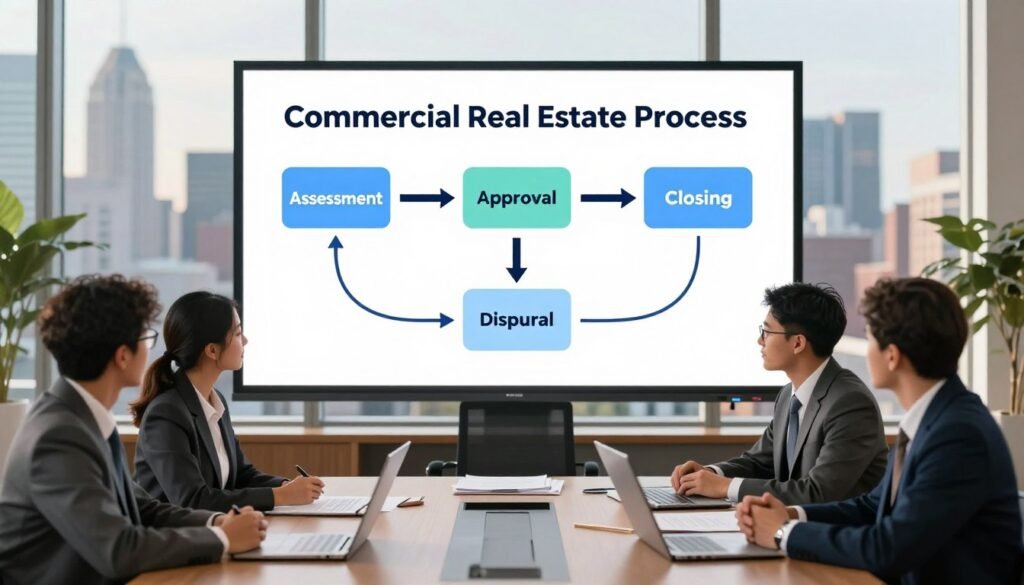
Start the loan process by clarifying whether the goal is acquisition, refinance, cash-out, or renovation. Early clarity helps match the right loan type to the asset and the sponsor’s timeline. This step saves time and reduces unnecessary conditions later.
Discovery and strategy
Discovery focuses on goals, timing, and borrower profile. Lenders ask: what are you buying, how will income perform, and which loan type fits best? Clear answers narrow options and speed approvals.
Underwriting workflow
Lenders collect financials, order appraisal and environmental reports, and review credit and cash flow. Appraisals and site studies often set conditions and adjust loan sizing for risk. Local appraisals can shorten the process and lower fees.
Typical timelines
Expect about 45 days for non‑SBA deals and 90+ days when SBA loans apply. Complexity, documentation speed, and third‑party timing affect both paths.
Closing and funding
At commitment, common requirements include reserves, insurance, reporting, lease deliverables, and guarantor documentation. Closing coordinates attorneys, title work, and final document review. Funding triggers when all conditions are satisfied.
- Provide rent rolls, leases, and clean entity documents early.
- Respond promptly to lender requests to avoid delays.
- Align structure to reality—don’t force max leverage or unrealistic deadlines.
| Step | Primary deliverable | Typical timing |
|---|---|---|
| Discovery | Loan purpose and docs | 1–7 days |
| Underwriting | Appraisal, enviro report, credit | 21–45 days |
| Closing | Title, funds, final docs | 7–14 days |
Local lending channels in Rhode Island and where we serve
Choosing the right lender channel often determines how fast a loan closes and how flexible the terms will be.
Community & regional banks vs. credit unions vs. national lenders
Community and regional banks dominate the local market. They value deposits, local reputation, and long-term relationships. That often means faster decisions and tailored covenants.
Credit union options compete on owner-occupied deals and smaller balances. Local credit union decisions can offer low fees, SBA access, and long terms.
National lenders enter for larger, stabilized properties with institutional reporting. They can offer scale but less flexibility on covenants and speed.
Where we serve and how geography affects underwriting
- Service areas include Providence, Warwick, Cranston, Pawtucket, Newport, and Westerly, with broader statewide coverage on request.
- Providence Metro is most active; coastal and secondary towns tend to face tighter leverage and higher reserve needs.
| Channel | Best use | Typical tradeoff |
|---|---|---|
| Community banks | Owner-users, mid-size deals | Flexible structure, local rates |
| Credit union | Smaller loans, SBA work | Low fees, local decisions |
| National lenders | Large, stabilized properties | Scale vs. less customization |
Bottom line: match lender type to property, timeline, and document readiness. That often beats chasing the lowest headline rates alone.
Conclusion
Conclusion
Success comes from aligning loan structure to asset stage and proving cash flow under stress. , Conservative structuring, crisp documentation, and realistic underwriting assumptions raise closing odds for most borrowers.
Owner-occupied deals, stabilized multifamily, and medical or other essential-use properties fit lenders best because they show steady income and lower execution risk.
Office, hospitality, and value-add transitions remain feasible but need stronger equity, clearer business plans, and conservative projections. Match the full capital stack to whether a property is stabilized, transitional, or under construction.
Next step: prepare financials, rent rolls/leases, and a concise project narrative to start lender conversations. Guideline figures are planning tools only—underwriting will set final terms.