
Commercial Real Estate Financing: Strategic Approaches for Today’s Market in Utah

brown rock formation under blue sky during daytime

Surprising fact: Nearly 60% of small businesses that use property loans report smoother cash flow within the first year.

Utah Commercial Real Estate Financing helps business owners evaluate options, match terms to cash flow, and cut closing-day surprises.

We outline the common product types—conventional loans, land development loans, and lines of credit—and explain when each aligns with acquisition, refinance, expansion, renovation, or development goals.

Decisions are strategic, not just transactional. Choices here affect occupancy, rent growth, operating costs, and capital planning across the current market.

What this page covers: financing options for income-producing properties, a step-by-step loan process, and state-specific compliance and disclosure notes.

We spotlight key decision lenses: property type, borrower strength, collateral quality, and how lenders price risk through rates, terms, and structure.

Goal: secure a solution that supports working capital, reserves, and predictable payments while keeping your business competitive today.

Key Takeaways

  • Loans and credit lines can stabilize cash flow and support growth.
  • Pick the product that fits your use case: acquire, refinance, expand, renovate, or develop.
  • Evaluate lender pricing by property type, borrower strength, and collateral.
  • Plan for occupancy, rent trends, and operating expenses in the current market.
  • A clear, aligned financing plan reduces closing surprises and preserves reserves.

Commercial real estate financing in Utah today: what business owners need to know

Smart capital decisions make growth possible without draining cash reserves needed for daily operations.

Using a loan or credit product lets owners acquire or expand a commercial property while keeping cash for payroll, inventory, and surprises. Match the product to your needs so operating budgets stay intact and contingency funds remain intact.

Why financing matters for starting, buying, or expanding properties

Loan terms—down payment, amortization, covenants, and prepayment—directly affect monthly payments and future flexibility. Short amortization raises payments now but cuts long‑term interest costs. Flexible prepayment rules help plans change without heavy penalties.

How market conditions influence rates, terms, and lender appetite

Interest and broader money market moves drive the rate lenders quote. When rates climb, affordability drops and underwriting tightens. Local demand, vacancy, tenant quality, and sales comps shape lender willingness and leverage by property type.

Factor Effect on loan Owner action
Property quality Higher quality = better rates and terms Prepare strong rent roll and comps
Market demand High demand = more leverage Lock terms quickly
Borrower cash Stronger liquidity = lower risk pricing Keep reserves and show statements

This section sets up the next part, which details the common types of loan solutions used for income-producing properties and how to pick the right one. Use this information to frame lender conversations and clarify priorities before you apply.
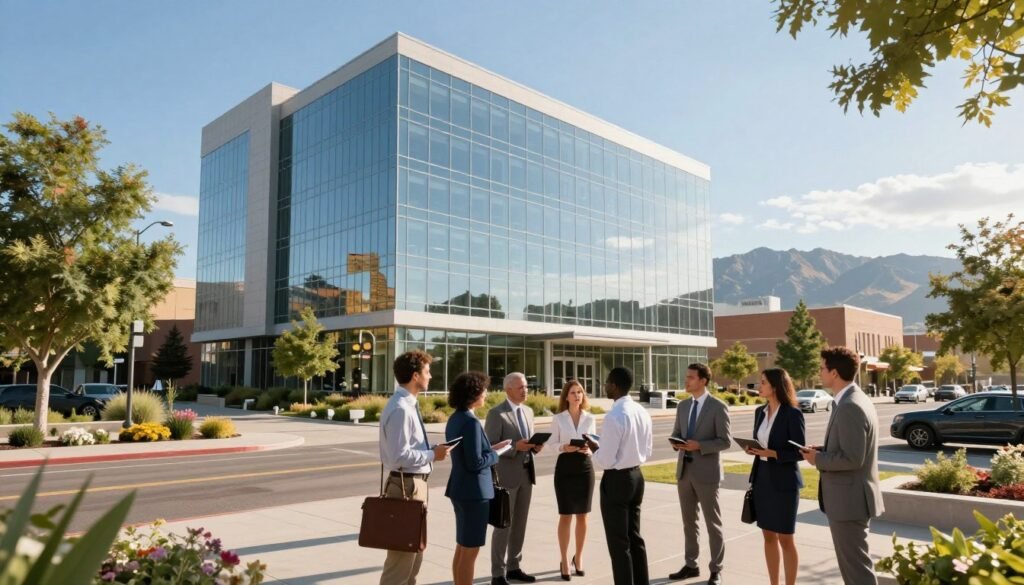
A modern commercial property in a vibrant Utah business district, showcasing a sleek glass-fronted office building. In the foreground, a diverse group of professionals in business attire engage in a discussion, holding digital tablets and briefcases, portraying an atmosphere of collaboration and strategizing. The middle ground features lush landscaping with trees and flowers, leading up to the building’s entrance, where stylish corporate signage is visible. The background reveals Utah's stunning mountain range under a clear blue sky, with soft sunlight illuminating the scene, creating a warm and inviting atmosphere. The angle is a slightly elevated view, depicting the property from a dynamic perspective to emphasize its importance in the commercial real estate landscape.

Utah Commercial Real Estate Financing options for income-producing properties

Choose the right loan type by matching property cash flow, sponsor experience, and exit plans to lender programs.

Conventional commercial real estate loans work best for stabilized assets with steady net operating income and predictable occupancy. Underwriting focuses on historical cash flow, lease terms, and debt-service coverage. These loans often offer longer terms and simpler amortization for owners planning steady hold periods.

Land development loans

Land development loans finance entitled land or ground-up projects. Lenders review entitlement status, absorption assumptions, construction budgets, and contingency plans.

Expect staged draws, milestone inspections, and tighter oversight when construction risk is present.

Lines of credit for property needs

Lines of credit provide flexible funds for repairs, tenant improvements, and timing gaps in cash flow. Draws and repayments vary by agreement, so structure them to match leasing and capital cycles.

SBA loans and alternatives

SBA loans suit many owner-occupied scenarios and can offer favorable terms for qualifying business owners. When timing, property profile, or eligibility rules don’t fit, consider non‑SBA options or hybrid structures.

Portfolio and case-by-case lending

Portfolio lenders underwrite deals outside rigid “box” programs and can be flexible on transitional cash flow or unique properties. They often weigh sponsor track record and mitigants instead of strict templates.

Recourse vs. non-recourse

Recourse structures typically require principal guarantees; full recourse means guarantors remain liable if liquidation proceeds fall short. Non-recourse limits lender claims to collateral but may include carve-outs for fraud or environmental issues.

  • Match each option to property type, leverage, sponsor experience, and exit strategy.
  • Pick structures that protect long-term cash flow and reduce refinancing risk.

A detailed urban landscape showcasing commercial real estate options in Utah, featuring modern office buildings and retail spaces interspersed with greenery. In the foreground, a diverse group of professional individuals in business attire discusses plans around a table with blueprints and market reports. The middle ground highlights eye-catching architecture, including a mix of glass-fronted skyscrapers and charming brick buildings. The background reveals majestic mountains under a clear blue sky, symbolizing Utah's unique geography. Soft, natural daylight illuminates the scene, creating an inviting atmosphere. The camera angle captures a dynamic perspective, emphasizing both the human element and the diverse real estate options available, conveying a sense of growth and opportunity in the commercial real estate market.

Explore specific loan options to align your financing with operational goals and risk tolerance.

The commercial real estate loan process: from application to closing

Knowing each step from application to closing helps owners avoid delays and hidden fees. A clear process lets you control timing, manage cash needs, and give lenders clean information early.

Pre-qualification inputs

Lenders look at property types, projected income, and borrower profile to set initial leverage and likely terms. These inputs shape how aggressive the lender will be on rate and term length.

Documentation checklist

Prepare financial statements, tax returns, rent rolls, executed leases, banking information, and entity/ownership records. An organized package speeds review and reduces requests for more information.

Underwriting focus areas

Underwriters assess credit quality, cash flow coverage, and collateral valuation. They also review loan terms like covenants, reserves, and recourse to manage risk.

Pricing mechanics

Final interest and rate decisions hinge on perceived risk, liquidity conditions, asset performance, sponsor strength, and the chosen term and amortization years. Longer amortization lowers payments but can affect rate.

Closing expectations

Timelines often stall on appraisals, environmental reports, or title issues. Clearfee disclosure and early communication — the “no surprises” approach HCN Bank favors — avoid last‑minute re‑trades.

  • Gather documents listed above before you apply.
  • Ask lenders for a checklist, timing estimate, and fee summary.
  • Compare term sheets on rate, term, amortization years, and covenants — not just the headline rate.

A professional office setting depicting the commercial real estate loan process. In the foreground, a diverse group of three business professionals in formal attire—one Black woman reviewing documents, one Caucasian man pointing at a digital tablet, and one Hispanic woman taking notes. The middle ground features a conference table with loan application forms and financial documents scattered. In the background, a large window showcasing an urban skyline of Utah under a bright, sunny sky. Soft, natural lighting floods the room, creating a welcoming and focused atmosphere. The scene captures a collaborative and strategic moment as they discuss financing options. Use a 35mm lens to create a slight depth of field, emphasizing the subjects in an engaging and dynamic composition.

Utah lending compliance and disclosures for commercial financing transactions

Providers and borrowers must understand new registration and disclosure duties that affect how offers are made, reviewed, and accepted.

Why compliance matters: registration and clear disclosures protect businesses by improving transparency, reducing surprises at closing, and raising the reliability of offers and services.

What changed: SB183 enacted the Commercial Financing Registration and Disclosure Act at Utah Code Title 7, Chapter 27. Two provisions that took effect on January 1, 2023 are especially important.

Key statutory points and timing

  • §7-27-201: providers must register with the Department of Financial Institutions before acting as a provider in the state or with a resident.
  • §7-27-202: requires specific disclosures for covered transactions; subsection (4) applies these disclosure rules to transactions consummated on or after January 1, 2023.

When comparing offers, ask who the provider is, confirm any required registration, and request full disclosure packets before you sign. Be especially cautious with products that look like revolving accounts, lines, or hybrid services.

For authoritative guidance and FAQs, review Title 7 Chapter 27 and contact the Department of Financial Institutions: Supervisor Paul Cline, (801) 538-8842, pcline@utah.gov or DFI at (801) 538-8830, msb.dfi@utah.gov.

A professional office setting in Utah focused on lending compliance and disclosures for commercial financing transactions. In the foreground, a diverse group of business professionals dressed in formal business attire are engaged in a discussion around a conference table filled with documents, charts, and a laptop displaying financial data. The middle ground shows a large window with a view of the Utah landscape, featuring mountains and blue skies, subtly highlighting the local context. In the background, a modern office design with sleek furniture and vibrant plants enhances the work environment. The lighting is bright and natural, creating an uplifting atmosphere, captured with a slightly tilted lens to emphasize the dynamic interactions in the scene. The overall mood is professional, focused, and collaborative.

Conclusion

strong, successful deals match product to purpose: conventional loans, development credit, lines of credit, SBA loans, or portfolio solutions. Choose the path that fits cash-flow timing, exit plans, and reserve needs.

Focus on five evaluation points: property performance, borrower credit, cash flow, collateral quality, and how those drive rates and terms. Be practical: plan payments, realistic refinance timing, and maintain buffers instead of chasing maximum leverage.

Organize documents early to win speed and negotiating leverage. Confirm provider registration and required disclosures, and review offers carefully.

Next step: define goals, gather financials, assess cash flow, compare loan options, and discuss scenarios with an expert. For tips on accelerating approvals, see our fast-track guide.
FAQ

What types of loans are available for income-producing properties?

Lenders offer several options, including conventional commercial loans for stabilized assets, land development loans for ground-up projects, lines of credit for short-term capital needs, SBA 7(a) and 504 loans for eligible businesses, and portfolio loans underwritten by banks on a case-by-case basis. Each option varies by term length, amortization, prepayment flexibility, and underwriting focus.

How do market conditions influence rates and loan terms?

Local market fundamentals — vacancy, rental growth, and competing property supply — affect lender appetite and pricing. Broader factors like the federal funds rate, treasury yields, and bank liquidity also drive interest spreads and available amortization. Strong market performance typically yields better loan-to-value limits and lower rates; weak conditions can tighten terms and require higher debt coverage.

What information do lenders need for pre-qualification?

Lenders typically request property type and location, projected or historical income, operating expenses, borrower credit profile, business financial statements, and ownership entity details. For stabilized properties, rent rolls and leases are essential; for development loans, pro forma cash flow and entitlements matter most.

Which documents should borrowers prepare for the application?

Common documents include personal and business tax returns, profit-and-loss statements, balance sheets, rent rolls, current leases, bank statements, entity formation records, and a property appraisal or broker opinion of value. For development projects, provide site plans, entitlements, budgets, and contractor agreements.

How do lenders underwrite cash flow and collateral?

Underwriters analyze historical and pro forma net operating income, apply debt service coverage ratios, and stress-test projections. They also assess property value through appraisals, loan-to-value calculations, and review physical condition. Borrower credit, liquidity, and management experience influence pricing and required reserves.

What drives interest rates and pricing on business property loans?

Rates depend on base market rates, lender risk premium, borrower creditworthiness, loan term, amortization schedule, and collateral quality. Loan size, prepayment features, and whether the loan is recourse or non-recourse will also affect pricing. Adjustable-rate products often include spreads tied to SOFR or prime.

What are recourse and non-recourse loan structures?

Recourse loans permit the lender to pursue borrower assets beyond the collateral if a default occurs; full recourse means personal guarantees and broad liability. Non-recourse loans limit recovery to the pledged property, though exceptions (carve-outs) may require guarantor liability for fraud, environmental issues, or willful misconduct.

When are SBA loans a good fit, and what are the alternatives?

SBA 7(a) and 504 loans suit owner-occupied properties and small businesses needing long-term, fixed-rate financing with lower down payments. Alternatives include conventional term loans, bank portfolio loans, bridge loans, and lines of credit that may offer faster closings or different underwriting criteria.

How long does the loan process typically take from application to closing?

Timelines vary: simple refinances or portfolio loans can close in 30–45 days, while construction or SBA loans often require 60–120 days due to extra reviews, appraisals, environmental reports, and title work. Early preparation of documents and clear communication with the lender shorten the timeline.

What fees and closing costs should borrowers expect?

Expect appraisal fees, title and recording charges, lender origination or commitment fees, attorney fees, third-party reports (environmental, engineering), and prepaid interest or escrows. Some lenders also require reserves or deposits for taxes and insurance at closing.

How can borrowers improve approval odds and secure better terms?

Strengthen cash flow and debt coverage, maintain clean financials and strong credit, provide complete documentation, select the appropriate loan product for the asset, and present realistic pro formas. A larger down payment or reduced leverage also improves pricing and lender confidence.

What compliance or disclosure requirements apply to financing transactions?

Loans must meet federal and state disclosure rules, anti-money-laundering checks, and any local registration or reporting requirements. Specific state statutes may mandate lender disclosures and licensing for certain transactions; borrowers should consult counsel or a licensed lender to confirm obligations effective under current law.

Are lines of credit common for property-related cash flow needs?

Yes. Commercial lines offer flexible liquidity for working capital, tenant improvements, and short-term gaps between lease-up and stabilized operations. Terms, availability, and pricing depend on collateral, borrower relationships, and covenant structures.

What is portfolio lending and when is it used?

Portfolio lending occurs when a bank holds loans on its balance sheet and underwrites based on internal criteria rather than secondary market standards. It’s useful for unique properties, complex cash flows, or borrowers seeking tailored covenants and pricing on a case-by-case basis.

How do amortization and term length affect monthly payments and long-term costs?

Longer amortization periods reduce monthly principal-and-interest payments but can increase total interest paid over the loan life. Shorter terms raise monthly payments but shorten interest exposure. Some borrowers combine longer amortization with shorter fixed-rate terms to balance cash flow and refinance flexibility.

Leave a Comment

Your email address will not be published. Required fields are marked *

Scroll to Top