Commercial Real Estate Financing: Strategic Approaches for Today’s Market in Vermont

brown and white house near brown trees and river during daytime

Fact: current commercial loan rates in the state range from about 5.05% to 12.95%, a span that reshapes borrowing strategy for many owners and investors.

This guide helps local owners compare loan structures that meet modern underwriting norms and closing timelines. Lenders here are small and relationship-driven, so documentation quality and realistic cash-flow assumptions matter more than ever.

We preview bank, SBA, agency, bridge, construction, and land pathways, and explain when each program usually fits a deal. Expect to read clear markers of what makes a project financeable now: stable income, conservative leverage, seasoned sponsors, and simple business plans.

Property type and location change lender appetite, from city-area liquidity to rural relationship banking and resort-seasonality scrutiny. Our promise is a program-by-program strategy that aligns rate, term, leverage, and closing certainty with your goals. Use published ranges as guidance, not binding offers.

Key Takeaways

  • Loan rates vary widely today; match program to your timeline and risk profile.
  • Local lending favors stable cash flow and experienced sponsors.
  • Bank, SBA, agency, bridge, construction, and land paths serve different needs.
  • Location and property type materially affect lender appetite.
  • Plan for conservative leverage and clear documentation to improve certainty.

Vermont Commercial Real Estate Financing Options for Owner-Occupied and Investment Properties

This section maps the primary lending paths owners and investors use today for owner-occupied and income-producing properties.

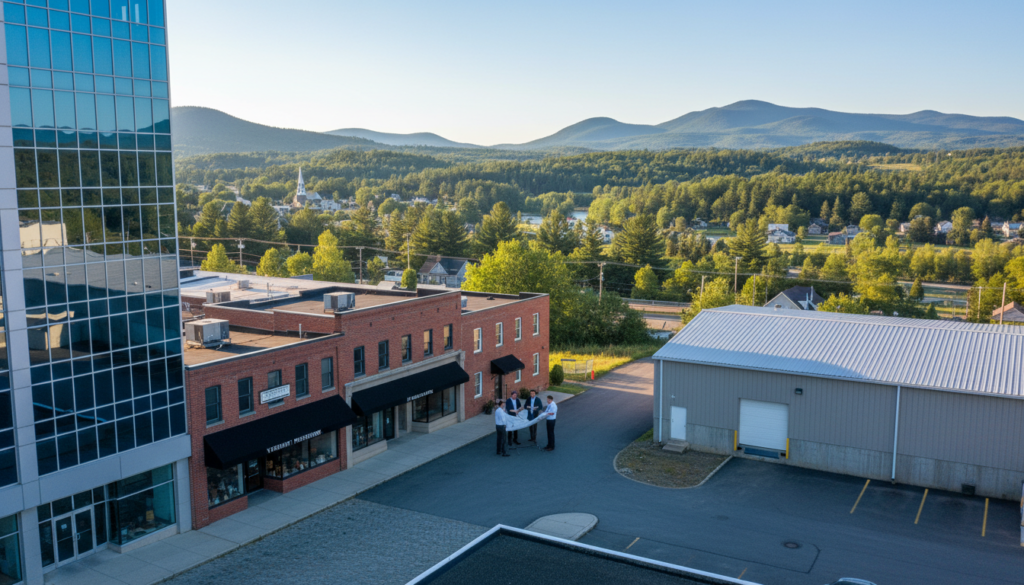
A vibrant scene showcasing a variety of commercial real estate options in Vermont, positioned in the foreground. Feature diverse architectural styles: modern office buildings gleaming with glass facades, cozy brick storefronts, and spacious warehouses. In the middle ground, display professional individuals in business attire discussing plans, reviewing documents, or using digital devices, projecting a dynamic work environment. The background features the picturesque Vermont landscape, with lush greenery and rolling hills under a clear blue sky, enhancing the atmosphere of opportunity. Use soft natural lighting to highlight the buildings and people, capturing a sense of warmth and professionalism. The angle should be slightly elevated to encompass both the structures and the engaging activities, setting a hopeful and optimistic tone for commercial real estate endeavors.

Owner-occupied vs. investment deals

Owner-occupied loans usually require 50%+ occupancy by the operating company. That rule improves credit outcomes and raises approval odds by linking cash flow to the borrower’s business.

Key program snapshots

Conventional mortgages are the workhorse for stabilized property loans. Banks want steady income, clean operating histories, and simple collateral stories.

Conduit/CMBS suits larger, stabilized investment transactions and demands formal third-party reports and securitization-style documentation.

Insurance lenders favor seasoned sponsors and strong assets, offering conservative leverage but attractive long terms for high-quality profiles.

Program Rate Range Max LTV Typical Minimum
Conventional 5.05% – 8.95% 80% $1,000,000
Conduit / CMBS 5.96% – 7.92% 75% $2,000,000
Insurance 5.36% – 8.75% 75% $5,000,000
Bridge / Construction / SBA 5.7% – 12.95% 75% – 90% $1,000,000

Commercial Loan Rates and Terms in Vermont’s Current Market

Snapshot: guideline rate ranges vary by program and depend on leverage, sponsor strength, and asset quality. Below are typical bands to use as planning benchmarks.

A professional office setting focused on commercial loan rates in Vermont's real estate market. In the foreground, a sleek glass conference table displays financial documents, calculators, and a laptop showing graphs of interest rates. In the middle, a diverse group of four individuals in professional business attire, engaged in discussion, reviewing the documents and pointing at the laptop screen. In the background, large windows reveal a picturesque view of Vermont’s landscape, with rolling hills and vibrant autumn foliage. Soft, natural lighting filters through the windows, creating a warm, productive atmosphere. The angle is slightly elevated, capturing the dynamic interactions among the group while emphasizing the importance of financial discussions in commercial real estate.

Typical rate ranges by program

Program Guideline rate range Notes
Conventional 5.05% – 8.95% Best for stabilized assets with strong track records.
Conduit / CMBS 5.96% – 7.92% Pricing favors larger, securitized transactions.
Insurance / FHA / USDA 5.00% – 9.80% Long terms possible but underwriting is selective.
Bridge / Construction / SBA 5.45% – 12.95% Higher cost for short-term or higher-risk projects.

How leverage, DSCR, and property type affect pricing

LTV: higher loan-to-value raises lender risk. More leverage often means higher rates, tighter covenants, and extra reserves.

DSCR: debt service coverage ratio measures income vs. debt service. A higher DSCR can lower rates and increase proceeds. A weak DSCR usually reduces loan size or forces more equity.

Property type: stabilized multifamily and essential-use assets typically secure better terms. Specialized or seasonal properties usually face higher rates and lower LTVs.

Structuring terms for cash flow

Amortization extends payments and smooths monthly cash flow. Maturity sets the refinance or balloon date. Longer amortization lowers monthly payments but may still carry a short maturity.

  • Choose fixed rates for predictable payments if you plan to hold long term.
  • Choose floating rates when you expect to refinance or sell soon and can tolerate volatility.
  • Account for existing debt, liens, and closing timelines—refinances add documentation and may lengthen the process.

Practical step: match payment structure to your operating plan so debt supports operations instead of squeezing working capital. For tailored guidance, review our commercial real estate loan options.

What Vermont Lenders Prioritize in Underwriting Today

Approval often hinges on relationships, conservative assumptions, and measurable operating history. Local bank officers and credit committees reward transparent packages and visible cash performance.

A modern office setting focused on commercial real estate financing in Vermont, showcasing a diverse group of professionals in business attire engaged in discussions around underwriting priorities. In the foreground, a middle-aged man with glasses reviews financial documents on a conference table, while a young woman pointing to a digital tablet presents market data. The middle ground features a sleek glass window overlooking the lush Vermont landscape, with a mix of modern office décor and real estate blueprints scattered across the table. The background shows a serene view of mountains under a clear blue sky, illuminating the room with natural light. The mood is collaborative and strategic, conveying a sense of professionalism and focus on financial decision-making.

Relationship-driven approvals with community and regional banks

Deposits, reputation, and track record matter. A strong local relationship can speed approvals and earn flexibility on covenants.

Property types that underwrite best

Essential-use properties, stabilized multifamily, and light industrial score well. These types show steady demand and predictable rent rolls.

Where underwriting gets tougher

Office buildings with thin tenant depth, hospitality with seasonal swings, and value-add plans face tighter scrutiny. Lenders want higher equity and conservative lease-up assumptions.

Cost realism lenders demand

Insurance premiums, heating, and maintenance are reviewed line-by-line. Underestimating these costs can break DSCR and slow credit decisions.

Market-by-market lens

Urban metros attract the most lending activity. Resort and tourism markets are selective due to seasonality. Rural deals depend on long-standing relationships and stronger guarantor support.

Focus Area What Lenders Look For Typical Outcome How Borrowers Improve Odds
Relationship strength Local deposits, history, referrals Faster reviews, conditional flexibility Engage early; share financials and refs
Property type Essential-use, stabilized multifamily, light industrial Better rates, higher LTV Provide stable rent roll and leases
High-risk sectors Office, hospitality, aggressive value-add Tighter covenants, lower LTV Use conservative projections and third-party reports
Expense realism Insurance, heating, maintenance Accurate DSCR and reserves required Document bids, historic costs, and contingency plans

Preparing a Strong Commercial Lending Package

A clean, lender-ready package closes faster and often secures better rates and terms. Organize files so a banker or underwriter can read the story of the borrower, the property, and the repayment plan at a glance.

A well-organized commercial lending package displayed prominently on a sleek, polished wooden desk. In the foreground, a neatly stacked collection of documents, including financial statements, property appraisals, and loan applications, arranged beside a modern laptop and a stylish pen. The middle ground features a confident, diverse group of professionals in smart business attire, engaging in discussion while reviewing the documents. They exude focus and determination, reflecting a collaborative atmosphere. The background showcases floor-to-ceiling windows with a view of Vermont's picturesque landscape, subtly illuminated by warm, natural light. The composition is captured from a slight elevation angle, emphasizing professionalism and productivity, while a calm, optimistic mood permeates the scene.

Business and personal financials lenders typically request

Provide business tax returns or CPA statements for three years, plus personal tax returns for all owners. Include interim profit & loss and balance sheet documents.

Rent roll, debt schedule, and NOI support

For investment properties, attach an annual rent roll, in-place leases, trailing 12-month and year-to-date operating statements, and a clear NOI reconciliation that matches underwriting definitions.

Purchase agreement, authorizations, and credit review

Include the purchase & sale agreement, borrower authorizations, and consent to obtain credit reports. Early signatures cut processing time.

Practical checklist:

  • One PDF package with a short narrative and sources/uses table.
  • Complete debt schedule (creditor, balance, monthly payment, collateral, maturity).
  • Statements for any affiliated business where principals own 20%+ to reveal contingent obligations.

Well-prepared documentation improves leverage, reduces conditions, and speeds closing. Present the file clearly and your bank review will be smoother.

How Our Team Supports Your Commercial Real Estate Loan Process

Our team turns complex borrowing choices into a clear plan that fits your timeline and business goals. We pair lending types to specific milestones—purchase closings, refinance maturities, or construction draws—so rate, term, and certainty all align with project needs.

A modern office setting showcasing the commercial real estate loan process. In the foreground, a diverse team of professionals in business attire is gathered around a large conference table filled with documents, laptops, and charts. They are engaged in discussion, pointing at a financial graph displayed on a sleek digital screen. The middle ground features a large window with a view of Vermont's lush green landscape, indicating a thriving market. The background showcases minimalist decor with abstract art on the walls, and a potted plant adding a touch of nature. The lighting is bright and natural, creating an inviting atmosphere, captured from a slightly elevated angle to emphasize collaboration and teamwork in finance.

Matching the right structure to timeline

We review the property profile, sponsor strength, use of proceeds, and exit strategy in a short consultative call. That lets us recommend targeted loans and credit lines rather than one-size-fits-all options.

Local decision pathways and partner programs

Local bank partnerships speed decisions and reduce friction for deals that need market nuance. We also use SBA Preferred Lender channels to streamline approvals for owner-occupied borrowers.

Partner programs such as VEDA can make financing more accessible and affordable when conventional paths are limited.

Coordinating broader business credit

We coordinate lines of credit for seasonal cash, equipment loans for growth, and letters of credit for performance needs. Our process covers packaging, lender outreach, term-sheet comparison, third-party reports, and closing coordination to keep timelines intact.

The goal: a sustainable finance structure that protects working capital and supports long-term growth. For fast execution tips, see fast-track financing tips.

Conclusion

Close alignment between your plan and a lender’s underwriting rules is the single best driver of successful loan outcomes. Pair a clear repayment story with a tight document package to improve certainty and pricing.

Today’s market, with rates roughly between 5.05% and 12.95%, rewards conservative leverage, stable cash flow, and experienced sponsors. Lenders favor owner-occupied and stabilized property profiles and underwrite riskier buildings more cautiously.

Choose structure intentionally: term, amortization, and payment approach should protect operations and support investment goals. Final interest depends on LTV, DSCR, property type, and sponsor strength—use program-based ranges as planning guides.

Share your property, timeline, and financing needs with our team and we will compare lending options, outline next steps, and help plan for credit review and third-party reports so transactions close on schedule.

FAQ

What financing options are available for owner-occupied and investment properties?

Lenders offer a range of options, including conventional mortgages for stabilized assets, SBA 7(a) and 504 loans for owner-occupied buildings, conduit/CMBS loans for larger investments, FHA/HUD and USDA programs for eligible projects, bridge loans for short-term needs, construction loans for ground-up builds or major rehabs, and land loans for future development. Each product has different eligibility, documentation, and rate profiles, so borrowers should match the loan type to the property use and timeline.

How do loan-to-value (LTV) and debt service coverage ratio (DSCR) affect the rates and leverage I can get?

Lenders price risk largely around LTV and DSCR. Higher LTV increases leverage but usually raises the interest rate or requires mortgage insurance or additional guarantees. A stronger DSCR — typically 1.25x or higher depending on property type — signals that cash flow covers debt and helps secure lower rates and longer amortization. Underwriters balance LTV, DSCR, borrower credit, and property condition when setting terms.

What typical rate ranges and terms should borrowers expect in the current market?

Rate ranges vary by program and borrower profile. Fixed and floating options exist, with shorter-term bridge and construction loans carrying higher spreads than stabilized-term mortgages. Amortization can be 20–30 years for mortgages, shorter for SBA programs, and interest-only for some bridge facilities. Exact pricing depends on lender, loan size, LTV, DSCR, and credit, so obtain quotes from community banks, regional lenders, and specialty lenders to compare.

Which property types underwrite most favorably today?

Essential-use retail, stabilized multifamily, and light industrial properties tend to underwrite best given predictable cash flow and strong demand. Lenders prefer assets with stable occupancy, long-term leases, and low capital expenditure needs. Value-add properties or sectors facing structural challenges require stronger borrower equity and higher yields to satisfy underwriters.

Where does underwriting get tougher and why?

Office, hospitality, and some value-add projects often face stricter scrutiny. Office demand changes, operating expense variability, and uncertain lease-up timelines increase risk. Hotels depend on transient demand and management performance, so lenders require detailed pro formas, stronger guarantees, and contingency reserves. Expect lower LTVs and higher DSCR requirements in these sectors.

What documents and financials do lenders typically request in a loan package?

Common requirements include business and personal tax returns, profit-and-loss statements, balance sheets, rent rolls, operating statements, a debt schedule, copies of leases, purchase and sale agreements (if applicable), environmental reports, and appraisal. For construction loans, lenders also want detailed budgets, schedules, and contractor information. Complete, organized documentation speeds approval.

How can borrowers improve their chances with local and regional banks?

Build relationships, present clear cash flow projections, and provide transparent financials. Local banks value sponsor experience, strong collateral, and community ties. Demonstrating realistic operating expense assumptions — including insurance, heating, and maintenance — and having contingency reserves and a credible business plan improves approvals and can lead to more favorable pricing.

What role do bridge and construction loans play in a financing strategy?

Bridge loans provide short-term capital for acquisitions, transitional assets, or to cover timing gaps until permanent financing is arranged. Construction loans fund ground-up projects or major rehabs and convert to permanent debt on stabilization. Both lend flexibility but carry higher interest rates and tighter covenants, so borrowers should plan exit strategies and realistic timelines.

Can SBA or USDA programs help small businesses with property purchases or expansions?

Yes. SBA 7(a) and 504 programs support owner-occupied acquisitions, refinancing, and expansion with favorable down payments and long amortizations. USDA programs target eligible rural projects and can offer competitive terms for economic development. Eligibility, collateral, and use restrictions apply, and borrowers should work with lenders experienced in those programs.

How do lenders view environmental and cost realities specific to Vermont markets?

Lenders factor regional cost items such as heating, insurance, winter maintenance, and seasonal demand into underwriting. Environmental assessments and site-specific risks also influence eligibility and terms. Accurate operating assumptions and documented mitigation plans for higher operating expenses help underwriters assess risk more favorably.

What additional financing solutions can support a project beyond a mortgage?

Borrowers can access lines of credit for working capital, equipment loans for critical assets, letters of credit for contractual obligations, and mezzanine or preferred equity to bridge capital gaps. These options provide flexibility for growth, tenant improvements, and interim needs, though they carry different cost and control implications than senior mortgages.

How does the team assisting with financing add value during the loan process?

An experienced team matches the borrower to the right program, coordinates documentation, and navigates local lender relationships and partner programs such as SBA and Vermont Economic Development Authority (VEDA). They streamline approvals, advise on structure, and help negotiate terms to align financing with the project timeline and business objectives.

Leave a Comment

Your email address will not be published. Required fields are marked *

Scroll to Top