
Did you know that many local lenders report commercial real estate (CRE) deals that closely match a tailored business plan close twice as often as one-size-fits-all loans? That gap changes business outcomes fast.
Commercial real estate financing in Washington provides capital structures specifically designed for property acquisition, refinancing, debt consolidation, and ground-up development across retail, industrial, office, and multifamily sectors.
This guide helps business owners evaluate practical, lender-ready steps for purchase, refinance, construction, SBA-backed options, and multifamily term lending.
Lenders evaluate three primary pillars: the property condition and location, the borrower’s financial capacity, and net operational cash flow. Loan structures should fit your business plan, not the other way around.
We cover both owner-occupied and non-owner occupied scenarios because underwriting standards, debt-service coverage requirements, leverage caps, and documentation differ significantly between them.
Today’s strategy balances certainty and flexibility—rate structure, amortization schedule, prepayment terms, and overall liquidity must match your business timeline and risk tolerance. Understanding how your debt fits into the broader capital stack is crucial when balancing senior mortgages, mezzanine debt, and equity.
Working with a knowledgeable local lending team leads to smoother execution, clearer communication, and faster alignment between property goals and financing terms.
Key Takeaways
- Underwriting focuses primarily on property quality, borrower creditworthiness, and verified debt-service cash flow.
- Select the capital structure tailored to your objective: purchase, refinancing, construction, SBA options, or multifamily term loans.
- Owner-occupied properties qualify for higher leverage than non-owner occupied investment assets.
- Balance long-term rate certainty with flexible amortization schedules and reasonable prepayment terms.
- Local financial institutions often accelerate approval timelines and align terms with local market dynamics.
Commercial Real Estate Financing in Washington: What Business Owners Need Now
Business owners in Washington must choose loan structures designed to withstand fluctuating interest rates and stringent lender cash-flow testing.

Today’s market demands heightened attention to interest rate sensitivity, thorough evaluation of rent roll stability, and structured contingency reserves.
Owners typically need accurate total-cost projections, predictable payment structures during stabilization phases, and flexible terms when expansion is on the horizon.
- Evaluate financing pathways based on lease duration, tenant concentration, tenant improvement needs, and construction timelines.
- Recognize that prevailing interest rates affect monthly debt service and key loan qualification metrics like Debt Service Coverage Ratio (DSCR).
- Determine whether to buy versus lease, or refinance versus hold, by relying on rigorous cash-flow modeling and stress testing.
| Lender | Primary structures | When to use |
|---|---|---|
| Chase | Fixed, adjustable, hybrid | Multifamily assets with rate uncertainty |
| Sound Credit Union | Flexible terms, tailored guidance | Owner-occupied properties and regional portfolios |
| First Fed | Personalized one-on-one structuring | Growth projects requiring dedicated support |
Presenting a coherent narrative linking property capacity and borrower capability helps lenders verify revenue consistency, expense control, and long-term operational resilience.
Financing Solutions for Purchase, Refinance, and Growth
Align funding to your project’s purpose: select acquisition loans, refinancing strategies, construction funding, or credit lines structured around your operational goals.

Acquisition Loans: Owner-Occupied vs. Non-Owner Occupied
Owner-occupied commercial loans often support higher Loan-to-Value (LTV) ratios and streamlined underwriting when operating cash flow covers debt service comfortably.
Non-owner occupied real estate transactions center heavily on tenant creditworthiness, lease terms, and historical vacancy rates, resulting in distinct risk pricing and documentation requirements.
Refinancing Strategies
Refinance commercial debt to lower monthly payments, adjust amortization schedules, convert variable interest to fixed rates, or unlock equity for capital improvements.
Strategic refinancing also consolidates multiple obligations into a single facility, preserving working capital for business growth.
Construction and Development Funding
Ground-up developments and extensive renovations use interest-only draw schedules, rigorous inspections, and structured exit strategies to stabilize assets prior to long-term takeout financing.
Flexible Credit Tools Beyond Mortgages
Commercial term loans and working capital lines of credit fund tenant improvements (TI), inventory expansion, and short-term capital gaps without burdening main property mortgages.
- Sound Credit Union supports acquisition and refinancing options for both owner-occupied and investor properties.
- Specialized programs like an SBA 504 loan for owner-occupied CRE deliver up to 90% financing with long-term fixed rates.
- First Fed delivers purchase, development, refinancing, and flexible credit facilities with personalized local support.
| Solution | Typical use | Key advantage |
|---|---|---|
| Acquisition Loan | Purchase owner-occupied or investment real estate | Aligns leverage with occupancy and cash flow |
| Refinance | Optimize cash flow or release capital equity | Lowers debt costs and releases working capital |
| Construction Loan | Ground-up build or major facility overhaul | Phased draw schedules tied to completion milestones |
| Credit Line / Term Loan | Tenant improvements, equipment, working capital | Protects liquidity during business expansion |
Commercial Properties Financed Across Washington State
Successful funding begins with understanding property categories that lenders actively target and the specific metrics applied to each asset class.
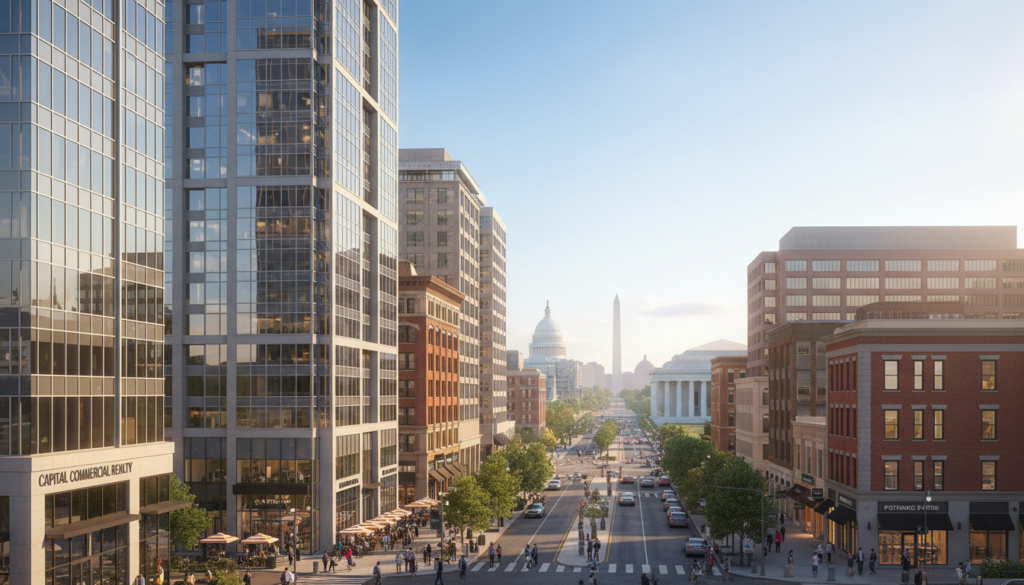
Office Buildings and Professional Medical Spaces
Underwriting focuses on tenant credit scores, Lease Expiration Schedules (WALT), and property location. Institutional lenders favor stable long-term leases and tenant diversification across regional employment hubs.
Retail Storefronts and Mixed-Use Properties
Foot traffic, regional anchor tenants, and co-tenancy clauses drive lender sentiment for retail. Mixed-use assets require separated income and expense analysis for residential and commercial spaces.
Warehouse and Industrial Facilities
Industrial underwriting evaluates clear heights, dock configuration, logistics access, and municipal zoning. Owner-user facilities benefit from programs backed by the U.S. Small Business Administration.
Multifamily Complexes for Rental Income
Stabilized historical occupancy, low turnover, and proven Net Operating Income (NOI) dictate borrowing capacity for multi-family residential assets.
Vacant Parcels and Development Sites
Land and development financing hinges on entitlement status, utility infrastructure, and clear project completion schedules backed by detailed exit strategies.
Loan Options, Rates, and Terms in Today’s Rate Environment
Selecting the optimal loan structure keeps monthly debt manageable regardless of broader rate fluctuations.

Fixed-Rate, Adjustable-Rate, and Hybrid Structures
Fixed-rate loans deliver budget predictability over 5, 10, or 20-year terms. Adjustable-rate mortgages (ARMs) offer lower initial rates but introduce rate reset risk. Hybrid structures offer fixed rates during an initial stabilization period before transitioning to variable adjustments.
Amortization Schedules and Loan Duration
While 15 to 25-year amortization schedules reduce monthly debt service to maximize cash flow, shorter terms lower cumulative interest expenses over the life of the loan.
Prepayment Terms and Exit Planning
Review prepayment clauses early. Stepdown schedules (e.g., 5-4-3-2-1%) gradually reduce prepayment penalties, whereas yield maintenance protection requires strict mathematical formulas to exit prior to maturity.
| Type | Best for | Typical advantage |
|---|---|---|
| Fixed-Rate | Long-term hold income properties | Complete interest certainty, easier cash flow planning |
| Adjustable-Rate | Short-term repositioning projects | Lower initial rate, maximum flexibility |
| Hybrid Loan | Assets undergoing stabilization | Initial fixed stability transitioning into variable flex |
SBA Financing Programs for Qualified Businesses
SBA-backed financing programs are standard tools for business owners seeking capital preservation through lower down payment structures and extended amortization.
Advantages of SBA 7(a) and SBA 504 Programs
Lower down payment requirements (starting at 10%) preserve vital operating cash for operational growth, hiring, and inventory. Combined with 25-year fully amortizing terms for real estate, SBA financing minimizes monthly capital outflows.
Accelerating Approvals through Preferred Lenders
Partnering with designated Preferred Lenders simplifies processing, as internal credit teams handle underwriting decisions directly without waiting for external agency review.
- Underwriters evaluate business tax returns, personal credit, cash flow, and management background.
- Commercial credit decisions require formal credit approval and standard personal guarantees.
- Review capital guidelines established by government agencies like the Federal Reserve to understand broader rate benchmark dynamics.
Multifamily Term Lending for Stabilized Assets
Multifamily real estate remains a key target for commercial lenders, with debt sizing evaluated primarily against historical occupancy, collections, and net operating income.

Underwriting Requirements and Debt Service Benchmarks
Lenders evaluate multifamily properties using minimum DSCR benchmarks (typically 1.20x to 1.35x) and maximum Loan-to-Value ratios (usually 65% to 80%). Borrowers must submit complete rent rolls, trailing 12-month (T12) operating statements, and capital expenditure history.
Frequently Asked Questions
What DSCR do lenders require for commercial financing in Washington?
Most commercial lenders require a minimum Debt Service Coverage Ratio (DSCR) of 1.20x to 1.25x, meaning net operating income must exceed annual debt service obligations by at least 20% to 25%.
What is the minimum down payment for an owner-occupied commercial property?
Owner-occupied properties financed via SBA 504 or 7(a) programs require down payments as low as 10%, whereas conventional commercial loans typically require 20% to 30% down.
How do interest rate structures compare across neighboring Pacific Northwest markets?
Financing parameters and interest rate benchmarks remain consistent across regional Pacific Northwest markets, including Oregon commercial real estate financing options, with specific loan pricing adjusted for hyper-local submarket demographics and asset quality.