


Surprising fact: a single 250 MW AI campus can cost roughly $800M–$1.5B, turning data center deals into full-scale infrastructure financings.
This explainer shows why energy-linked commercial real estate in north dakota is now underwritten like integrated infrastructure, not just traditional CRE. Projects combine four sequenced layers—real estate, power generation, grid interconnection, and compute—each with distinct risk, contracts, and funding timing.
Power availability and interconnection queues often gate development. That reality shifts who lends and who invests. Senior debt typically secures the early, lower-risk layers while mezzanine and preferred tranches bridge timing gaps.
Why it matters: large ticket sizes change syndication, tranche sizing, and which institutions can write checks. From a capital markets view, infrastructure allocators are reshaping the capital stack and altering exit and risk allocation across layers.
Key Takeaways
- AI campuses are financed as multi-layer infrastructure projects, not simple CRE.
- The North Dakota Capital Stack concept maps funding across land, power, interconnection, and compute.
- 250 MW projects sit in the $800M–$1.5B band, driving institutional syndication.
- Senior debt usually covers lower-risk construction; mezz and sponsor equity take later risk and upside.
- Power and interconnection constraints are often the primary project gating factors.
What’s Driving Energy-Linked CRE Financing in North Dakota Right Now
Financing for energy-linked CRE has shifted because projects now bundle real estate with generation, interconnection, and compute in one delivery timeline.

AI data centers as energy projects in disguise
AI training hubs are four-layer bundles: site control and entitlements (real estate), generation build or contracting, interconnection studies and upgrades, and compute fit-out with procurement.
This sequencing makes power delivery and queue position the gating items. The building shell is only one component of a larger integrated system.
Why volatility matters for underwriting
Underwriters must price two volatility channels explicitly. First, frontier energy volatility: fuel and power price swings and basis risk.
Second, compute-side shocks: GPU pricing, utilization swings, and short-term customer contracts can swing cash flows.
| Layer | Key Risk | Timing Driver | Capital Response |
|---|---|---|---|
| Site / real estate | Permits, land control | Entitlements | Senior debt, short tenor |
| Generation | Fuel & pricing risk | Construction & contracting | Structured term debt |
| Interconnection | Queue delays | Grid upgrades | Contingency reserves |
| Compute | Market pricing | Procurement lead time | Mezz/pref equity |
Higher volatility pushes investors toward structured capital, tighter covenants, and liquidity buffers. Firms with infrastructure underwriting DNA price multi-layer risk better than single-asset lenders.
For more on sequencing and tranche design, read navigating the capital stack.
North Dakota Capital Stack: Debt and Equity Layers for Energy-Linked CRE
How capital follows milestones: Large energy-linked projects require a sequenced financing plan that mirrors construction phases and contractual certainty.
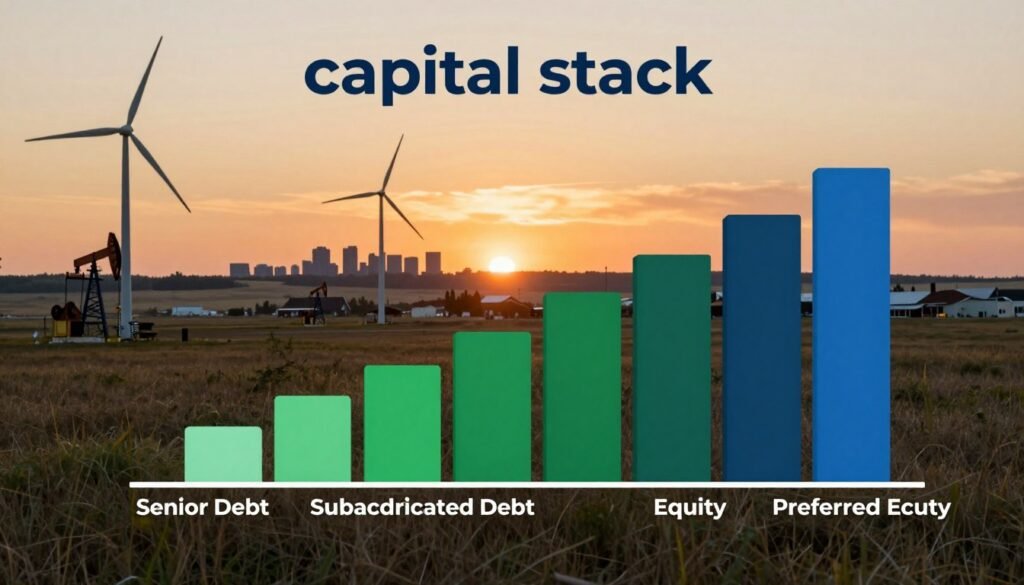
Sequencing across four layers
Site control and entitlements must be locked before major equipment orders. Permits de-risk land and allow senior lenders to commit.
Generation contracts and energy procurement are next; those deals shape term debt sizing. Interconnection milestones then gate later draws.
Compute fit-out is last: GPU orders need committed power and grid dates to avoid stranded inventory.
Tranche profiles and underwriting
| Layer | Bankability | Typical Tranche | Exit Path |
|---|---|---|---|
| Site / real estate | Permits, leases | Senior debt | Refinance or sale |
| Generation | PPAs, fuel | Structured term debt | Sell generation or retain |
| Interconnection | Queue position | Contingency reserves / mezz | Bridge to stabilized financing |
| Compute | Customer contracts | Mezz/pref equity & common equity | Hold as infrastructure or sell |
Senior debt becomes volatility-sensitive: lenders demand stronger covenants, tighter DSCR, milestone draws, and shorter tenors. That reflects current market pricing and risk tolerance.
Mezz and preferred equity bridge overruns and timing gaps. Common equity captures upside from contracting reprices but dilutes on rescue rounds or pref step-ups. For a 250 MW campus ($800M–$1.5B), syndication and tranche minimums mean only certain investors can lead or anchor rounds.
Who’s Allocating Capital in North Dakota and How Strategy Is Shifting
Capital flows are converging as core infrastructure funds, sovereign-style pools, and private equity reshape regional project finance.
Main providers:
- Core infrastructure funds — seek contracted, utility-like cash flows and long-term yield stability.
- Private equity — targets development dislocations and higher-return opportunistic tranches.
- Sovereign-wealth and commodity-linked pools — add scale and long-dated capital for large tickets.
- Government-linked trust funds — act as patient allocators with endowment-like profiles.

Why the Trust Lands matter: Frank Mihail proposed a move to a 10% infrastructure target and a bespoke FT Wilshire Private Markets Infrastructure Index built with Wilshire Indexes and GCM Grosvenor. The goal: reduce benchmark mismatch and track private, core exposures more closely.
“An investable private markets index lowers tracking error and supports disciplined rebalancing.”
Implications: a ~$400M underweight implies active manager searches, more co-invest pacing, and appetite for data-led digital infrastructure as an alpha satellite. Raising private equity and venture to 12% with ~$250M/year pacing can increase spillover demand for power, interconnection, and CRE-adjacent assets.
Conclusion
Successful deals hinge on matching the right capital type to each project milestone across real assets and power systems.
For north dakota projects, financing outcomes depend on structuring the stack across four layers, not treating developments as single-purpose estate. Senior debt should secure contracted visibility, mezzanine and preferred tranches bridge timing and overrun risk, and equity captures development upside.
The true value of an estate is tied to power availability and interconnection. Site control and sequencing decide whether centers move from plan to online without costly dilution.
Watch the market for allocator moves tied to a 10% infrastructure target and for greater convergence of investor types. As more infrastructure capital chases de-risked layers, returns may shift to earlier, more complex tranches—demanding tighter structuring and clear exits.
Practical lens: identify the layer you underwrite, confirm milestones, and ensure the capital stack can absorb delays. For faster closings and execution tools, see our guide on fast-track financing.
FAQ
What are the primary debt and equity layers used for energy-linked commercial real estate projects in this region?
How do AI data centers change the financing profile of such projects?
Why is volatility a central consideration for underwriting returns in frontier energy markets?
How are the four stack layers sequenced and financed across site, generation, grid interconnection, and compute infrastructure?
What covenant and tenor structures are common for senior debt on volatility-sensitive assets?
When is mezzanine or preferred equity used, and what risks does it address?
Where does common equity concentrate upside and where does dilution typically occur?
What project sizes and check ranges signal institutional-scale development in this market?
FAQ
What are the primary debt and equity layers used for energy-linked commercial real estate projects in this region?
Typical capital structures layer senior construction and acquisition debt at the base, followed by mezzanine financing or preferred equity to bridge timing and cost gaps, and common equity from sponsors and investors that capture upside. For integrated projects—site, generation, interconnection, and compute—each layer maps to specific risks and cash flows, so lenders and investors align terms to the asset’s revenue visibility and contractual protections.
How do AI data centers change the financing profile of such projects?
Data centers tie real estate to power and interconnection economics. Lenders require stronger grid contracts, offtake or demand agreements, and clear service-level commitments. Investors focus on power consumption profiles, compute pricing exposure, and interconnection capacity, which can shift debt tenors and equity return expectations compared with traditional CRE.
Why is volatility a central consideration for underwriting returns in frontier energy markets?
Volatility affects fuel, power prices, and demand for compute, which in turn drives cash-flow variability. Underwriters demand stress-tested scenarios, larger covenants or reserves, and staged capital deployment to mitigate downside. Investors price these risks through higher returns on mezzanine and equity layers or tighter covenant packages on senior debt.
How are the four stack layers sequenced and financed across site, generation, grid interconnection, and compute infrastructure?
Sequence typically starts with site acquisition and preparatory CRE financing, then generation construction financing, followed by interconnection spend and grid upgrade financing, and finally compute infrastructure for data centers. Each phase can use different instruments: traditional mortgages or construction loans for site, project finance or tax equity for generation, specialized utility or infrastructure debt for interconnection, and lease-backed or asset-backed debt for compute.
What covenant and tenor structures are common for senior debt on volatility-sensitive assets?
Lenders prefer shorter initial tenors tied to construction and stabilization milestones, transitioning to longer-term refinancing once cash flows stabilize. Covenants include DSCR triggers, maintenance of reserve accounts, and step-in rights tied to major contract breaches. Cash-flow visibility through long-term offtake or power purchase agreements materially eases lender requirements.
When is mezzanine or preferred equity used, and what risks does it address?
Mezzanine and preferred equity bridge financing shortfalls during construction, cover cost overruns, and mitigate timing mismatches between generation commissioning and compute ramp. These layers absorb higher risk than senior lenders and are priced accordingly. They also provide flexible repayment profiles that can align with milestone-based sponsor payouts.
Where does common equity concentrate upside and where does dilution typically occur?
Common equity captures residual cash flows and appreciation after debt and preferred returns are paid, so upside concentrates on stabilization and long-term operating margins. Dilution often occurs when additional capital is required—through follow-on equity or convertibles—especially if project revenues underperform or if sponsors inject capital to preserve project value.
What project sizes and check ranges signal institutional-scale development in this market?
Campus-scale builds with aggregated capacity around 250 MW commonly sit in the 0M–
FAQ
What are the primary debt and equity layers used for energy-linked commercial real estate projects in this region?
Typical capital structures layer senior construction and acquisition debt at the base, followed by mezzanine financing or preferred equity to bridge timing and cost gaps, and common equity from sponsors and investors that capture upside. For integrated projects—site, generation, interconnection, and compute—each layer maps to specific risks and cash flows, so lenders and investors align terms to the asset’s revenue visibility and contractual protections.
How do AI data centers change the financing profile of such projects?
Data centers tie real estate to power and interconnection economics. Lenders require stronger grid contracts, offtake or demand agreements, and clear service-level commitments. Investors focus on power consumption profiles, compute pricing exposure, and interconnection capacity, which can shift debt tenors and equity return expectations compared with traditional CRE.
Why is volatility a central consideration for underwriting returns in frontier energy markets?
Volatility affects fuel, power prices, and demand for compute, which in turn drives cash-flow variability. Underwriters demand stress-tested scenarios, larger covenants or reserves, and staged capital deployment to mitigate downside. Investors price these risks through higher returns on mezzanine and equity layers or tighter covenant packages on senior debt.
How are the four stack layers sequenced and financed across site, generation, grid interconnection, and compute infrastructure?
Sequence typically starts with site acquisition and preparatory CRE financing, then generation construction financing, followed by interconnection spend and grid upgrade financing, and finally compute infrastructure for data centers. Each phase can use different instruments: traditional mortgages or construction loans for site, project finance or tax equity for generation, specialized utility or infrastructure debt for interconnection, and lease-backed or asset-backed debt for compute.
What covenant and tenor structures are common for senior debt on volatility-sensitive assets?
Lenders prefer shorter initial tenors tied to construction and stabilization milestones, transitioning to longer-term refinancing once cash flows stabilize. Covenants include DSCR triggers, maintenance of reserve accounts, and step-in rights tied to major contract breaches. Cash-flow visibility through long-term offtake or power purchase agreements materially eases lender requirements.
When is mezzanine or preferred equity used, and what risks does it address?
Mezzanine and preferred equity bridge financing shortfalls during construction, cover cost overruns, and mitigate timing mismatches between generation commissioning and compute ramp. These layers absorb higher risk than senior lenders and are priced accordingly. They also provide flexible repayment profiles that can align with milestone-based sponsor payouts.
Where does common equity concentrate upside and where does dilution typically occur?
Common equity captures residual cash flows and appreciation after debt and preferred returns are paid, so upside concentrates on stabilization and long-term operating margins. Dilution often occurs when additional capital is required—through follow-on equity or convertibles—especially if project revenues underperform or if sponsors inject capital to preserve project value.
What project sizes and check ranges signal institutional-scale development in this market?
Campus-scale builds with aggregated capacity around 250 MW commonly sit in the $800M–$1.5B total capital range. Those check sizes attract institutional infrastructure funds, sovereign and commodity-linked investors, and large private equity allocators capable of underwriting multi-layered financing and long-duration holds.
What are the typical exit pathways for each layer of the stack?
Senior debt exits via refinancing into long-term takeout loans or securitization. Mezzanine and preferred equity can realize returns through refinancing, recapitalization, or sale to opportunistic buyers. Common equity exits through asset sales, IPOs of operating platforms, or by holding as infrastructure-style assets for yield. Layer-specific contractual rights and market conditions drive the chosen path.
Who are the main allocators of capital for these projects and how are strategies shifting?
Allocators include infrastructure funds, private equity, sovereign wealth funds, and commodity-linked players. Strategies are shifting toward core-plus and core-satellite approaches, with increased appetite for digital infrastructure as an alpha satellite. Many institutional investors now emphasize diversified exposure across generation, grid, and compute to manage correlated risks.
How does an institutional 10% infrastructure target and an underweight position affect near-term deployment?
A stated 10% target signals long-term allocation intent; an underweight—such as a $400M shortfall versus benchmark—can slow immediate deployment while managers rebalance. It often leads to selective deal-making, preference for higher-conviction opportunities, and potentially larger individual check sizes when entry points meet return thresholds.
What role does digital infrastructure play as an “alpha satellite” for institutional portfolios?
Digital infrastructure—data centers and compute platforms—can offer differentiated return streams tied to pricing for compute and dedicated power contracts. As an alpha satellite, it provides upside through specialized operational expertise, ability to capture premium rents, and exposure to secular demand growth, while increasing portfolio complexity and volatility.
How will increased private equity and venture pacing affect CRE-adjacent deal flow?
Growth in private equity and venture allocations—such as a 12% target and $250M per year pacing—boosts available capital for technology-led components, spurs sponsor activity, and increases competition for early-stage infrastructure rights. This often accelerates development timelines and raises valuation expectations across CRE-adjacent assets.
What due diligence should investors prioritize for integrated energy and compute projects?
Prioritize offtake and interconnection agreements, fuel and power price exposure, permitting and land title, construction counterparty strength, and operational expertise for data center management. Rigorous stress testing of revenue under different demand and price scenarios is essential to align covenants, reserves, and return expectations.
How do government policy and land trust strategies influence institutional allocation and deal structuring?
Policy signals—such as incentives for grid upgrades or land trust benchmark changes—can reshape risk-return profiles and create targeted sourcing opportunities. When public stakeholders pursue core or core-satellite frameworks, private investors adjust allocation strategies, favoring structured partnerships and longer-term hold models that align public and private goals.
.5B total capital range. Those check sizes attract institutional infrastructure funds, sovereign and commodity-linked investors, and large private equity allocators capable of underwriting multi-layered financing and long-duration holds.
What are the typical exit pathways for each layer of the stack?
Senior debt exits via refinancing into long-term takeout loans or securitization. Mezzanine and preferred equity can realize returns through refinancing, recapitalization, or sale to opportunistic buyers. Common equity exits through asset sales, IPOs of operating platforms, or by holding as infrastructure-style assets for yield. Layer-specific contractual rights and market conditions drive the chosen path.
Who are the main allocators of capital for these projects and how are strategies shifting?
Allocators include infrastructure funds, private equity, sovereign wealth funds, and commodity-linked players. Strategies are shifting toward core-plus and core-satellite approaches, with increased appetite for digital infrastructure as an alpha satellite. Many institutional investors now emphasize diversified exposure across generation, grid, and compute to manage correlated risks.
How does an institutional 10% infrastructure target and an underweight position affect near-term deployment?
A stated 10% target signals long-term allocation intent; an underweight—such as a 0M shortfall versus benchmark—can slow immediate deployment while managers rebalance. It often leads to selective deal-making, preference for higher-conviction opportunities, and potentially larger individual check sizes when entry points meet return thresholds.
What role does digital infrastructure play as an “alpha satellite” for institutional portfolios?
Digital infrastructure—data centers and compute platforms—can offer differentiated return streams tied to pricing for compute and dedicated power contracts. As an alpha satellite, it provides upside through specialized operational expertise, ability to capture premium rents, and exposure to secular demand growth, while increasing portfolio complexity and volatility.
How will increased private equity and venture pacing affect CRE-adjacent deal flow?
Growth in private equity and venture allocations—such as a 12% target and 0M per year pacing—boosts available capital for technology-led components, spurs sponsor activity, and increases competition for early-stage infrastructure rights. This often accelerates development timelines and raises valuation expectations across CRE-adjacent assets.
What due diligence should investors prioritize for integrated energy and compute projects?
Prioritize offtake and interconnection agreements, fuel and power price exposure, permitting and land title, construction counterparty strength, and operational expertise for data center management. Rigorous stress testing of revenue under different demand and price scenarios is essential to align covenants, reserves, and return expectations.
How do government policy and land trust strategies influence institutional allocation and deal structuring?
Policy signals—such as incentives for grid upgrades or land trust benchmark changes—can reshape risk-return profiles and create targeted sourcing opportunities. When public stakeholders pursue core or core-satellite frameworks, private investors adjust allocation strategies, favoring structured partnerships and longer-term hold models that align public and private goals.