
Debt Financing and Capital Stack Approaches for Rhode Island Commercial Assets

city skyline under blue sky and white clouds during daytime

Surprising fact: the state has deployed $250 million in federal pandemic recovery funds, with $161.5 million earmarked for housing production and preservation and projected to be fully obligated by mid-2024.

This shift forces a near-term rethink of how mixed-use projects find money. As underwriting tightens and costs rise, the traditional one-lender model is giving way to a layered system of public programs, tax equity, senior and subordinate debt, and mission capital.

Developers, nonprofits, and community groups must align schedules, compliance, and documentation to keep projects on track. Ground-floor retail, childcare, and community services are now central to leasing stability and long-term asset performance.

This article looks forward: we will analyze how debt layers are being reassembled to sustain housing and neighborhood-serving commercial space, what drives the shift, and how impact investment can steady predevelopment risk over the next few years.

Key Takeaways

  • How the Rhode Island Capital Stack is changing as funds are obligated and costs climb.
  • Why layered debt and coordinated timing matter for mixed-use housing projects.
  • How compliance and documentation affect development schedules.
  • Why ground-floor commercial uses boost occupancy and long-term value.
  • How impact investment and mission capital can reduce predevelopment risk.

What’s Driving New Debt Financing Strategies in Rhode Island Commercial Real Estate

Rising construction cost and an urgent need for more homes are changing how teams put deals together. Developers and mission groups must blend housing and retail to create stable cash flow and serve families in growing neighborhoods.

“Zoning reforms and approvals are promising, but they must be paired with steady affordable housing capital,” said Jennifer Hawkins.
— Jennifer Hawkins, ONE Neighborhood Builders

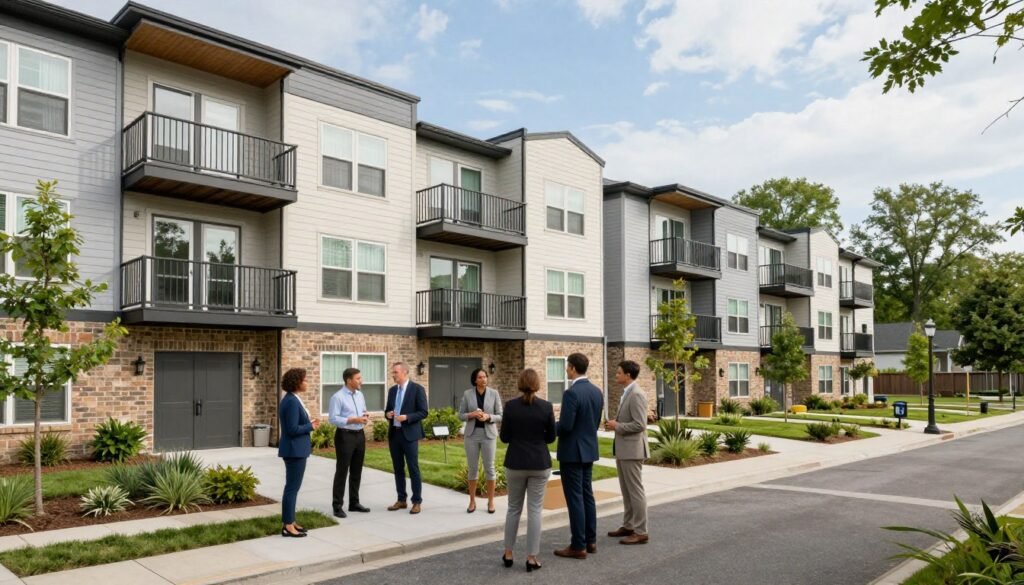
A picturesque scene of affordable housing in a suburban neighborhood of Rhode Island, showcasing a series of modern, eco-friendly apartments. In the foreground, a diverse group of professionals in business attire engage in discussion outside a newly constructed building, representing the intersection of community and commerce. The middle of the image features well-designed three-story apartments with inviting balconies and landscaped gardens, reflecting a sense of community. In the background, lush trees and blue skies with soft, natural lighting create a vibrant atmosphere. The scene is shot from a slightly elevated angle, providing a comprehensive view of the development. Include the logo "Thorne CRE" subtly integrated into one of the building's entrances, emphasizing innovation in real estate.

Affordable housing, zoning momentum, and mixed-use demand

Looser zoning makes more land feasible for multi-family use, but approvals alone won’t close financing gaps. Practical capital programs matter because developers take early risk by securing sites and paying for design and engineering.

Mixed-use, mixed-income approaches are becoming the default. Combining housing development with ground-floor businesses and services helps stabilize operations and supports people and community needs.

Why predictable programs matter for early-stage risk

Predevelopment costs create the bottleneck. Without clear award timing and reliable programs, nonprofit sponsors and for-profit developers hesitate to carry property through long approval cycles.

Predictability—not just total dollars—lets teams bridge gaps with layered loans, grants, and mission capital so projects can move from site control to construction with fewer stops.

Rhode Island Capital Stack: How Debt, Equity, and Tax Credits Are Being Combined for Future Projects

A mosaic of loans, tax benefits, and mission capital is becoming the default path to finance affordable housing with commercial space.

Defining the layers

Capital for mixed-use development is layered to match risk and repayment priority. Public grants, tax credits, equity, senior and subordinate loans, and bridge funding each cover different cost slices for buildings and ground-floor retail.

What tax credits and equity do

Low-Income Housing tax credits convert future tax value into upfront equity. That equity closes the gap between restricted rents and actual development cost, reducing the amount of conventional debt a project must carry.

A dynamic scene depicting a modern office environment representing "tax credits equity financing" in the context of Rhode Island's commercial assets. In the foreground, a diverse group of professionals in business attire is engaged in discussion around a sleek conference table, with financial documents and laptops open. The middle layer features a whiteboard filled with diagrams illustrating the capital stack concept, showcasing debt, equity, and tax credits. In the background, large windows reveal a skyline of Rhode Island, with an ambient golden light suggesting optimism and future growth. The atmosphere conveys collaboration and innovation, highlighting concepts of finance and investment. The overall composition should evoke professionalism and a sense of progress, prominently featuring the brand name "Thorne CRE" on one of the documents in a subtle manner.

Core debt layers and timing

Acquisition and predevelopment credit appear first. A construction loan and, if needed, a bridge loan follow to handle timing gaps. A permanent loan replaces construction debt once the project stabilizes.

Real-world signals

ONE Neighborhood Builders’ Center City Apartments used 21 sources and best-case 33 months from site control to groundbreaking, showing multi-source complexity in action.

Merchants Capital’s HōM Flats deal pairs tax-exempt lending with tax credit equity and a construction bridge to keep schedules on track. This model signals a repeatable stack for preservation and new units.

Impact Investing and Revolving Loan Funds as a Growing Layer of Capital in Rhode Island

A vibrant gathering of diverse professionals in a modern conference setting, discussing impact investment strategies. In the foreground, a group of individuals in business attire passionately engages in conversation, with charts and graphs on tablets showcasing investment opportunities. The middle layer features a large screen displaying positive social and environmental impact metrics. In the background, a bright, open-space office with large windows letting in natural light, accented by green plants symbolizing sustainability. Soft, warm lighting enhances the collaborative atmosphere. The scene captures the essence of teamwork and innovation in the realm of impact investment, all under the branding of "Thorne CRE".

Impact investment now fills the “missing middle” by moving faster and pricing below market to cover predevelopment and acquisition needs.

How a foundation model works

The foundation offers below-market loans, lines of credit, and occasional equity stakes with typical investments of $200,000–$2M and terms of 1–10 years. The program targets a modest 3% portfolio return and reports full repayment over years.

Revolving funds that multiply impact

A $975,000 revolving loan to NeighborWorks Blackstone River Valley seeded a regional fund that catalyzed $176M and produced 35 homeownership units plus 350+ rental units.

Bridge financing as schedule insurance

Patient loans have funded quick acquisitions — for example, a short-term loan secured a 30,000 sq ft parcel for 25–30 affordable units. A $2M investment into a Providence revolving pool shows how pooled funds scale residential and commercial development across neighborhoods.

“Revolving capital keeps dollars working and lets community projects show steady progress.”

Tool Typical Size Primary Use Impact
Below-market loan $200K–$2M Acquisition, predevelopment Holds site, speeds closings
Revolving fund $0.5M–$5M Rehab, new construction Multiplies investment over years
Bridge financing $50K–$2M Short-term gap financing Protects pipelines and families

Conclusion

Sustaining new housing and ground-floor commercial uses requires engineered financing that matches long build timelines. Jennifer Hawkins urges pairing zoning gains with predictable, patient money so affordable housing development actually gets built in the state.

Strong, practical playbook elements include tax-driven equity where applicable, construction and permanent debt, short-term bridge facilities, and revolving funds to cover predevelopment risk. Sponsors should plan early for multi-source underwriting, longer legal timelines, and careful sequencing of debt and equity to reduce execution risk.

What to watch next: policy and program continuity, senior debt availability and pricing, growth of revolving funds, and how compliance rules shape schedules. For a deeper primer on structuring layered finance, see this capital stack guide.

The state will reward sponsors who design resilient stacks that close gaps, respect timing, and deliver lasting value for residents and communities.

FAQ

What debt financing approaches are common for commercial assets and affordable housing in Rhode Island?

Developers and nonprofits commonly use a mix of construction loans, permanent mortgages, bridge financing, and subordinated loans. Pairing these debt sources with equity and tax credit capital reduces upfront cost and fills funding gaps. Lenders often structure staggered draws and interest reserves to match construction milestones and lease-up timelines.

Why are new debt strategies emerging in the state’s commercial real estate market?

Rising demand for affordable homes, zoning updates that encourage mixed-use and mixed-income projects, and tighter traditional lending standards have pushed stakeholders to adopt creative debt tools. Predictable public programs and clearer subsidy paths also make lenders and investors more comfortable taking early-stage risk.

How do predictable capital programs benefit developers and community organizations?

When state and municipal programs offer clear timelines and funding commitments, developers can price projects more accurately, secure construction financing faster, and attract equity partners. Predictability lowers risk for nonprofits and businesses that often carry site control costs before major awards arrive.

What is included when defining a capital stack for housing development and commercial space?

A typical stack layers senior debt, mezzanine or subordinate debt, equity from tax credit syndication or private investors, and public subsidies such as grants or tax-exempt bonds. Each layer serves a role: senior debt covers stabilized value, subordinate pieces fill gaps, and equity absorbs long-term affordability requirements.

How do Low-Income Housing Tax Credits (LIHTC) solve financing gaps?

LIHTC converts future tax benefits into immediate equity through syndicators. That equity reduces the amount of debt needed and lowers operating costs for affordable units. For many projects, LIHTC is the cornerstone that makes deep affordability financially feasible.

What debt layers keep projects moving from groundbreak to stabilization?

Construction loans provide short-term capital for building. Bridge loans cover costs during soft periods or regulatory delays. Permanent loans replace short-term debt once projects stabilize and meet occupancy targets. Mezzanine debt or gap financing bridges equity shortfalls when needed.

What does a multi-source financing stack look like in practice?

Multi-source stacks often combine 10–20+ funding lines: senior construction and permanent loans, subordinate lender commitments, LIHTC equity, historic tax credit equity where applicable, federal or state grants, tax-exempt bonds, and soft loans from foundations or local programs. Coordinated timelines and contingency reserves are critical to manage complexity.

How do tax-exempt loans and LIHTC equity work together in deal structuring?

Tax-exempt bonds can lower borrowing costs and pair with LIHTC to increase eligible equity. This combo often attracts institutional investors and can improve feasibility for deeply affordable units. Underwriters and counsel align bond issuance timing with tax credit syndication to meet IRS and state compliance rules.

How do affordability rules and AMI targeting affect project schedules?

Compliance with Area Median Income (AMI) targets and regulatory restrictions adds underwriting, monitoring, and reporting steps. These requirements extend predevelopment timelines for design, subsidy applications, and tenant selection, so stakeholders build longer contingency windows into project schedules.

How do foundations and impact investors participate in the capital stack?

Foundations and impact investors provide below-market loans, lines of credit, guarantees, or selective equity. Those instruments reduce risk for traditional lenders, enable earlier site acquisition, and support preservation projects that may not meet market-return thresholds. The Rhode Island Foundation model is a local example of this catalytic role.

What role do revolving loan funds play in expanding affordable housing supply?

Revolving funds supply fast, patient capital for predevelopment, acquisition, or rehabilitation. As loans are repaid, the fund re-lends to new projects, amplifying impact over time. These funds have helped catalyze additional private investment and supported hundreds of units when timed with other subsidies.

When is bridge financing most useful for site control and preservation?

Bridge financing proves essential when a project needs to secure land or preserve an at-risk building before permanent funding closes. Patient capital from mission-driven lenders can cover acquisition and short-term rehab, keeping projects viable while tax credits, grants, or bond issuances are finalized.

What are common risks developers should plan for when assembling complex capital stacks?

Schedule delays, cost overruns, subsidy award timing, regulatory compliance, and market rent fluctuations are top risks. Mitigation includes contingency reserves, conservative rent and expense assumptions, committed bridge lines, and close coordination among syndicators, lenders, and public agencies.

How can nonprofits and small developers improve chances of financing approval?

Build strong project teams, prepare realistic pro formas, secure precommitments from subsidy sources, and demonstrate operational capacity through prior project performance or partnerships. Early engagement with lenders and equity partners clarifies expectations and shortens approval timelines.

Where can developers find technical assistance and capital programs in the state?

State housing agencies, local economic development corporations, community development financial institutions, and national intermediaries offer technical help, loan products, and grant programs. Engaging these partners early helps navigate compliance, subsidy applications, and financing coordination.

Leave a Comment

Your email address will not be published. Required fields are marked *

Scroll to Top