

Surprising fact: more than 60% of failed development deals trace back to a misaligned capital plan before construction began.
The Arkansas Capital Stack is the layered map of who gets paid first — and it determines every return and every risk on an acquisition, rehab, or development deal.
This short guide previews the listicle roadmap: senior debt, mezzanine and subdebt, preferred and common equity, plus Arkansas-specific community development tools that can shift feasibility.
We will show how capital choices interact with market timing, interest-rate risk, and refinance or sale exits. You’ll get the core vocabulary investors need — LTV/LTC, DSCR, guarantees, covenants, draws, subordination, and intercreditor mechanics — so later sections move fast.
Examples use local banks, Arkansas Capital Corporation programs, and growth capital players to keep concepts grounded. This is practical information for sponsors and investors, not legal or tax advice, and deal terms vary by lender, property type, and sponsor track record.
For a deeper playbook on layered financing, see our capital stack guide.
Key Takeaways
- Who gets paid first shapes returns and loss exposure.
- Senior debt lowers cost but limits upside; equity takes last losses.
- Mezzanine and preferred equity bridge gaps in project funding.
- Align LTV and exit plans with market timing and interest risk.
- Know key terms (LTV, DSCR, covenants) to underwrite deals fast.
- Local programs and lenders can change feasibility on a deal.
Why capital stack literacy matters for Arkansas real estate investors
Mastering layered finance gives you the tools to preserve optionality when markets shift.
How debt financing decisions affect returns, risk, and exit options
Debt choice affects project returns and downside protection. Higher leverage can lift IRR but also raises refinance and covenant breach risks.
Pick loan term, prepayment rules, and recourse levels to match your exit plan. Sale, refinance, or hold each favors different durations and covenants.
Where local funding ecosystems can change your best structure
Local banks and community lenders often prefer straightforward loans. That can make a simple senior loan the better choice for certain business models.
Nonbank options and public programs create opportunities that reduce sponsor cash needs. Examples include CDFI capital, NMTCs, and EB-5 paths that bridge gaps.
Quick structure checklist before signing an LOI
- Timeline and absorption assumptions
- Tenant profile and lease contingencies
- Contractor budget, appraisal needs, and capex plan
| Feature | Lower-Leverage Bank Loan | Layered Financing (mezz/pref) |
|---|---|---|
| Typical leverage | 60–75% LTV | 75–90% total funding |
| Best for | Stable income, simpler businesses | Development, gap-filling opportunities |
| Risks | Lower upside, stricter covenants | Higher refinance and priority risk |
Arkansas Capital Stack explained in plain English
Every dollar in a deal has an order; that order shapes pricing, control, and downside risk.
What a capital stack is and why priority of payments matters
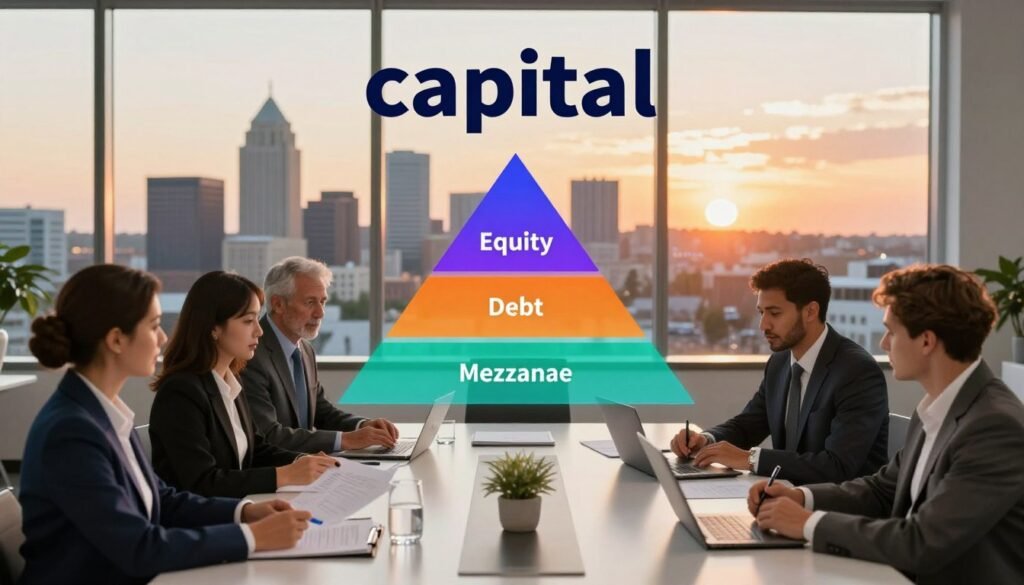
The capital stack is the ordered layers of money behind a project. Payment priority sets who gets paid first and who takes losses last.
Why it matters: senior lenders get operating cash and sale proceeds first, then subordinated debt, then preferred equity, and finally common equity. That waterfall drives interest rates, covenants, and control rights.
Common stack “layers” used in real estate development finance
- Senior acquisition or refinance debt
- Construction loans with draws and contingencies
- Mezzanine or subordinated debt
- Preferred equity and sponsor/common equity
How capital flows from banks, private funds, and community development finance
Banks provide balance-sheet loans for stabilized properties. Private debt funds bridge gaps with mezzanine or unitranche structures. Community development sources offer tools that lower cost or fill funding shortfalls for projects serving underserved communities.
“The best structure is the one that can close, fund on time, and survive downside—not just the cheapest headline rate.”
| Layer | When used | Typical role |
|---|---|---|
| Senior debt | Acquisition, stabilized refinance | Lowest cost, highest priority |
| Construction loan | Development and rehab | Draws, completion covenants |
| Mezz/subordinated | Gap financing | Higher yield, junior to senior |
| Preferred/common equity | Sponsor funding, upside capture | Last paid, first loss |
Senior debt fundamentals for acquisition, rehab, and development
Senior loans set the tempo for a project: they dictate cashflow timing, risk limits, and exit flexibility.
What senior lenders typically underwrite
Lenders focus on borrower profile and property metrics. Expect checks on liquidity, net worth, and prior project experience.
- Property cash flow, DSCR, LTV/LTC, and exit viability.
- Personal and entity financials for the sponsoring company and key principals.
- Bank and sponsor references to confirm track record and underwriting comfort.
Documentation, economic terms, and controls
Third‑party services matter: appraisal, Phase I, PCA/engineering, ALTA, budget reviews, and lease audits inform risk decisions.
| Term | What to model | Why it matters |
|---|---|---|
| Interest type | Fixed vs float | Cashflow sensitivity |
| Term / amortization | Maturity and payment schedule | Refi risk |
| IO / extensions | Interest‑only periods | Construction pacing |
Covenants, guarantees, and timeline fit
Common controls include cash management, minimum DSCR, reporting cadence, draw inspections, and limits on additional debt.
Guarantees range from full recourse and completion guarantees to narrow “bad‑boy” carveouts.
If maturity dates or amortization don’t match your project plan, you may face a forced refinance or sale.
Lender‑readiness checklist
- Clear business plan with timelines, budgets, and exit scenarios.
- Clean third‑party reports and contractor contracts.
- Proof of sponsor liquidity, comps, and market studies demonstrating demand.
- Contacts for underwriting questions and demonstration of relevant expertise.
Mezzanine and subordinated debt as gap-fillers
Mezzanine debt and other subordinated instruments are the last layer of capital that lets a deal close when senior loans plus equity fall short.
When to use subdebt: it makes sense for deals with an expensive land basis, high tenant-improvement needs, or a value-add scope where the sponsor wants to avoid equity dilution.
Pricing reflects the extra risk: expect higher coupon rates, arrangement fees, and stricter remedies than senior loans. Still, subdebt can be cheaper than giving up large ownership slices to equity partners.
Key intercreditor concepts every investor should know
- Standstill periods and cure rights that delay senior enforcement.
- Collateral assignment and whether the sub lender takes a pledge of equity or membership interests.
- Payment blockage mechanics that let seniors stop distributions to junior holders during default.
How subdebt changes feasibility: it raises total LTC and can lower sponsor equity needs, but it also tightens debt yield and DSCR cushions. Appraisers and senior lenders may adjust assumptions when juniors sit in the capital mix.
“The right subordinated piece gives sponsors breathing room without surrendering upside.”
Negotiation checklist: permitted payments, prepayment and refinancing flexibility, remedies in default, and explicit cure mechanics. These items determine final returns and operational results.
Preferred equity and common equity basics for sponsors
Who holds equity and under what terms changes how sponsors run a project from groundbreak to sale. This section explains where preferred sits versus mezzanine, how sponsor promote works, and what investors underwrite as credible execution.
How preferred equity differs from mezzanine in control and cash flow
Preferred equity usually sits in the equity layer with negotiated governance, dividend mechanics, and limited creditor remedies.
Mezzanine is structured as debt: contractual remedies, default triggers, and priority claims can be more forceful than equity protections.
Common equity, sponsor promote, and alignment with investor goals
Common equity is last paid and captures most upside. The sponsor promote allocates an extra share of gains to the sponsor after hurdles are met.
When hurdles match realistic returns, the promote creates strong investment alignment. If hurdles are unrealistic, it can misalign incentives and slow decisions.
What investors want to see in a credible development plan
- Clear track record for the sponsor and construction partner.
- A concise business plan with budgets, contingencies, and schedule discipline.
- Leasing strategy, realistic rent comps, and absorption timelines supported by market data.
- Transparent reporting: monthly draws, construction updates, KPIs, and variance explanations that show investor support.
“Transparency and realistic assumptions win investor confidence more often than optimistic projections.”
Bottom line: preferred equity can bridge funding gaps while preserving upside for sponsors. Credible plans that show execution and reporting create the best path to investment alignment and project success.
Community development capital in Arkansas through Arkansas Capital Corporation
When market gaps threaten a project’s feasibility, community development capital often steps in to bridge funding shortfalls.
What a CDFI does: a Community Development Financial Institution provides flexible financing and technical help to underserved communities. This funding matters for real estate sponsors when place-based impact strengthens project economics.

How the organization operates statewide
arkansas capital corporation (ACC) serves rural and urban markets with loans and advisory support. It blends mission-driven goals with practical underwriting to move deals that traditional lenders will not.
Support to entrepreneurs, small businesses, and communities
ACC backs entrepreneurs and small businesses that drive tenant demand and local supply chains. That local economic lift can improve rent growth and reduce leasing risk for investors.
What financial support looks like
- Microloans and small business lending for tenant improvements.
- Larger project financing that sits alongside conventional lenders.
- Technical assistance, job-creation metrics, and flexible repayment terms.
To engage ACC, prepare a concise project narrative, clear sources-and-uses, and evidence of job creation or community benefits. Aligning your underwriting with mission metrics can improve feasibility and attract partners. For related lender strategies, see our fast-track financing guide.
EB-5 financing in Arkansas and the Pine State Regional Center model
EB-5 investor capital can act as a reliable bridge for projects that create measurable local jobs.
What EB-5 is: immigrant-investor funding tied to job creation. It can be structured as subordinated debt that lowers sponsor equity needs while preserving senior lender primacy.
How ACC created a state-accessible EB-5 path
arkansas capital corporation established the Pine State Regional Center so local firms could compete for EB-5 pools.
The center made EB-5 accessible where none existed before and played a role in providing subordinated financing for large projects, including Big River Steel.
Where EB-5 sits in the capital order and why it helps
- EB-5 usually sits below senior debt, reducing sponsor equity requirements.
- It offers lower cash cost than some equity and keeps control with the sponsor and lenders.
- Best-fit projects show clear job counts, tight budgets, and rigorous timelines.
“When structured transparently, EB-5 can widen funding opportunities without upsetting lender covenants.”
Sponsor checklist: reporting obligations, approved job-count methodology, timeline controls, and covenant interaction with senior lenders. These tools make EB-5 a practical option to improve project feasibility.
New Markets Tax Credits and other tools that can strengthen your capital stack
NMTCs turn tax credits into patient project capital for developments in underserved areas.
What NMTCs do in plain English: they are a federal incentive that attracts private dollars to qualifying low‑income communities by offering investors a tax credit over several years.

NMTC-related capital often lowers the effective cost of capital or fills gaps that conventional lenders will not cover. That makes NMTCs a practical tool for sponsors working on complex projects.
ACC’s Heartland Renaissance Fund example
The Heartland Renaissance Fund used NMTC financing to provide $19.8 million supporting Big River Steel’s supplier network in low-income areas. This shows how targeted tax‑credit initiatives can catalyze supplier and neighborhood investment.
Structuring and underwriting implications
- Compliance: additional reporting and job‑count tracking are required.
- Complexity: layered entity structures and rigid timing can lengthen closings.
- Expertise: specialized legal and tax counsel is essential.
- Underwriting fit: projects with verifiable community impact, measurable jobs, and clear timelines benefit most.
“When paired correctly with senior loans and subordinated sources, NMTCs can preserve lender covenants while improving feasibility.”
Practical tip: build NMTC timelines into your LOI and secure committed senior terms early. That reduces risk that tax‑credit timing derails the closing and keeps senior lenders comfortable with the layered financing.
Arkansas investment and growth capital players beyond banks
Venture and private funds drive talent hubs that, in turn, shape real estate demand patterns.
Non-bank funders influence job creation, tenant mixes, and where developers should place new office, lab, and industrial product.
Key categories to watch:
- Venture and angel groups that back early-stage technology and life sciences startups.
- Private equity and growth firms focused on scaling operators and supply-chain businesses.
- Corporate venture arms that bring strategic partnerships and industry expertise.
- Public and regional development agencies offering non-dilutive funding and infrastructure support.
Notable firms and what they back
- VIC Technology Venture Development (Fayetteville) — life sciences and early-stage growth with hands-on guidance.
- Stephens Group — long-term investments across multiple industries and exec partnerships.
- NewRoad Capital Partners (Rogers) — operator-led growth in logistics, retail, and martech.
- Tyson Ventures — corporate venture in food technology that drives cold storage and industrial demand.
- Fund for Arkansas’ Future (North Little Rock) — angel funding for tech-driven startups that seed office and flex corridors.
- Natural Capital (Little Rock) — private fund with an $80M second fund signaling larger growth funding availability.
- SymBiosis Capital (Bentonville) — biotherapeutics focus, implying lab and specialized buildout needs.
- Delta Regional Authority — infrastructure and transport programs that change site-selection economics.
- Resolution Equity Partners (Fort Smith) — M&A advisory that can trigger relocations and submarket shifts.
- Arkansas Capital Corporation — CDFI support for entrepreneurs and project-level gap funding.
Why sponsors should track these players
These firms create the tenants and employers that fill new buildings.
Knowing funding flows reveals where opportunities will appear and which asset types may appreciate.
| Investor Type | Typical Targets | Real Estate Implication |
|---|---|---|
| Venture / Angel | Early-stage technology, life sciences | Demand for lab, flex, small-office space |
| Growth / PE | Scaling supply-chain, logistics firms | Industrial, cold storage, last-mile hubs |
| Corporate Venture | Food tech, sustainable nutrition | Manufacturing campuses, specialized cold chain |
| Public / Regional | Infrastructure and business grants | Improved site viability and lower development costs |
“Tracking growth funding gives sponsors early insight on tenant formation and site selection.”
Economic development momentum and what it means for underwriting in Arkansas
Local industrial megaprojects can rewrite underwriting assumptions faster than a single new anchor tenant.

Big River Steel’s transformation of Mississippi County since 2017 as a capital case study
Since 2017, Big River Steel helped make Mississippi County a leading U.S. steel producer. The project spurred roughly 16,000 jobs and more than $4 billion in new investment.
ACC provided $19.8 million in NMTC financing for the supplier network and used the Pine State Regional Center for EB-5 subordinated debt, demonstrating how layered tools support complex deals.
Job creation and local impact metrics to watch
Translate headline numbers into underwriting variables: household formation, rent growth, absorption, and retail demand shift with job gains.
- Committed investment dollars
- Direct and indirect jobs
- Payroll and multiplier effects
- State and local tax revenue
How supplier ecosystems and infrastructure investment can de-risk a market
Supplier networks diversify employer bases so vacancy risk falls if one anchor slows. Improved logistics and roads compress vacancy timelines and broaden tenant pools for industrial and workforce housing.
| Metric | Why it matters | Underwriting signal |
|---|---|---|
| Committed investment | Shows durable demand | Higher allowable leverage |
| Direct/indirect jobs | Drives household formation | Faster absorption assumptions |
| Tax revenue | Supports public services | Lower municipal risk |
“Layered public and private tools can change a market’s risk profile and justify different capital choices.”
Governance, industry dynamics, and how they can influence capital structure choices
Sponsor controls and reporting practices often determine whether a complex financing can close. Good governance changes lender confidence and investor appetite. It also shapes the practical options a sponsor can access.
What cross-sector research suggests for investors
A study of 689 firms found governance relates to capital choice differently across industries.
Results showed a negative link in healthcare firms, a positive link in consumer goods firms, and no clear effect in technology or industrial firms (International Academy of Business and Economics).
Practical takeaways for sponsor evaluation
Governance in real estate means decision rights, reporting cadence, approval thresholds, and conflict rules. Strong controls lower surprise costs and shorten problem resolution.
- Evaluate who controls draws and change-order signoffs.
- Check reporting frequency and KPI transparency.
- Confirm forecast update protocols and remedy clauses.
| Industry | Governance Impact | Investor Implication |
|---|---|---|
| Healthcare | Negative correlation | Demand stricter controls, lower leverage |
| Consumer | Positive correlation | May allow more flexible financing |
| Technology / Industrial | No clear effect | Assess on sponsor merits, not sector alone |
“Better controls can reduce lender anxiety, improve terms, and support more complex capital without raising blowup risk.”
Investor protection: require clear operating agreements, transparent KPI reports, and defined remedies to align expertise, reduce risk, and improve financing choice and results.
Conclusion
Build a closeable plan: secure a reliable senior loan from a bank, test gap funding options, then set preferred and common equity splits to match risk and timeline.
Local tools matter: programs and initiatives from arkansas capital corporation and other state services can unlock funding opportunities that improve feasibility without sacrificing long‑term success.
Track nonbank firms and growth investors. They shape which businesses, startups, and technology tenants will drive demand and impact local markets.
Next steps: refine the plan, validate assumptions with third‑party information, and match each capital layer to your exit. Present clear documents, realistic schedules, and measurable impact to win support.
Final note: the best solutions close reliably, protect downside, and still leave room for upside when the business plan outperforms.