
Surprising fact: a recent PwC investor survey pegs the yard-focused market at roughly $200 billion, with about $1.7 billion of institutional capital raised in the past year.
This scale signals a shift. What was once overlooked is now a defined niche in U.S. real estate, where the lot—not the building—creates value.
Financing these assets differs from typical warehouse deals. Lenders and investors underwrite based on location, access, and yard improvements rather than interior finishes.
This section frames current market trends, rent drivers, and how equity and debt providers price risk across the sector.
Readers—principals, asset managers, and capital partners—will get a practical lens for evaluating zoning, lease clauses, and capex realities for these properties.
Key Takeaways
- Yard utility now often outweighs building specs in valuation and finance.
- Capital formation is rising, with institutional funds entering the niche.
- Underwriting focuses on access, site work, and lease structure over interiors.
- Trend analysis blends rent, vacancy, tenant demand, and capital mechanics.
- Treat these assets as core logistics infrastructure for strategic investment.
IOS market snapshot in the United States
Market attention shifted when yards proved to be critical nodes in modern supply chains. E-commerce, onshoring, and a focus on transport efficiency recast these lots from informal trailer parking to strategic logistics assets.
Why the asset class became institutional
Large funds and pension plans began to notice scale and predictability. Recent data show a roughly $200 billion market and about $1.7 billion of institutional capital raised in the past year. That math signals that this is material — not fringe — within the broader industrial landscape.
Key numbers and liquidity realities
Transaction activity climbed from roughly $1.8B per year (2015–2018) to more than $2.6B in 2019. Yet the market remains fragmented; many deals are small, which slows how fast large investors can deploy capital.
“As more institutional investors underwrite yards, bid intensity rises for infill sites near ports and intermodals.”
- Operations plus real estate: buyers often pay for operational upgrades — paving, security, and lease standardization.
- Recent years matter: post-2019 rent growth and tightening vacancy changed underwriting assumptions.
- Financing implication: lenders now demand standardized documentation, clear use cases, and defensible tenant durability.
What qualifies as an industrial yard property in the IOS sector
A yard-focused site earns value from open space and circulation rather than enclosed floor area. Lenders prefer a clear definition: a site where the yard is the primary revenue engine and any building is accessory.
Core metrics investors track include low FAR—often under 20%—minimal building coverage, and layouts built for staging, parking, and heavy maneuvering. Typical parcel sizes range from small infill lots (0.5–3 acres) to 2–10 acres for most holdings, and up to mega-sites of 50+ acres.
Yard-first functionality and common uses
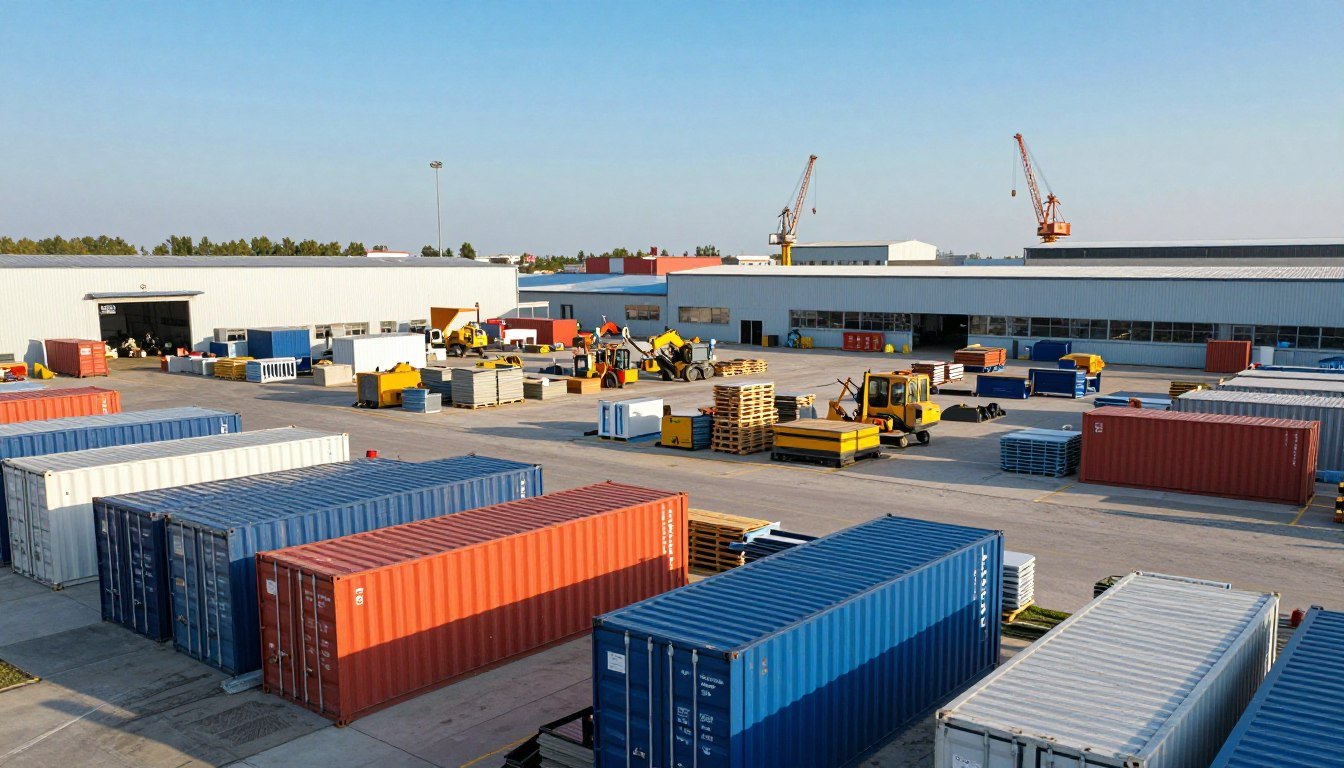
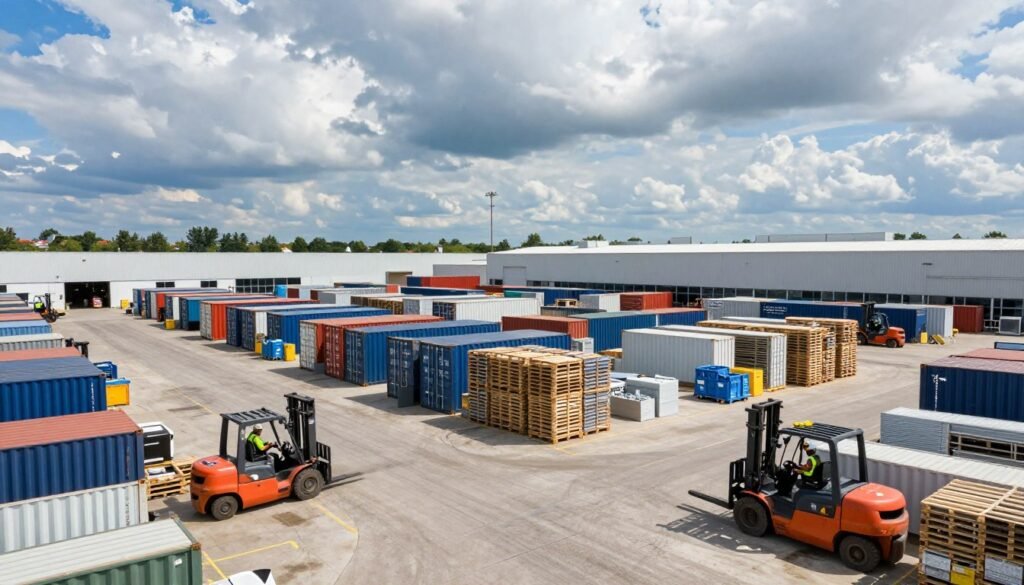
These properties host fleet parking, container and chassis holding, bulk laydown, contractor yards, and heavy work that happens outdoors. A modest office or maintenance bay expands tenant appeal without changing the yard-dominant thesis.
Improvements that move pricing
- Paving vs. gravel: paved lots command higher rents and easier financing.
- Security: quality fencing, controlled gates, and camera systems reduce risk.
- Lighting and circulation: full illumination and multiple access points improve safety and tenant acceptance.
Location criteria that drive value
Proximity to population centers and critical nodes—ports, airports, railyards, intermodals, and highways—reduces transport friction and raises demand. Multiple ingress/egress points improve circulation and safety for high truck volumes, which underwriters view favorably.
Industrial Outdoor Storage (IOS): current asset type evolution and institutionalization
What began as small, operationally driven lots is now a target for platform investors and cross-border capital.
Timeline: Local operators sold single-site holdings to aggregators like Industrial Outdoor Ventures, Alterra Group, Transport Properties, Zenith, and Triten IOS. Early buys often landed in the $1–$5M band and relied on quick operational upside.
Strategy: Aggregators improved yards with paving, security, and standardized leases, then re-leased on NNN terms to raise cash flows and appeal to larger buyers.
The next step is recapitalization. International groups and pension capital now back these platforms. GFH Partners’ $300M fund with Transport Properties is a clear example. Lower cost of capital boosts bidding power and compresses yields on top sites.
Institutionalization brings formal asset management, portfolio-level leasing standards, and disciplined capex programs focused on tenant retention and rent growth.
Trade-off: Greater scale reduces flexibility for local deal tweaks but creates cleaner, investible transactions for long-term holders.
Demand trends driving IOS leasing and rent growth
Bigger e-commerce volumes and changing supply chains are shifting where operations need room to run. Owners with well-located yards see more leasing interest from carriers, retailers, and service companies that require flexible outdoor working space.
Last-mile and final-mile pressures
Last-mile fulfillment pushes activity closer to population centers. Yards support staging, trailer parking, and quick transfers that buildings alone cannot handle.
Inventory strategy and resiliency
Onshoring and safety-stock policies increase touchpoints across networks. A single e-commerce sale can need roughly 3x the logistics space of traditional retail, so companies hold more outdoor area for staging and overflow.
Transportation economics
Tenants optimize total delivered cost. Transportation often makes up 45%–70% of logistics expense, while rent is typically only 3%–6% of fixed facility costs.
- An 8% rise in fixed facility costs is roughly equal to a 1% rise in transportation costs, so proximity to ports and intermodals often wins.
- Reducing miles or dwell time can justify higher per-acre rent if it cuts overall delivery spend.
Takeaway: These forces drive durable demand and support rent growth on mission-critical sites. Tenants that rely on frequent truck turns become sticky, giving owners pricing power within credit and cycle limits.
Tenant landscape and what it means for credit and stability
The make-up of users on a lot often tells more about credit risk than the lease term alone. Lenders examine who pays the rent, how essential the site is to operations, and whether alternatives exist nearby.
Major logistics and parcel carriers anchor many portfolios. Names like Amazon, UPS, FedEx, Walmart, Target, Home Depot, and XPO show that yard-based sites are embedded in mainstream networks. Those relationships signal investment-grade use cases and support lender comfort.
Broader commercial and municipal users
Two-thirds of demand can come from non-trailer-parking users. Contractors, building-supply firms, utilities, and municipal fleets value laydown, staging, and fleet space.
Companies such as ABC Supply, Beacon Roofing, Herc Rentals, Ryder, Builders FirstSource, Sunbelt, and United Rentals illustrate this breadth.
Why tenant mix matters to lenders
- Diversification: A balanced roster reduces reliance on one trade or cycle.
- Credit depth: JLL notes credit-worthy entities can represent 35%–50% of income in some portfolios.
- Operational stickiness: Location-specific needs, access, and compliant zoning make moves costly for tenants.
Debunking a common myth: these sites are not just trailer parking. Many users require equipment, fleet, and long-term laydown space. That mix expands underwriting beyond a single macro driver and improves stability for owners and lenders.
Lease structures and income mechanics investors underwrite
Underwriting often begins at the lease table, where wording and duration set value. Investors treat contract terms as the primary risk lever for yard-focused properties.
Triple-net norms
Triple-net leases dominate because they simplify expense recovery and make net operating income predictable. Lenders and yield-focused equity prefer this clarity when sizing loans and setting return targets.

How rent is quoted and why it matters
Rents are commonly stated per acre per month rather than per square foot. That metric captures yard utility better when buildings are minimal.
Typical institutional box
- Term: 5–7 years
- Escalators: 3%–4% annual
- Guarantees: parent or corporate guarantees preferred
- Termination: limited or no early termination rights
| Metric | Typical | Investor Rationale |
|---|---|---|
| Lease length | 5–7 years | Balances tenant flexibility with income stability |
| Escalation | 3%–4% annually | Supports contracted rent growth for valuation |
| Pricing unit | Per acre / month | Reflects open-area utility vs. per-sq-ft metrics |
Clauses and improvements
Investors push for restoration obligations, strict permitted-use language, and compliance duties tied to vehicle activity. Paved, secured, and gated yards routinely command higher rent and longer commitments because they reduce operational risk.
Ultimately, steady contracted rent growth and predictable expenses convert operational utility into a bankable income-led return even when comparables are scarce.
Supply constraints and zoning headwinds limiting new industrial outdoor storage sites
Even as demand climbs, municipal limits and redevelopment pressure shrink the pool of compliant lots. Zoning change is slow, and many communities resist uses that bring truck traffic, noise, or visual impacts.
Why supply is constrained: Local rules often restrict new sites. Entitlements add cost and delay. That means fewer usable parcels hit the market, which creates durable scarcity for compliant sites.
Municipal resistance explained
Neighbors and officials cite truck movements, late-hour noise, dust, and the perceived low job or tax yield of yard uses.
Those concerns translate into tougher hearings, special permits, and conditions that can make a project uneconomic.
Redevelopment pressure
Well-located yards are attractive targets for warehouses and higher-value uses. Conversions remove existing inventory and tighten supply further.
Entitlement risk and the by-right advantage
Entitlement risk brings timeline and political uncertainty. After a casualty, nonconforming uses may be prohibited from rebuilding.
By-right zoning reduces execution risk, speeds leasing, and often supports tighter cap rates than entitled peers.
| Constraint | Effect on sites | Investor implication |
|---|---|---|
| Zoning & permits | Delays market entry, fewer compliant sites | Higher underwriting premiums, need for local expertise |
| Community opposition | Stricter conditions, added mitigation costs | Longer hold periods; capex for buffers and screening |
| Redevelopment | Existing lots converted to buildings | Reduced supply supports rent growth on remaining properties |
Rent and vacancy trends shaping underwriting today
Since 2019, yard-focused rents have climbed sharply, forcing underwriters to reframe income assumptions.

Why rent performance outpaced broader industrial trends
Nearly 30% average rent growth since end‑2019 is the baseline across many metros. Some locations saw rates double due to scarce supply and mission‑critical use.
What sub‑3% vacancy signals
Sub‑3% vacancy points to real pricing power, but it also masks micro‑market gaps and thin reporting. Underwriters must drill into local data, not just national aggregates.
Renewal versus re‑tenanting tradeoffs
Owners face a choice: accept steady renewals (often +10%–15%) or chase market resets that can exceed +30% but incur downtime and capex. When freight softens, tenant affordability often limits upside.
When a building replaces a yard
Some building‑supply users prefer a larger building with drive‑in doors. That option can cap rents in certain corridors and creates a real competitive substitute.
- Practical takeaway: model conservative downtime, re‑tenanting capex, and realistic rent discovery.
- Stress test assumptions against local vacancy and tenant cash flow.
- See how market cycles affect loan terms for underwriting sensitivity: market cycle guidance.
Capital markets and transaction dynamics in a fragmented IOS market
Deal activity in this niche reflects fragmentation and a need for repeatable sourcing models.
Why capital markets look different: many sites are small, often trading at roughly $5M–$15M per asset. That scale sits below typical large LP check sizes and keeps ownership fragmented.
This deal-size reality shapes buyer pools and financing execution. Smaller transactions favor local buyers, family owners, and specialist operators who can move quickly.
Why off-market deals are common
Unsophisticated owners, limited broker coverage, and the hands-on nature of yard utility mean many sales never hit public listings.
Value-add and aggregation playbook
Value-add: identify below-market rents, upgrade paving and security, and standardize triple-net leases to institutional norms. Those improvements convert operational upside into predictable income for lenders.
Aggregation: buying many small assets creates scale, diversifies tenant exposure, and unlocks a wider universe of investors at exit. Portfolio comps help with price discovery and can compress return hurdles.
- Transactions often move off-market due to owner profiles and specialized underwriting needs.
- Repeatable sourcing and disciplined management raise appeal to larger buyers.
- Standardized data and scale reduce lender friction and can increase proceeds on refinancing or sale.
| Feature | Impact | Investor implication |
|---|---|---|
| Small deal size ($5M–$15M) | Fragmented ownership | Need for aggregation to reach institutional scale |
| Off-market supply | Lower listing visibility | Advantage to repeat buyers with local networks |
| Standardized upgrades | Improved cash flow predictability | Better access to capital and tighter pricing |
In short, scale and consistent management convert small, operational assets into investment-ready portfolios. That evolution attracts more capital and smooths future transactions.
Financing IOS properties and industrial yards: what lenders and investors focus on
Financing decisions hinge on measurable yard quality, access geometry, and who signs the rent checks. These items steer debt size, amortization, and lender covenants for Industrial Outdoor Storage (IOS) deals.
Underwriting priorities center on location and access first, then legality of use, tenant durability, and yard condition. Lenders value infill proximity to highways, ports, and intermodals because it cuts transport cost and turnover risk.

Yield positioning and income-led terms
Ios assets typically price at entry cap rates roughly 100–250 bps higher than traditional industrial. That spread supports an income-led approach: stable contracted rent streams and predictable recoveries underpin loan sizing despite smaller buildings.
Structuring for risk
Best practice includes parent guarantees, tight permitted-use language, and restoration obligations to preserve yard value. A clear lease assigning maintenance and paving responsibilities reduces lender stress.
Expense and capex profile
Limited building area lowers long-term obsolescence. Big-ticket replacements like roof work are often absent, shifting capex focus to pavement, drainage, and security systems.
| Underwriting Order | Why it Matters |
|---|---|
| Infill location & access | Affects tenant demand and re-leasing risk |
| Zoning & legality | Reduces entitlement delays and execution risk |
| Tenant durability | Drives income predictability |
| Yard quality | Influences rent and financing terms |
Realistic expectation: lenders reward institutional-grade documentation, clean environmental and zoning diligence, and a funded plan for yard upkeep. Those elements unlock the best capital and terms.
Development and “future-proofing” trends shaping new IOS supply
Developers are shifting to larger regional hubs because infill entitlement scarcity makes small lots harder to secure. These mega-sites—often 50+ acres—serve as strategic nodes rather than simple day-use parking.
Mega-sites and regional hub models
Fifty‑plus acre models change circulation and security expectations. Planned lanes, staging areas, and high-capacity fencing permit scalable trailer and truck parking that appeals to national fleet operators.
New tenant requirements
Tenants now demand on-site maintenance and repair bays to reduce downtime for trucks and equipment. Providers add dispatch offices, lounges, restrooms, and showers to support drivers on repeat routes.
Electrification readiness
Future-proofing means running conduit, planning transformer capacity, and coordinating utility timelines to support EV fleet charging. Carriers with carbon goals—DHL, UPS, FedEx—push sites to factor power planning into selection criteria.
Underwriting impact: these improvements broaden tenant appeal and stabilize income, but lenders expect upgrades to match market demand. Proper sizing of parking, repair capacity, and electrical infrastructure is critical for financing and long‑term value.
Forecast and watchlist for the IOS sector over the coming years
Forecasting in this niche requires pairing local supply constraints with freight cycle sensitivity to find where growth holds. Use a practical framework rather than a single-point call: rent persistence depends on local supply, tenant affordability, and transportation volume cycles.
Where rent growth may persist vs. normalize
Persist: Infill-constrained markets with by-right zoning and close proximity to ports or intermodals, rent growth tends to stay above national averages.
Normalize: Markets with easy land assembly, competing industrial formats, or tenant bases heavily exposed to freight softness will see growth pull back toward trend.
Markets and site profiles that attract institutional capital
Institutional capital favors secure, paved, well-improved yards with strong access and clear legal use. Tenants with scalable operations and corporate guarantees make underwriting cleaner.
“Better portfolio data will convert localized anecdotes into reliable comps and tighter pricing.”
| Driver | Near-term signal | Investor implication |
|---|---|---|
| Supply constraint | Low available lots, strict zoning | Supports durable rent growth |
| Demand sensitivity | Freight cycles and tenant margins | Stress-test rent steps and downtime |
| Data transparency | More portfolio sales and standard leases | Improves lender appetite; can compress cap rates |
Practical watchlist: monitor markets where supply is tight but tenant economics remain solid, and watch the transparency flywheel—more institutional trading will improve comps and change financing dynamics.
Conclusion
Clear legal use, strong access, and tenant-critical circulation convert parcels into bankable assets. The yard-first model has created an investable market near ~$200B, with about $1.7B of institutional capital raised recently.
Rents rose nearly 30% since end-2019 while vacancy tightened below 3% at the peak. Cap rate spreads commonly run 100–250 bps versus traditional industrial, and typical leases are 5–7 year NNN with 3%–4% escalators.
This is not just dirt. The best outdoor storage sites need paving, security, and engineered circulation to serve trucks and modern logistics tenants.
Financing takeaway: win with disciplined site selection, document-ready leases, realistic rent assumptions, and a capex plan focused on yard integrity. As the sector matures, better data and standardized leases will narrow gaps—while zoning constraints will keep high-quality sites scarce.