
Financing Island CRE: Capital Stack Considerations for Hawaii Projects

an aerial view of a city and the ocean

Surprising fact: a recent survey found that island projects now need far more sponsor equity than mainland deals, with private investors filling funding gaps at unprecedented levels.

This introduction explains what follows: we will show how developers assemble a Hawaii Capital Stack for island commercial real estate and housing projects.

Rising interest rates and higher construction costs force different underwriting assumptions. Lenders and sponsors mix equity, senior and subordinate debt, tax-credit equity, and limited public gap funds to close budgets.

Expect practical guidance: the article will flag Hawaii-specific constraints — higher build costs, logistics, long entitlement timelines, and constrained public funding — and how these shape deal structure.

We use real examples and current programs to show where money and investment actually come from, and what lenders watch when pricing risk.

Key Takeaways

  • Island projects need larger sponsor equity cushions than mainland peers.
  • Financing blends multiple debt and equity sources to bridge higher costs.
  • Entitlement delays and logistics raise both schedule risk and budget pressure.
  • Public gap programs help but rarely fully close the funding shortfall.
  • Underwriters now price tighter assumptions for rent, cost, and timing.

Why Hawaii’s Financing Environment Is Forcing New Capital Stack Playbooks

The supply shortfall and long timelines demand different investor behavior.

Developers now face a statewide need for about 50,000 new units for 2020–2025 while recent permits covered roughly 16% of that. Lenders react by requiring larger equity cushions and clearer execution plans.

Workforce housing pressure:

Workforce housing defined and why it matters

Workforce units typically target households at 80%–140% AMI. These homes fall between subsidy programs and market rents, so projects can struggle to absorb cost overruns without extra equity.

A vibrant coastal scene depicting workforce housing in Hawaii, showcasing modern, multi-family buildings with tropical landscaping. In the foreground, a diverse group of professionals in business attire discuss their projects, exuding a collaborative spirit. The middle layer features clusters of well-designed housing units, integrating green spaces with palm trees and native flora, emphasizing community and sustainability. In the background, the stunning ocean and mountains create a picturesque Hawaiian landscape, bathed in warm, golden sunlight, capturing the serene, inviting atmosphere. Utilize a wide-angle lens perspective to highlight the scale and environment. The image should evoke a sense of optimism and innovation, embodying Thorne CRE’s commitment to enhancing Hawaii’s real estate landscape.

Case snapshot: Kaulana Mahina

Kaulana Mahina (Wailuku) is a 14.4‑acre project with 324 rental units. It cost over $100 million and was delivered with private money and a PNC loan. About 95% of equity came from PNC Realty Investors, illustrating concentrated institutional investment.

  • Underwriting now uses tighter stress tests and conservative absorption assumptions.
  • When supply is constrained, sponsors face stricter contingencies and early community engagement to keep schedules financeable.

Hawaii Capital Stack Components: Equity, Debt, and the Real Cost of Capital Today

Today’s developer budgets show a heavier equity tilt as financing costs and build budgets outpace traditional leverage models.

Private equity’s outsized role: developers report private equity can represent about 40% of a project budget, replacing portions of bank leverage as lenders tighten covenants and underwriting.
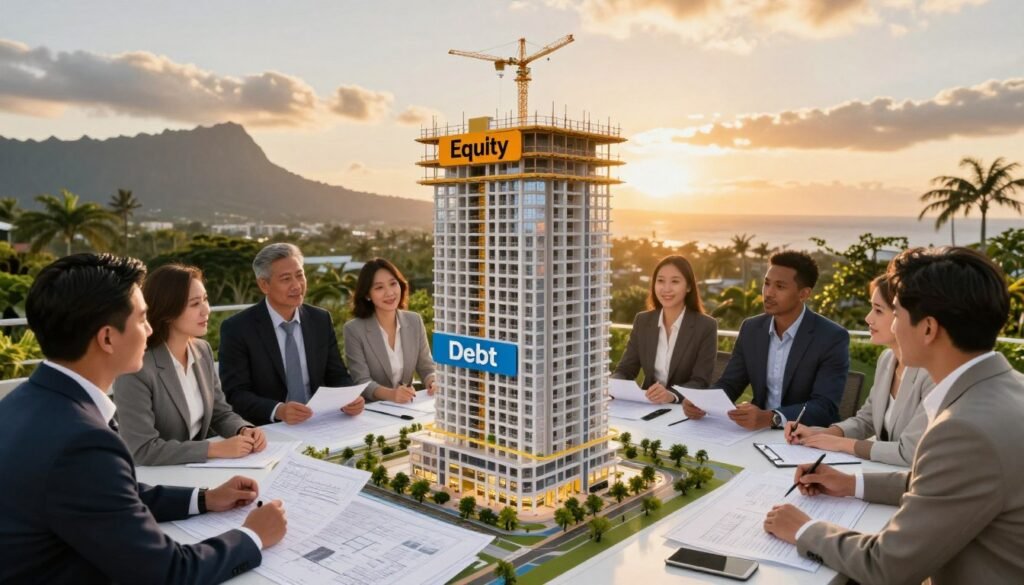
A vibrant and dynamic representation of equity in real estate, centered on a stylized capital stack concept. In the foreground, a diverse group of professionals dressed in business attire, engaged in a discussion over blueprints and financial documents, symbolizing collaboration and investment insights. In the middle ground, a visually striking 3D model of a high-rise building under construction, showcasing various layers labeled 'Equity' and 'Debt' in bold, clear typography. In the background, a scenic view of a Hawaiian landscape with lush greenery and distant mountains, bathed in warm, golden lighting during sunset, creating a sense of opportunity and growth. The image reflects a professional atmosphere, emphasizing the significance of equity in financing Hawaiian real estate projects. Include the brand name "Thorne CRE" subtly integrated into the environment.

Where equity and capital come from

Major sources include pension funds, endowments, and accredited investors—plus local high‑net‑worth partners that underwrite schedule and cost risk.

Tax credit equity mechanics and limits

LIHTC equity can cover roughly 40%–75% of costs depending on credit type, but credits are oversubscribed and typically limited to rentals under 60% AMI.

Practical effect: many workforce rentals and for‑sale projects cannot rely on LIHTC and must use private investments instead.

Debt sizing and return targets

For‑sale loans depend on presales to justify construction loan sizing, while rental loans price off stabilized NOI and underwriting rents.

Expected returns differ: affordable rentals commonly clear near 13%–16% overall, while market‑rate deals often target 20%–25%. These targets drive residual land value, contingency cushions, and how much subordinate debt a sponsor can carry.

  • Checklist lenders and equity partners watch: accurate sources/uses, contingency levels, credible schedule, tenant income compliance, and realistic exit or refinance assumptions.

Public and Community Capital Programs Filling Gaps Across the Islands

Public programs often act as marginal closers when private sources fall short. They reduce sponsor equity needs but remain limited and competitive.

A vibrant scene illustrating community capital programs supporting island development in Hawaii, featuring a diverse group of professionals in business attire, engaging in a collaborative discussion around a table with architectural blueprints and financial documents. The foreground showcases hands pointing at a map of Hawaii with marked development areas, while the middle ground highlights a lush tropical background with palm trees swaying gently. In the distance, represent high-rise buildings under construction, symbolizing growth and opportunity. Soft, natural lighting enhances a hopeful and productive atmosphere, capturing the spirit of community and investment. The scene subtly incorporates the brand name "Thorne CRE" into the blueprints on the table, ensuring a sense of professionalism and credibility in the context of public and community capital avenues.

Rental Housing Revolving Fund: capacity and underwriting reality

RHRF typically supports projects serving ≤60% AMI, though 2022 allocations reached 61%–100% AMI in some cases. In underwriting terms it functions like a subordinate loan that softens required equity but adds compliance.

Scale remains tight: HHFDC notes ~$100M from the fund covers roughly 650 low‑income units versus ~15,000 needed. That gap forces sponsors to assemble significant private investment.

Bond‑forward alternatives and higher leverage models

Tax‑exempt, multi‑layer bond structures can raise leverage and reduce reliance on state money. They add issuance complexity and ongoing reporting, but can replace some gap funds.

HI‑CAP (2025) and community impact terms

HI‑CAP includes Collateral, Loans, CDFI channels, and Invest (a venture vehicle). These channels can unlock supplier and contractor financing and support catalytic mixed use.

Community requirements—local hiring, reporting, or prevailing wages—can change timelines and collateral needs.

  • Pursue RHRF for deep affordability; use bond execution for scale and HI‑CAP when catalytic ecosystem support is needed.

Execution Risks Unique to Island Projects and How Lenders and Investors Mitigate Them

Long predevelopment periods and multi-agency reviews create an execution premium that lenders price into deals.

Entitlements, environmental reviews and traffic studies often take years to clear. Community opposition can add months or more. Those delays move the financing window and raise the chance sponsors must bring extra equity or accept costlier terms.

A serene Hawaiian island landscape serves as the backdrop, featuring lush greenery and distant mountains under a clear blue sky. In the foreground, a diverse group of professionals, dressed in business attire, discusses strategies to mitigate execution risks associated with island development projects. They stand around a sleek, modern conference table with plans and blueprints spread out, highlighting financing options. The middle ground captures a tranquil beach scene, with a small boat gently bobbing in the water, symbolizing the unique maritime aspects of island financing. The warm, golden hour lighting casts a soft glow, creating an optimistic atmosphere. In the corner, the brand "Thorne CRE" subtly incorporated into the scene, enhancing the professional look without overpowering the natural beauty.

Timeline and entitlement pressure

Why it matters: schedule slippage can trigger extension fees, re-underwriting, or lender re-trades. Lenders often require hard milestones and extension reserves to protect the loan.

Cost escalation and the equity impact

Material and labor costs have risen roughly 57% since 2000, so contingencies burn faster. When senior loan proceeds are capped by underwriting, sponsors must increase their equity checks to cover overruns.

Labor, operational mandates, and compliance

Some institutional investments require union labor for construction and ongoing maintenance. That can raise bids and affect schedules, but it can also improve reliability and lower execution risk.

Risk Typical Lender Mitigation Practical Sponsor Mitigation
Entitlement delays Tighter covenants, extension reserves, step-in rights Early stakeholder outreach, phased permitting
Cost escalation Minimum hard cost contingencies, GMP expectations Long-lead procurement, fixed-price contracts
Rate-driven presale risk Stricter presale thresholds, stress-tested debt service Flexible financing triggers, conservative presales
LIHTC compliance and resyndication Audit readiness covenants, compliance reporting Year‑14 sweeps, clean tenant files and documentation

Where lenders and sponsors align: stronger completion guarantees, defined contingency layers, and procurement plans that lock prices where possible. Practical playbooks also include union-aware RFPs and compliance-first operations to protect future recapitalizations.

For more on structuring sources and protections within a layered capital plan, see this capital stack guide.

Conclusion

Today’s financings favor sponsors who blend deeper private equity with pragmatic contingency planning. ,

Key, quantified takeaways: the housing shortfall (≈50,000 needed vs 16% permitted) forces larger sponsor checks; private investors now supply roughly 40% of project budgets. Public relief is limited—RHRF’s ~$100M funds about 650 units versus a ~15,000-unit need.

Returns remain distinct: affordable rentals clear near 13%–16%, while market-rate deals often target 20%–25%.

Practical closing guidance: use tax-exempt bond options, rigorous LIHTC compliance planning, and programs like HI-CAP for catalytic support. Kaulana Mahina shows fully private solutions work when institutional partners accept tight controls.

Protect schedule, budget, and compliance—those controls keep the capital plan intact from predevelopment through stabilization.

FAQ

What are the main components of a capital stack for island commercial real estate projects?

A typical stack layers equity at the top, followed by mezzanine and senior debt, and may include tax credit equity and public program funding. Equity comes from private investors, pension funds, and local partnerships. Debt is structured from construction loans to permanent mortgages, and public capital can bridge gaps through grants, bond proceeds, or loan programs.

How do rising interest rates change the role of private equity in project financing?

Higher rates increase borrowing costs and reduce leverage, so developers rely more on private equity to fill the shortfall. That shifts return expectations and forces longer hold periods or higher rents to meet investor targets. Equity providers may also demand stronger covenants or preferred returns to offset rate risk.

What public programs commonly support island rental housing and how do they differ?

Programs include revolving loan funds, tax-exempt bond financing, and state-backed collateral facilities. Revolving funds offer lower-cost loans with eligibility tiers tied to affordability. Tax-exempt bonds provide higher leverage but require adherence to set affordability rules. Collateral support and CDFI channels can reduce lender risk for community-focused projects.

How does tax credit equity work and what constraints should sponsors expect?

Tax credit equity, such as low-income housing credits, is provided by investors who use tax benefits to offset liabilities. It reduces cash needs but creates compliance obligations, long-term affordability covenants, and timing constraints tied to syndication and credit allocation cycles. Scarcity of credits can limit deal feasibility.

What are the common debt sizing differences between rental and for-sale projects?

Rental projects typically allow for higher debt service coverage ratios and longer-term permanent loans, enabling larger loan amounts. For-sale projects rely more on construction financing and sales pace, which limits leverage and increases reliance on equity during construction. Lenders price in differing refinance and exit risks.

Which execution risks are most significant for island projects and how are they mitigated?

Major risks include entitlement delays, environmental reviews, community opposition, and supply-chain or labor cost escalation. Mitigation strategies involve robust due diligence, contingency budgets, phased permitting strategies, community engagement, and contracting approaches like fixed-price or GMP contracts with reputable contractors.

How do community impact requirements influence financing terms?

Lenders and public funders often require community benefits—affordability levels, local hiring, or services—which can increase operating costs or require additional capital. Meeting these terms may unlock lower-cost loans or grants, but sponsors must price obligations into pro formas and secure partner commitments early.

What return targets do investors expect for affordable versus market-rate projects?

Affordable housing investors accept lower cash-on-cash returns and often seek equity-like tax or social benefits, while market-rate investors demand higher returns to compensate for market risk. Return targets vary by capital source: impact investors and public programs prioritize social outcomes, while private equity and pension funds target market-based IRRs.

How can bond-forward or tax-exempt structures increase leverage for projects?

Tax-exempt financing reduces interest costs, allowing sponsors to take on larger loans and preserve equity. Bond-forward structures enable commitments ahead of closing, improving certainty and sometimes extending conversion periods. These approaches require compliance with tax rules and often include covenants tied to affordability and use.

What lenders or debt products are commonly used to fund construction and permanent phases?

Construction is typically financed with short-term construction loans from banks or specialty lenders, sometimes supported by bridge loans. Permanent financing uses agency loans, life-company debt, or tax-exempt bonds. CDFIs and community lenders also provide tailored products for mission-driven projects.

How do union labor and operational requirements affect capital sourcing?

Projects that commit to union labor or specific operational standards may gain access to certain public funds or favorable loan terms but face higher construction and operating costs. Sponsors must quantify these costs and obtain lenders’ and investors’ approval early to avoid surprises at closing.

Where does short-term construction cost escalation pressure equity contributions?

Escalating labor and material costs raise overall budgets, shrinking lender loan-to-cost ratios and forcing sponsors to increase equity injections or seek subordinated financing. Developers mitigate this with contingency reserves, escalation clauses, or by negotiating fixed-price contracts with contractors.

What role do CDFIs and venture capital pathways play in island project financing?

Community Development Financial Institutions (CDFIs) provide flexible, mission-driven loans and technical assistance, often filling gaps left by traditional lenders. Venture-style capital or impact investors can supply patient equity for innovative housing models, though they expect measurable community outcomes or exit plans.

How should sponsors approach underwriting given workforce housing demand and delivery gaps?

Underwriting must reflect realistic absorption, conservative rent growth, and sensitivity to extended permitting timelines. Sponsors should model multiple scenarios, secure off-take or subsidy commitments where possible, and align capital partners who understand long timelines and community-focused metrics.

Leave a Comment

Your email address will not be published. Required fields are marked *

Scroll to Top