
The real estate world is changing fast, with a big move towards mixed-use developments. Live-work units are leading this change. These projects mix homes, businesses, and sometimes factories. They offer something special for developers and communities.
As cities grow, so does the need for integrated living and working spaces. This change is changing how we live, work, and connect. It’s key to look into the growth, types, and ways to fund live-work and non-traditional mixed-use projects.
Key Takeaways
- Mixed-use developments are becoming increasingly popular in the real estate sector.
- Live-work units offer a unique value proposition for developers and communities.
- The demand for integrated living and working spaces is on the rise due to urbanization.
- Financing strategies for live-work and non-traditional mixed-use projects are evolving.
- Understanding the evolution and types of mixed-use projects is crucial for success.
The Evolution of Live-Work and Mixed-Use Spaces
For centuries, people have lived and worked in the same spaces. This idea has changed a lot over time. It shows how society, economy, and technology have evolved.
Historical Context of Combined Living and Working Spaces
Long ago, places like medieval shophouses were common. Merchants lived above their stores. These early examples show mixed-use development has always been part of city planning.
From Medieval Shophouses to Modern Lofts
Now, we see modern lofts that mix living and working. These lofts fit today’s lifestyle, blending homes and workspaces.
The Industrial Revolution made us separate work and home. But, now, we’re seeing more mixed-use places again. This is because of city growth and the wish for a better work-life balance.
Today, live-work and mixed-use spaces keep changing. They’re shaped by our need for flexible, multi-use areas. These areas support both our personal and work lives.
Types of Non-Traditional Mixed-Use Developments
Creative mixed-use projects are becoming more popular. They mix living, working, and fun spaces together. These projects aim to create lively, dynamic places that bring people together and spark creativity.
Artist Live-Work Studios and Makerspaces
Artist live-work studios and makerspaces are on the rise. They blend homes with professional studios and shared work areas. This setup is perfect for artists and makers to live, work, and share ideas.
Gallery-Residence Combinations
Some projects mix galleries into homes. This lets artists show their work and lets residents see new art all the time.
Collaborative Creation Environments
Makerspaces in these developments offer shared spaces for making and inventing. They help people share ideas and start new projects.
These non-traditional mixed-use projects offer many benefits:
- Increased creativity: They bring different people together, sparking new ideas.
- Community building: Shared spaces help people connect, building a community.
- Economic benefits: They can make old areas lively again, attracting businesses and talent.
As cities change, the need for these projects will grow. Developers who can mix different uses and create lively spaces will thrive.
The Unique Value Proposition of Mixed-Use Projects
Mixed-use projects combine different land uses. They benefit developers, communities, and residents. These projects mix residential, commercial, and recreational spaces into one unit.
Economic Benefits for Developers and Communities
Mixed-use projects bring economic gains for developers and communities. They can boost property values and local economies. They also create new income sources through varied land uses. For developers, mixed-use financing can offer higher returns.
Sustainability Advantages of Combined-Use Spaces
Combined-use spaces have many sustainability benefits. They cut down on infrastructure costs and use resources more efficiently. They also improve environmental performance. Mixed-use projects help reduce urban sprawl and protect natural habitats.
Quality of Life Improvements for Residents
Residents in mixed-use developments, like those with live-work units, enjoy better lives. They benefit from the convenience and amenities.
Reduced Commuting Time and Costs
Mixed-use projects cut down on commuting times and costs. This improves work-life balance and supports a greener lifestyle.
Work-Life Integration Opportunities
Mixed-use developments, with live-work units, help residents blend work and personal life. This boosts productivity, work-life balance, and overall happiness.
Understanding Mixed-Use Financing Fundamentals
Mixed-use financing is complex, needing a detailed approach. It deals with different income sources and risks. Unlike single-use properties, mixed-use projects mix residential, commercial, and industrial spaces. This makes the financial picture more intricate.
How Mixed-Use Financing Differs from Single-Use Funding
Mixed-use financing is different from single-use funding because of its varied nature. Lenders must look at different income sources. These include residential rents, commercial leases, and industrial income.
The Complexity of Valuing Multi-Function Properties
Valuing multi-function properties is complex. This is because of the different income streams and unique risks. It also involves understanding how different parts of the project work together.
Income Stream Diversification
Income stream diversification is key in mixed-use projects. They can earn money from various sources. For example, a property might have homes, shops, and office spaces. Each part brings in different income.
Risk Assessment Challenges
Assessing risks in mixed-use projects is tough. Lenders must check the credit of tenants and how different parts work together. They need to understand the project’s dynamics and market well.
In summary, knowing mixed-use financing basics is vital. It helps tackle the project’s complexities. By understanding the differences and valuation challenges, developers and lenders can succeed in these projects.
Traditional Commercial Lending Options
Traditional commercial lending is key for financing mixed-use properties. It offers various loan options. These are vital for developers to complete their complex projects.
Commercial Bank Loans for Mixed-Use Properties
Commercial bank loans are a main financing source for mixed-use developments. They are designed to meet the project’s specific needs. This includes the mixed-use nature of the property.
Term Lengths and Interest Rate Structures
Commercial bank loans have different term lengths. They can last from 5 to 20 years, based on the project and lender policies. Interest rates can be fixed or floating.
Fixed rates offer stability. Floating rates might start lower but can increase over time.
Collateral and Guarantee Requirements
Lenders often ask for collateral to secure the loan. This can be the property itself, other assets, or personal guarantees. The requirements depend on the lender’s risk assessment.
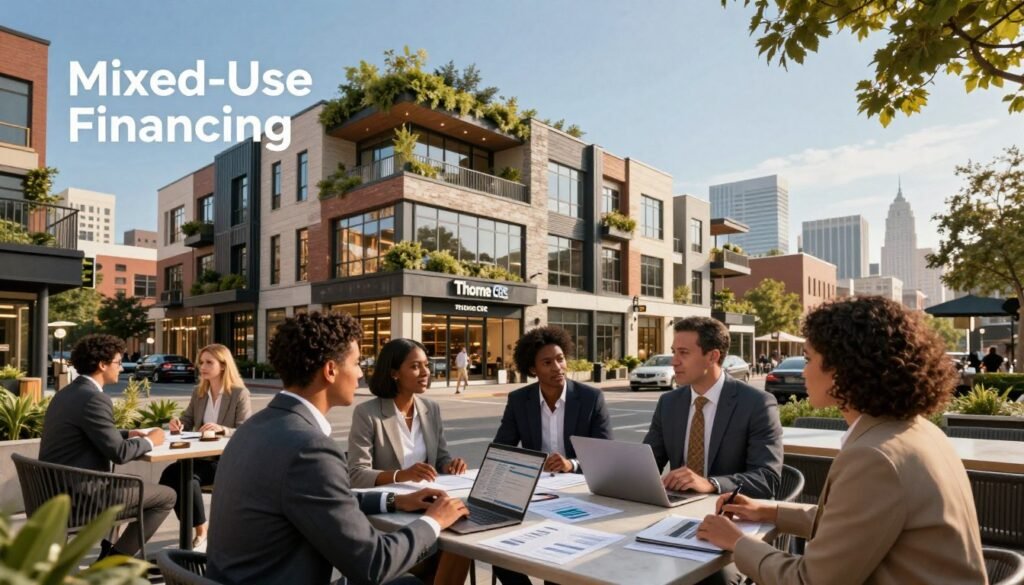
Understanding these loan aspects is crucial for developers. It helps them navigate the complex world of mixed-use financing.
Government-Backed Financing Programs
For developers of live-work units and other non-traditional mixed-use concepts, government-backed financing programs can be a game-changer. These programs offer attractive terms and conditions that can make a significant difference in the viability of a project.
Government-backed financing programs are crucial for mixed-use developments. They often involve complex financing structures. Two key programs that developers should be aware of are FHA 223(f) and 221(d)(4) multifamily loans.
FHA 223(f) and 221(d)(4) Multifamily Loans
The FHA 223(f) loan program is designed for the acquisition and refinancing of existing multifamily properties. The 221(d)(4) loan program is geared towards the construction or substantial rehabilitation of multifamily projects. Both programs offer competitive interest rates and favorable loan terms.
- FHA 223(f) Loans: Ideal for acquiring or refinancing existing properties.
- 221(d)(4) Loans: Suitable for new construction or substantial rehabilitation projects.
HUD-Insured Financing Options
HUD-insured financing options provide another avenue for developers to secure funding for their mixed-use projects. These programs offer a range of benefits, including non-recourse loans and the ability to finance up to 90% of a project’s value.
Eligibility Requirements
To be eligible for HUD-insured financing, projects must meet specific requirements, including:
- Location in a designated HUD-insured area.
- Compliance with HUD’s regulatory requirements.
- Adequate collateral to secure the loan.
Application Process Overview
The application process for HUD-insured financing involves several steps, including pre-application, firm commitment, and closing. Developers should be prepared to provide detailed project information and financial documentation.
By leveraging government-backed financing programs, developers can access the capital they need. Whether through FHA loans or HUD-insured financing, these programs can help mitigate risk. They also enhance lender appetite for non-traditional assets.
Alternative Financing Strategies for Creative Projects
As more people look for non-traditional assets, new ways to fund projects are needed. Creative mixed-use projects, in particular, need fresh ideas to get the money they need.
Private Equity and Venture Capital
Private equity and venture capital are now big in funding creative mixed-use projects. They see the chance for big profits and the special value of mixed-use properties.
Structuring Equity Partnerships
It’s key to be clear about roles and expectations in equity partnerships. You need to figure out the money each side puts in, how profits will be shared, and how to exit. A good partnership can lower risks and increase chances of making money.
Return Expectations and Exit Strategies
Investors in creative mixed-use projects want big returns. Developers must show why their project is worth it, including a clear plan for getting out. Common plans include selling, refinancing, or getting more capital.
Here’s a comparison of traditional financing and alternative financing strategies for creative mixed-use projects:
| Financing Aspect | Traditional Financing | Alternative Financing |
|---|---|---|
| Sources of Funding | Banks, conventional lenders | Private equity, venture capital |
| Return Expectations | Lower, more stable returns | Higher, potentially volatile returns |
| Project Flexibility | Less flexible, strict criteria | More flexible, adaptable terms |
In conclusion, new financing options like private equity and venture capital are key for creative mixed-use projects. By knowing how these work, developers can find the funding they need to make their projects real.
Tax Incentives and Credits for Mixed-Use Development
Tax incentives are key to making mixed-use projects work financially. They help lower costs for live-work units and other mixed-use properties. This makes them more appealing to investors and developers.
Historic Preservation Tax Credits
Historic Preservation Tax Credits are a big help for mixed-use projects. They aim to save historic buildings by turning them into mixed-use properties. This includes live-work units.
Federal vs. State Programs
Both the federal and state governments offer these tax credits. The federal program gives up to 20% of the costs back. State programs offer more, sometimes up to 20% extra.
Qualification and Application Process
To get these credits, properties must be historic. They need to be on the National Register or in a historic district. Developers must submit detailed plans and proof of the work done.
| Program | Credit Percentage | Eligibility Criteria |
|---|---|---|
| Federal Historic Preservation Tax Credit | 20% | Listed on the National Register of Historic Places |
| State Historic Preservation Tax Credit | Varies (e.g., 10%-20%) | Meets state-specific criteria, often aligned with federal |
Using these tax incentives, developers can make their projects more financially sound. This makes them more appealing in the market.
Understanding Lender Appetite for Non-Traditional Assets
As mixed-use projects get more unique, knowing what lenders want is key. Lenders look at risk in different ways for these projects. They consider things like market demand and if the project can work well.
Risk Assessment Factors for Unconventional Projects
Lenders check a few important things when they look at the risk of these projects. These include:
Market Demand Analysis
They really look at if people want what the project offers. This could be places to live and work, or other unique uses.
Operational Viability Concerns
They also check if the different parts of the project can work together well. This is important for the project’s success.
The table below shows what lenders look at and how it affects their decision:
| Risk Factor | Description | Impact on Lender Appetite |
|---|---|---|
| Market Demand | Analysis of demand for mixed-use components | High demand increases lender confidence |
| Operational Viability | Assessment of how well different uses coexist | Strong operational viability reduces risk |
| Economic Resilience | Ability of the project to withstand economic downturns | Projects with diverse income streams are more attractive |
Lenders are more likely to fund projects that show they understand these risks. They also need to have plans to deal with them. By knowing what lenders want and addressing these points, developers can make their projects more likely to get funded.
Preparing a Winning Loan Package
To get funding for creative mixed-use projects, developers need a strong loan package. This package is key to showing the project’s worth and its chance for profit.
Essential Documentation for Mixed-Use Financing
A good loan package for mixed-use financing has several important parts. These parts help lenders understand the project’s risks and its income potential.
Financial Statement Requirements
Financial statements are a big part of the loan package. They should have income statements, balance sheets, and cash flow projections. Lenders look at these to see if the project can make money.
Property and Market Analysis
An in-depth look at the property and market is also key. This includes studying the local real estate, competition, and growth chances. It should show what makes the project special and how it meets demand for mixed-use spaces.
Here’s an example of what a loan package might include in terms of financial projections and market analysis:
| Year | Projected Income | Operating Expenses | Net Operating Income |
|---|---|---|---|
| 1 | $1,000,000 | $600,000 | $400,000 |
| 2 | $1,050,000 | $630,000 | $420,000 |
| 3 | $1,102,500 | $661,500 | $441,000 |

By adding detailed financial statements and market analysis, developers can make a strong loan package. This approach helps reduce risk and shows the project’s potential for success.
Case Studies: Successfully Financed Live-Work Projects
Looking at successful live-work projects shows us how to finance non-traditional assets. These examples highlight the challenges and chances in funding mixed-use developments, mainly in cities.
Urban Warehouse Conversion in Chicago
A great example is the makeover of a Chicago warehouse. It turned an old industrial spot into a lively mixed-use area. This area has live-work units and business spaces.
Financing this project was tricky. It needed private money, government loans, and tax credits for historic buildings. Figuring out the property’s value was hard because it had homes and shops. The project’s mix of uses needed a special financing plan, using non-traditional financing strategies.
Key Success Factors
Several things helped the project succeed:
- A skilled team with experience in mixed-use projects
- Knowing the local market and rules well
- A solid financial plan that showed the project’s details
These points, along with a flexible funding plan, helped the project beat its hurdles and succeed.
The Chicago warehouse project is a good example for other live-work projects. It shows how non-traditional assets can be turned around and funded well. By learning about financing and challenges of such projects, developers can handle mixed-use development better.
Navigating Zoning and Regulatory Hurdles
Zoning and regulatory hurdles can greatly affect the success of creative mixed-use projects. These projects often challenge traditional zoning laws.
To overcome these challenges, developers need to know mixed-use zoning requirements well. They must understand current laws and predict future changes that could impact their projects.
Understanding Mixed-Use Zoning Requirements
Mixed-use zoning rules differ across areas. It’s essential for developers to collaborate with local authorities.
Form-Based Codes vs. Traditional Zoning
Modern zoning focuses on building form and character, not just use. This shift is key.
- Form-based codes lead to more detailed and context-sensitive development.
- They create lively, welcoming spaces.
- But, they can be harder to understand and work with.
Variance and Conditional Use Processes
Developers may need variances or conditional use permits for projects that don’t fit standard zoning.
- Variances allow for exceptions to zoning rules.
- Conditional use permits permit specific uses under certain conditions.
Grasping these processes is vital for managing lender appetite. It ensures projects are viable financially and meet regulatory standards.
| Zoning Approach | Key Features | Impact on Development |
|---|---|---|
| Traditional Zoning | Focuses on land use, strict categorization | Can be restrictive, limiting mixed-use potential |
| Form-Based Codes | Emphasizes building form and character | Encourages more flexible, context-sensitive development |
By mastering zoning and regulatory challenges, developers can fully realize their creative mixed-use projects. This boosts their appeal to lenders and investors.
Risk Mitigation Strategies for Mixed-Use Projects
Mixed-use projects are complex, combining homes, shops, and fun spaces. They need a solid plan to handle risks in financing, building, and demand. This is key for their success.
Insurance Considerations for Multi-Function Properties
Insurance is crucial for mixed-use projects. Comprehensive coverage is needed for property damage, liability, and when businesses can’t operate. It’s important to work with insurance companies to create policies that fit the project’s needs.
Phased Development Approaches to Reduce Risk
Phased development is a smart way to lower risks in mixed-use projects. It lets developers test the market and adjust their plans as needed.
Testing Market Demand Incrementally
Developing in phases helps developers see how the market reacts. They can then make smart choices for the next steps.
Scaling Financing Requirements
Phased development also helps manage money better. Developers can adjust funding based on how well each phase does. This keeps the project financially sound.
| Risk Mitigation Strategy | Description | Benefits |
|---|---|---|
| Comprehensive Insurance | Tailored insurance policies covering property damage, liability, and business interruption. | Financial protection against unforeseen events. |
| Phased Development | Developing the project in stages to test market demand and adjust plans. | Reduced financial risk, ability to adjust based on market feedback. |
The Role of Public-Private Partnerships
In mixed-use development, public-private partnerships are key to success. They team up government and private groups to fund projects. This includes live-work units and creative mixed-use developments.
Leveraging Municipal Support and Infrastructure
Municipal support is vital for mixed-use projects. It can include better infrastructure, tax breaks, or zoning changes. For example, a city might give tax breaks for a mixed-use project with live-work units.
Community Development Financial Institutions
Community Development Financial Institutions (CDFI) help mixed-use projects, mainly in poor areas. They offer loans that regular banks might not.
CDFI Loan Products
- Flexible loan terms for mixed-use projects
- Lower interest rates than some private lenders
- Help with the development process
Technical Assistance Programs
CDFIs also provide technical help. This helps developers deal with rules, make projects better, and improve quality.
With public-private partnerships and CDFI support, developers can get the funding and know-how. This helps bring complex projects to life, making communities better and more sustainable.
Future Trends in Mixed-Use Financing
Mixed-use financing is on the verge of a big change. ESG-focused lending programs are leading this change. Lenders are now looking at more than just money. They’re considering how projects affect the environment, society, and governance.
ESG-Focused Lending Programs
ESG-focused lending is becoming more popular. These programs focus on projects that are good for the planet, society, and have strong leadership.
Green Building Incentives
Green building incentives are a big part of ESG lending. Lenders give better deals to developers who use sustainable designs and save energy.
Social Impact Investment Criteria
Social impact is also key. Lenders want projects that help communities, like affordable housing and community centers.
The following table shows what ESG-focused lending is all about:
| ESG Component | Description | Example |
|---|---|---|
| Environmental | Green building practices and energy efficiency | LEED-certified buildings |
| Social | Community development and social welfare | Affordable housing projects |
| Governance | Transparent management and ethical practices | Regular audits and compliance reporting |
As mixed-use financing grows, ESG lending will play a bigger role. Developers who focus on sustainability and social good will have an edge in getting funding.
Conclusion: Creating Your Mixed-Use Financing Strategy
Creating a solid financing plan is key for mixed-use projects to thrive. Knowing the different financing options, like Mixed-Use Financing, is important. It helps developers get funding for live-work units and creative projects.
Lenders are now more open to non-traditional assets, thanks to mixed-use projects’ unique benefits. Developers need to show a clear loan package that showcases their project’s potential.
Using government-backed loans, tax breaks, and other financing methods can strengthen a project’s financial base. Risk management, like phased development and insurance, also plays a big role. These steps help lower the risks of non-traditional assets.
A good financing plan is vital for getting funding and keeping mixed-use projects going strong. Understanding Mixed-Use Financing and keeping up with new trends helps developers succeed in this changing market.