

Rising interest rates are changing how we finance commercial real estate. As rates go up, the way we fund projects is shifting. This affects everything from loans to who invests in properties.
These changes are big, impacting how investors plan and the market’s flow. It’s key for everyone to understand these shifts to succeed in CRE Capital Markets.
Recent data shows a big change in the capital stack’s makeup. Interest rates are key in changing what investors want and how much risk they’re willing to take.
Key Takeaways
- Rising interest rates are transforming the CRE capital stack.
- Changes in interest rates affect various components of the capital stack.
- Investors must adapt their strategies to navigate the evolving market.
- The composition of the capital stack is shifting in response to rate changes.
- Understanding these dynamics is crucial for success in CRE Capital Markets.
The Current Interest Rate Environment
Understanding the current interest rate environment is key for navigating the CRE capital stack. The interest rate landscape has seen big changes, affecting the commercial real estate market in many ways.
Historical Context of Interest Rate Cycles
Interest rate cycles have always played a big role in the CRE market. Rate hikes and cuts affect property values, investment choices, and the capital stack. By looking at past cycles, investors can grasp the effects of today’s rate changes.
Federal Reserve’s Recent Rate Hikes and Policy Direction
The Federal Reserve has raised rates to fight inflation and stabilize the economy. These moves directly impact the CRE market, changing loan pricing and investment appeal. As the Fed adjusts its policies, it’s crucial to understand these shifts for smart investment choices.
Recent rate hikes have made borrowing more expensive, possibly slowing down property deals and projects. Yet, this situation also opens doors for investors who can adapt to the new landscape.
Understanding the CRE Capital Stack
The CRE capital stack is made up of different financing layers. Each layer has its own risks and benefits. It’s key for real estate projects and important for investors and developers to know about it.
Components of the Capital Stack
The capital stack has four main parts: senior debt, mezzanine financing, preferred equity, and common equity. Each part has its own role in the financing structure.
Senior Debt Characteristics
Senior debt is the safest layer, given by banks or financial institutions. It gets paid first from assets and cash flows. It has a lower return because it’s less risky.
Mezzanine and Preferred Equity Positions
Mezzanine financing is a mix of debt and equity. It offers more return than senior debt but is riskier. Preferred equity gets returns before common equity but has less control.
Common Equity Structure
Common equity is the riskiest layer, getting returns last. But, it has the chance for the highest returns through property value increase and cash flows.
Risk-Return Relationship Across the Stack
The risk-return relationship in the capital stack is opposite; more risk means more potential return. Knowing this is key for smart investment choices.
| Capital Stack Component | Risk Level | Potential Return |
|---|---|---|
| Senior Debt | Low | Low |
| Mezzanine Financing | Medium | Medium-High |
| Preferred Equity | Medium-High | High |
| Common Equity | High | Very High |
Senior Debt in a Rising Rate Environment
Rising interest rates are changing the senior debt scene in commercial real estate. As rates go up, lenders are tweaking their plans. Borrowers are now facing new hurdles.
Impact on Loan Terms and Pricing
The rising rate environment is altering loan terms and prices in senior debt. Lenders are becoming more cautious, making changes in loan structures and prices. For example, floating-rate loans are gaining ground as they adjust to rate changes.
Lender Behavior and Underwriting Changes
Lenders are tweaking their ways and underwriting rules due to rising rates. There’s a greater focus on debt yield as a key loan evaluation metric.
Increased Focus on Debt Yield
Debt yield, which gauges a loan’s return based on its net operating income, is now crucial. This change shows lenders’ focus on loan viability in a higher-rate world.
Stress Testing Requirements
Lenders are stress testing loans more to check their strength under different rate scenarios. This move aims to reduce risks tied to rising rates.
| Loan Term | Pre-Rise Pricing | Post-Rise Pricing |
|---|---|---|
| Floating Rate | LIBOR + 1.5% | LIBOR + 2.0% |
| Fixed Rate | 4.5% | 5.5% |
In conclusion, the rising rate environment is deeply affecting senior debt in commercial real estate. Lenders are adjusting, and borrowers must adapt to new loan terms and prices. Understanding these shifts helps investors navigate the changing senior debt landscape.
The Shifting Role of Mezzanine Financing
With interest rates going up, mezzanine financing is becoming key in the CRE world. It fills the space between senior debt and equity. This layer of capital is vital for CRE projects.
Increased Demand for Mezzanine Capital
The rising interest rates have made mezzanine capital more sought after. Senior lenders are getting more careful, so mezzanine financing steps in. It helps developers get the funding they need.
Mezzanine lenders are changing their terms and prices to fit the new market. This change is because of the growing need for different financing options in CRE.
Pricing Adjustments and Terms
Mezzanine lenders are tweaking their loan prices because of higher interest rates. They’re raising interest rates and fees. This is to balance the risk of mezzanine financing.
Intercreditor Agreement Changes
Intercreditor agreements are also changing. Mezzanine lenders are working on new terms to protect their interests. This includes subordination agreements and standstill provisions.
Control Rights Evolution
Mezzanine lenders are now wanting more control over the projects they fund. They’re getting more oversight and decision-making power in some cases.
As the CRE market keeps changing, mezzanine financing’s role will grow. By understanding these changes and adapting, investors and developers can handle the challenges and chances brought by rising interest rates.
Preferred Equity: Bridging the Gap
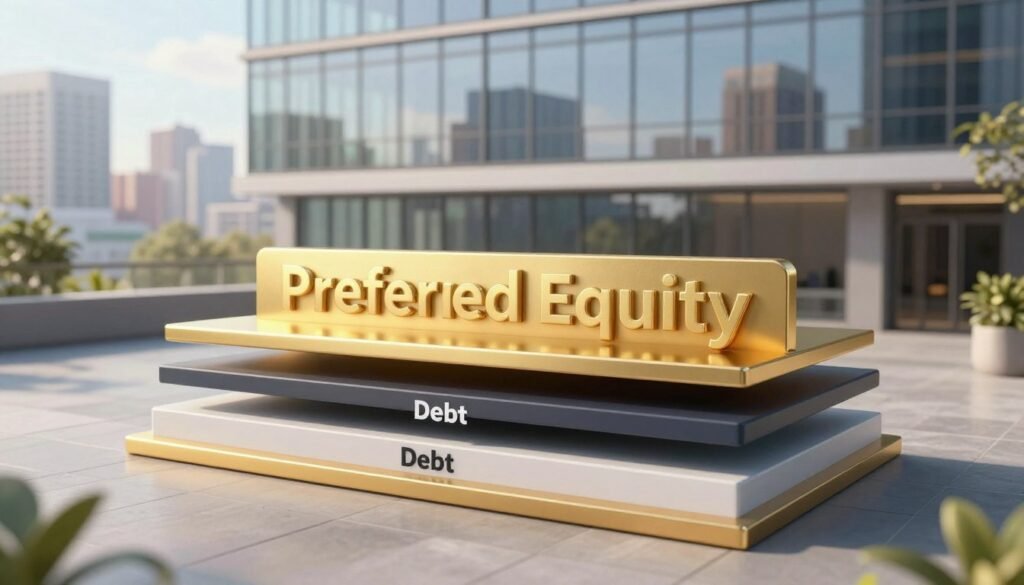
As interest rates go up, preferred equity is becoming key in the CRE capital stack. It’s a mix of benefits for investors and developers, making it popular now.
Advantages in the Current Market
Preferred equity has many pluses today. It gives higher returns than usual financing and helps fill gaps between senior debt and common equity. Experts say, “It’s a top choice for investors wanting high returns with less risk.”
Structuring Considerations
When setting up preferred equity, several things matter. These include return hurdles, promote structures, and exit strategies. Investors need to agree on these to meet their goals.
Return Hurdles and Promote Structures
Return hurdles and promote structures are key in preferred equity. A return hurdle is the minimum needed for an investment to work. Promote structures show how profits are split. A good promote structure can boost investor earnings.
Exit Strategies for Preferred Equity Investors
Having a clear exit plan is crucial for preferred equity investors. This could be through a sale, recapitalization, or other ways to get money out. Investors must think about the market, property performance, and more when picking the best exit.
In summary, preferred equity is essential in the CRE capital stack, offering a flexible option in a rising rate world. By knowing its benefits and how to structure it, investors can make the most of this changing market.
Common Equity Strategies Amid Rate Volatility
Investors in common equity are changing their ways due to rate changes. The rising interest rates are affecting commercial real estate (CRE) in many ways. This includes how investors think and how joint ventures are set up.
Investor Expectations and Returns
Investor hopes are changing because of the rising interest rates. Increased volatility makes investors more careful. They look for ways to reduce losses while still getting good returns.
The cost of capital is very important for investors. When interest rates go up, borrowing costs rise. This means investors want higher returns to make up for the extra risk.
| Factor | Impact on Investor Expectations | Potential Strategies |
|---|---|---|
| Rising Interest Rates | Increased return expectations | Focus on assets with strong cash flow |
| Volatility | More cautious investment approach | Diversification across asset classes |
Joint Venture Structures in the New Normal
Joint ventures are still a big deal for common equity investors in CRE. They help share risks and get more capital. But, the rising rate environment is making them rethink how these ventures are set up.
GP/LP Alignment Challenges
One big issue in joint ventures is making sure GPs and LPs are on the same page. With rising interest rates, it’s harder. Different people might have different ideas about what’s fair and how to manage risks.
Waterfall Provisions Adjustments
Waterfall provisions, which decide how profits are split, might need to change. Negotiating these provisions is key. It helps make sure everyone gets a fair deal.
As CRE keeps changing, common equity investors need to stay quick on their feet. They must adjust their plans to deal with the ups and downs of rate volatility.
How Debt Service Coverage Ratios Are Changing
With interest rates going up, it’s key for investors and lenders to understand the changes in debt service coverage ratios. The debt service coverage ratio (DSCR) is a key tool lenders use. It compares a property’s net operating income (NOI) to its debt service payments.
DSCR Calculation in Higher Rate Environments
In a rising rate environment, calculating DSCR gets more complicated. Higher interest rates mean borrowing costs go up. This can lower DSCR if NOI doesn’t grow fast enough. For example, a 1% rise in interest rates can make a good investment seem less appealing.
Let’s look at an example:
| Interest Rate | Debt Service | NOI | DSCR |
|---|---|---|---|
| 4% | $100,000 | $120,000 | 1.20 |
| 5% | $110,000 | $120,000 | 1.09 |
| 6% | $120,000 | $120,000 | 1.00 |
Implications for Refinancing Existing Properties
Rising interest rates make refinancing harder. As rates go up, DSCR can drop. This makes it tough to refinance. Lenders might ask for higher DSCRs to cover the increased risk.
Strategies to Improve DSCR
To boost DSCR, property owners can try a few things:
- Boost NOI by adjusting rents or cutting costs
- Refinance to a longer term to lower annual debt service
- Add more equity to reduce the loan amount
Lender Expectations vs. Reality
Lenders often have high DSCR expectations, but reality can differ in a rising rate world. They might expect a certain DSCR, but rates can quickly change this. An expert noted:
“In a rising rate environment, lenders need to be more flexible with their DSCR requirements. Borrowers can’t always control the NOI, and rising rates can quickly impact their ability to service debt.”
As shown in the table, even a small rate increase can hurt DSCR. Owners and lenders must find new ways to keep DSCR healthy in these times.
Cap Rate Expansion and Valuation Impacts
Interest rates are going up, and this affects cap rates and property values. It’s key for investors to understand these changes. The commercial real estate market is changing a lot because of these rising rates.
The Relationship Between Interest Rates and Cap Rates
Understanding how interest rates and cap rates relate is crucial. Cap rates are influenced by interest rates. When interest rates go up, cap rates do too, which can lower property values.
Asset Class Variations in Cap Rate Response
Not all property types react the same to rate changes. For example, multifamily properties might keep their cap rates steady. But office buildings might not. Knowing these differences helps investors make better choices.
Compression vs. Expansion Factors
Cap rate compression happens when rates drop, often due to high demand. On the other hand, cap rate expansion occurs when rates go up, usually because of rising interest rates or lower demand. Investors need to think about these factors when looking at investments.
Valuation Methodologies in Uncertain Markets
In uncertain times, how we value properties matters a lot. Investors might need to change their valuation methods because of rate changes. They might use different methods to get a full picture of a property’s worth.
CRE Capital Markets: Liquidity and Transaction Volume
As interest rates go up, the CRE capital markets are changing. This affects how investors want to invest and how much capital is available. It’s making a big difference in how much is being traded in the commercial real estate world.
Changing Investor Appetite
Investors are now looking at CRE differently because of higher interest rates. They want investments that give better returns and are more stable. They’re looking for properties with solid foundations and growth potential.
Risk aversion is growing. Investors are choosing properties in top locations and of high quality. This is causing a flight to quality, where money is going to safer, more resilient assets.
Debt and Equity Capital Availability
The rise in interest rates is affecting how much debt and equity capital is available. Lenders are being more careful, making it harder for borrowers to get loans. This is harder for properties with low occupancy rates or in secondary markets.
On the equity side, investors are seeking strong returns despite the rates. There’s a growing interest in value-add strategies. This means investors are looking to increase property value through redevelopment or repositioning.
Public vs. Private Market Dynamics
The changes in interest rates are also affecting public and private CRE markets. Public markets, like REITs, are seeing ups and downs as investors adjust to rate hikes. Private markets are seeing a shift in investor interest. Some prefer the transparency and liquidity of public markets. Others like the flexibility and potential for higher returns in private markets.
Cross-Border Capital Flows
Global economic conditions and interest rate differences are impacting cross-border capital flows. Investors from countries with lower interest rates are looking for higher yields in the U.S. CRE market. But, this flow is affected by currency exchange rates and global economic stability.
The current state of CRE capital markets is shaped by these factors. It has big implications for liquidity, transaction volume, and the availability of capital for commercial real estate projects.
Refinancing Challenges and Strategies
Rising interest rates are making refinancing tough for CRE owners. As rates go up, the hurdles to refinancing grow bigger.
Dealing with the Wall of Maturities
CRE investors face a big worry: the “wall of maturities.” Loans from the low-rate days are now due, and refinancing at higher rates is a reality. This raises debt costs and can hurt cash flow.
A recent report shows many CRE loans will mature soon. This makes refinancing a big challenge.
Creative Refinancing Solutions
CRE owners are looking at new ways to refinance. Two strategies are becoming popular:
Loan Modifications and Extensions
Modifying or extending loans can offer short-term help. It adjusts terms or pushes back the due date. This can ease cash flow worries.
Recapitalization Strategies
Recapitalization means adding new money or changing the capital mix. It can improve a property’s finances and make it more appealing to lenders.
“In the current market, creative financing solutions are becoming increasingly important for CRE owners looking to navigate the refinancing landscape.”
Here’s a look at refinancing options:
| Strategy | Benefits | Challenges |
|---|---|---|
| Loan Modifications | Temporary relief, flexible terms | Lender approval required |
| Recapitalization | Strengthens financial position, attracts new investors | Complex to execute, potential for ownership dilution |

By knowing the refinancing options and their effects, CRE owners can tackle the interest rate rise better.
Distressed Opportunities in the Capital Stack
With rising interest rates, investors see new chances in the CRE capital stack. The market is full of challenges and chances for those who know how to find them.
Identifying Value-Add Positions
More investors are searching for value-add spots in the distressed CRE market. They look for properties or investments that are not valued right or not doing well because of the economy.
| Investment Type | Potential Return | Risk Level |
|---|---|---|
| Distressed Debt | 12-15% | High |
| Preferred Equity | 10-12% | Medium |
| Opportunistic Equity | 15-20% | Very High |
Risk Mitigation Approaches
To deal with the risks of distressed investments, investors use several methods. These include note acquisitions and rescue capital deployment.
Note Acquisitions Strategy
Buying distressed debt at a lower price can be very profitable. This means buying loans for less money, hoping to make a lot if the loan is changed or the property is improved.
Rescue Capital Deployment
Helping struggling projects with capital can also be smart. By adding money to projects that are just having a tough time, investors can get a big share or control. This way, they can make a lot when the market gets better.
Alternative Financing Sources Gaining Traction
As interest rates go up, new financing options are becoming more popular in the commercial real estate (CRE) market. This change is because people need flexible and creative ways to finance. These solutions help them deal with the changing economic scene.
Private Debt Funds and Their Role
Private debt funds are now big players in CRE financing. They offer flexible capital solutions that fit the needs of borrowers. These funds are great for investors who want to dive into CRE without the usual bank rules.
- Provide financing for projects that may not meet traditional bank criteria
- Offer more flexible terms and structures
- Can close deals more quickly than traditional lenders
Insurance Companies and Other Non-Bank Lenders
Insurance companies and other non-bank lenders are also key in CRE financing. They like the stable, long-term returns CRE investments offer. Insurance companies, in particular, are big debt capital providers for CRE projects.
Debt Funds vs. Traditional Bank Financing
The rise of debt funds has changed CRE financing, offering a new choice to traditional bank loans. The main differences are:
- Flexibility in loan structuring
- Speed of execution
- Risk appetite
CMBS Market Adaptations
The CMBS market has also changed to keep up. It faces challenges but still offers new financing chances. Recent changes include:
- Increased focus on loan quality
- Enhanced underwriting standards
- More diverse investor base
In conclusion, new financing options are changing the CRE market. Private debt funds, insurance companies, and other non-bank lenders are opening up new financing paths. They do this because of the need for flexibility and creativity in a rising rate world.
Technology’s Role in Capital Stack Management
Technology is changing how we manage the CRE capital stack. PropTech, data analytics, AI, and digital capital markets are making a big difference. They are changing how we raise capital and make investments.
PropTech Solutions for Capital Raising
PropTech is key in raising capital. It offers new platforms for investing in property and crowdfunding. This lets more investors join CRE projects.
Data Analytics for Investment Decision-Making
Data analytics helps make better investment choices. It gives insights into market trends, property performance, and risk. Advanced tools help investors make smart decisions.
AI and Machine Learning Applications
AI and machine learning predict market trends and optimize property values. They also find new investment chances. These technologies make investment choices more accurate and efficient.
Digital Capital Markets Platforms
Digital capital markets platforms make raising capital and investing easier. They offer a clear and efficient way to connect investors with CRE opportunities.
| Technology | Application | Benefit |
|---|---|---|
| PropTech | Capital Raising Platforms | Increased accessibility for investors |
| Data Analytics | Market Trend Analysis | Informed investment decisions |
| AI and Machine Learning | Predictive Modeling | Improved accuracy in investment decisions |
Asset Class Winners and Losers
Rising interest rates are changing the commercial real estate world. This change makes some asset classes winners and others losers. The market is showing different performances, with some sectors doing well and others facing big challenges.
Multifamily and Industrial Resilience
The multifamily and industrial sectors are doing well despite rising interest rates. Multifamily properties are in demand because of housing needs and lifestyle changes. The industrial sector is growing thanks to e-commerce, needing more logistics and distribution spaces.
These sectors are resilient because they have steady cash flow. Multifamily properties keep their occupancy rates high. Industrial properties have long-term leases, which helps them.
Office and Retail Challenges
The office and retail sectors are struggling. Remote work has reduced office space demand. Retail is facing challenges from e-commerce, affecting brick-and-mortar stores. Adapting to these changes is key for investors and owners in these sectors.
Niche Sectors Performance
Niche sectors like data centers and self-storage facilities are doing well. Data centers are growing with cloud computing. Self-storage facilities are in demand due to urbanization and lifestyle changes.
Adaptive Reuse Opportunities
Adaptive reuse is a good strategy for underperforming assets. Turning old office or retail spaces into new uses like homes, coworking spaces, or mixed-use developments can add value. This approach not only breathes new life into properties but also meets current market needs.
| Asset Class | Performance | Key Drivers |
|---|---|---|
| Multifamily | Resilient | Demographic trends, housing demand |
| Industrial | Strong | E-commerce growth, logistics demand |
| Office | Challenged | Remote work, reduced demand |
| Retail | Challenged | E-commerce impact, changing consumer behavior |
Geographic Variations in Capital Stack Adjustments
Geographic variations in capital stack adjustments are becoming more clear. Regional economic factors are playing a big role in investment choices. The commercial real estate (CRE) scene is changing in different ways across various regions.
Gateway Markets vs. Secondary/Tertiary Markets
Gateway markets like New York, Los Angeles, and San Francisco have high liquidity and a seasoned investor base. Secondary and tertiary markets, on the other hand, have different capital stack dynamics. Investors in these markets must adapt their strategies to the local conditions, considering population growth, job markets, and infrastructure development.
Regional Economic Factors Influencing Capital
Regional economic factors are key in shaping the CRE capital stack. Local economic growth, industry diversification, and demographic trends all affect capital availability and cost.
Sunbelt Growth and Capital Flows
The Sunbelt region has seen rapid growth lately. This is due to a good business climate, population increase, and infrastructure investments. Markets like Miami, Austin, and Phoenix are drawing in a lot of capital.
Coastal Markets Recalibration
Coastal markets are also changing, as investors reevaluate risks and opportunities in high-cost areas. This shift is leading to a more careful approach to capital stack adjustments. A focus on selective investments in high-quality assets is emerging.
Conclusion
Rising interest rates are changing the CRE capital stack a lot. This affects many people and how they invest. The changes are happening in senior debt, mezzanine financing, preferred equity, and common equity.
The current interest rates are also changing loan terms and prices. Investors need to find ways to make the most of these changes. The CRE Capital Markets are shifting, affecting both debt and equity availability.
To do well, investors and developers must keep up with the capital stack changes. They need to understand how cap rate changes and valuation impacts work. They also need to know about alternative financing options. By adjusting to these changes, they can find new opportunities in the CRE market.
As the CRE world keeps changing, it’s important to stay updated. Knowing about interest rates, capital stack changes, and market trends is key. This way, investors can make smart choices and reach their goals in the CRE Capital Markets.