
In short
Buying commercial property with no money down is possible when another source supplies the equity, collateral, or seller credit, but it does not mean the purchase has no capital requirement or no risk. The most realistic routes are seller financing, equity partners, pledged collateral, eligible SBA owner-user financing, assumptions, and lease-option agreements.
- A zero-down deal usually means the buyer is not bringing a conventional cash down payment, not that the transaction needs no money.
- Seller financing can replace part or all of a bank loan, but the seller will usually expect interest, security, and clear default remedies.
- A partner can provide equity, but the operating agreement must define ownership, control, distributions, guarantees, and exit rights.
- SBA 504 financing is for eligible owner-occupied business property, not passive investment in rental real estate, and commonly includes at least a 10% borrower contribution.
- Due diligence, deposits, legal work, reserves, repairs, and lender fees can still require cash even when the purchase down payment is reduced.
Table of contents
- Can you actually buy commercial property with no money down?
- What does “no money down” actually mean?
- Which low-cash structures can actually close a commercial purchase?
- Can SBA financing eliminate the down payment?
- What costs still need cash even if the down payment is zero?
- How do you decide whether a low-cash structure is worth the risk?
- What should you prepare before asking a lender or seller?
- Frequently asked questions
Can you actually buy commercial property with no money down?
Yes, but a commercial property purchase still needs a credible capital stack: debt, equity, seller credit, collateral, or a combination of them. The real question is not whether money disappears, but who provides it and what they receive in return.
A conventional lender may want a borrower contribution because it aligns the buyer's incentives with the loan. If the buyer does not provide that contribution in cash, the gap has to be addressed through a seller note, a partner's equity, existing collateral, or a lender-approved structure.
That distinction matters because each option changes the risk. A partner reduces your personal cash requirement but shares the upside. Cross-collateral may preserve cash but puts another asset at risk. Seller financing can improve flexibility but may create a large balloon payment.
The right framing is: no personal cash down can be possible, but no-cost commercial real estate is not.
What does “no money down” actually mean?

“No money down” can mean no cash from the buyer at closing, no conventional down payment, or no cash contribution beyond fees and reserves. These are different claims, and treating them as interchangeable is where many weak deals begin.
A buyer may contribute no cash because a partner funds the equity. That is not a zero-equity transaction. A buyer may use another property as collateral. That is not a no-risk transaction. A buyer may obtain seller financing for the full price. That is not a no-payment transaction.
Before pursuing any structure, write down four figures:
- Purchase price: What the seller will receive for the property.
- Total project cost: Purchase price plus lender fees, legal costs, inspections, environmental work, repairs, tenant improvements, and reserves.
- Cash at closing: Funds required before ownership transfers.
- Capital sources: Senior debt, seller debt, partner equity, pledged collateral, and your own cash.
A deal is only truly low-cash if its sources cover the full project cost without leaving an unfunded obligation or an unrealistic refinance assumption.
Which low-cash structures can actually close a commercial purchase?
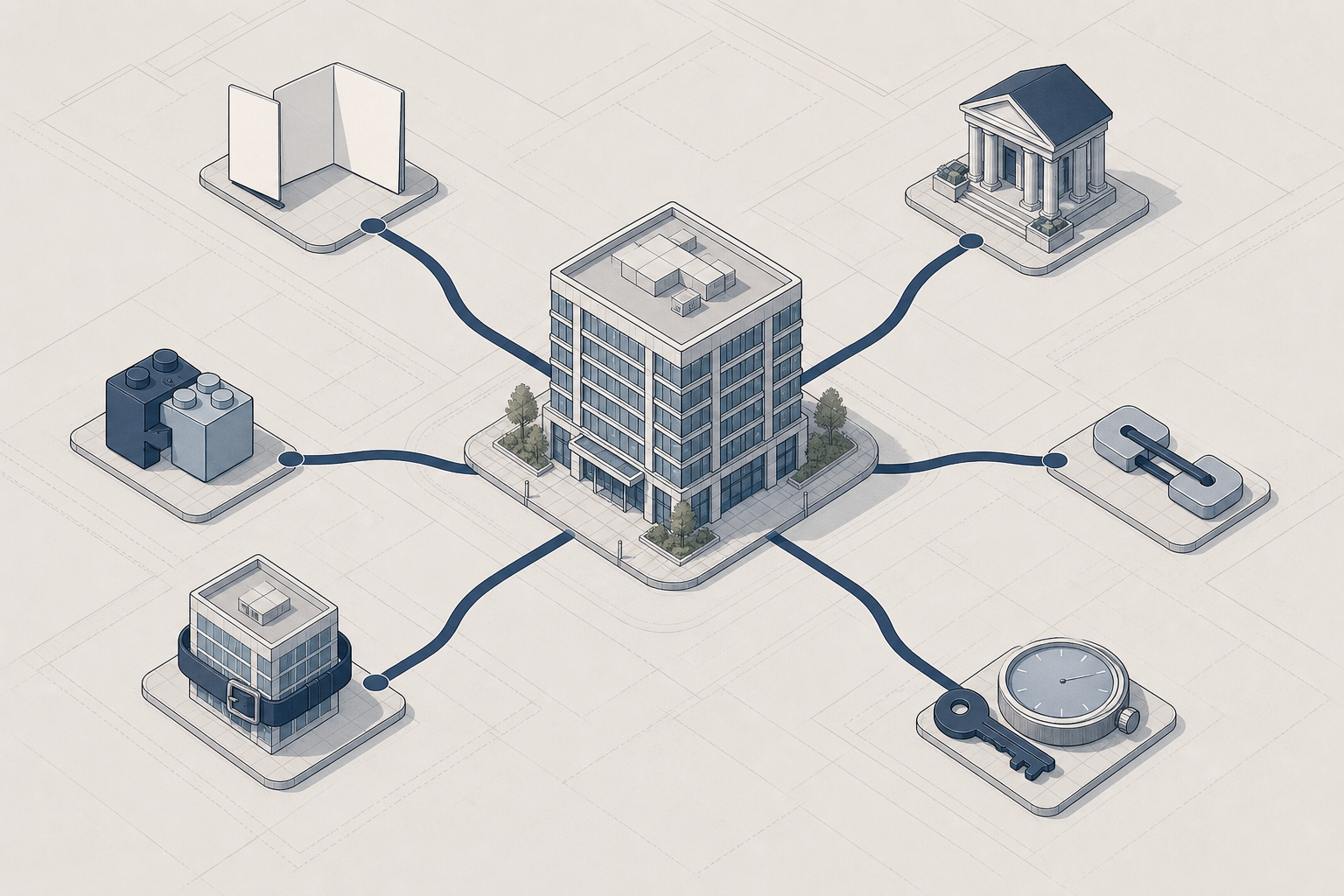
The structures below can reduce the buyer's cash requirement when the property, borrower, and transaction support them. None is automatic, and each needs terms that a lender, seller, and legal adviser can accept.
1. Seller financing or a seller carry note
The seller becomes part of the financing plan by carrying a note for some or all of the price. A seller carry note may sit behind a senior lender, replace the bank loan entirely, or bridge the difference between the senior loan and the total cost.
The important questions are practical: Is the seller note subordinate to the senior lender? What interest rate and amortization apply? Is there a balloon payment? Can the seller foreclose if the buyer defaults? A seller note can reduce closing cash, but it can also make future refinancing harder if the payment burden is too high.
2. An equity partner or joint venture
An equity partner contributes cash in exchange for ownership, preferred returns, decision rights, or a combination of these. This can work when one party has a strong deal, operating plan, or property-management capability and the other has capital.
Do not rely on a handshake. The agreement should state who signs guarantees, how cash flow is distributed, who approves refinancing or a sale, what happens when additional capital is needed, and how either party can exit.
3. Cross-collateral or a pledge of another asset
A borrower who owns another property, marketable assets, or a cash-equivalent account may be able to offer additional collateral instead of providing a larger cash contribution. The lender decides whether the additional collateral is sufficient and how it affects loan terms.
This can preserve liquidity, but it expands the downside. If the acquired property underperforms, the lender may have claims against the additional pledged asset. Borrowers should also understand whether the loan is recourse. This recourse vs non-recourse guide explains why the liability language matters as much as the down payment.
4. SBA 7(a) financing for an operating business
The SBA's 7(a) program can be used to acquire, refinance, or improve real estate and buildings, subject to program eligibility and lender underwriting. SBA describes 7(a) as a lender-delivered program, not direct government lending, and lenders still assess creditworthiness, repayment ability, cash flow, equity, and collateral. (sba.gov)
A 7(a) loan is not a universal zero-down loan. For certain uses, including complete changes of ownership above $500,000, SBA policy requires a 10% equity injection, while other transactions may follow lender policies for comparable conventional loans. Current SBA policy is contained in SOP 50 10 8.1, effective October 1, 2026, so borrowers should confirm the rule applicable to their specific transaction before making an offer. (legacy.sba.gov)
For an owner-user acquisition, see this guide to SBA and conventional debt for owner-occupied buildings before treating SBA financing as a substitute for investor-property financing.
5. Assumption of existing debt
A buyer may seek to assume the seller's existing loan if the loan documents permit it and the lender approves the new borrower. This can reduce the need to originate an entirely new senior loan, particularly when existing financing has favorable terms.
Assumption is not simply taking over payments informally. The lender must review the borrower, the property, and the legal transfer. The buyer also needs to confirm whether the seller remains liable after closing and whether the assumed debt leaves enough proceeds to satisfy the seller's price expectations.
6. A lease option or purchase option
A lease option gives a prospective buyer control of a property for a defined period and a contractual right, but not an obligation, to purchase later. It can create time to improve operations, secure tenants, or build a financing record before the purchase.
A lease option is not an acquisition at signing. The option price, option fee, rent credits, maintenance obligations, recording rights, and expiration date need careful legal review. If financing is unavailable when the option expires, the buyer may lose the option payment and any value created under the agreement.
The best low-cash structure is the one that funds the purchase honestly without creating a repayment, control, or liability problem that the property cannot support.
Can SBA financing eliminate the down payment?
SBA financing can lower the equity needed for eligible owner-occupied commercial property, but it should not be described as a blanket no-money-down solution. The SBA 504 program is designed for major fixed assets used by eligible operating businesses and cannot be used for speculation or investment in rental real estate. (sba.gov)
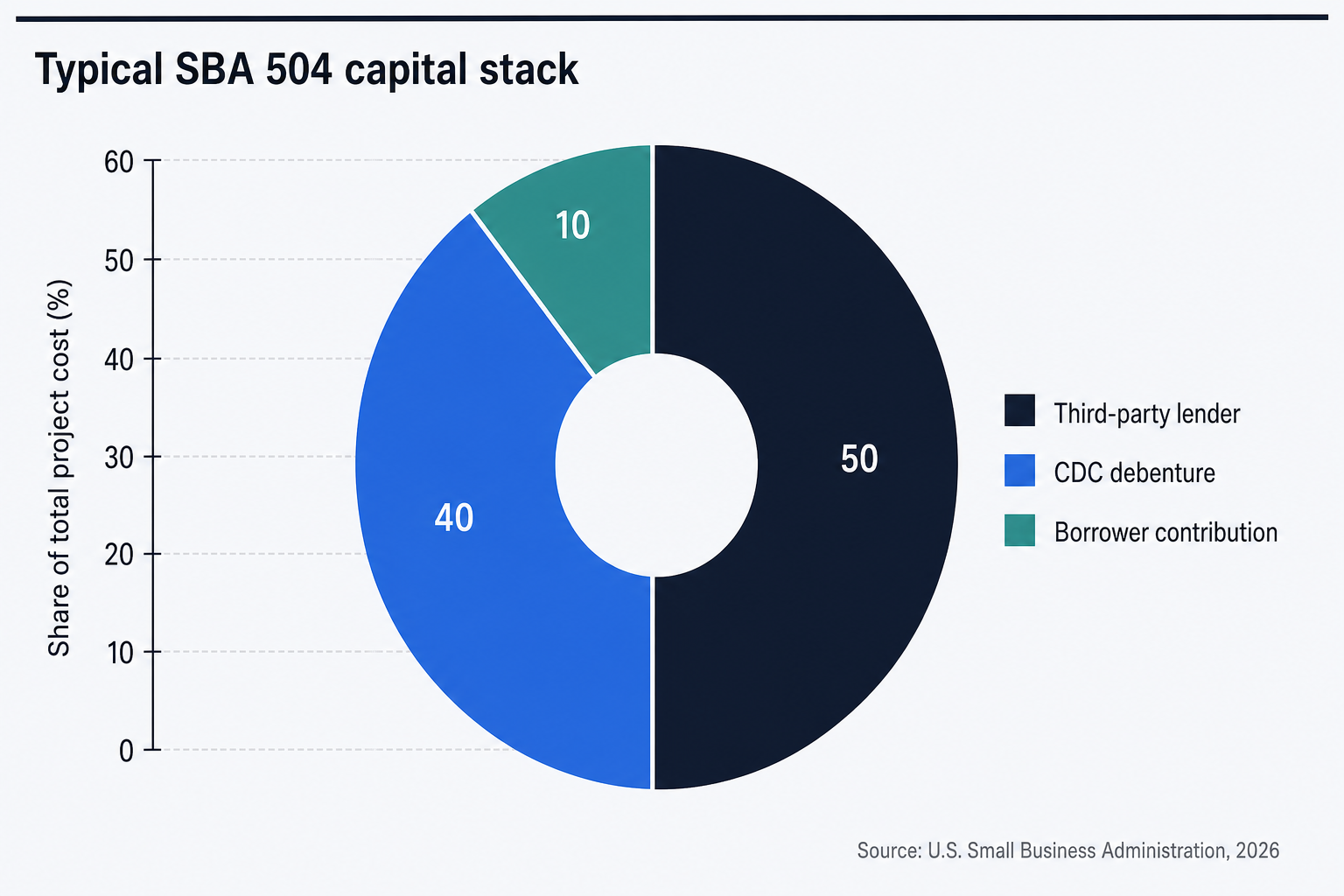
For a standard 504 project, SBA materials describe a capital stack in which a third-party lender provides at least 50%, a CDC-backed debenture provides up to 40%, and the borrower contributes at least 10%. Some projects require a larger borrower contribution based on factors such as the business or property type. (legacy.sba.gov)
Occupancy matters. SBA documents describe at least 51% occupancy for certain existing-building projects and at least 60% occupancy for certain new-construction projects, with additional requirements for space not immediately occupied. Confirm the current rule and the transaction structure with the lender or Certified Development Company because SBA policy can change. (catweb2.sba.gov)
SBA financing can reduce the cash requirement for a qualifying business owner who will occupy the property, but it does not turn a passive commercial investment into an eligible owner-user transaction.
What costs still need cash even if the down payment is zero?

A zero-down agreement does not remove the cost of proving that the building is financeable, transferable, insurable, and suitable for the planned use. Buyers should budget separately for both closing costs and post-closing liquidity.
Common costs include:
- Earnest money or an option fee
- Property inspection and engineering reports
- Phase I environmental assessment and, if needed, further environmental work
- Appraisal, survey, title insurance, and lender legal fees
- Entity formation, partnership, and purchase-agreement legal costs
- Insurance deposits, utility transfers, repairs, tenant improvements, and working-capital reserves
A seller may agree to credit some expenses, and a partner may fund them, but someone must pay them. A buyer who cannot cover diligence costs may be unable to reach closing even with a full-price seller note.
This is why a credible offer begins with underwriting. A commercial property financing guide can help frame the loan, equity, and documentation questions before terms are negotiated.
The cash you preserve at closing is useful only if the deal still has enough money for diligence, repairs, debt service, and operating reserves.
How do you decide whether a low-cash structure is worth the risk?
A low-cash purchase is worth considering only when the property can support its debt and the buyer can survive the downside case. If the structure works only when rents rise quickly, refinancing is easy, or no repairs appear, it is speculation rather than a financing plan.
Test the structure against these questions:
| Question | Why it matters |
|---|---|
| Can property and business cash flow cover every required payment? | Senior debt, seller debt, preferred returns, and reserves may all compete for cash flow. |
| What happens when the seller note matures? | A balloon payment can force a refinance or sale at an unfavorable time. |
| Who guarantees the debt? | A partner's cash contribution does not necessarily remove your personal liability. |
| What collateral is at risk? | Cross-collateral can expose assets beyond the acquired property. |
| Who controls major decisions? | Partnership disputes often arise over capital calls, leasing, refinancing, and sale timing. |
| Is there a realistic exit? | Underwrite a refinance, sale, or long-term hold using conservative assumptions. |
Do not confuse a smaller initial cash contribution with a lower total cost. Seller interest, profit-sharing, partner returns, or additional collateral can be more expensive than an ordinary down payment.
A low-cash structure is sound only when its payment obligations, guarantees, and exit plan still work under conservative assumptions.
What should you prepare before asking a lender or seller?
A lender or seller is more likely to consider an unconventional structure when the buyer presents a complete, testable plan. Bring the numbers before requesting flexibility.
Prepare:
- A purchase price and sources-and-uses schedule.
- Trailing property income and expense statements, current rent roll, and lease summaries where applicable.
- A realistic property valuation, not just the asking price.
- Personal financial statements, entity documents, tax returns, and evidence of available reserves.
- A concise explanation of the operating plan, including occupancy, repairs, and management.
- Draft terms for any seller note, partner contribution, or collateral pledge.
- A downside case showing what happens if revenue falls, repairs cost more, or refinancing takes longer.
For time-sensitive or transitional purchases, compare permanent financing with short-term debt carefully. This explanation of commercial mortgages versus bridge financing can help identify when speed creates a separate refinancing risk.
When the capital stack is clear, a commercial financing professional can assess lender fit, identify conflicts among the proposed sources, and help determine whether the deal needs more equity rather than more complexity. Request a commercial financing conversation with Thorne CRE when the property, business plan, and sources of capital are ready for review.
The best first step is not finding a creative label for the deal; it is proving that every dollar, payment, guarantee, and exit path has been accounted for.
Frequently asked questions
Can you get a commercial real estate loan with no money down?
A commercial real estate loan with no money down is possible in limited cases, but lenders usually require another form of support, such as seller financing, an equity partner, additional collateral, or strong cash flow. SBA-backed financing can reduce required equity for eligible owner-occupied businesses, but it is not a universal zero-down product.
How much money do you need to buy commercial real estate?
The money needed to buy commercial real estate depends on the purchase price, lender requirements, property condition, and deal structure. Even when a buyer avoids a conventional down payment, cash may still be needed for earnest money, inspections, appraisal, environmental diligence, legal fees, insurance deposits, repairs, and operating reserves.
How to avoid 20% down payment on investment property?
To avoid a 20% down payment on commercial investment property, a buyer may use seller financing, partner equity, extra collateral, or an assumption approved by the existing lender. Each alternative shifts risk rather than eliminating it, so the buyer should compare total payments, guarantees, collateral exposure, and the refinance plan before proceeding.
What is the 2% rule in commercial real estate?
The 2% rule is a screening shortcut often associated with residential rental investing, comparing monthly rent with purchase price. It is not a commercial real estate lending rule. Commercial lenders focus more directly on net operating income, debt service, lease quality, property condition, borrower strength, and the durability of cash flow.
The useful question is not whether a structure sounds creative, but whether the building, business, and capital sources can carry the obligations after closing.
Choose the capital structure before making an offer
A commercial property can be acquired with little or no personal cash down, but the strongest transactions make the hidden trade-offs visible before the contract is signed. If the capital stack requires seller debt, partner equity, or pledged collateral, make sure the documents, payment obligations, and exit plan are as solid as the purchase price.