


Surprising fact: CHIPS-era reindustrialization examples show public funds often make up a small share yet unlock multiples of private capital, accelerating major project timelines.
This guide explains how an institutional approach to a New York Capital Stack creates execution certainty for city and statewide commercial real estate deals. It is written for sponsors, owners, and operators evaluating acquisition, construction, and transitional financing choices.
Expect an actionable, sponsor-facing primer that links capital stack basics to real structuring decisions in today’s market. We preview core layers — senior debt, mezzanine, preferred equity, and common equity — and show how they form repeatable financing playbooks across asset types.
New York’s market presents higher basis, tighter timelines, and many stakeholders, so underwriting can shift fast between term sheet and close. Modern projects are often stack-adjacent, where infrastructure, workforce, and public incentives shape feasibility and lender confidence.
Key Takeaways
- Institutional, layered financing can catalyze larger private investment and reduce execution risk.
- Core layers—senior debt, mezzanine, preferred, common—combine into repeatable playbooks.
- City and state deals demand faster underwriting and stakeholder coordination.
- Public incentives and infrastructure often change feasibility and proceeds.
- Later sections use CHIPS-era examples to show how outside funding derisks projects.
What a Capital Stack Means in Commercial Real Estate Financing
A capital stack is the layered financing map sponsors use to show who has priority, who bears first loss, and who owns upside.
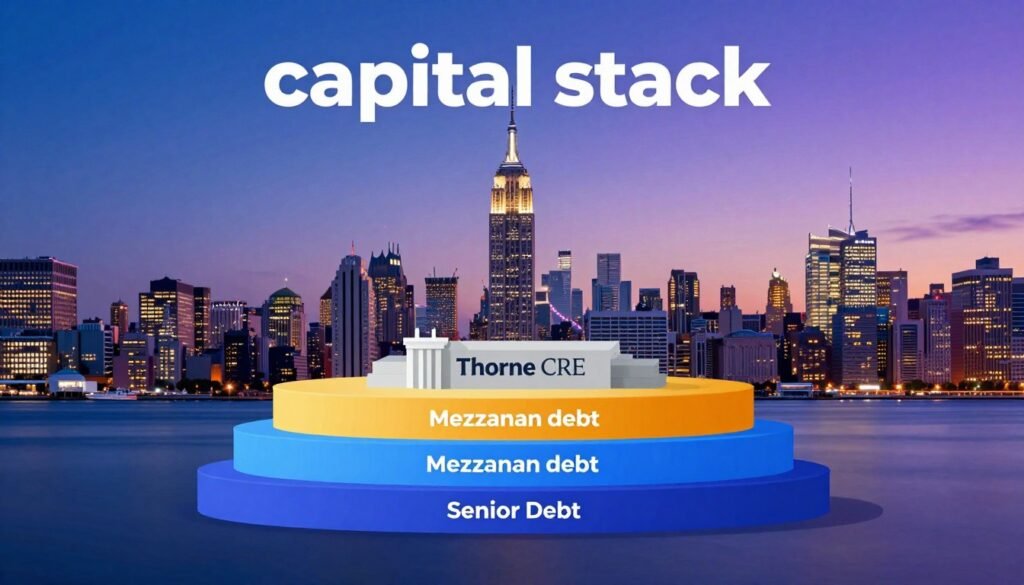
Understanding each layer helps sponsors translate underwriting inputs into real proceeds and governance outcomes.
How the layers interact
Senior debt establishes the floor for proceeds and the primary repayment obligation. Mezzanine and preferred fills gaps between senior claims and sponsor equity.
Common equity absorbs first loss but retains most of the upside at exit. Each tranche brings distinct documentation and covenant profiles.
Why cost and control shift by layer
The cost of capital rises as priority falls. Lenders with higher priority demand tighter covenants and greater consent rights.
Investors higher in risk accept less control but expect higher returns. Intercreditor terms allocate remedies and voting on key decisions.
How underwriting and credit shape the final structure
Underwriting inputs—NOI, DSCR, LTC/LTV, lease-up assumptions, recourse, and reserves—drive how much proceeds lenders will provide.
Credit committees and third-party reports (appraisal, ESA, engineering, cost review) often change sizing and pricing before close.
Quick comparison
| Layer | Risk Position | Typical Cost | Control & Docs |
|---|---|---|---|
| Senior debt | Lowest | Lowest coupon | Strict covenants; lender remedies |
| Mezzanine | Subordinate to senior | Higher yield | Intercreditor agreement; default cures |
| Preferred equity | Preferred over common | Fixed preferred return | Payment priority; limited control |
| Common equity | Highest / first loss | Return via appreciation | Sponsor control; residual upside |
Practical note: Different banks, agencies, debt funds, and preferred providers price risk differently, producing multiple viable stacks for a single asset. Sponsors should evaluate the entire stack as a system because one covenant tweak in senior debt can change mezz pricing, intercreditor terms, and total returns.
Why New York’s CRE Market Demands Institutional-Grade Capital Strategies
Successful deals in this region require financing plans that treat underwriting and execution as simultaneous tasks.

City versus statewide dynamics
Urban deals face denser tenants, stricter permits, and high replacement costs. Rural and suburban projects trade those constraints for longer entitlement paths and different infrastructure needs.
Execution timelines vary by asset type and geography, which changes lender comfort and the blend of debt and equity.
Construction and transition risks
Draw schedules, GMP reliability, and subcontractor availability create midstream funding gaps. Even small change orders can push timelines and increase interest carry.
“Execution risk, not just price, often determines whether financing closes on schedule.”
- Regulatory and labor complexity raise lender sensitivity.
- Higher costs and longer timelines increase contingency and equity needs.
- Transition plans generally need bridge financing and a clear takeout path.
| Risk Factor | Impact | Mitigation |
|---|---|---|
| Permitting & approvals | Schedule delays, higher soft costs | Early municipal engagement, realistic timelines |
| Labor & unions | Wage pressure, availability constraints | Union planning, contracted labor commitments |
| Cost overruns | Funding gaps, higher interest carry | GMP clauses, larger contingencies, staged equity |
Practical point: Sponsors who align lenders, contractors, and third-party reports before close reduce execution risk and improve investment outcomes. In this market, capital planning must be part of feasibility—not an afterthought.
New York Capital Stack: The Core Layers Sponsors Use to Finance Deals
A well-constructed financing plan turns underwriting assumptions into actionable proceeds and governance outcomes.
Senior debt options and when to use them
Banks suit stabilized core assets and offer speed when sponsor relationships and collateral are strong.
Agencies fit mission-aligned assets with longer terms and lower coupons but slower approval timelines.
CMBS/structured executions can deliver non-recourse capital for transit-oriented or stabilized properties, though lockup and prepayment terms differ.
Debt funds bridge tight timing or underwriting gaps, accepting higher yield for flexible covenants.
Proceeds, covenants, and sizing drivers
Proceeds reflect more than leverage targets. Underwriting haircuts, reserves, and how lenders size to in-place versus stabilized cash flow shape available funds.
Cash management and reserve lines carve into usable proceeds and affect interest carry during lease-up.
Mezzanine vs preferred equity
Mezzanine debt is efficient when sponsors accept subordination and a clear cure structure. It preserves preferred equity returns for lenders who want credit-like priority.
Preferred equity can be cleaner when avoiding intercreditor complexity. It offers payment priority without adding a lien, but often costs more.
Equity pacing and sponsor objectives
Plan equity checks across initial close, construction draws, tenant improvements, lease-up deficits, and potential capital calls.
Align objectives—control, speed, and long-term refi optionality—with return targets and lender covenants to prevent conflicts later.
| Senior Source | Best For | Speed | Typical Constraint |
|---|---|---|---|
| Banks | Stabilized, relationship-driven loans | Fast | Recourse options; detailed covenants |
| Agencies | Affordable housing, mission projects | Moderate | Longer approval; program compliance |
| CMBS / Structured | Large stabilized assets | Moderate | Prepayment penalties; rigid docs |
| Debt Funds | Timing gaps; complex overlays | Fast | Higher coupon; flexible covenants |
Before closing checklist: intercreditor terms, permitted transfers, supplemental financing flexibility, default triggers, and cure rights.
Credit conditions and fund mandates shift pricing and availability—so having multiple executable options is essential for sponsors pursuing institutional-quality capital stacks.
Public Capital as a Catalyst: What the CHIPS Act Reveals About Modern Capital Stacks
Targeted public funding often tips the economic math enough to turn borderline projects into bankable ones.
The CHIPS Act shows how modest federal commitments can unlock much larger private funds. Congress set aside $39B for production incentives, including about $6B in credit supports that enable up to $75B in loans. It also funds roughly $13B for R&D and $200M for workforce programs, plus a 25% investment tax credit.

How CHIPS maps into stack language
Grants and incentives reduce sponsor equity needs and improve returns. Credit supports function like partial loan guarantees, raising lender comfort.
Tax credits and R&D funds act as long-term value drivers that underwrite future cash flow and regional demand for industrial real estate.
“Even a small federal share can change lender sizing and pricing by reducing execution and market risk.”
Why a small share matters
Federal funds are often a limited share of total capitalization. Yet that share acts as a catalyst: it lowers perceived downside, shortens diligence timelines, and boosts sponsor liquidity.
Infrastructure commitments—utilities, water, transportation—play like off-balance-sheet credit enhancement by cutting permit and construction risk. Workforce programs matter too: labor availability affects schedule, ramp, and stabilized income that lenders and investors price tightly.
| Public Tool | Form | Effect on Financing | CRE Translation |
|---|---|---|---|
| Production incentives | Grants / rebates | Reduces upfront equity | Lowers required sponsor checks |
| Credit supports | Loan guarantees / direct loans | Improves lender capacity | Raises senior proceeds; cheaper debt |
| R&D funds | Grants; ecosystem spending | Boosts long-term demand | Supports supplier facilities and logistics |
| Workforce programs | Training grants | Reduces schedule and ramp risk | Improves underwriting of stabilized cash flow |
Practical takeaway: For sponsors, the CHIPS example underlines a simple rule—layer incentives, credit supports, and private capital so each element reduces a specific risk. That approach turns policy programs into real funding levers that make projects executable and more investable.
Case Study Spotlight: Micron’s New York Investment and Its Layered Funding Stack
Micron’s Clay project shows how large industrial investments layer corporate cash with public incentives to solve scale and timing risk.

Scale and sources
Corporate capital anchors the financing: Micron’s announced $100B program is backed by balance sheet investment.
Federal direct funding (~$4.6B allocated locally) and proposed CHIPS loans (~$7.5B) supplement that equity and improve lender appetite.
State incentives and cost impact
State tax credits (5% on qualified capital; 7.5% on eligible labor) can shave material costs over years.
Estimated savings could approach $5.5B, changing how much private financing the sponsor needs.
Infrastructure, workforce, and ecosystem
Public commitments for site readiness ($200M plus land support) reduce execution risk and speed permitting and utility buildout.
Workforce funds and training programs link directly to ramp timing, which affects when stabilized cash flow appears — and how lenders size debt.
“Braiding public and private funds can unlock projects, but it adds compliance, reporting, and timing complexity that must be planned.”
| Component | Form | CRE Effect |
|---|---|---|
| Federal CHIPS | Direct grants & proposed loans | Raises senior proceeds; lowers sponsor equity |
| State credits | Investment & labor tax credits | Reduces long-term costs; alters capex sizing |
| Infrastructure | Public commitments & land | Improves site readiness; shortens schedules |
| Workforce & R&D | Training funds; R&D partnerships | Supports ramp; creates regional demand opportunities |
CRE sponsor lesson: Treat every credible source of capital as a timeline-driven funding item. Size equity, debt, and compliance plans to match draw schedules and reporting windows. Even smaller projects benefit from this discipline.
Structuring a Capital Stack for New York Construction, Acquisition, and Transition Projects
When sponsors plan construction and transition financing, early sequencing of takeout options preserves optionality and controls timing risk.
Construction financing strategies should match lender type to project stage. Choose banks for speed on stabilized assets, debt funds for flexible terms during complex buildouts, and agency or HUD takes for long-term permanence.
Construction planning and takeout timing
Start takeout planning before closing. The underwriting handoff—pro forma to in-place performance—drives permanent eligibility and affects contingency sizing.
Bridge-to-permanent sequencing
Manage timing risk by building extension options, clear DSCR tests, and operational milestones into documents. Identify the trigger events that move a loan from bridge to permanent.
Reducing execution friction
Align appraisers, engineers, cost consultants, and municipalities early to shorten reviews and avoid stop-work surprises.
Common lender requirements include cash management, leasing covenants, approved budgets, change-order thresholds, and regular sponsor reporting. Clean documentation preserves optionality across multiple stacks.
| Item | Action | Effect on Financing |
|---|---|---|
| Lender type | Match to stage (bank, fund, agency) | Speed vs. flexibility |
| Draw mechanics | Define milestones, inspections | Controls disbursement; reduces cost overruns |
| Contingency & reserves | Size to risk and permit timelines | Protects debt service during delays |
| Takeout plan | Document exit criteria early | Reduces timing risk; improves pricing |
For an actionable framework and deeper methods to sequence funds and documentation, see this capital stack guide.
Risk, Resilience, and Underwriting: What Can Break a New York Capital Stack
A resilient financing plan anticipates how delays, cost spikes, and policy shifts cascade through every layer of funding.
Construction schedule and cost cascade
Schedule slips raise interest carry and lender exposure. Delays extend draw periods, increase reserve burn, and can trigger covenant breaches or extension fees.
Cost overruns often force fresh equity checks or re-trades with mezzanine and preferred providers. In extreme cases, sponsors lose control after a restructuring.
Labor, stabilization, and refinance timing
Workforce shortages slow both buildout and lease-up. That timing drag weakens DSCR and delays refi events, tightening options for senior debt and credit providers.
Infrastructure and hard feasibility limits
Utilities, water, power, and transport are binary constraints: inadequate capacity can make otherwise modelled projects unfinanceable regardless of returns.
Policy, programs, and funding uncertainty
Incentive revisions or compliance costs can shift the public share of investments. Underwrite conservatively and build backup funding scenarios.
Mitigation tactics include higher contingencies, phased scopes, strong GMP terms, interest reserves, and strict sponsor reporting and approval processes.
Healthcare projects are especially sensitive: operational rules and licensing amplify fragility, so lenders demand deeper diligence and larger reserves.
“Resilient stacks survive rate moves, delays, and compliance changes across multi-year plans.”
| Risk | Effect | Mitigation |
|---|---|---|
| Schedule delay | Higher carry; covenant risk | Interest reserve; milestone-based draws |
| Cost overrun | Equity calls; restructure | Contingency; GMP; insurance |
| Infrastructure gap | Unfinanceable | Site diligence; utility agreements |
Conclusion
A thoughtful financing plan ties each funding source to a clear execution milestone and downside cushion.
The core takeaway: there is no single template for a successful capital approach. Match structure to asset risk, timeline, and sponsor priorities so proceeds and covenants align with real-world execution.
Layer-by-layer logic matters. Use senior debt to set base leverage, mezzanine or preferred to fill gaps, and size equity to absorb volatility. That mix balances return, control, and speed of close.
Targeted public credit supports and incentives act as a catalyst. The CHIPS-era examples show modest federal shares can change lender appetite and unlock larger private investment pools.
Before committing, pressure-test the plan against delays, cost spikes, and slower lease-up. Sector nuances—especially in healthcare—affect underwriting, covenants, and required checks. Well-structured funds and financing unlock lasting opportunities across city and statewide markets when sponsors prioritize execution and resilience.