

In today’s complex commercial real estate (CRE) world, lenders are getting more careful with ground-up CRE projects. With high interest rates, it’s key to know what lenders check when looking at these projects. This is vital for developers and investors wanting to get construction financing for their next big thing.
The CRE world is always changing. It’s important to understand the basics of construction financing to make projects happen. Knowing what lenders want in ground-up CRE projects helps developers succeed.
Key Takeaways
- Lenders are becoming more cautious with ground-up CRE projects due to elevated interest rates.
- Understanding key metrics lenders review is crucial for securing construction financing.
- Developers must grasp the fundamentals of construction financing to succeed.
- Ground-up CRE projects require careful planning and execution.
- Construction financing is a critical component of bringing CRE projects to life.
The Current State of Commercial Real Estate Development
The CRE lending scene in 2025 is changing. This is due to market trends, economic factors, and new lender preferences.
Market Trends Affecting Ground-Up Construction
Several market trends are shaping ground-up construction. These include a liquidity crunch, creative capital stacks, and a focus on resilient asset classes.
Economic Factors Influencing Lending Decisions
Economic factors like interest rate changes and new regulations are big in CRE lending. They greatly affect how loans are given out.
Regional Variations in CRE Development Opportunities
CRE development opportunities vary by region. Some places see more demand because of demographic shifts and urbanization.
In construction underwriting, lenders are getting more careful. They stress the need for solid risk assessment and mitigation strategies.
Navigating Construction Financing for CRE Projects
Understanding construction financing is key for CRE project success. It gives developers the funds needed for ground-up projects. This includes costs from buying land to finishing the project.
Types of Construction Loans Available
CRE developers have several construction loan options. Each has its own benefits and features. Here are the main types:
- Construction-only loans: These loans fund the construction phase. They expect repayment or refinancing when the project is done.
- Construction-to-permanent loans: These loans cover construction and then turn into a mortgage. This happens after the project is finished.
- Bridge loans: These are short-term loans. They help until long-term financing or the property is sold.
How Construction Loans Differ from Traditional Mortgages
Construction loans are different from traditional mortgages. They have unique structures and terms. Here are the main differences:
| Feature | Construction Loans | Traditional Mortgages |
|---|---|---|
| Disbursement | Funds are given in stages as the project moves forward | The full amount is given at closing |
| Interest Rate | Often variable and can be higher | Usually fixed and lower |
| Term | Short-term, usually 1-3 years | Long-term, often 15-30 years |
The Construction Loan Application Process
The construction loan application process is more detailed than traditional mortgages. It requires detailed plans, budgets, and timelines. Lenders look at the project’s feasibility, the developer’s experience, and the risks.
To get through the construction loan application, developers need to be ready with lots of information. This includes:
- Detailed construction plans and specifications
- Project budget and timeline
- Developer experience and track record
- Market analysis and feasibility studies
Loan-to-Cost Ratio: The Foundation of Construction Lending
The loan-to-cost ratio is key in construction lending. It shows if a project can be funded. It’s the loan amount as a percentage of the total project costs.
Calculating Loan-to-Cost Ratio
To find the loan-to-cost (LTC) ratio, lenders divide the loan by the total project costs. This includes land, construction, and other costs like permits. For example, if a developer wants an $8 million loan for a $10 million project, the LTC ratio is 80%.
Typical LTC Ranges by Property Type
LTC ratios change based on the property and project details. Here are some common ranges:
- 70-80% LTC for office and retail
- 75-85% LTC for apartments
- 60-75% LTC for industrial projects
These numbers can change based on the developer’s experience, market conditions, and project feasibility.
How Lenders Use LTC to Assess Risk
Lenders see the LTC ratio as a risk tool. A lower ratio means less risk for the lender. A higher ratio means more risk. They adjust loan terms to manage this risk.
Impact of Land Costs on LTC
Land costs can affect the LTC ratio. If land costs are high, the LTC ratio might go up. Lenders check land costs to make sure they’re fair.
Construction Cost Verification Methods
Lenders check construction costs with detailed budgets and third-party estimators. This ensures costs are right and the project budget works. Accurate costs are key for a good LTC ratio and loan approval.
Loan-to-Value Considerations for Unbuilt Properties
Lenders face a big challenge when dealing with unbuilt properties. They need to guess the future value to make smart lending choices. This is really tough in new commercial real estate projects. The loan-to-value (LTV) ratio is key in figuring out the risk.
Determining Future Value in Ground-Up Projects
Figuring out the future value of a new commercial project is complex. It depends on market trends, the type of property, and the sponsor’s strength. Lenders look at how the property might grow in value and any risks that could affect it.
LTV vs. LTC: Which Drives Lending Decisions?
LTV and loan-to-cost (LTC) ratios are both important in construction loans. LTV looks at the property’s future value, while LTC looks at the construction cost. Lenders use both to decide on loans, often choosing the more cautious ratio.
Appraisal Methodologies for Ground-Up Construction
Appraisers use different ways to figure out the future value of unbuilt properties. Two main methods are the comparable sales approach and the income approach.
Comparable Sales Approach Limitations
The comparable sales method looks at recent sales of similar properties. But, it’s not perfect, mainly for new or unique projects. Finding similar sales data can be hard.
Income Approach Considerations
The income approach looks at how much income the property could make. It’s based on rental rates, how often it’s rented, and expenses. This method needs careful planning.
| Appraisal Method | Description | Limitations |
|---|---|---|
| Comparable Sales | Estimates value based on recent sales of similar properties | Limited by availability of comparable sales data |
| Income Approach | Estimates value based on property’s income-generating potential | Requires accurate projections of income and expenses |
Knowing the good and bad of different appraisal methods helps lenders make better choices. This is crucial when looking at loan-to-value for unbuilt properties.
Debt Service Coverage Ratio Requirements
In construction lending, the Debt Service Coverage Ratio (DSCR) is crucial. It shows if a project can pay its debt. Lenders check this to see if the property’s income can handle loan payments.

DSCR Calculation Methods for Construction Projects
The DSCR is found by dividing the property’s Net Operating Income (NOI) by its annual debt service. For construction, lenders look at the NOI after the project is done. The formula is: DSCR = NOI / Annual Debt Service. A higher DSCR means less risk for lenders, showing the property can pay its debt.
Minimum DSCR Requirements by Property Type
Different properties need different DSCRs. For example:
- Office buildings: 1.20x – 1.30x
- Apartment complexes: 1.15x – 1.25x
- Retail centers: 1.25x – 1.35x
- Industrial properties: 1.20x – 1.30x
These numbers can change based on the market, location, and more. Lenders might ask for a higher DSCR for riskier projects or in unstable markets.
Stress Testing DSCR for Market Fluctuations
Lenders stress test the DSCR to prepare for market changes. They look at how changes in occupancy, rental income, or expenses might affect debt service. Stress testing helps lenders see if a project can handle economic downturns, making better lending choices.
Sponsor Financial Strength and Capacity
Lenders look closely at a project sponsor’s financial health. They check if the sponsor can get and pay back construction loans. This is key to see if a project can succeed.
Net Worth and Liquidity Requirements
Lenders want sponsors to have a lot of net worth and liquidity. They usually ask for a net worth of $1 million to $5 million. This amount can change based on the project’s size and details.
- Liquidity needs are often 10% to 30% of the project’s cost.
- Sponsors must show they have enough cash or liquid assets.
Credit Score and History Evaluation
A sponsor’s credit score and history are very important. Lenders like sponsors with credit scores over 700. This shows they have a good credit history and are less risky.
- Credit reports are checked to see how sponsors have handled credit in the past.
- Any defaults or late payments can hurt loan chances.
Guarantor Considerations and Structures
Guarantors are key in getting construction loans. They add security for lenders. There are different guarantor setups, each with its own effects.
Personal Guarantees vs. Limited Guarantees
Personal guarantees risk the sponsor’s personal assets, offering more security for lenders. On the other hand, limited guarantees limit the lender’s reach to specific assets or amounts. This might lower the sponsor’s personal risk.
Joint Venture Partner Evaluation
When there are joint venture partners, their financial health is also checked. Lenders look at the joint venture’s overall financial health. They consider the combined wealth and debts of all partners.
Developer Experience and Track Record Analysis
Lenders look closely at a developer’s experience and past projects when reviewing loan applications. A developer’s success in starting a new project depends a lot on their background and past achievements.
Previous Project Performance Metrics
Lenders check a developer’s past projects by looking at important metrics. These include:
- Project completion rates
- Budget adherence
- Timeliness of project milestones
- Overall project quality
These metrics help show if a developer can manage and finish construction projects well.
Experience in Similar Property Types
Experience in developing similar property types is key. Lenders like developers who have done well with the same type of property before. This could be office buildings, retail centers, or apartments.
Local Market Knowledge Assessment
A developer’s local market knowledge is very important. Lenders check if the developer knows the local market well. This includes understanding demand, competition, and local rules.
Contractor and Project Team Evaluation
It’s also important to evaluate the developer’s team. Lenders look at the qualifications and experience of the project team. This includes the general contractor, architects, and other key professionals.
Market Feasibility and Demand Assessment
Market feasibility and demand assessment are key to a commercial real estate project’s success. Lenders and developers must carefully check these factors. This ensures a new project will work well in the market.
Absorption Rates and Demand Analysis
Absorption rates show how fast a new project will fill up. It’s important to do a deep demand analysis. This helps understand how quickly a new CRE project will be taken up.
This analysis looks at the local market and the demand for the property type.
Competitive Property Assessment
It’s crucial to compare a new project to existing ones. This helps find what makes the new project stand out. It shows its unique selling points and advantages.
Demographic Trends Evaluation
Demographic trends greatly influence CRE demand. Knowing these trends is key to seeing if a project will last long.
Employment Growth Indicators
Employment growth shows if people need more commercial spaces. Places with more jobs need more office and retail areas.
Population Migration Patterns
How people move around can change CRE demand. For example, more young professionals might want modern offices and shops.
Here’s a table showing how demographics affect CRE demand:
| Demographic Indicator | Impact on CRE Demand |
|---|---|
| Employment Growth | Increases demand for office and retail spaces |
| Population Migration | Affects demand for various types of CRE projects based on the demographic characteristics of the migrating population |
| Age Distribution | Influences the type of CRE projects in demand (e.g., senior housing vs. family-friendly developments) |
By studying these factors, lenders and developers can make smart choices. A detailed market check and demand analysis are vital. They help avoid risks and ensure a project’s success over time.
Pre-Leasing and Tenant Quality Metrics
The success of a ground-up CRE project depends on its pre-leasing strategy and tenant quality. These are key factors lenders look at closely. They help determine if a CRE project is viable.
Minimum Pre-Leasing Thresholds by Property Type
Lenders set minimum pre-leasing thresholds for construction financing approval. These vary by property type. For example, office buildings need 40-50% pre-leasing. Retail centers might need 50-60% to secure anchor tenants.
Tenant Credit Quality Evaluation
The credit quality of tenants is very important. Lenders check if major tenants can pay their leases. They look at credit reports, financial statements, and more.
Lease Term and Structure Analysis
Lenders also examine lease terms and structures. Longer leases with reliable tenants offer more stability. This makes the project more appealing to lenders.
Anchor Tenant Importance in Retail Developments
In retail, anchor tenants are key. They draw in customers and other tenants. Lenders see projects with strong anchor tenants as safer.
By looking at these pre-leasing and tenant quality metrics, lenders can evaluate risk and potential returns. This helps them make informed decisions on ground-up CRE projects.
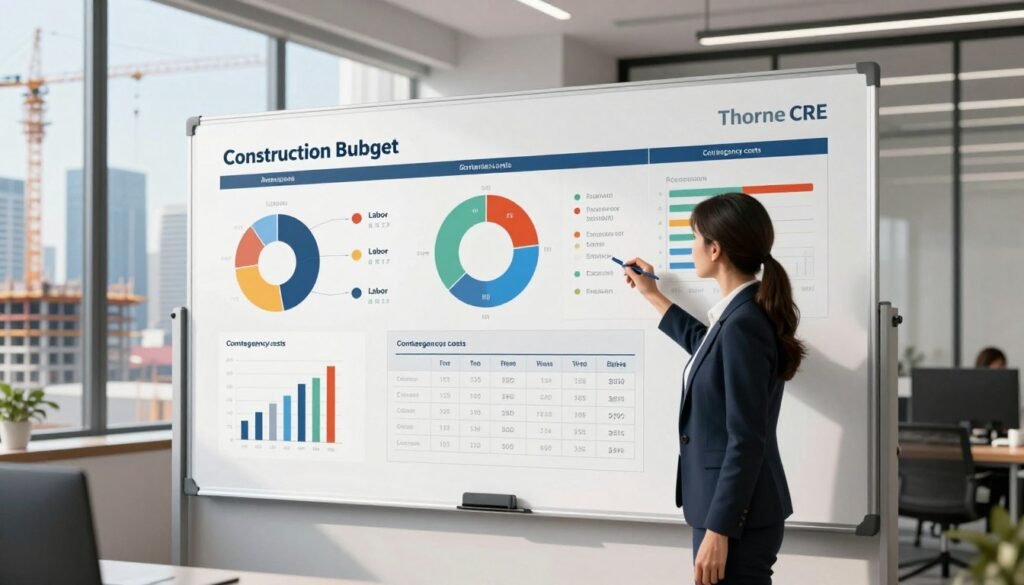
Construction Budget and Cost Analysis
The construction budget and cost analysis phase is key to a commercial real estate (CRE) project’s success. It looks at all costs from start to finish. This includes everything from the first ground-breaking to the final project completion.
Hard Cost Evaluation Methods
Hard costs are direct expenses like materials, labor, and equipment. To evaluate these, contractors’ quotes, material prices, and labor market conditions are considered. Getting these costs right is key to avoiding budget overruns.
Soft Cost Assessment and Reasonableness
Soft costs are indirect expenses like architectural fees, permits, and financing. To check if these costs are fair, they’re compared to industry standards and past projects.
Contingency Requirements and Reserves
Contingency planning helps manage unexpected expenses. A part of the budget is set aside as a reserve for these costs.
Material Cost Escalation Factors
Material costs can change due to supply chain issues, demand shifts, and policy changes. Knowing these factors helps predict cost increases.
Labor Market Considerations
Labor costs are affected by market conditions, like skilled labor availability and wage rates. Understanding these trends is crucial for accurate budgeting.
| Cost Component | Typical Percentage of Total Budget | Factors Influencing Cost |
|---|---|---|
| Hard Costs | 70-80% | Material prices, labor rates, construction methodology |
| Soft Costs | 15-25% | Design complexity, permitting fees, financing terms |
| Contingency Reserves | 5-10% | Project risk assessment, market conditions |
Project Timeline and Draw Schedule Scrutiny
Lenders carefully look at the project timeline and draw schedule. They want to know if the project can be finished on time and within budget.
Construction Timeline Feasibility Assessment
Checking the construction timeline is key. Lenders see if it’s realistic and if the developer can meet it. They look at the project’s complexity, labor and material availability, and possible delays.
Draw Schedule Structure and Monitoring
The draw schedule shows when money is given out during construction. Lenders make sure it matches project milestones. They watch it closely to spot any problems early.
Milestone Achievement Metrics
Lenders track progress with milestone metrics. These include foundation laying, topping out, and final completion. By watching these, lenders see if the project is on schedule.
Handling Construction Delays and Budget Overruns
Construction delays and budget overruns can happen. Lenders help find ways to fix these, like changing the timeline or draw schedule. Good communication and planning are important to solve these problems.
| Milestone | Planned Completion Date | Actual Completion Date | Status |
|---|---|---|---|
| Foundation Laying | 2024-03-15 | 2024-03-18 | Delayed |
| Topping Out | 2024-06-01 | 2024-06-05 | Delayed |
| Final Completion | 2024-12-31 | – | In Progress |
Exit Strategy and Takeout Financing Options
Exit strategies and takeout financing are key to a successful CRE project. A good exit plan helps developers leave a project smoothly, through sale or refinancing.
Permanent Financing Qualification Metrics
To get takeout financing, developers must meet certain criteria. These include:
- Debt Service Coverage Ratio (DSCR): Lenders check if the property’s income covers loan payments.
- Loan-to-Value (LTV) Ratio: This ratio shows how much financing is available.
- Creditworthiness: Developers’ credit scores are checked to see if they can handle the loan.
Sale Scenarios and Cap Rate Projections
Lenders look at possible sales and cap rate projections. They analyze market trends and similar sales to judge the project’s exit potential.
Refinancing Requirements and Timing
Refinancing needs and timing are vital in exit strategies. Developers must know when and how to refinance to increase project value.
Bridge Financing Considerations
Bridge financing helps between construction and permanent financing. Lenders look at the developer’s ability to get bridge financing and its terms.
In summary, a solid exit strategy and good financing options are crucial for CRE success. Understanding the metrics, sale scenarios, refinancing needs, and bridge financing helps developers manage CRE financing complexities.
Environmental and Regulatory Compliance Verification
Lenders check if CRE projects follow environmental and regulatory rules. This step is key to avoid future problems. It makes sure the project meets all laws and rules.
Environmental Assessment Requirements
Lenders need detailed environmental checks. These include Phase I and Phase II site assessments. They look for contaminants or hazardous materials.
Zoning and Entitlement Verification
It’s important to check zoning and entitlements. Lenders look at zoning laws and permits. They make sure the project fits local rules.
Permit Status Evaluation
Lenders check if all needed permits are in place. They see if the borrower has the right permits and if they’re current.
Impact of Building Code Changes
Building code changes can affect a project’s cost and feasibility. Lenders look at how these changes might impact the project’s budget and compliance.
Risk Mitigation Requirements for Ground-Up Projects
Effective risk mitigation is key for ground-up commercial real estate (CRE) projects to succeed. Lenders need strong strategies to handle construction financing risks.
Insurance Coverage Types and Limits
Lenders usually demand full insurance coverage for ground-up projects. This includes builder’s risk insurance for property damage during construction. Also, general liability insurance protects against claims from others.
Performance and Payment Bonds
Performance bonds make sure the project is done right. Payment bonds ensure subcontractors and suppliers get paid. These bonds add security for lenders.
Completion Guarantees and Structures
Completion guarantees promise the project will be finished on time and budget. These can be backed by the developer’s assets or third-party guarantors.
Interest Reserves and Carrying Costs
Lenders often ask for interest reserves to cover loan payments during construction. This reduces the risk of default due to cash flow problems.
By using these risk mitigation steps, lenders can protect their investments in ground-up CRE projects. This makes the financing process more stable and secure.
Conclusion: Securing Successful Construction Financing
Getting construction financing right means knowing what lenders look for in new CRE projects. We’ve talked about important factors like loan-to-cost ratios and debt service coverage. Also, sponsor financial strength and market feasibility play big roles.
Developers need to understand these key metrics to get financing. It’s not just about meeting the basics. They must show they know the project’s potential and risks well. This is key to success in commercial real estate.
To get financing, developers must present a strong, well-planned project. This project must meet lender standards. Doing this boosts their chances of getting the funding they need to complete their projects.