
Lease-Up Self-Storage: How to Finance a New Facility

Self-Storage Financing

Surprising fact: after 5.25% of Fed hikes since 2022, a 50-basis-point cut in September still leaves many deals sensitive to interest moves.

Lease-up means a newly built or expanded facility ramping occupancy and revenue from near-zero to stabilized levels. That transition makes capital needs different than for a stabilized asset; lenders judge cash flow, timelines, and borrower experience more closely.

This guide helps owners and investors compare practical funding options—construction loans, bridge loans, SBA 504/7(a), conventional bank loans and more—and pick a path that fits construction, stabilization, and exit timing. Lenders tighten standards when volatility rises, so shop structures not just rates.

Modeling interest carry and sensitivity matters more than waiting for perfect rates. For a structured approach and sample strategies, see a deeper analysis at commercial real estate financing.

Key Takeaways

  • Lease-up projects need staged capital: construction, bridge, then permanent debt.
  • Compare multiple loan sources and terms, not just the lowest rate.
  • Model rate sensitivity; lease-up delays increase interest carry and risk.
  • Lender requirements vary by loan type and borrower profile.
  • Choose a funding stack that aligns cash flow, timeline, and exit plans.

Lease-Up Reality Check: Budgeting for Construction, Stabilization, and Cash Flow

Successful lease-up plans begin with a clear runway: expenses start early while occupancy lags. That gap creates a predictable operating deficit the borrower must fund before steady collections arrive.

A business-professional setting showcasing a modern self-storage facility in the lease-up phase. In the foreground, a diverse group of three professionals in business attire (two men and one woman) are discussing financial charts and cash flow data on a tablet, their faces focused and engaged. In the middle ground, the newly constructed self-storage building with bright, welcoming colors can be seen, partially filled with storage units, as workers set up the exterior. In the background, a busy city skyline under a clear blue sky provides context. Soft, natural lighting casts an optimistic atmosphere, with shadows creating depth. The image should evoke a sense of planning and financial opportunity in the lease-up phase, representing "Thorne CRE."

Why lease-up creates negative cash flow and how lenders underwrite the ramp

Expenses—taxes, insurance, management fees, marketing, utilities, security, and software—hit immediately after construction finishes. Rent collections trail, so negative cash flow is normal early on.

Lenders model a month-by-month ramp. They evaluate achievable street rates, concessions, and timing to stabilization rather than one-year NOI snapshots.

Reserves, interest carry, and operating shortfall planning

Many bridge and construction loans are interest-only at first. Borrowers must plan for interest costs that accrue even while occupancy builds.

Common reserve buckets include interest carry, operating shortfall, marketing ramp, tenant fit-out, and contingency. Underfunded reserves often cause refinance failures.

Market stress-tests lenders use

Lenders pressure-test absorption pace, achievable rents, and nearby new supply. Defensible comps and a response plan to competitor openings matter.

Reserve Type Purpose Typical Size
Interest carry Cover debt service during ramp 3–9 months
Operating shortfall Cover OPEX deficit until break-even 3–12 months
Marketing & TI Drive leasing and tenant fit-out 1–6 months or fixed $
Contingency Unexpected costs or delays 5–10% of hard costs

Practical budget rule: hard + soft costs + contingency + start-up cash + lease-up deficit = true all-in capital need. Better planning shortens the runway and improves funding options and rates over time.

Self-Storage Financing Options Compared for New Facilities and Expansions

Choosing the right loan product for a new or expanded facility hinges on trade-offs between speed, leverage, and long-term cost.

A sleek, modern office environment featuring a large, polished conference table at the foreground, strewn with financial papers and charts representing various self-storage financing options. In the middle ground, a diverse group of professionals—two men and a woman—dressed in professional business attire, engaged in a discussion, analyzing the documents with intent expressions. In the background, through a floor-to-ceiling window, an expansive view of a self-storage facility under construction, showcasing rows of units and cranes, bathed in warm, natural light. The atmosphere is focused and collaborative, conveying a sense of strategic planning and ambition in real estate finance. The brand name "Thorne CRE" is subtly integrated into the design elements of the conference room.

Construction loans: typical mechanics

Construction loans usually fund 60%–80% of total cost. Borrowers commonly bring 20%–25% equity. Recourse and completion guarantees are standard, and draws require inspections.

Rates vary and many lenders set interest-only payments during build. Contingency and interest-reserve buckets are essential to avoid shortfalls.

Construction-to-perm takeout

Locking a permanent takeout before breaking ground forces realistic DSCR and LTV targets. That clarity shapes unit mix, pricing, and timeline so the project meets permanent mortgage requirements at stabilization.

Bridge loans

Bridge debt buys speed and flexibility for lease-up or repositioning. Typical terms run 6 months–4 years, often interest-only, with 1% origination and exit fees and extension options.

Nonrecourse structures are common, but a credible takeout (bank, CMBS, SBA, or life company) is required from day one.

SBA 504 and 7(a)

SBA 504 often uses a 50/40/10 structure: bank first mortgage, CDC/SBA second, and ~10% borrower equity.

504 loans suit buy/build/rehab projects and offer long fixed terms, though CDC funding can lag closing by 60–90 days.

SBA 7(a) gives higher leverage and working-capital flexibility with prime-based pricing and typical prepayment steps (5-3-1%).

Conventional banks, credit unions, CMBS, and life companies

Banks and credit unions favor relationship deals and may offer 20–25 year amortization; credit unions can beat rates but often avoid complex transitional risk.

CMBS provides fixed-rate, nonrecourse mortgages for stabilized assets with strict prepayment mechanics. Life insurers lend at low leverage (≈60%–65%) for high-quality, stable properties.

Short-term alternatives

Lines of credit and merchant cash advances fill short liquidity gaps but carry cost trade-offs. Hard-money and low-doc loans close fast, require significant equity, and serve as bridge solutions to permanent mortgages.

Costs, Rates, and Repayment Terms Borrowers Should Model in Today’s Market

Modeling true project costs requires more than a headline rate—build a complete annualized cost view before you pick a loan.

Why timing risk matters: the Fed cut 50 bps in September after 5.25% of hikes since 2022, so interest rates can swing. Waiting for perfect rates can backfire if construction costs or local competition change while you wait.

Translate the cost of capital into a checklist: interest expense, origination and exit fees, CDC/SBA fees, closing costs, reserves, and refinance expense. That gives a real annualized cost instead of a quoted rate.

A professional and modern office setting depicting a table covered with financial documents and charts related to self-storage lease terms. In the foreground, a neatly organized stack of paperwork displaying graphs and numerical data on costs and repayment terms, showcasing a clear and engaging layout. In the middle ground, a business professional in smart attire examines the documents, their expression focused and thoughtful. In the background, a large window offers a view of a city skyline, illuminated with natural light, enhancing the atmosphere of a bustling financial environment. The overall mood is one of seriousness and diligence, reflecting the importance of understanding financing in today's market. Include the brand name "Thorne CRE" subtly integrated into the financial documents.

Common term structures and amortization

Bridge loans often run 6 months–4 years (commonly three years plus extensions). SBA 7(a) supports up to 25 years; SBA 504 typically 10–20 years.

Banks usually offer 3–10 year terms with 20–25 year amortization. CMBS tends to use 5- or 10-year terms with 30-year amortization. Longer amortization lowers payments and helps DSCR; shorter terms raise refinance pressure.

Prepayment and exit costs to model

SBA 7(a) often uses a 5-3-1% step-down in early years. SBA 504 can lock penalties for a decade. Bridge loans commonly include ~1% exit fees and extension costs. CMBS may require yield-maintenance or defeasance and can be restrictive.

“Choose a loan by matching the repayment terms and maturity to a realistic stabilization plan, not an optimistic timeline.”

What to stress-test

  • Base case, slow lease-up, and rate-up sensitivity.
  • Expense inflation and reserve depletion timelines.
  • Refinance test: conservative LTV and DSCR for permanent takeout.

Bottom line: model multiple scenarios and include fees, reserves, and prepayment math. That reveals the true cost in money and time and points to the best lending option for your real estate project.

How Lenders Qualify Self-Storage Borrowers: Credit, Collateral, LTV, and Experience

Lenders focus on who is behind a project as much as the bricks and pro forma numbers. Underwriting balances sponsor strength with the asset’s cash flow and collateral. That mix drives leverage, pricing, and recourse terms.
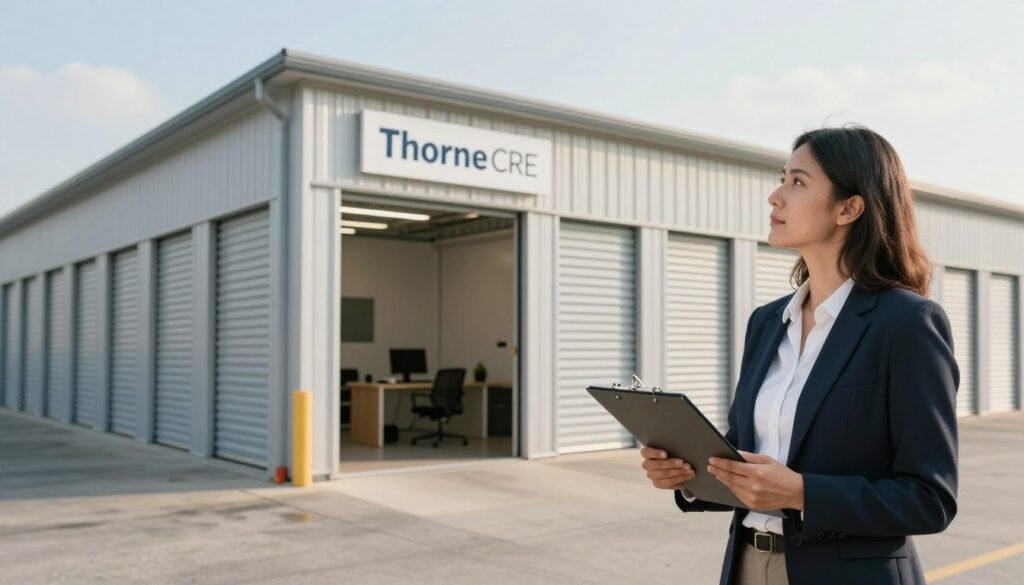
A professional self-storage facility setting, showcasing rows of modern storage units with well-maintained exteriors. In the foreground, a business professional in smart attire, holding a clipboard, looks thoughtfully at the facility, symbolizing careful financial planning. In the middle, a sleek office area can be seen with a desk and computer, representing administrative functions. The background features a clear sky, suggesting a positive business atmosphere. Soft, natural lighting enhances the scene, with warm tones to create an inviting feel. The image should subtly incorporate the brand name "Thorne CRE" on a sign within the facility, reflecting professionalism and trust. Capture this in a wide-angle view to convey the scale of the operation, while maintaining focus on the thematic elements of finance and management in the self-storage industry.

Documentation expectations

Full-doc files typically include personal financial statements, tax returns, entity documents, and proof of liquidity. Lenders want a third-party appraisal, environmental reports, and a defensible pro forma with market support.

Leverage and appraisal lens

Permanent mortgage underwrites to conservative ltv based on income. Expect 60%–75% LTV for stabilized loans and ~20%–25% equity for construction. Appraisers weight income approach, market rents, occupancy, and cap rates.

Deal-killers and fixes

“Weak sponsorship, thin reserves, and unrealistic pro formas kill approvals faster than market cycles.”

  • Common issues: unverifiable comps, short reserves, optimistic lease-up timing.
  • Fixes: strengthen liquidity, document team experience, add contingency reserves, and present a clear takeout plan.
Area What Lenders Check Typical Expectation
Credit & Sponsor Cash flow, net worth, track record Strong PFS, relevant experience
Collateral & Appraisal Income approach, rents, occupancy Conservative rents, market cap rate
Leverage LTV / LTC 60%–75% LTV; 75%–80% LTC limits

Prepare your package and then shop terms. For guidance on rate strategy and loan structure, see how to secure the best possible rate on your next CRE.

Choosing the Right Lender and Funding Stack for Your Facility’s Timeline

Match each required use of funds to a lender that permits those uses and supports the project timeline. Start by listing capital needs for land, buildings, construction, security upgrades, marketing, and working capital.

Mapping uses of proceeds and a practical stack

Use the right tool: land often fits a mortgage or construction-to-perm product; vertical construction needs a construction loan with draw mechanics; working capital and marketing are best covered by 7(a) or short-term lines.

Typical stack: equity + construction loan + interest-carry/operating reserves → stabilization → permanent takeout (bank/CMBS/life company/SBA).

When to use a broker vs go direct

Use a broker for complex capital stacks, nonrecourse needs, or larger balances where multiple financing options matter.

Go direct when you have a strong bank relationship, a straightforward deal, or need quick, local decisioning.

  • Align term with realistic construction + lease-up + seasoning, and include extensions as a contingency.
  • Cash flow governance: track occupancy, rate realization, concessions, and expense discipline from day one.

Lender selection checklist

  • Track record with facilities and construction draws
  • Clarity on reserves and inspection process
  • Prepayment flexibility and realistic underwriting assumptions
  • Willingness to fund working capital and interest reserves

Conclusion

Wrap your plan by proving the lease-up economics, lining up reserves, and securing a realistic takeout before you commit to construction.

Decision hierarchy: (1) validate lease-up economics and cash runway, (2) pick the loan path that fits the timeline, (3) model costs, prepayment, and rates, and (4) package the deal to meet underwriter standards.

Lease-up risk is manageable when you build in reserves, assemble defensible comps, and show a credible takeout strategy. SBA 504 or bridge options can work, but each has timing and fee trade-offs.

Next steps: gather market comps and a realistic pro forma, prepare financials, request multiple quotes (bank, SBA, bridge, CMBS, life), and stress-test the plan under conservative assumptions.

Ready to decide? Compare offers with a lender or mortgage broker and stress-test the structure before breaking ground.


FAQ

What are the main financing paths for building and leasing up a new facility?

Typical options include construction loans, construction-to-permanent takeouts, bridge loans, SBA 504 and 7(a) loans, conventional bank mortgages, credit union loans, CMBS, and life-insurance company loans. Short-term tools like lines of credit, merchant cash advances, and hard-money or low-doc loans can cover timing gaps. Each product differs on leverage, term, interest, recourse, and required cash equity.

Why does lease-up often cause negative cash flow and how do lenders underwrite the rent ramp?

New facilities usually open with low occupancy, so revenue lags operating expenses and debt service. Lenders underwrite lease-up by stress-testing pro formas for slower absorption, applying vacancy reserves, and requiring interest carry or interest reserve accounts. They expect realistic rent curves based on market comparables and may require sponsor guaranties or higher equity if the ramp looks aggressive.

How should borrowers plan reserves, interest carry, and operating shortfalls during lease-up?

Budget a dedicated interest reserve covering construction-period interest and a stabilization buffer for several months of operating shortfall. Maintain working capital for marketing and tenant improvements. Lenders often require specific reserve levels on construction and permanent loans; failing to fund these can block closings or trigger higher pricing.

What market factors do lenders stress-test for new facilities?

Underwriters model new supply in the trade area, achievable rental rates, local absorption trends, competing product quality, and demand drivers such as population and employment. They also test sensitivity to slower rent growth and higher concessions to ensure the borrower can service debt under downside scenarios.

What are typical LTC ranges and recourse requirements for construction loans?

Construction loan loan-to-cost commonly ranges from 65% to 80% depending on sponsor strength and market. Many lenders require borrower recourse or completion guarantees, especially for speculative builds. Strong sponsors may secure higher leverage or limited-recourse structures, but expect rigorous draw controls and completion covenants.

How does a construction-to-permanent takeout strategy work?

With this approach, a permanent lender or a pre-arranged takeout facility is lined up before groundbreaking. The construction loan converts to long-term debt at stabilization, reducing refinancing risk. Borrowers should secure written takeout commitments and meet covenants tied to occupancy and operating metrics prior to conversion.

When are bridge loans the right choice and what are trade-offs?

Bridge loans suit deals needing speed, short-term capital, or repositioning before long-term financing. They offer quick closings and higher leverage but carry higher interest rates, short terms, possible extension fees, and often limited or nonrecourse structures. Plan the exit strategy carefully to avoid costly rollovers.

What advantages do SBA 504 loans offer for new construction and expansion?

SBA 504 combines a long-term, fixed-rate first mortgage from a Certified Development Company with a bank or private small loan covering the balance. It supports owner-occupied projects, offers attractive 10- to 25-year terms, and preserves cash by allowing lower down payments. Project eligibility, job-creation tests, and documentation are required.

How does an SBA 7(a) compare for working capital and project flexibility?

SBA 7(a) loans provide broader working capital flexibility and can be used for equipment, acquisition, and certain building expenses. Pricing usually tracks prime plus a spread, and prepayment terms vary. They are useful when 504 eligibility is limited or when borrowers need operational liquidity alongside real estate funding.

What should borrowers expect from conventional bank loans and credit unions?

Banks and credit unions offer relationship-based pricing, negotiable amortization, and varying recourse profiles. Credit unions may be competitive on rates for cash-flow-stable borrowers but often avoid transitional lease-up risk. Banks can structure construction-to-perm packages for established sponsors but will require strong documentation and reserves.

When do CMBS and life-insurance company loans make sense?

CMBS is attractive for larger, stabilized portfolios seeking fixed-rate, nonrecourse financing with predictable terms. Life-insurance company loans favor low-leverage, high-quality assets and offer very long-term, fixed-rate products. Neither is ideal for speculative lease-up unless paired with a credible bridge or completion plan.

Are hard-money and low-doc loans viable for time-sensitive deals?

Yes. Hard-money and low-document products provide speed and flexible underwriting based on asset and sponsor equity. They come with higher interest rates, shorter terms, and often higher fees. Use them for short windows when conventional capital cannot deploy quickly, and have an exit plan ready.

How should borrowers model interest-rate risk and timing in today’s market?

Account for current market rates plus a buffer for possible increases during construction or pre-stabilization. Fixed-rate permanent financing or hedges can lock pricing, but waiting for lower rates can delay projects and increase soft costs. Model scenarios with varying rates and time-to-stabilization to measure sensitivity.

What amortization and term differences matter between bridge and SBA loans?

Bridge loans have short terms (6–36 months) and may interest-only payments, while SBA 504 and many bank permanent loans amortize over 10–25 years with full amortization schedules. Longer amortization lowers monthly debt service but may require higher equity or stricter underwriting at closing.

What prepayment and exit costs should borrowers expect?

Expect varying prepayment penalties: SBA loans can have step-down structures, CMBS often imposes defeasance or yield maintenance, and bridge lenders may charge exit or extension fees. Understand the loan documents early and factor exit costs into your refinancing or sale assumptions.

What documentation do lenders require to qualify a borrower?

Lenders commonly require detailed pro formas, construction budgets, third-party appraisals, environmental reports, rent-roll projections, sponsor financial statements and tax returns, and proof of equity. Full-document underwriting is standard for permanent debt; low-doc paths accept fewer items but at higher cost.

What leverage benchmarks and down payment expectations apply for construction and permanent loans?

Construction loans often require 20%–35% borrower equity depending on risk. Permanent LTVs for stabilized assets typically range from 60% to 75% depending on lender and asset quality. Lower leverage is common for lower-credit sponsors or markets with supply concerns.

What common deal-killers should sponsors address early?

Weak sponsor track record, thin operating reserves, unrealistic pro formas, unresolved entitlement or zoning issues, and insufficient equity will derail approvals. Fix these early by boosting reserves, cleaning financials, securing pre-leases, or improving project documentation.

How do you match funding to specific uses of proceeds?

Assign short-term products—construction loans, lines of credit, or bridge funding—for land, hard construction, and initial TI. Use permanent or SBA 504 loans for stabilized buildings and long-term mortgage needs. Keep separate working capital or merchant cash advance facilities for operational liquidity.

When should borrowers use a mortgage broker versus going direct to lenders?

Use a broker when you need market access, multiple product comparisons, or help structuring complex stacks. Go direct when you have a strong relationship with a bank or credit union that offers competitive terms. Brokers add placement expertise but confirm fee structures upfront.

Leave a Comment

Your email address will not be published. Required fields are marked *

Scroll to Top