

Surprising fact: since 2022 federal incentives tied to advanced manufacturing total tens of billions, and a single major manufacturer announced a $28B investment that reshaped local development demand.
The phrase Ohio Capital Stack names the order and mix of funds that make a project work. For industrial and multifamily projects, most outcomes hinge less on the site and more on how the capital stack is engineered.
In this ultimate guide, you will learn what sits in each position of the capital stack, how to compare sources, and how to make complex deals financeable in today’s market. Expect clearer lender comfort, fewer surprises in diligence, and stronger negotiating leverage.
We frame the topic around two demand stories: re-industrialization tied to semiconductor incentives and growing workforce/affordable multifamily needs. You’ll see why structure shifts by asset type and business plan, and why capital is not a single pool—pricing, covenants, collateral, and timing all differ.
Key Takeaways
- Understand each position in the capital stack and its role in project viability.
- Compare debt and equity by pricing, covenants, collateral, and timing.
- Design stacks that improve lender comfort and streamline diligence.
- Match stack choices to asset type—industrial vs. multifamily needs differ.
- Use local incentives wisely to enhance feasibility without replacing private funding.
Why Capital Stack Strategy Matters in Ohio’s Industrial and Multifamily Markets
Market signals from recent federal programs have reset how lenders and investors judge industrial and multifamily deals. Those shifts affect underwriting, contingency planning, and what counts as bankable documentation.

Re-industrialization and the CHIPS signal
The CHIPS Act brought targeted funds: production incentives, credit supports, a 25% investment tax credit, plus R&D and workforce allocations. These federal moves catalyze private investment rather than replace it.
Intel’s investment as a template for layering
Large corporate commitments show how funding layers work: corporate balance sheet capacity, federal grants/loans/tax credits, and state or local packages for infrastructure. Together they create separate uses that change the optimal capital mix.
Infrastructure, workforce, and research reshape underwriting
Sitework, utilities, and R&D needs increase upfront costs and phasing risk. Lenders will stress-test those non-building scopes and often expect separate tranches or off-balance-sheet structures to cover them.
Bottom line: a coherent underwriting narrative — showing how a project advances regional industry growth, job creation, and research capacity — improves access to funds and keeps multifamily and workforce housing plans financeable.
Capital Stack Fundamentals for Real Estate Deals
How funds are layered determines underwriting, negotiation leverage, and deal resilience under stress.
Senior debt and the “first position” role
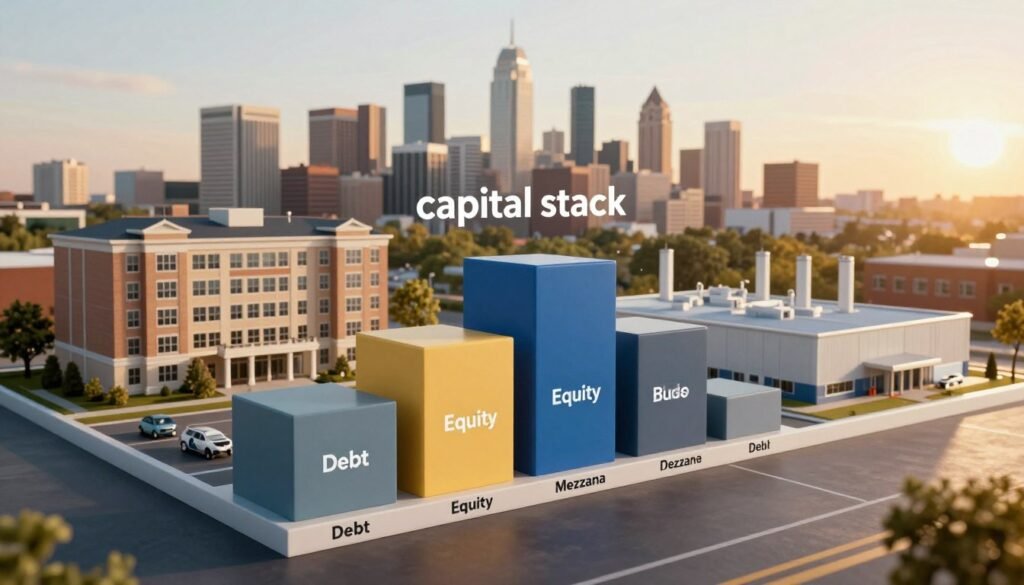
Define a capital stack as the ordered set of claims that fund a project. Risk falls as you move up the stack and return rises toward the bottom.
Senior debt sits in first position. Lenders focus on collateral coverage, stabilized cash flow, covenants, and conservative downside cases. They get paid first from operations and liquidation.
Mezzanine debt and preferred equity
Mezzanine and preferred equity bridge gaps when senior leverage is capped. These positions take more risk and command higher pricing and tighter intercreditor terms.
Market reality: many mezzanine providers look for one to two turns of EBITDA‑equivalent support, price roughly 8%–20%, and prefer minimum checks near $2M–$3M.
Common equity and sponsor capital
Common equity is first-loss capital. Meaningful sponsor capital signals alignment and improves lender comfort.
Equity debt or co-invest features can sit mid-stack, but legal terms must match senior lender consent and remedy priorities.
Non-traditional sources and security
Tax credits, grants, and incentives can lower cash equity needs but add compliance and timing risk. Document deliverables early to avoid closing delays.
“The best stacks are structured to survive draws, cost overruns, and lease-up cycles.”
Security and intercreditor mechanics — who holds liens, cure rights, and remedy control — often determine whether a deal closes, even when numbers look strong.
For a practical guide to sequencing and documentation, see this strategic guide.
Ohio Capital Stack: Building a Winning Structure for Industrial and Multifamily Deals
Winning deals start by mapping who brings money, what each provider will cover, and when funds must arrive.

Mapping sources and roles
Local and national banks typically provide construction and permanent senior debt. Agencies and housing programs fill agency debt or tax-exempt bond roles for multifamily.
Private debt and equity funds and family offices supply mezzanine, bridge, and preferred capital. Public programs and grants reduce upfront enabling costs and improve lender metrics.
Blending public and private dollars
Mega-project lessons: federal funds usually catalyze larger private contributions. For example, CHIPS-era support often covered infrastructure while private money carried most of the project financing weight.
Public dollars lower risk if compliance and timing are documented early. That strengthens negotiating posture with providers and can secure better terms in capital markets.
Make projects financeable: documentation checklist
- Lender-ready pro forma and stress tests
- Third-party reports: appraisal, environmental, geo-technical
- Permits, utility plans, and a linked draw schedule
- Contingency plan and concise narrative for credit committees
| Provider | Typical Role | Best Use | Timing Sensitivity |
|---|---|---|---|
| Regional / National Banks | Construction / Senior Debt | Low-cost takeout for stabilized assets | High (requires permits, collateral) |
| Private Debt Funds | Bridge / Mezzanine | Fill gaps during lease-up or refinance | Medium (shorter tenor) |
| Equity Funds / Family Offices | Common or Preferred Equity | Early-stage risk and sponsor capital | High (capital calls tied to milestones) |
| Public Programs / Agencies | Grants, Tax Credits, Infrastructure Funding | Enable site readiness and workforce costs | Very High (conditional, compliance-heavy) |
Stage matters: early development needs more equity and conservative leverage. Later-stage projects can bring in lower-cost senior lenders and broader provider participation.
“Projects that present clear sources, uses, and schedules win deeper access to capital markets.”
Deal Size, Risk, and Access to Capital Markets
A clear break occurs near $5M of EBITDA—above it, institutional mezzanine and equity follow set rules; below it, relationships and creativity rule.
Why size matters: Deals with trailing EBITDA above $5M attract standardized mezzanine debt and institutional equity. These providers quote predictable pricing and minimum checks. Smaller transactions often need seller notes, private lenders, or higher sponsor equity.
Why the $5M EBITDA threshold changes mezzanine and equity availability
Above $5M, mezzanine offers are more common and underwritten on one to two turns of EBITDA. Below that line, many companies compete for fewer providers and underwriting becomes relationship-driven.
Typical mezzanine parameters: pricing ranges, minimum checks, and leverage limits
Mezzanine structures are often interest-only. Pricing ranges roughly 8%–20%, with minimum checks around $2M–$3M. Leverage limits tie to cash-flow durability and collateral coverage.
Equity requirements and “skin in the game” expectations
Equity needs vary by lender and program. Expect anywhere from about 10% up to 50% of project capitalization depending on risk and sponsor history. Smaller sponsors must plan for more equity or alternative financing to bridge gaps.
Transition risk, cyclicality, and contingency planning that banks want to see
Lenders want credible transition plans that secure customer or tenant retention and management continuity. Seller consulting, seller notes, or phased handoffs reduce transition risk.
Banks also test downturn scenarios. Show contingency reserves, covenants that provide breathing room, and operational “things” like alternative revenue streams or expense-cutting triggers.
“Prepare a concise CIM-style memo, key diligence exhibits, and a transition narrative to speed credit decisions.”
| Area | What lenders expect | Typical metric | Implication for deals |
|---|---|---|---|
| Mezzanine | Interest-only, EBITDA turns | 8%–20% pricing; $2M–$3M check | Best for deals >$5M EBITDA; fills senior gaps |
| Equity | Skin in the game, alignment | 10%–50% of capital | Smaller sponsors need higher equity or seller financing |
| Transition & cyclical plan | Operational continuity, reserves | 3–6 months cash reserves typical | Improves lender confidence, lowers pricing |
| Deal documentation | CIM, exhibits, stress tests | Clear pro forma and concentration analysis | Shortens approval process in capital markets |
Actionable next steps: size your capital ask to match market expectations, prepare a CIM, and plan seller involvement for smoother transition. These steps make mezzanine and equity providers more likely to commit and reduce closing friction.
Multifamily Capital Stacks in Practice: Workforce and Affordable Housing Structures
Mixed-income housing deals hinge on timing, compliance, and a clear forward-takeout plan. LIHTC equity often forms the economic foundation by lowering required hard cash equity and locking long-term affordability covenants.

LIHTC equity as a pillar
LIHTC equity reduces upfront cash needs and improves feasibility for many development plans. It also creates compliance layers lenders watch closely—rent bands, monitoring, and extended covenants that affect operations.
Tax-exempt bonds and forward commitments
Forward TELs and agency executions cut rate risk by promising permanent takeout at closing or stabilization. That certainty stabilizes underwriting and makes permanent debt more predictable during lease-up.
Bridge debt and timing mismatches
LIHTC pay-ins arrive on milestones, while construction costs draw continuously. That mismatch typically requires a construction bridge loan sized to cover the interim amount and protect cashflow.
A model stack and what to replicate
Merchants Capital structured a model: a $30.6M Freddie Mac 4% unfunded forward TEL + $16.7M 4% LIHTC equity + $43.5M construction bridge loan, totaling $74.1M in debt and equity. Use the same approach conceptually: clear sources/uses, a forward takeout, and a bridge sized to equity timing.
- Underwriting note: 40%–80% AMI targeting changes rent assumptions and reserve needs.
- Community assets—transit, retail, childcare—strengthen the financing narrative and demand case.
“The best stack pairs low cost with certainty of execution—each tranche should cover a specific development risk.”
Conclusion
A well-designed financing plan wins deals more often than the best site or tenant.
Design the structure to align risk, timing, and documentation. Protect senior debt with conservative underwriting. Size mezzanine to realistic cash flow and keep equity large enough to absorb volatility.
CHIPS-era incentives and awards like the $24M DOD grant show federal funds catalyze private investments and research, but they rarely replace core sources. Both industrial and multifamily projects benefit from the same discipline: clear sources, contingency plans, and credible narratives for providers and lenders.
Closing checklist:
- Map sources and confirm lender constraints.
- Validate incentive eligibility and timing.
- Align intercreditor terms and document remedies.
- Build a lender-ready narrative and pressure-test money assumptions (rates, carry, reserves, exit).
In short, sponsors who communicate clearly, document fully, and build resilient capital stacks will keep access to capital over the next several years.