
Surprising fact: recent public equity commitments tied to strategic industries have reached into the billions, changing how deals are underwritten and funded across the region.
The phrase Alaska Capital Stack describes the layered mix of equity, debt, and contracted revenues that makes a project bankable. Government equity participation is now used to anchor investment cases and attract private money. This shift affects commercial real estate, energy projects, and enabling infrastructure alike.
Designing the right capital mix is often the make-or-break factor for deals. Sponsors need creative financing that aligns risk, timelines, and returns with real-world permitting and logistics. Our practical guide lays out an actionable approach to these evolving market opportunities and outlines the funding levers—public anchoring, revenue contracts, and modern finance structures—that matter to sponsors, lenders, tribal organizations, and institutional investors.
Key Takeaways
- Public equity can unlock private participation and change valuations.
- Projects need layered funding to match long timelines and local risks.
- Contracted revenues reduce execution risk for lenders and investors.
- Modern structures lower upfront burdens while keeping performance discipline.
- This guide targets sponsors, lenders, municipal leaders, utilities, and investors.
Why Alaska’s commercial real estate capital stack is changing
Developers now face steep pressure from higher costs, constrained labor, and tight weather windows. These factors push up budgets and extend schedules, forcing fresh conversations about financing and risk allocation.

Higher costs, longer timelines, and why many projects don’t pencil
Elevated material and transport fees, plus scarce trades, raise contingency and carry needs. Longer completion horizons increase interest exposure and make awards vulnerable.
Housing illustrates the problem: a 2023 Agnew::Beck estimate finds 27,500 new or rehabbed homes needed over ten years. Affordability gaps mean many deals require gap funding or layered capital to become feasible.
What “crowding in” private capital looks like
Catalytic public money—equity stakes, guarantees, or commitments—reduces downside risk and signals durable support. That cue often lets private lenders and strategic investors re-rate risk and move in.
“Government participation can reshape investor expectations about exits, reinvestment, and operations discipline.”
Where demand is coming from
- Infrastructure modernization: aging systems need upgrades to stay serviceable.
- Housing shortages: feasibility gaps are increasing the need for layered funding.
- Energy resilience: high power costs in remote communities drive renewable project demand.
These dynamics mean future projects must link public purpose with bankable revenue streams and credible delivery partners. The rest of this guide explains practical stack designs that align those aims.
Alaska Capital Stack fundamentals for development and infrastructure projects
A practical capital blueprint starts by stacking funding layers that match project risk and timelines.

Core layers and what each requires
Sponsor equity sits at the base and carries first-loss risk. Mezzanine and tax-advantaged sources sit in the middle. Senior debt is placed at the top.
| Layer | Role | Typical requirement |
|---|---|---|
| Sponsor equity | Absorb initial losses; capture upside | Strong sponsor balance sheet; contingency reserves |
| Mezzanine / hybrids | Bridge funding gaps | Higher yields; performance covenants |
| Tax credits & grants | Lower net capital needs | Compliance documentation; award certainty |
| Senior debt | Lower-cost, secured lending | Stable revenues; tight covenants |
Risk allocation and revenue levers
As the stack fills, return expectations shift. Senior lenders want predictable cash flows and strong covenants.
Mezzanine providers expect higher yields. The developer accepts most downside but also the largest upside.
Public private partnerships and financeable revenues
Public private partnerships can de-risk early work—site prep, permitting, and interconnection—while keeping market discipline through performance guarantees.
Long-term leases, PPAs, and ESPCs convert services into predictable streams. Infrastructure as a Service lets a provider fund and operate assets, avoiding agency debt limits.
- Checklist for a developer: contractor credibility, bankable revenue story, robust procurement, and third‑party validation.
- Secure grants early and lock long-term contracts to attract senior financing.
Public capital as an anchor in the stack: what recent deals signal for Alaska
Public money is shifting from backstop grants to equity and hybrid commitments that change how lenders underwrite long projects.

Government equity and hybrid structures that reshape incentives
Government stakes mean longer time horizons and different return profiles. When a state takes equity, exit optionality narrows and public goals—resilience or supply security—become formal priorities.
Hybrid structures blend funding types and can force stricter performance metrics while lowering near‑term financing costs.
Catalytic capital in action: using state participation to attract banks and strategic partners
Intel’s equity-for-grants pattern shows sequencing: public participation first, then rapid private follow‑on from major investors. That signaling can re-price risk and bring banks into lengthy builds.
MP Materials and Lithium Americas demonstrate how a government equity slice plus offtake or loan relief stabilizes production and unlocks large private financing rounds.
Supply chains and cross-border alignment: why strategic capital matters
Projects tied to critical production attract patient partners who value resilience over short-term yield. Allied supply‑chain priorities increase the presence of strategic capital.
State involvement can crowd in banks and industry partners when paired with enforceable contracts, clear governance, and credible operators.
“Public anchor capital is catalytic, not comprehensive—delivery discipline and realistic assumptions still determine project success.”
Takeaway: design public participation to signal commitment, lock demand with long contracts, and maintain strict performance oversight. That combination makes development projects more financeable while protecting public objectives.
Models that are working on the ground in Alaska communities
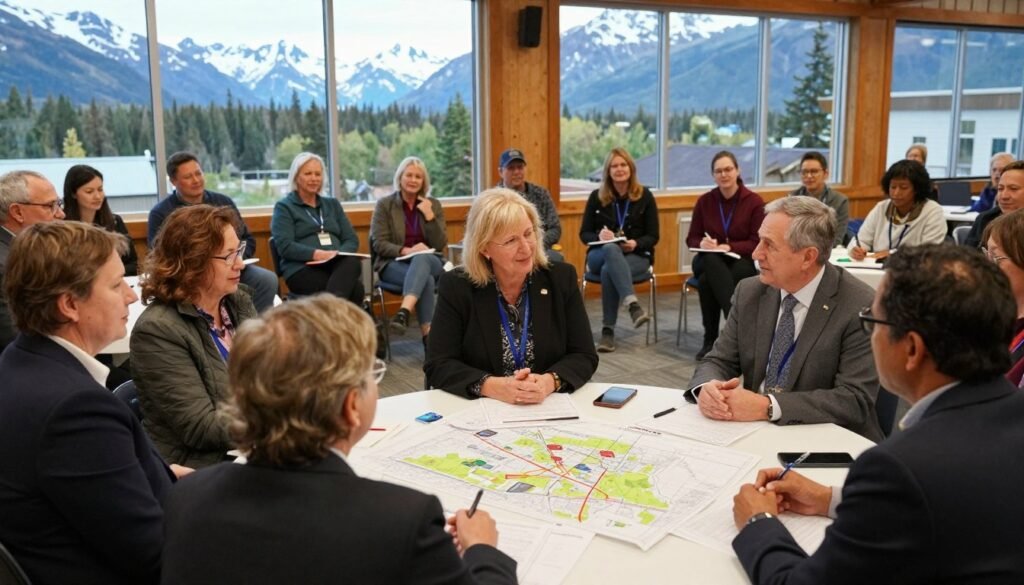
On-the-ground programs show how contract-based delivery and new marketplaces convert local needs into bankable projects. These repeatable models cut upfront costs, speed delivery, and improve access to long-term financing for small and large work alike.
Energy contracts and service-based funding
ESPCs and PPAs let a provider guarantee savings or output so public facilities avoid big upfront bills. Ameresco’s ESPC examples reduce capital barriers and improve financing terms.
Infrastructure as a Service
Infrastructure as a Service vendors fund upgrades, run assets, and absorb lifecycle risk. This model keeps government balance sheets cleaner while delivering reliable infrastructure.
Big-grid opportunity and small-deal solutions
Railbelt interconnection creates scale that makes large generation and storage easier to underwrite. For remote sub-$1M projects, digital marketplaces and standard docs—like Banyan Infrastructure’s approach—speed underwriting and enable aggregation.
- Catalytic capital: Coalition for Green Capital’s $10M to Spruce Root seeds local pipelines.
- Housing top-offs: HAPPP’s $750K produced 84 homes and closed last-mile gaps.
- Coordination: aligned partners reduce staff time and keep grants from lapsing.
Conclusion
Conclusion
Well‑designed public overlays can tip the scales from theoretical finance models to real, delivered assets.
The central message is simple: thoughtful capital design determines whether a plan becomes built reality. Public participation often acts as an anchor that draws private partners, but it does not replace execution, governance, or credible operators.
Practical fundamentals remain: match risk to the right layer, lock contracted revenues (leases, offtake, PPAs), and stress‑test timelines and contingencies. Proven models—ESPCs/PPAs, Infrastructure as a Service, Railbelt coordination, and tech aggregation for sub‑$1M work—address specific barriers.
Targeted gap funding and coordination, as with the housing top‑off example, convert “paper” stacks into operating assets. For deeper guidance on designing layered finance solutions, see our strategic guide.