
In short
Direct answer: The three-month CME Term SOFR rate stood at 3.86% as of October 9, 2026. For floating-rate commercial real estate loans, the 3 month SOFR rate serves as a forward-looking benchmark that combines with your contractual lender spread to establish quarterly debt-service obligations. Borrowers must always confirm the exact determination date, index definition, and interest rate floor defined in their promissory note before finalizing cash flow forecasts.
Key takeaways
- The latest published three-month CME Term SOFR benchmark was 3.86% (rounded) on October 9, 2026, and must be re-verified against your note’s specific lookback period prior to reset.
- The 3 month SOFR rate from CME is a forward-looking derivative metric, whereas the New York Fed’s 90-day Average SOFR (3.70963% on the same date) is backward-looking.
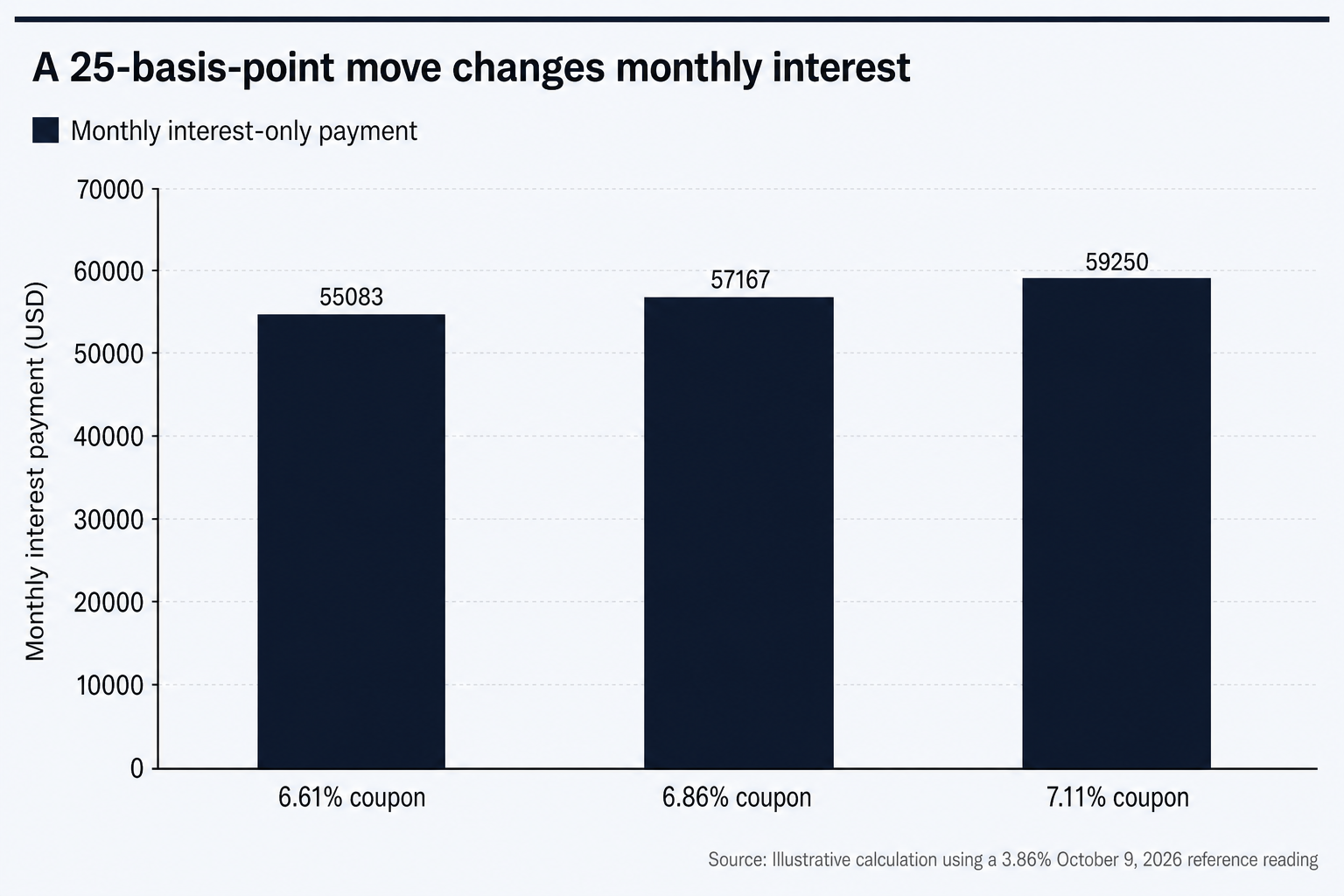
- On a $10,000,000 interest-only loan balance, each 25-basis-point fluctuation in the index shifts monthly debt service by approximately $2,083.33.
- Contractual loan provisions—including index definitions, reset lookbacks, floors, and margins—dictate effective borrowing costs far more than market headlines alone.
Table of contents
- What is the 3 month SOFR rate?
- 3-Month Term SOFR vs. 90-Day Average SOFR: Evidence and comparisons
- How does the 3 month SOFR rate affect your commercial loan payment?
- Loan mechanics, floors, and terms to verify before reset
- Navigating SOFR movements in bridge financing and refinancing decisions
- Frequently asked questions about current SOFR rates
- Recommended next actions before your next loan reset
What is the 3 month SOFR rate?
The 3 month SOFR rate generally refers to the forward-looking three-month Term SOFR reference rate administered by CME Group. As of October 9, 2026, the benchmark published at 3.86% (rounded to two decimal places from the five-decimal CME Group publication). In commercial real estate, lenders routinely apply this rate to floating-rate bridge, construction, and interim mortgage facilities.
To understand the rate in context, we examine four primary short-term benchmarks observed on the same date:
| Measure | Latest available reading | Date | What it tells a commercial borrower |
|---|---|---|---|
| 3-month CME Term SOFR | 3.86% | October 9, 2026 | A forward-looking three-month benchmark commonly used for loan coupons that reset in advance. |
| 90-day Average SOFR | 3.70963% | October 9, 2026 | A compounded average of prior overnight SOFR observations over a rolling 90 calendar days. |
| Overnight SOFR | 3.87% | October 8, 2026 | The secured overnight repo-market benchmark published by the New York Fed. |
| Bank prime loan rate | 7.00% | October 9, 2026 | A separate bank lending benchmark, not an index substitute for SOFR-based facility notes. |
As the benchmark administrator, CME Group calculates Term SOFR using transaction data from liquid SOFR futures markets, delivering a forward-looking rate calibrated for 1-, 3-, 6-, and 12-month tenors. In contrast, the Federal Reserve Bank of New York calculates overnight SOFR as a volume-weighted median of secured overnight repo transactions backed by Treasury securities. Borrowers must always consult their specific promissory note to confirm which reference index governs their borrowing costs.
3-Month Term SOFR vs. 90-Day Average SOFR: Evidence and comparisons
A frequent point of confusion among property owners is whether three-month CME Term SOFR is interchangeable with the New York Fed’s 90-day Average SOFR. They are entirely separate measures calculated on different data structures.
| If your loan document specifies | Official data source | Pitfall to avoid |
|---|---|---|
| 3-month CME Term SOFR | CME Group Benchmark Administration (Term SOFR) | Substituting backward-looking compounded averages from the NY Fed |
| 90-day Average SOFR | Federal Reserve Bank of New York SOFR Averages | Using forward-looking derivative term quotes |
| Daily SOFR compounded in arrears | NY Fed Daily SOFR / SOFR Index | Assuming interest expense is locked in advance at the period opening |
On October 9, 2026, the New York Fed reported the 90-day compounded average at 3.70963%, whereas 3-month CME Term SOFR registered at 3.86%. This 15.037 basis point disparity arises naturally: the 90-day average reflects historical transactions occurring across the preceding 90 days, while Term SOFR incorporates forward market expectations.
On a $10,000,000 balance, applying an incorrect 15-basis-point assumption skews estimated monthly carry by approximately $1,253 before the lender’s contractual margin is even incorporated. You can verify primary documentation directly via CME Term SOFR Reference Rates and the New York Fed SOFR Averages and Index.
How does the 3 month SOFR rate affect your commercial loan payment?
To calculate a standard floating-rate coupon, add the contractual margin to the active index reading, then verify whether an interest rate floor applies. For interest-only loans, monthly debt service is calculated as:
Monthly Payment = (Loan Principal × All-In Coupon) / 12
Consider an illustrative $10,000,000 interest-only facility with a 3.00% lender spread and no active floor, referencing a 3 month SOFR rate of 3.86%. The all-in coupon is 6.86%, equating to $57,167 in monthly interest. The table below illustrates the sensitivity of monthly cash flow across interest rate movements:
| Index Reading (3-Mo SOFR) | Contract Margin | All-In Coupon | Monthly Interest ($10M Balance) | Variance from Baseline |
|---|---|---|---|---|
| 3.36% (-50 bps) | 3.00% | 6.36% | $53,000 | -$4,167 |
| 3.61% (-25 bps) | 3.00% | 6.61% | $55,083 | -$2,083 |
| 3.86% (Baseline) | 3.00% | 6.86% | $57,167 | $0 |
| 4.11% (+25 bps) | 3.00% | 7.11% | $59,250 | +$2,083 |
| 4.36% (+50 bps) | 3.00% | 7.36% | $61,333 | +$4,167 |
When modeling interim debt, we advise sponsors to evaluate total capital costs rather than headline index figures alone. Additional financing components such as exit fees, interest reserve sizing, and minimum debt yields all interact with debt service, especially when executing transitional projects or construction financing checklists.
Loan mechanics, floors, and terms to verify before reset

Before relying on index updates, we recommend conducting a structured review of your credit agreement. The five core structural mechanics include:
- Index Precision: Confirm whether the facility specifies 1-month Term SOFR, 3-month Term SOFR, or 30-/90-day compounded averages.
- Contractual Margin: Verify the spread added to the base rate (e.g., 2.75% to 3.50%).
- Interest Rate Floor: Check whether the contract mandates a benchmark floor (e.g., SOFR cannot drop below 1.50%) or an all-in floor (e.g., total coupon cannot drop below 5.50%).
- Determination Mechanics: Note whether the reset relies on a two-business-day prior lookback or an alternative determination window.
- Amortization Status: Clarify whether the loan is purely interest-only or includes scheduled principal amortization, which accelerates cash outlay irrespective of index shifts.
Understanding these variables is vital when evaluating what lenders review in a commercial loan application. When working through loan documents, borrowers can avoid costly underwriting surprises by aligning expectations early with experienced advisers; see our guide on what to review before working with a commercial mortgage broker.
Navigating SOFR movements in bridge financing and refinancing decisions
Tracking the 3 month SOFR rate should serve to stress-test holding capacity, not speculate on macroeconomic rate cuts. If an asset is undergoing value-add repositioning or lease-up, the primary underwriting threshold is whether net operating income (NOI) can absorb higher-for-longer floating coupons without triggering cash-flow deficits or covenants.
When projects mature or extension options near their end, sponsors often seek permanent fixed-rate financing to stabilize cash flows. For owner-occupied commercial properties, alternative long-term capital structures—such as SBA 504 refinancing for owner-occupied real estate or exploring SBA 504 debt refinancing without expansion rules—can eliminate floating-rate volatility by securing long-term fixed debentures.
Similarly, borrowers pursuing acquisitions or recapitalizations on tight timelines must balance the flexibility of flexible commercial loans for urgent opportunities with disciplined sensitivity testing that models index increases of 50 to 100 basis points.
Frequently asked questions about current SOFR rates
What is the 3 month SOFR rate today?
The 3-month CME Term SOFR reading was recorded at 3.86% on October 9, 2026. This forward-looking metric is updated daily by CME Group and reflects trading sentiment across interest rate derivative markets.
What is the 90 day SOFR rate today?
The New York Fed’s 90-day Average SOFR registered at 3.70963% on October 9, 2026. Because this metric is a geometric average of historical overnight transactions over the trailing 90 calendar days, it lags forward-looking Term SOFR during shifting monetary environments.
What are the projected 90-day SOFR rates for 2026?
Neither the Federal Reserve nor benchmark administrators publish guaranteed rate forecasts. While futures markets implied by CME Term SOFR provide market expectations, conservative sponsors stress-test debt coverage ratios against multiple scenarios rather than relying on a singular projection.
What is the historical high for SOFR?
Since the Federal Reserve began publishing overnight SOFR on April 2, 2018, historical highs depend on the tenor evaluated. When comparing historical peaks, ensure you do not conflate daily overnight spikes with 30-day, 90-day, or forward Term SOFR rates.
What is the difference between SOFR and the prime rate?
Overnight SOFR stood at 3.87% on October 8, 2026, while the Federal Reserve’s H.15 release listed the bank prime loan rate at 7.00% on October 9, 2026. SOFR reflects collateralized overnight repo markets, while prime reflects unsecured commercial bank rates. Access current official figures via the Federal Reserve H.15 Selected Interest Rates.
Recommended next actions before your next loan reset
Before your next coupon reset or debt restructuring, take the following steps:
- Verify your loan’s exact index wording, determination date, and reset lookback schedule.
- Calculate your debt service at the current 3 month SOFR rate, along with stress cases of +25 and +50 basis points.
- Check whether your loan agreement includes an index floor or an all-in rate floor that restricts rate reductions.
- Examine fixed-rate or longer-term refinancing alternatives if your property is stabilized and ready for permanent debt.
If you need deal-specific guidance on floating-rate debt exposure, bridge facilities, or refinancing options, connect with our financing team at Thorne CRE to review your capital structure.