
In short
Building an apartment complex typically requires a project-specific budget, not a single per-unit figure. RSMeans’ May 2026 guide, which cites 2024 national cost data, places apartment construction at roughly $220 to $700 per square foot; land, soft costs, contingency, and financing carry sit on top of that starting range. RSMeans 2026 guide. (rsmeans.com)
- Apartment construction benchmarks are not total development budgets. Land, due diligence, design, permits, insurance, contingency, and financing costs can materially change the required capital.
- RSMeans reports a $220 to $700 per-square-foot national range for apartment construction, with the range varying by building height, location, materials, and complexity.
- An 85,000-square-foot project at $300 per square foot implies $25.5 million of direct construction cost before land, soft costs, contingency, and financing carry.
- Construction lenders review the whole capital stack, not just the contractor’s bid. The budget, contingency, sponsor equity, lease-up assumptions, and permanent-financing exit all matter.
- A lower cost per unit does not automatically produce a larger loan. Loan proceeds depend on the lender’s underwriting of cost, value, and repayment feasibility.
Table of contents
- What should you budget to build an apartment complex?
- What does the per-square-foot range actually mean?
- How do land and design change the budget?
- What costs sit outside the contractor’s bid?
- How do construction lenders size the proceeds?
- Is it cheaper to build or buy?
- Frequently asked questions
An apartment development budget should start with a current, localized estimate and then be tested against the site’s zoning, intended unit mix, likely rents, and financing plan. The fastest way to get a misleading answer is to multiply a national average by the number of units and call that the project cost.
What should you budget to build an apartment complex?
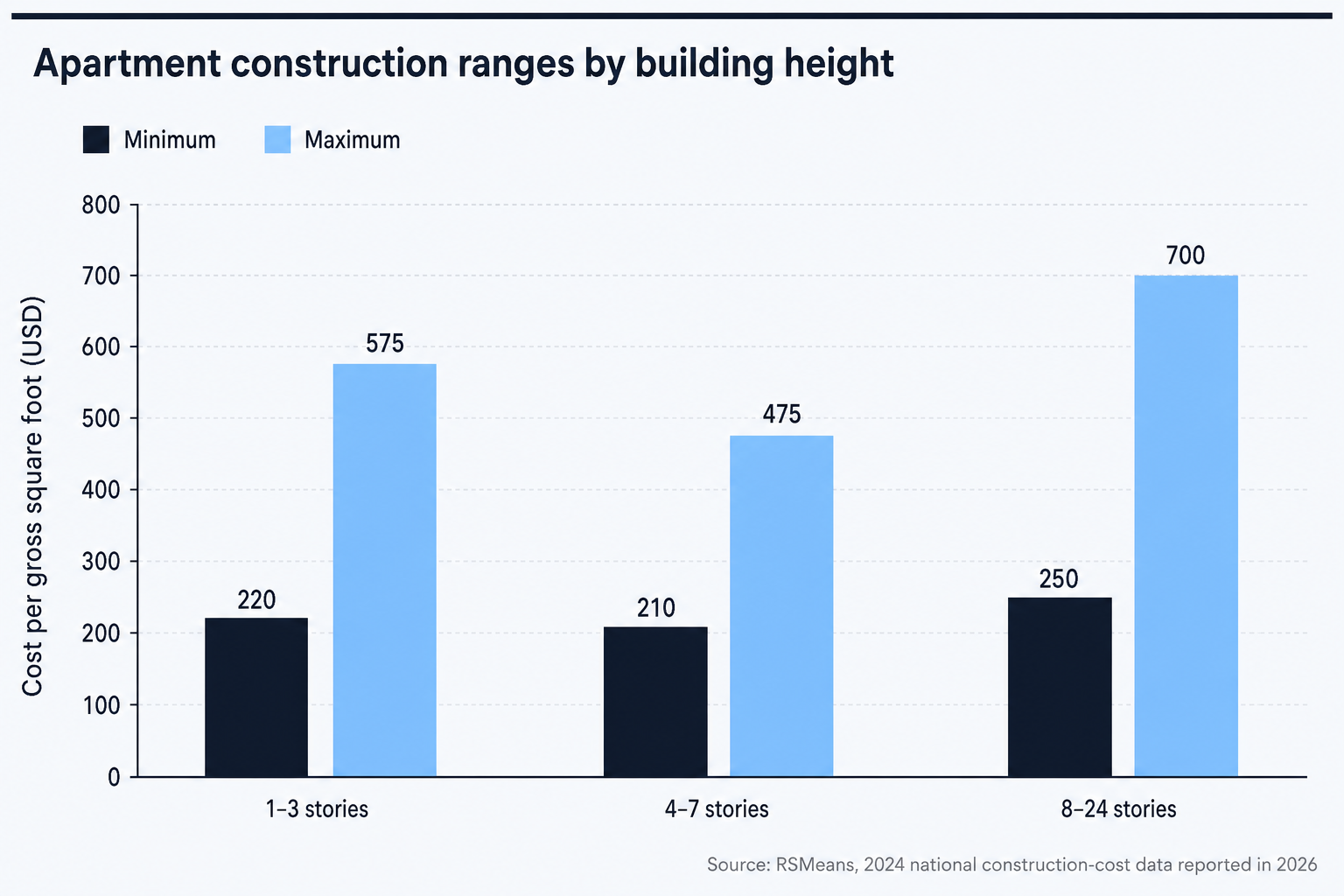
A reasonable first-pass construction benchmark is $220 to $700 per gross square foot, based on RSMeans’ May 2026 guide using 2024 national cost data. That range is useful for early screening, but it is not a promise of the total amount needed to acquire land, complete the project, lease it, and repay construction debt. RSMeans 2026 guide. (rsmeans.com)
RSMeans lists these building-type ranges:
- One to three stories: $220 to $575 per square foot.
- Four to seven stories: $210 to $475 per square foot.
- Eight to 24 stories: $250 to $700 per square foot.
The apparent contradiction between a lower four-to-seven-story starting point and a higher overall range is a reminder that construction type matters. A low-rise wood-frame project, a podium building, an elevator-served mid-rise, and a concrete high-rise may all be called apartments, but they do not share the same structural systems, site work, code requirements, or construction logistics.
For a simple example, an 85,000-square-foot apartment project at $300 per square foot produces a $25.5 million direct-construction estimate. That calculation is 85,000 multiplied by $300. It does not include the land purchase, predevelopment expenses, lender fees, interest during construction, or reserves.
The construction benchmark is an early filter, not a completed budget.
What does the per-square-foot range actually mean?
Per-square-foot figures are most useful when the reader knows what area and cost categories are being measured. A quoted rate can refer to gross building area, net rentable area, hard construction costs only, or a wider scope that includes selected site work and other items.
Before relying on any number, ask four questions:
- What square footage is being used? Gross square footage includes common areas, corridors, walls, mechanical rooms, and other non-rentable space. Net rentable area is smaller, so a cost stated per rentable square foot will look higher than the same building cost stated per gross square foot.
- What is included? Confirm whether the figure includes demolition, grading, utility connections, structured parking, landscaping, off-site improvements, furniture, and equipment.
- What is the building type? Elevator service, podium construction, deep foundations, fire protection, and high-rise structural systems can change the cost profile.
- When and where was the estimate prepared? Labor availability, material pricing, local codes, climate, soil conditions, and contractor workload are local variables.
The Maryland Department of Housing and Community Development illustrates why categories matter. Its February 2025 multifamily cost limits list $227 per square foot for garden apartments, $246 for certain non-elevator stacked or elevator buildings of four stories or fewer, and $271 for elevator buildings of five stories or more. The agency calculates the measure from the construction contract and excludes construction contingency, so those figures are not total development cost. Maryland multifamily construction cost limits. (dhcd.maryland.gov)
A cost-per-square-foot figure becomes useful only after the scope, measurement basis, location, and estimate date are clear.
How do land and design change the budget?
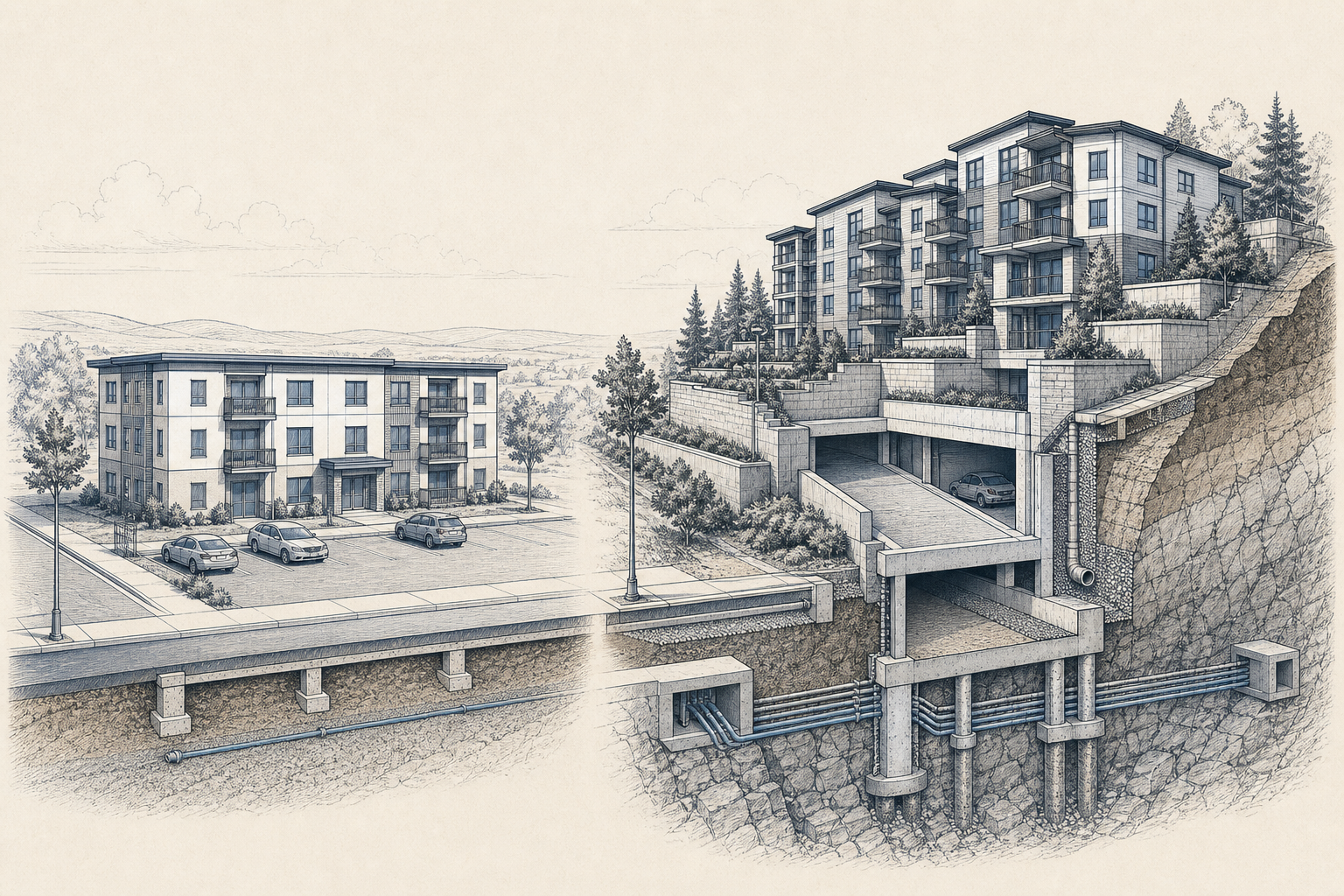
Land and design can move a project’s total capital requirement more than the difference between two national construction averages. The site determines what can be built, while the design determines the systems and finishes needed to build it.
Start with the development capacity. Zoning, setbacks, height limits, parking requirements, utility access, and environmental or geotechnical conditions can reduce the feasible unit count or increase the cost of each unit. A proposed apartment project may look economical at one density and fail at another because the same land cost is spread over fewer rentable units. Before setting a unit-count target, use this guide to calculate floor area ratio for a commercial development and compare the permitted building envelope with the initial concept.
Design choices then determine the cost of turning that envelope into housing. Examples include:
- An elevator, enclosed corridors, structured parking, pools, and large amenity spaces.
- A below-grade garage, retaining walls, poor soil, flood mitigation, or difficult utility extensions.
- Higher-performance windows, more complex façades, premium kitchens, and larger unit layouts.
- Structural choices such as wood framing, steel, or concrete.
A low land basis does not solve a difficult site, and an efficient building design does not solve an infeasible zoning plan. Both must work together.
What costs sit outside the contractor’s bid?
The contractor’s bid is usually only one line in the complete development budget. A sponsor should keep hard costs, soft costs, contingency, land, and financing carry separate so that the source and timing of each cost remain visible.
| Budget category | Typical items to identify | Why lenders care |
|---|---|---|
| Land and acquisition | Purchase price, closing costs, title, surveys, environmental review | Land value and basis affect sponsor equity and project feasibility. |
| Hard costs | Site work, foundations, structure, MEP systems, interiors, exterior work | The construction contract and draw schedule are central to funding controls. |
| Soft costs | Architecture, engineering, legal, permits, insurance, studies, project management | Soft costs can be incurred before vertical construction begins. |
| Contingency | Construction and owner reserves for defined uncertainty | A credible contingency helps absorb changes without exhausting project cash. |
| Financing carry | Interest, lender fees, inspections, legal costs, extension risk, interest reserve if applicable | Financing costs rise when construction or lease-up takes longer than expected. |
| Lease-up and stabilization | Marketing, operating shortfalls, taxes, utilities, management, reserves | The property needs sufficient cash and time to reach a financeable operating level. |
For a deeper explanation of the debt and equity components that sit around a construction loan, review commercial real estate capital stack structuring. The correct budget is not the lowest spreadsheet total. It is the budget that identifies the project’s full scope, timing, and reserves before the first draw.
A complete apartment budget includes the costs of getting to construction, building the property, carrying the project through completion, and reaching a viable exit.
How do construction lenders size the proceeds?
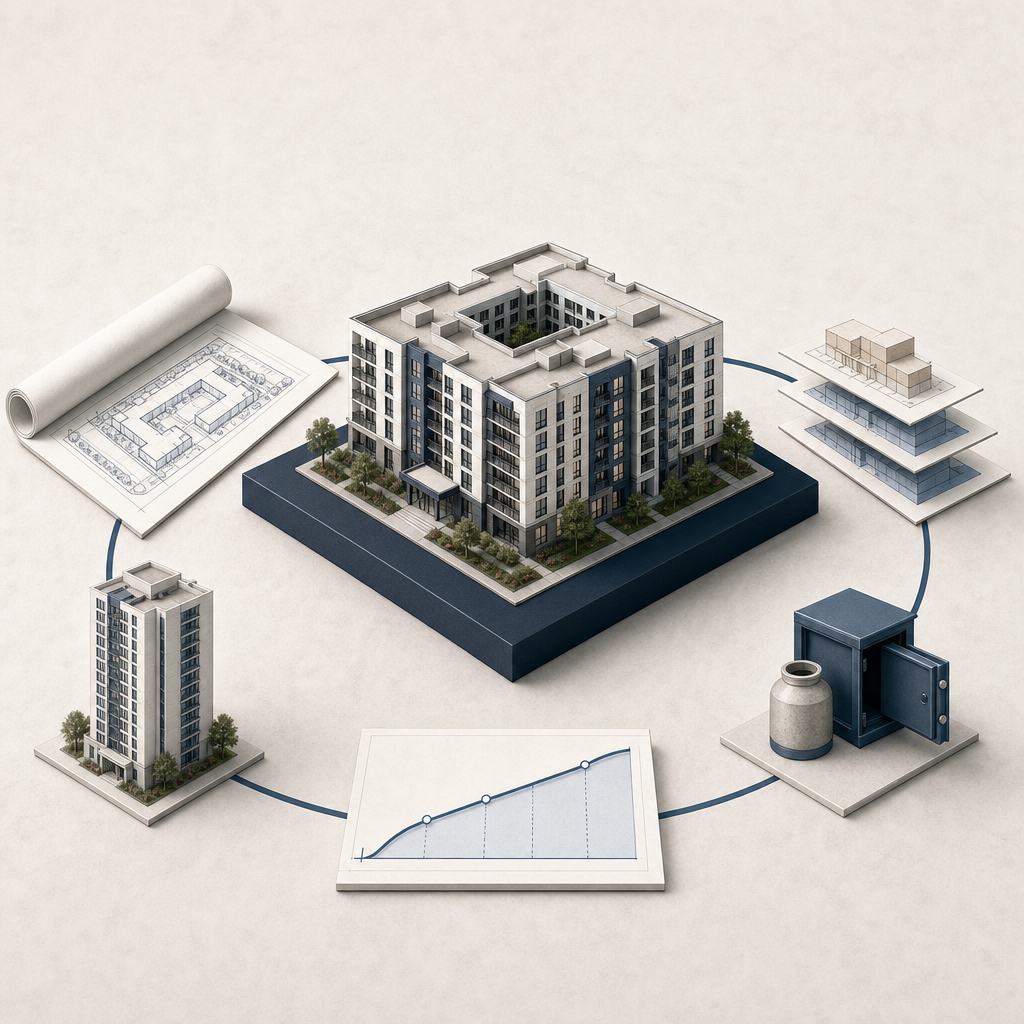
Construction lenders generally size proceeds from a combination of the total project budget, the as-completed value, sponsor equity, and the lender’s assessment of whether the project can be completed and repaid. A cost-per-unit estimate can begin the conversation, but it does not determine the loan amount by itself.
The exact underwriting standards vary by lender and project. Still, sponsors should expect review of:
- The land basis and evidence that the site can support the planned development.
- The construction contract, plans, specifications, timeline, and draw schedule.
- The general contractor, guarantor, development team, and project controls.
- Hard-cost and soft-cost budgets, including a stated contingency.
- Projected rents, operating expenses, absorption, and lease-up timing.
- The intended repayment path, such as a permanent loan, sale, recapitalization, or other documented exit.
Fannie Mae’s Multifamily Guide, in its construction and feasibility review for affordable forward commitments, directs lenders to review the project budget including construction contingencies and to evaluate repayment feasibility at conversion under stress scenarios such as lower rents or higher operating expenses. That is a useful illustration of why lenders focus on the complete plan rather than a headline building cost. Fannie Mae Multifamily Guide, effective April 30, 2026. (mfguide-acpt.fanniemae.com)
A sponsor seeking construction financing should prepare a clear sources-and-uses schedule, supporting reports, a construction timeline, and a realistic exit strategy before asking for terms. A lender can then assess the deal on its actual merits rather than guessing at missing costs.
Construction loan proceeds are sized from a documented development plan and repayment path, not from a national construction average alone.
Is it cheaper to build or buy?
Building can be cheaper than buying only when the all-in development cost is below the value and return supported by the completed property. Buying can be cheaper when an existing asset offers immediate cash flow, lower execution risk, or a price below replacement cost.
The comparison should use equivalent measures. Compare an existing asset’s price, closing costs, renovation needs, assumed debt, and near-term operating performance with a new project’s land basis, full development budget, interest carry, lease-up period, and expected stabilized value. A new property may have newer systems and a tailored unit mix, but it also carries entitlement, construction, rate, and lease-up risk.
If the decision is between acquiring an existing property and developing from the ground up, the next analysis should include acquisition diligence and the financing structure. See how to purchase an apartment complex for the broader acquisition process, and review multifamily acquisition financing when evaluating debt options for an existing apartment property.
The better choice is the one whose all-in cost, risk, timing, and stabilized income fit the sponsor’s capital plan.
Frequently asked questions
Is it cheaper to build or buy?
Building is cheaper only if the full development cost, including land, soft costs, contingency, financing carry, and lease-up, is lower than the economic value of the finished property. Buying may be less expensive when an existing apartment asset has stable operations, requires limited repairs, and trades below replacement cost.
Is $10,000 enough for an apartment?
No, $10,000 is not enough to construct an apartment building or fund an apartment development. It may cover limited early work, such as an initial consultation, feasibility research, or selected due-diligence items, but land deposits, design, permits, equity, and construction funding require substantially more capital.
Is it profitable to own an apartment building?
An apartment building can be profitable when collected rent and other income exceed operating expenses, replacement reserves, debt service, and the owner’s required return on invested equity. Profitability depends on occupancy, achievable rents, operating discipline, financing terms, purchase or development basis, and the timing of major capital expenditures.
Before relying on a national cost range, build a project-specific sources-and-uses schedule and test it with a construction lender, contractor, and local development team. That work will reveal whether the apartment concept is financeable before capital is committed.