
In short
Debt yield is annual net operating income divided by the loan amount. Use a debt yield calculator to calculate that percentage, then size the loan backward from the lender's target and compare it with DSCR and LTV limits. The lowest permitted loan amount is the constraint that limits proceeds.
- Debt yield uses annual NOI and loan amount, so it does not directly change when the interest rate or amortization changes.
- Maximum loan proceeds under a debt-yield test equal annual underwritten NOI divided by the required debt yield.
- An 8% debt yield means the property produces $8 of annual NOI for every $100 borrowed.
- A debt-yield result is only as reliable as the NOI used, so reconcile sponsor NOI with lender underwritten NOI.
- Compare debt yield, DSCR, and LTV before assuming that any one test determines the loan amount.
Table of contents
- How do you calculate a debt yield?
- Which test actually limits loan proceeds?
- What is debt yield vs DSCR?
- What is a good debt yield?
- How should you use a debt yield calculator before applying?
- What else do borrowers ask about debt yield?
A debt yield calculator answers two related questions: what is the property's debt yield at the requested loan amount, and what loan amount can the property's NOI support at a required debt yield? The second question matters more when a lender's debt-yield test could reduce proceeds below the amount suggested by DSCR or loan-to-value.
How do you calculate a debt yield?

Debt yield equals annual net operating income divided by the total loan amount, expressed as a percentage. A public CMBS prospectus defines underwritten NOI debt yield as underwritten NOI divided by the loan's cut-off-date balance, which is the same core relationship used in a basic debt yield calculation. See the SEC-filed definition.
Use this debt yield formula:
Debt Yield = Annual NOI ÷ Loan Amount × 100
For example, a property with $480,000 of annual NOI and a $6,000,000 loan has an 8% debt yield:
$480,000 ÷ $6,000,000 × 100 = 8%
To size a loan backward from a lender's target, rearrange the formula:
Maximum Loan Amount = Annual Underwritten NOI ÷ Required Debt Yield
If the lender requires a 10% debt yield, the maximum loan supported by $480,000 of underwritten NOI is $4,800,000:
$480,000 ÷ 10% = $4,800,000
Use annual, stabilized figures where the lender requires them. Also confirm what the lender has included or deducted from NOI, because property taxes, replacement reserves, vacancy assumptions, management fees, and nonrecurring income can all change the underwritten number. A lender's document review commonly focuses on property income, operating expenses, and supporting records, as outlined in this guide to what lenders review before approving a commercial loan.
Debt yield is simple mathematically, but lender underwritten NOI is the input that decides whether the result is meaningful.
Which test actually limits loan proceeds?
The binding constraint is the lowest loan amount produced by the debt-yield, DSCR, and LTV tests. Calculate each maximum independently, then use the lowest result as the working loan-size assumption until a lender completes underwriting.
Consider this illustrative stabilized commercial property:
| Assumption | Illustrative amount |
|---|---|
| Annual underwritten NOI | $480,000 |
| Required debt yield | 10.0% |
| Minimum DSCR | 1.20x |
| Annual debt constant | 7.68% |
| Property value | $7,500,000 |
| Maximum LTV | 70.0% |
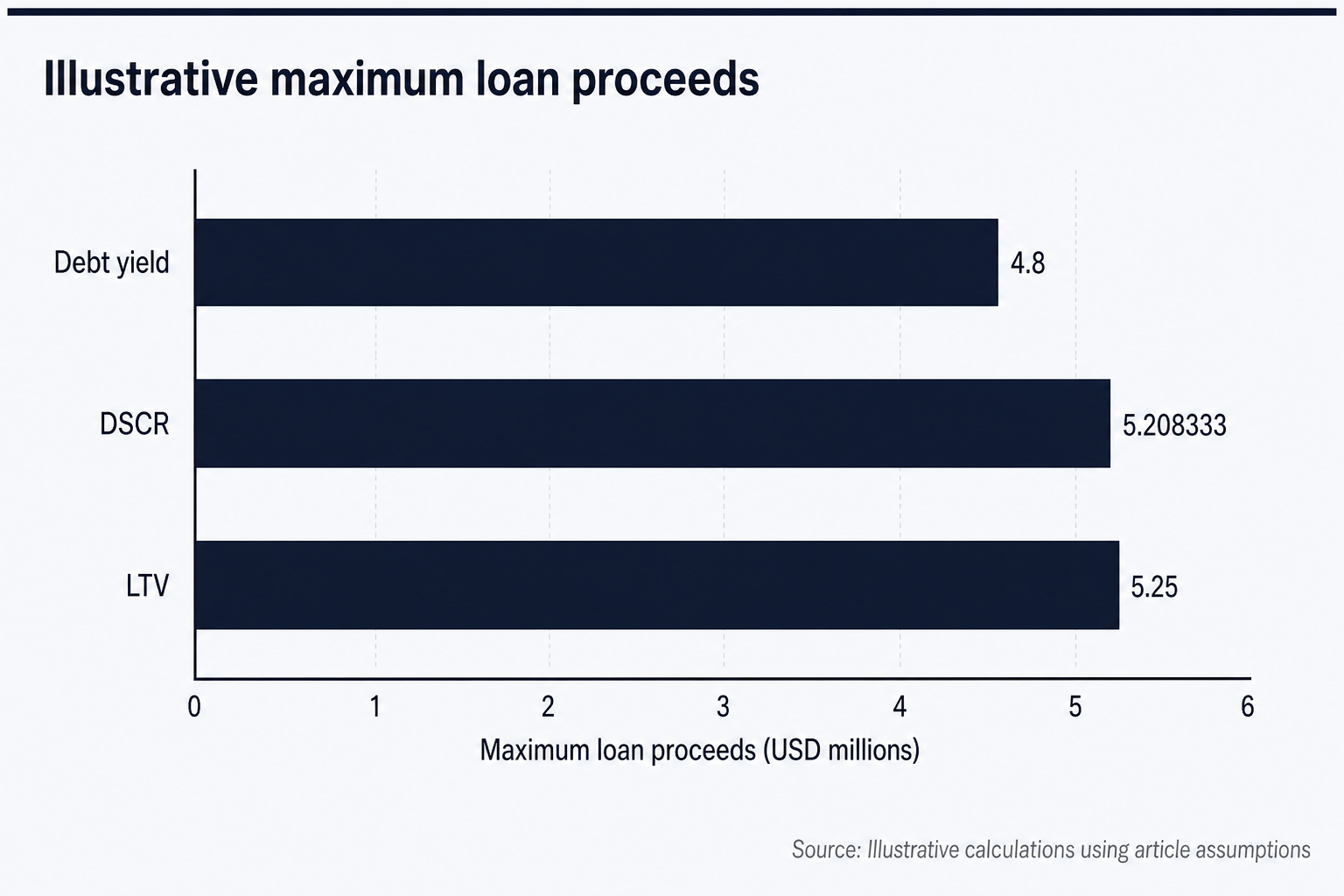
The debt-yield maximum is $4,800,000, calculated as $480,000 divided by 10%.
The DSCR maximum is about $5,208,333. First, the property supports maximum annual debt service of $400,000, calculated as $480,000 divided by 1.20. Dividing $400,000 by the illustrative 7.68% annual debt constant produces approximately $5,208,333 of maximum loan proceeds.
The LTV maximum is $5,250,000, calculated as $7,500,000 multiplied by 70%.
In this example, debt yield limits proceeds because $4,800,000 is lower than the DSCR maximum of about $5,208,333 and the LTV maximum of $5,250,000. The gap matters: a borrower seeking $5,250,000 has an LTV-supported request, but not a debt-yield-supported request.
The annual debt constant is not a universal number. Obtain it from the lender's pricing and amortization assumptions, because it reflects the proposed interest rate, amortization schedule, and any interest-only period.
The lowest maximum-loan result is the underwriting constraint that matters, even when another ratio appears acceptable.
What is debt yield vs DSCR?

Debt yield compares NOI with the loan balance, while DSCR compares NOI with annual debt service. LTV compares the loan balance with property value, and cap rate compares NOI with property value, so each ratio answers a different underwriting question.
| Metric | Formula | Main question answered | Sensitive to interest rate and amortization? |
|---|---|---|---|
| Debt yield | NOI ÷ loan amount | How much property income supports each dollar borrowed? | No, not directly |
| DSCR | NOI ÷ annual debt service | Can property income cover scheduled debt payments? | Yes |
| LTV | loan amount ÷ property value | How much of the property's value is financed? | No |
| Cap rate | NOI ÷ property value | What income return does the property produce relative to value? | No |
Debt yield and DSCR can point in different directions. A lower interest rate or longer amortization can improve DSCR because annual debt service falls, while debt yield remains unchanged if NOI and loan amount stay the same.
LTV can also be less restrictive than debt yield in a strong-valuation environment. If value rises but NOI does not, LTV may allow a larger loan even though the debt-yield calculation does not improve. For the property-value side of the analysis, use a cap rate calculation alongside debt yield. For the equity-return side, compare the financing effect with a cash on cash calculator.
Debt yield measures income against principal, DSCR measures income against payments, and LTV measures principal against value.
What is a good debt yield?
A good debt yield is the one that meets the specific lender's requirement for the asset, leverage, sponsorship, and loan structure. There is no universal debt-yield minimum that applies to every commercial or multifamily loan.
A useful reality check comes from a 2026 public CMBS term sheet. Its 29-loan pool had underwritten net-cash-flow debt yields ranging from 6.9% to 25.5%; 23.5% of the pool balance fell in the 6.9% to 9.0% band, 26.1% in the 9.1% to 10.0% band, 21.0% in the 10.1% to 12.0% band, 3.4% in the 12.1% to 14.0% band, 13.4% in the 14.1% to 16.0% band, 9.0% in the 16.1% to 20.0% band, and 3.7% in the 20.1% to 25.5% band. That is one disclosed pool, not a marketwide benchmark, but it shows why a single target should not be treated as a rule. Review the SEC-filed 2026 pool data.
A 10% target may be useful for preliminary analysis only when it matches the lender conversation and asset profile. Do not increase NOI, decrease the target, or assume a more generous debt constant simply to make the requested proceeds fit.
A good debt yield is lender-specific, while a conservative preliminary model makes the lender discussion more productive.
How should you use a debt yield calculator before applying?
Run the debt-yield calculation using the requested loan amount first, then run it backward from the lender's stated target. Next, compare the debt-yield result with DSCR and LTV so the financing request reflects the likely binding constraint.
Use this short process:
- Start with an annual NOI bridge. Show effective gross income, operating expenses, reserves if applicable, and the final NOI used in the calculation.
- Calculate debt yield on the requested proceeds. Divide NOI by the requested loan amount and express the result as a percentage.
- Size proceeds backward from the target. Divide the lender's underwritten NOI by the lender's minimum debt yield.
- Calculate the DSCR maximum. Divide NOI by the required DSCR, then divide that permitted annual debt service by the quoted annual debt constant.
- Calculate the LTV maximum. Multiply the lender-supported property value by the maximum LTV.
- Prepare for the lowest result. The lowest maximum is the initial loan-size constraint, not a guarantee of approval.
Bring the NOI bridge, rent roll, operating statements, debt schedule, valuation support, and requested-loan rationale into the conversation. A commercial mortgage application preparation checklist can help organize the materials before lender underwriting starts.
For a transaction close to a sizing boundary, submit a commercial financing request to Thorne CRE with the property financials and the three calculated loan limits. A lender match and full underwriting can then test the assumptions against the actual program.
Use the calculator to expose the constraint early, not to replace lender underwriting.
What else do borrowers ask about debt yield?
The questions below address common debt-yield searches in plain terms. The answer always depends on the NOI definition, loan structure, and lender requirement documented for the specific transaction.
How do you calculate a debt yield?
Calculate debt yield by dividing annual net operating income by the total loan amount and multiplying by 100. For example, $480,000 of annual NOI divided by a $6,000,000 loan equals 8%. For loan sizing, divide annual underwritten NOI by the lender's required debt yield to estimate maximum proceeds.
What is a good debt yield?
A good debt yield is one that satisfies the lender's current underwriting standard for the asset and loan structure. Debt-yield expectations can vary by property type, leverage, cash-flow stability, and lender. Use the lender's stated minimum, not a generic internet benchmark, when estimating financeable loan proceeds.
What does 8% debt yield mean?
An 8% debt yield means annual NOI equals 8% of the loan balance, or $8 of annual NOI for every $100 borrowed. It does not automatically mean the loan qualifies. A 2025 public filing described 8% as a cash-management trigger for one CMBS loan, showing that the consequence depends on the specific loan documents. Read the filing.
What is debt yield vs dscr?
Debt yield divides NOI by loan balance, while DSCR divides NOI by annual debt service. Debt yield does not directly change with the interest rate or amortization schedule. DSCR does change when payments change, so lenders may use both measures to test principal risk and payment coverage.
Debt yield becomes useful when it turns a requested loan amount into a clear underwriting question: which ratio limits proceeds, and what input would need to change to close the gap?
What should you do after you run the numbers?
If debt yield is the constraint, do not assume a higher valuation will solve the problem. Focus on the underwritten NOI, requested proceeds, and whether the lender's debt-yield requirement fits the asset and loan structure.
The next useful step is to present the NOI bridge and all three maximum-loan calculations together, so the financing discussion starts with the real constraint.