
In short
A commercial property cash-out refinance replaces an existing mortgage with a larger loan and pays the remaining proceeds to the owner after the old debt, costs, and required reserves are covered. The amount available depends on the lowest loan amount supported by appraisal value, property cash flow, debt yield, and the lender's rules for ownership history and proceeds.
Key takeaways
- Cash available is not the new loan amount: subtract the existing payoff, prepayment charge, closing costs, and any required reserves.
- The maximum loan is usually the lowest result produced by LTV, DSCR, debt-yield, and program-specific limits.
- A stronger appraisal does not guarantee more cash if the property's net operating income cannot support the proposed payment.
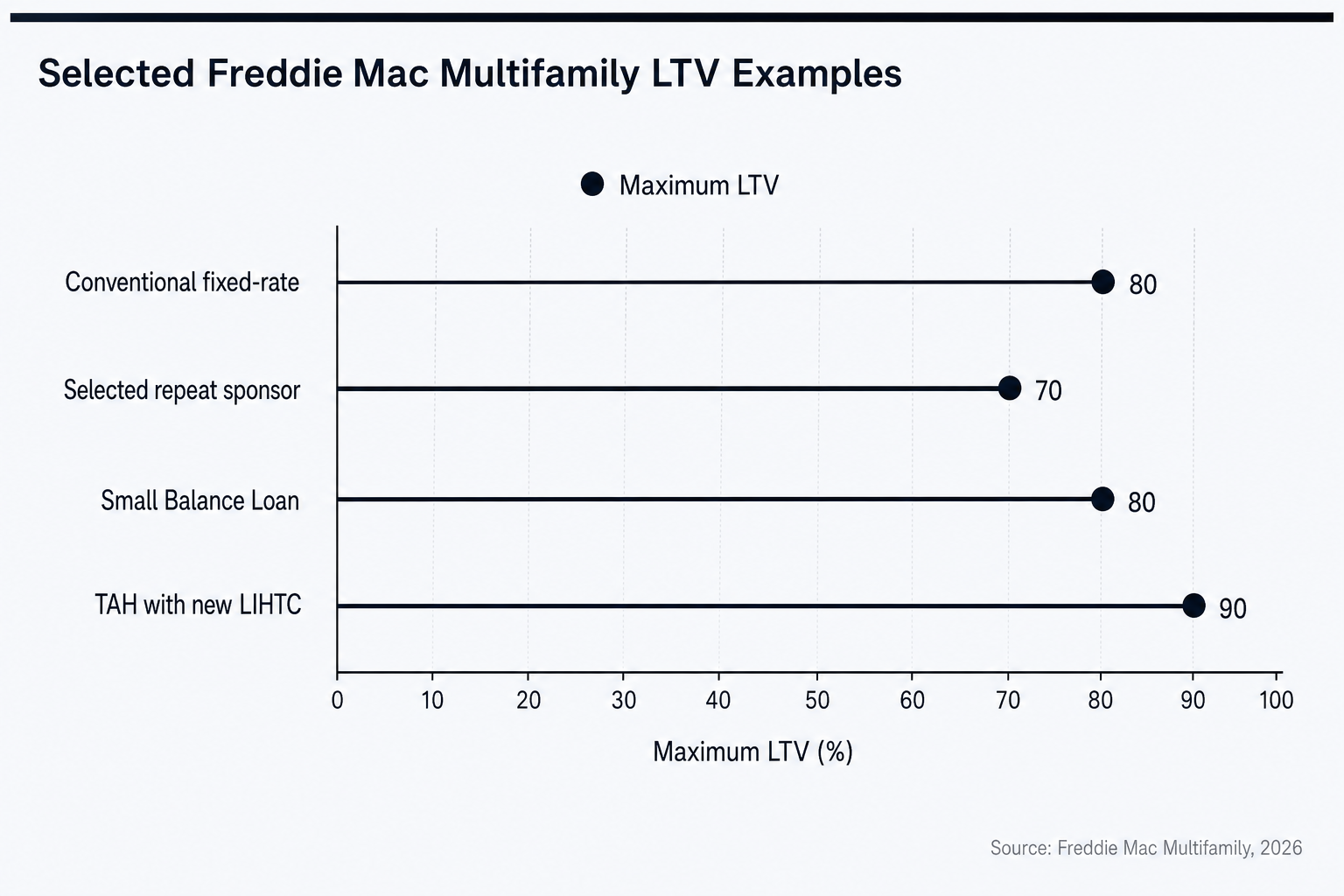
- Freddie Mac's June 2026 multifamily materials show conventional fixed-rate examples with up to 80% LTV and a 1.25x minimum DSCR, but these are product-specific benchmarks rather than universal commercial lending rules.
- SBA 504 refinancing can be relevant to qualifying owner-occupied businesses, but SBA states that 504 financing cannot be used for passive or speculative rental real estate.
How does a commercial cash-out refinance work?
A commercial cash-out refinance replaces the current property loan with a new loan that is large enough to pay the existing balance and, if underwriting permits, leave cash for the borrower. The closing agent pays the old lender first, then deducts approved transaction costs before distributing any remaining proceeds.
The key distinction is between loan proceeds and cash to borrower. A $4 million refinance is not $4 million of liquidity when the current payoff, a prepayment charge, title expenses, lender fees, and reserve requirements must be paid from the transaction.
A practical starting formula is:
Estimated cash out = new loan amount − current loan payoff − prepayment cost − closing costs − required reserves
For example, consider an illustrative property with a $5 million appraised value and a $2.6 million existing payoff. If the lender can support a $3.5 million new loan, and closing costs plus reserves total $150,000, estimated cash out would be $750,000. If property cash flow supports only a $3.1 million loan, estimated cash out falls to $350,000 even though the appraisal did not change.
This is why cash-out refinancing is a sizing exercise, not simply an equity calculation. The lender also reviews the asset, lease profile, sponsor strength, loan purpose, and the proposed debt structure. For an overview of maturity-driven choices before a refinance deadline, review these commercial refinance options for maturing mortgages.
The amount of equity on paper matters, but the amount a lender can safely refinance is what determines usable cash.
How much cash can a commercial property cash-out refinance provide?

The maximum cash-out amount equals the smallest supportable new loan amount, less the current payoff and transaction deductions. LTV is often the first screen, but it is only one of several constraints.
A preliminary LTV calculation is straightforward:
LTV-based loan limit = appraised value × maximum LTV
If a property appraises at $5 million and a lender's preliminary limit is 70% LTV, the LTV-based loan ceiling is $3.5 million. That is only a ceiling. The property may qualify for less if its cash flow cannot cover debt service at the lender's underwriting rate and amortization schedule.
Avoid treating advertised LTV ranges as promises. Property type, occupancy, lease rollover, tenant concentration, location, borrower experience, recourse, and loan term can all affect proceeds. A value-add asset with temporary vacancy may need bridge financing or a lower-leverage refinance until income stabilizes. The decision between permanent debt and transitional capital is explained in commercial mortgages versus bridge financing.
For multifamily, Freddie Mac's June 2026 Multifamily Structured Credit Risk materials describe conventional fixed-rate loans with LTV not exceeding 80% and a 1.25x minimum DSCR in that program. The same materials note that adjustments can apply based on loan term, product type, and asset-specific credit factors. Those figures are useful benchmarks, not a universal rule for retail, industrial, office, hospitality, or owner-occupied property. Freddie Mac's June 2026 presentation is the source for those product-specific examples.
The cash-out number starts with value, but it ends with the lowest loan amount the underwriting can support.
What limits the loan before LTV does?

A lender may reduce the loan below the LTV ceiling when DSCR, debt yield, or sponsor and property risks do not support the proposed debt. In many refinancing requests, cash flow rather than equity is the controlling constraint.
LTV measures the equity cushion
LTV compares the new loan with appraised value. It answers: if the lender had to rely on collateral value, how much equity remains beneath the loan?
A recent appraisal can become the central document in a cash-out request because income, market rents, expenses, capitalization rates, comparable sales, and property condition can all influence value. Do not base the request solely on an owner estimate or an old purchase price.
DSCR measures payment coverage
DSCR compares property net operating income with annual debt service:
DSCR = NOI ÷ annual debt service
A DSCR of 1.25x means the property generates $1.25 of qualifying NOI for each $1.00 of annual debt service. The calculation depends on how the lender underwrites income and expenses, which can differ from a borrower's trailing financial statements. Vacancy assumptions, management fees, replacement reserves, taxes, insurance, and nonrecurring income may change the lender's NOI.
Debt yield measures income against the loan balance
Debt yield is generally calculated as:
Debt yield = NOI ÷ loan amount
Unlike DSCR, debt yield does not change because a loan has a longer amortization period or a lower interest rate. That makes it a useful second check on leverage, particularly when rates or debt-service assumptions move. A loan can pass an LTV screen and still fail a debt-yield requirement if income is too thin for the requested balance.
Ownership history, seasoning, and use of proceeds affect credit approval
There is no single commercial cash-out seasoning rule that applies to every lender and property. Lenders may ask how long the sponsor has owned the asset, whether value growth came from market movement or completed improvements, and whether the property has stabilized after lease-up or renovation.
Use of proceeds also matters. Common purposes include property improvements, acquisition equity, refinancing short-term debt, partner buyouts, or business expansion. The lender may require a clear explanation and may restrict certain uses. A new loan can also change guarantees and liability, so borrowers should compare the proposed guaranty package with the existing debt. See recourse vs. nonrecourse commercial loans before accepting a structure that changes personal exposure.
The binding constraint is the weakest underwriting test, not the most favorable metric in the file.
Which commercial refinance structure fits the property and purpose?
The best commercial property refinance loan depends on whether the asset is stabilized, owner-occupied, transitional, or subject to a near-term business plan. Cash-out proceeds should fit the property's income profile and the borrower's ability to carry the new debt.
Stabilized investment property refinance
A stabilized, income-producing property may be suited to permanent commercial mortgage financing when rents, occupancy, expenses, and leases support the requested balance. The lender will still test the new payment against underwritten NOI, not simply historical appreciation.
Transitional property refinance
A property in lease-up, renovation, repositioning, or tenant transition may not qualify for the desired permanent cash-out loan yet. In that situation, a shorter-term bridge structure may fund a defined business plan before a later permanent refinance. The cost and exit plan deserve close review because transitional debt can create refinance risk if the property does not stabilize on schedule.
Owner-occupied business property refinance
A qualifying owner-occupied business may have SBA-related options. SBA states that its 504 program provides long-term, fixed-rate financing for major fixed assets and can refinance qualified debt under applicable rules. The SBA also states that 504 loans cannot be used for working capital or inventory and cannot finance passive or speculative rental real estate. Read the current SBA 504 loan program guidance before assuming that cash-out for an investment property or unrestricted operating liquidity qualifies.
Acquisition-focused use of proceeds
Cash-out proceeds may become equity for another acquisition, but the new property purchase will have its own underwriting, equity, and timing requirements. Borrowers considering that strategy should understand how to purchase commercial property with no money before treating extracted equity as a substitute for a complete capital plan.
The right refinance structure matches the current property's cash flow, the intended use of proceeds, and a realistic exit plan.
What should you prepare before requesting terms?

A well-prepared refinance request gives lenders enough information to size the loan accurately before a full application. Incomplete records tend to produce vague preliminary feedback, late credit issues, and avoidable closing delays.
Prepare these items before asking for commercial property refinance rates or terms:
- Current mortgage statement, payoff instructions, maturity date, and prepayment schedule.
- Recent operating statements, rent roll, leases, and explanations for vacancy or unusual expenses.
- Most recent property tax and insurance information.
- Existing appraisal, recent capital-improvement records, and a clear explanation of value creation, if applicable.
- Entity documents, ownership schedule, personal financial statements, and tax returns requested by the lender.
- A concise use-of-proceeds schedule that separates property costs, debt payoff, reserves, acquisition equity, and other uses.
Rates should be compared with the entire structure. A lower nominal rate can still be the weaker proposal if it requires a larger reserve deposit, creates restrictive covenants, adds recourse, shortens the term, or imposes a costly prepayment provision. A practical overview of lender-facing information is available in what lenders review before approving a commercial loan.
Once the file is organized, request refinance terms that show the rate, index and spread where relevant, amortization, maturity, DSCR assumptions, recourse, fees, reserves, prepayment terms, and estimated net cash out. Thorne CRE can help commercial property owners evaluate refinancing structures and request lender options tailored to the asset and objective through its commercial financing application and quote intake.
A complete file turns a broad cash-out question into lender terms that can be compared line by line.
What are the risks of taking cash out?
The central risk is exchanging existing equity for a larger loan that must be repaid under the new loan's rate, amortization, maturity, and guaranty provisions. Cash out can support a productive purpose, but it can also reduce the margin for declining NOI, vacancy, unexpected repairs, or refinancing at maturity.
Review these issues before proceeding:
- Payment pressure: A larger balance, higher rate, or shorter amortization can increase debt service even when the old loan had a lower payment.
- Prepayment expense: Existing debt may have defeasance, yield maintenance, or another prepayment charge that materially reduces net proceeds.
- Rate and maturity risk: A loan that looks manageable at closing may create pressure when a floating rate resets or a short maturity arrives.
- Reduced flexibility: New reserve requirements, cash-management provisions, reporting obligations, or lender covenants can affect operations.
- Personal liability: The proposed loan may have different guaranties or carve-outs from the old debt.
- Misallocated proceeds: Using long-term real estate debt for a short-lived operating expense can leave the property carrying debt after the benefit is gone.
A cash-out refinance is strongest when the proceeds have a defined purpose, the property can support the new debt under conservative assumptions, and the borrower understands the exit path before closing.
Frequently asked questions
What is the 2% rule in commercial real estate?
The 2% rule is an informal investor screening shortcut that compares monthly gross rent with a property's purchase price. It is not a commercial lending requirement and does not determine cash-out refinance proceeds. Commercial lenders generally focus on appraisal value, underwritten NOI, DSCR, debt yield, property risk, and the proposed loan structure instead.
How to pull equity out of a commercial property?
To pull equity out of a commercial property, refinance the existing mortgage with a larger loan or pursue another lender-approved equity-access structure. The new loan must first pay the old debt and transaction costs. The available cash is limited by the lowest amount supported by LTV, DSCR, debt yield, underwriting, and any program-specific restrictions.
Can an LLC do a cash-out refinance?
An LLC can generally seek a cash-out refinance on commercial property it owns, subject to the lender's entity, sponsorship, and guaranty requirements. The lender may request formation documents, an operating agreement, ownership information, and financial records for principals. Exact requirements vary by lender, property type, loan program, and borrower strength.
What is the downside of a cash-out refinance?
The downside of a cash-out refinance is that it increases or restructures property debt, which can raise payments, reduce equity, create prepayment costs, and introduce new maturity or recourse risk. Cash-out refinancing can also fail to deliver expected liquidity if the appraisal, underwritten NOI, or lender-required reserves reduce the approved loan amount.
The most useful first step is to calculate a conservative estimated cash-out amount using current payoff figures and realistic NOI, then compare lender terms based on net proceeds and risk rather than the headline loan amount.