
In short
A commercial property loan calculator estimates monthly principal-and-interest payment, interest-only debt service, and the balance due at maturity from the loan amount, rate, amortization period, and term. For a balloon loan, use an amortization period longer than the loan term, then test whether projected property cash flow can carry the debt service and whether the exit plan can repay the remaining balance.
- A 10-year loan term with 25-year amortization can leave a substantial balloon balance even when every monthly payment is made.
- A $400,000 loan at 7% with 25-year amortization has estimated monthly principal and interest of $2,827.12.
- A $1,000,000 loan at 7% with 25-year amortization has estimated monthly principal and interest of $7,067.79.
- A payment estimate is not an approval decision because lenders also review cash flow, property value, borrower strength, and the proposed financing structure.
Table of contents
- What numbers should you enter into a commercial property loan calculator?
- How do payment, amortization and balloon balance fit together?
- How do lenders use calculator outputs?
- Do you have to put 20% down on a commercial loan?
- How much can I borrow for a commercial property?
- What should you test before relying on the result?
- Frequently asked questions
What numbers should you enter into a commercial property loan calculator?
Start with the actual amount to be borrowed, the note rate, the amortization period, and the maturity term. Add projected annual net operating income if the goal is to estimate debt service coverage rather than payment alone.
Use the figures from a realistic sources-and-uses estimate, not rounded numbers pulled from a listing. Review our commercial property financing guide to establish baseline assumptions for your property acquisition.
| Calculator input | What to enter | Why it matters |
|---|---|---|
| Loan amount | Total debt requested, after down payment and any financed costs | Payment calculations use the amount borrowed, not the purchase price. |
| Interest rate | Annual note rate as a percentage | The rate determines monthly interest and affects both payment and remaining balance. |
| Amortization period | Years over which payments are calculated, such as 20, 25, or 30 years | A longer period lowers the monthly principal-and-interest payment but usually leaves more principal outstanding at maturity. |
| Loan term | Months or years until the note matures | If the term is shorter than amortization, the unpaid balance is generally due as a balloon. |
| Annual NOI | Projected annual net operating income, if available | NOI allows a preliminary debt-service coverage calculation. |
For a fixed-rate, fully amortizing payment, use this standard standard debt service formula:
Monthly P&I = Loan amount × [monthly rate × (1 + monthly rate)^number of payments] ÷ [(1 + monthly rate)^number of payments - 1]
For the remaining principal balance after a given number of payments, use an amortization schedule or the balance formula in a financial calculator. As detailed by the Consumer Financial Protection Bureau, standard principal-and-interest payments are calculated from the loan amount, interest rate, and repayment term.
The most important distinction is simple: the amortization period sets the payment math, while the loan term sets the date by which the debt must be repaid or refinanced.
How do payment, amortization and balloon balance fit together?
A commercial mortgage can have a 10-year term but payments calculated over 25 years. In that structure, the regular payment reduces principal, but it does not pay off the loan before maturity.
Example: a $1 million loan at 7%
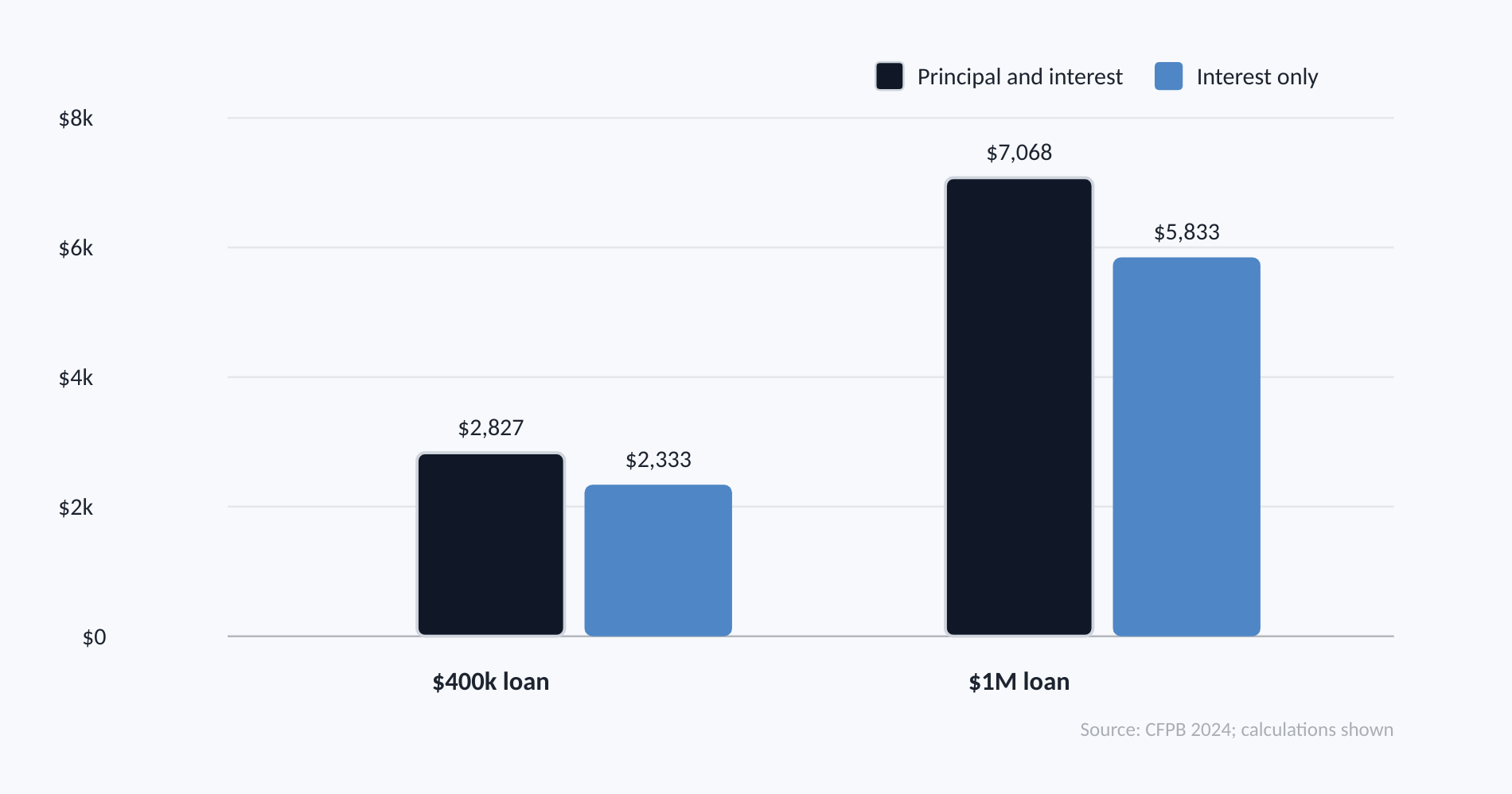
Assume a $1,000,000 loan, a 7% fixed rate, 25-year amortization, and a 10-year term. The estimated monthly principal-and-interest payment is $7,067.79. After 120 payments, the estimated balloon balance is $786,333.96.
The same loan on an interest-only payment structure would have estimated monthly debt service of $5,833.33, but the original $1,000,000 principal balance would still be due at maturity unless another feature of the note reduces it.
| Assumption | $400,000 loan | $1,000,000 loan |
|---|---|---|
| Fixed interest rate | 7.00% | 7.00% |
| Amortization period | 25 years | 25 years |
| Maturity term | 10 years | 10 years |
| Monthly principal and interest | $2,827.12 | $7,067.79 |
| Monthly interest-only payment | $2,333.33 | $5,833.33 |
| Estimated balance after 10 years | $314,533.59 | $786,333.96 |
A lower monthly payment is not automatically a lower-risk structure. The key question is whether the business or property has a credible plan to refinance, sell, or pay the balloon balance when the loan matures.
How do lenders use calculator outputs?
Lenders use projected debt service to test repayment capacity, but a calculator cannot decide whether a transaction qualifies. The payment estimate becomes useful when paired with conservative income, operating expenses, property value, borrower financials, and the proposed exit at maturity.
A basic debt-service coverage ratio, or DSCR, is calculated as annual NOI divided by annual debt service. For example, if a property has $120,000 of annual NOI, a $1,000,000 loan with the principal-and-interest payment above produces estimated annual debt service of $84,813.50 and a preliminary DSCR of 1.41x. An interest-only payment of $5,833.33 produces estimated annual debt service of $70,000 and a preliminary DSCR of 1.71x.
| Illustrative $1 million scenario | Principal and interest | Interest only |
|---|---|---|
| Monthly debt service | $7,067.79 | $5,833.33 |
| Annual debt service | $84,813.50 | $70,000.00 |
| Assumed annual NOI | $120,000.00 | $120,000.00 |
| Preliminary DSCR | 1.41x | 1.71x |
| Estimated balance at 10-year maturity | $786,333.96 | $1,000,000.00 |
The U.S. Small Business Administration states that applicants must be creditworthy and show reasonable repayment ability. Payment estimates serve as a foundation for underwriting rather than a guarantee of credit approval.
Do you have to put 20% down on a commercial loan?
No. A 20% down payment is a useful planning scenario, not a universal commercial-loan rule.
Required equity can differ by property type, lender, borrower strength, loan program, appraisal, and whether the property is owner-occupied or investment real estate. Government-backed programs like SBA loans frequently offer alternative equity requirements for eligible small businesses.
How much can I borrow for a commercial property?
The practical loan amount is usually the lower of what the property or business cash flow can support and what the lender will advance against value. A calculator can reverse-engineer an estimated loan amount from a target monthly payment, but it cannot establish the final loan size.
For time-sensitive property acquisitions or repositioning projects, evaluating bridge financing alongside long-term debt options helps clarify short-term capital requirements versus permanent debt structure.
What should you test before relying on the result?
Test the calculator under more than one rate, income, and exit scenario before treating the output as affordable. A single payment is not enough when the loan has a balloon balance, variable rate, planned renovation, or lease-up period.
At minimum, run these checks:
- Rate sensitivity: Recalculate the payment at a higher rate than the initial quote.
- Income sensitivity: Reduce projected NOI to reflect vacancy or higher operating expenses.
- Balloon readiness: Compare the projected maturity balance with a conservative future value.
- All-in cash need: Add down payment, lender fees, closing costs, and reserves.
- Prepayment and exit terms: Check prepayment provisions and maturity requirements.
When moving from initial calculations to formal request, use our commercial mortgage application prep checklist to prepare required documentation.
Frequently asked questions
Do you have to put 20% down on a commercial loan?
No, 20% is not mandatory for every commercial loan. Equity requirements vary based on borrower strength, asset type, and loan program rules.
What is the monthly payment on a $400,000 loan at 7%?
A $400,000 fixed-rate loan at 7% amortized over 25 years has an estimated monthly P&I payment of $2,827.12, leaving an estimated balance of $314,533.59 after 10 years.
What is the payment on a $1,000,000 business loan?
A $1,000,000 loan at 7% amortized over 25 years has an estimated monthly P&I payment of $7,067.79. On an interest-only basis, the estimated payment is $5,833.33.
Next steps
Save all calculator inputs alongside your cash flow projections. Contact Thorne CRE to evaluate your financing scenario with realistic lender underwriting parameters.