
In short
Commercial property valuation estimates what a commercial real estate interest is worth in a defined market, on a defined date, for a defined use. For a purchase or refinance, the lender usually cares about more than the headline value: the appraisal, underwriting assumptions, loan-to-value limit, debt service capacity, property condition, and marketability can each reduce maximum proceeds.
- Income-producing property is commonly screened with net operating income divided by a market-derived capitalization rate, but the inputs must be credible before the result is useful.
- Sales comparison and cost approaches can confirm, challenge, or outweigh an income-based conclusion when the property is specialized, vacant, newly built, or poorly stabilized.
- A purchase price is evidence of value, not proof of value. An appraisal can reach a lower conclusion if its market evidence or assumptions differ.
- Loan proceeds usually depend on the lower of the lender’s permitted loan-to-value amount and the amount supported by debt service, debt yield, borrower strength, and loan terms.
- A borrower can improve the appraisal process by supplying complete leases, operating statements, rent rolls, capital-expenditure records, and a clear explanation of the business plan.
Contents
- Why does commercial property valuation control the loan conversation?
- Which commercial property valuation method should you use?
- How do you calculate the value of a commercial property?
- Why can the appraisal be lower than the purchase price or broker opinion?
- How does a lender convert value into maximum proceeds?
- What should you give an appraiser before a purchase or refinance?
- How can you get a commercial property valuation?
- Frequently asked questions about commercial property valuation
Commercial real estate does not have one universal value. A leased warehouse, a vacant office building, a new medical facility, and an apartment property may each require different evidence, assumptions, and valuation emphasis.
The practical question for a buyer or refinancing owner is not simply, “What is the property worth?” It is, “What value conclusion will a lender rely on, and does that conclusion support the financing plan?” If you are planning an acquisition, reviewing a guide on how to purchase an apartment complex or commercial asset will help align underwriting criteria with property valuation.
Why does commercial property valuation control the loan conversation?
Commercial property valuation controls the collateral side of a purchase or refinance because lenders use a value conclusion to measure the loan against the real estate securing it. A strong operating story cannot always overcome a low appraisal, just as a high appraisal does not remove the need to show reliable repayment capacity.
For U.S. federally related transactions, state-licensed and state-certified real property appraisers must comply with the Uniform Standards of Professional Appraisal Practice, commonly called USPAP. The Appraisal Foundation describes USPAP as the generally recognized ethical and performance standards for appraisal practice in the United States. The Appraisal Foundation’s USPAP overview explains the standards framework.
A valuation conclusion is also separate from the transaction’s negotiated price. A buyer may agree to pay more because the property has strategic value, a planned redevelopment, a tax-driven deadline, or a scarce location. An appraiser must instead support the defined value opinion with market evidence and disclosed assumptions.
For a lender, value answers only one part of the credit question:
- Collateral: What may the real estate support if the lender must rely on the property?
- Cash flow: Does property income, business income, or another repayment source cover the proposed debt?
- Execution risk: Can the sponsor close, operate, stabilize, and eventually refinance or repay the loan?
The Office of the Comptroller of the Currency states that commercial real estate policies typically address loan-to-value limits, debt-service coverage, debt yield, terms, and borrower or project strength. That is why a lender can reduce proceeds even when the property appraises at or above the contract price. See the OCC Commercial Real Estate Lending handbook for guidance.
A commercial property value is a necessary collateral input, not a loan approval by itself.
Which commercial property valuation method should you use?
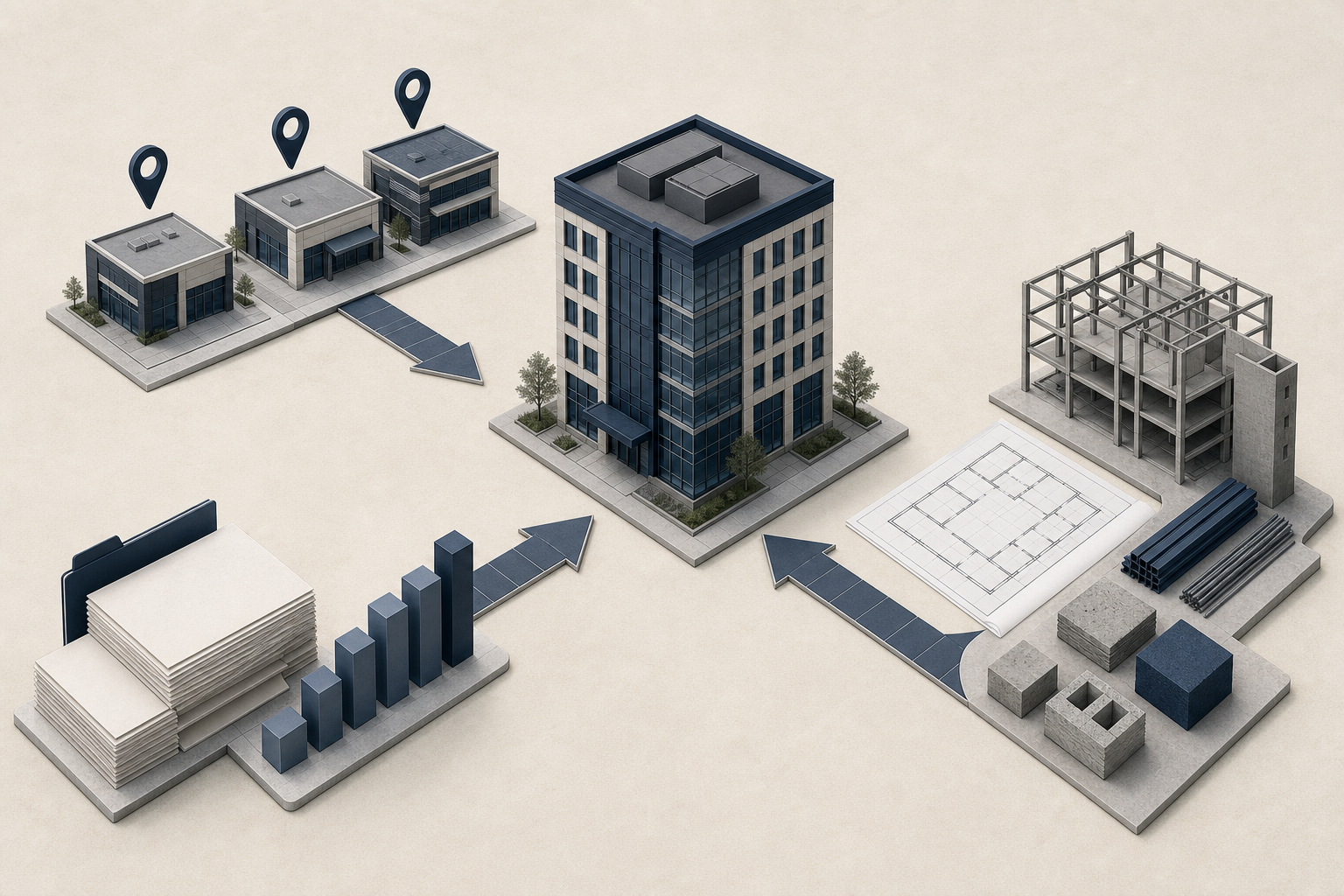
The best commercial property valuation method depends on how the property earns income, how much comparable transaction evidence exists, and whether the building is stabilized, vacant, new, specialized, or under construction. Appraisers may consider more than one method and reconcile the evidence rather than treating one formula as automatically decisive.
The income capitalization approach
The income approach estimates value from a property’s ability to generate net operating income, or NOI. For a stabilized income-producing property, the direct-capitalization shorthand is:
Value = NOI ÷ capitalization rate
NOI generally begins with effective gross income and subtracts normal operating expenses. It does not automatically equal cash flow available to an owner, because debt service, income taxes, capital expenditures, leasing costs, and reserves may be treated differently depending on the analysis.
The cap rate is not a generic percentage taken from a website. It should reflect evidence from comparable transactions and the subject property’s risk profile, location, lease terms, tenant concentration, physical condition, growth expectations, and market liquidity. A lower cap rate produces a higher mathematical value for the same NOI; a higher cap rate produces a lower one.
Before relying on this calculation, verify the income definition. A rent roll with expiring leases, large concessions, unpaid reimbursements, or one tenant responsible for most revenue may need adjustments before it represents stabilized NOI. For the detailed formula, explore our full guide on the NOI formula for commercial real estate.
The discounted cash flow approach
A discounted cash flow, or DCF, approach models expected future cash flows over a holding period and discounts them back to a present value. It is particularly useful when income is expected to change materially because of lease rollover, construction, renovations, rent growth assumptions, tenant improvements, lease-up, or a planned sale.
DCF analysis can be more revealing than direct capitalization when the first year’s NOI is not representative. It is also more assumption-sensitive. Small changes to renewal probabilities, downtime, exit cap rates, leasing costs, or the resale assumption can materially change the result.
The OCC handbook notes that appraisals for development situations can require deductions and discounts that reflect factors such as holding costs, marketing costs, entrepreneurial profit, and sales absorption. Those adjustments illustrate why gross projected revenue is not the same as present market value.
The sales comparison approach
The sales comparison approach compares the subject with recent sales of similar properties, then adjusts for meaningful differences. Relevant differences can include location, building size, age, condition, land area, tenancy, lease structure, parking, access, zoning, occupancy, and sale conditions.
Comparable sales are strongest when the subject and the transactions genuinely compete for the same buyer pool. A sale that looks similar in a spreadsheet may be a poor comparable if it included unusual seller financing, a portfolio allocation, an unreported capital need, or a different highest and best use.
Buyers often start with price per square foot or price per unit. Those measures can help organize the evidence, but they do not explain why two properties with the same physical size may have very different income durability and financing appeal.
The cost approach
The cost approach starts with land value, then adds the current cost to build the improvements and subtracts depreciation or other loss in utility. It is often useful for newer buildings, owner-occupied properties, special-purpose improvements, ground-up development projects requiring construction loan approval, or properties with limited comparable sales.
The weakness is that construction cost is not a guarantee of market value. A property can cost more to build than buyers will pay if the location, design, market demand, or future operating economics are weak. Conversely, a well-located, income-producing asset may sell for more than its depreciated physical cost.
Use the income approach to test earnings, sales comparison to test market behavior, and cost to test the contribution of land and improvements. The right method is the one supported by the property and the available evidence.
How do you calculate the value of a commercial property?

To calculate a preliminary commercial property value, first identify the property type and its current economic condition, then select the evidence that best fits it. A stabilized leased property often starts with NOI and cap-rate analysis; a vacant, new, owner-occupied, or specialized property may require greater emphasis on sales comparison or cost.
A disciplined first-pass process looks like this:
- Define the interest and date: Is the analysis for a fee-simple sale, a leased-fee interest, a refinance, an as-is acquisition, or a prospective stabilized condition?
- Collect operating evidence: Review rent rolls, leases, trailing operating statements, budgeted expenses, tax bills, service contracts, capital needs, and tenant information.
- Normalize NOI: Separate recurring operating income and expenses from one-time items, seller-specific expenses, uncollected income, or future improvements that have not yet created income.
- Find market evidence: Gather comparable sales, comparable rents, vacancy evidence, cap-rate indications, replacement-cost information, and local supply conditions.
- Choose and reconcile methods: Explain why one method receives more weight, rather than averaging unrelated outputs without judgment.
Why can the appraisal be lower than the purchase price or broker opinion?

An appraisal can come in below the contract price because the appraiser and the buyer are answering different questions. The buyer may be paying for a plan, scarcity, a strategic operating location, or anticipated upside; the appraisal must determine whether market evidence supports its opinion under the assignment conditions.
Common reasons for a gap include:
- Comparable sales support a lower price per square foot, unit, or income multiple.
- The appraiser uses lower stabilized income than the buyer’s pro forma assumes.
- A cap rate derived from market evidence is higher than the buyer’s assumption.
- Deferred maintenance, environmental issues, vacancy, lease rollover, or tenant concentration increase risk.
- The sale includes motivation or terms that are not typical market conditions.
How does a lender convert value into maximum proceeds?
A lender typically begins with an appraised or otherwise accepted collateral value, applies its loan-to-value limit, and then tests whether the proposed payment is supported by the property’s income and cash flow profile. To evaluate how debt constraints interact with property income, learn how DSCR loans made simple work under commercial underwriting guidelines.
The collateral calculation is conceptually straightforward:
Maximum loan by value = accepted value × lender's permitted loan-to-value ratio
The highest property value is not necessarily the highest loan amount because repayment capacity and lender risk limits can be more restrictive than collateral value alone.
What should you give an appraiser before a purchase or refinance?

Give the appraiser complete, current property information early, through the lender’s approved process. The goal is to prevent the analysis from relying on incomplete leases, stale financials, or misunderstood capital needs.
For an income-producing property, assemble:
- Current rent roll with unit or suite details, lease dates, rent, concessions, arrears, deposits, and tenant names.
- Fully executed lease agreements, amendments, renewals, and options.
- Past 3 years of historical operating statements (profit & loss) plus trailing 12-month (T12) statements.
- Schedule of capital improvements completed in recent years and planned capital expenditures.
- Property tax statements, site plans, zoning documents, and environmental reports.
How can you get a commercial property valuation?
To obtain a commercial property valuation, lenders and property owners typically engage licensed certified general real property appraisers. For informal assessments or early acquisition screening, commercial real estate brokers provide Broker Price Opinions (BPOs), or investors analyze comparable sales and local capitalization rates directly.
Frequently asked questions about commercial property valuation
What are the three main commercial property valuation methods?
The three primary commercial property valuation methods are the Income Capitalization Approach, the Sales Comparison Approach, and the Cost Approach.
Why is an appraisal lower than the purchase price?
An appraisal may be lower than contract price if comparable market sales, conservative stabilized NOI, higher market capitalization rates, or unverified seller projections do not support the buyer’s purchase price.
How do lenders convert valuation into loan proceeds?
Lenders convert valuation into maximum loan proceeds by applying maximum loan-to-value (LTV) benchmarks and constraining total debt through debt service coverage ratio (DSCR) and debt yield tests.